

A First-Time Buyer’s Guide to Securing the Best Mortgage Rates
Securing the best mortgage rates for first time buyers isn't about finding some hidden secret—it's about meticulous preparation, strategic timing, and deeply understanding what makes lenders view you as a prime candidate. The right interest rate is far more than a simple percentage; it's the bedrock of a manageable monthly payment and your key to potentially saving tens, if not hundreds, of thousands of dollars over the lifespan of your home loan.
As a seasoned financial expert, I've seen countless first-time buyers navigate this complex process. The most successful ones consistently follow a proven path: they first build a rock-solid financial profile, then they strategically compare tailored offers from multiple lenders. This two-step process isn't just about shopping; it's about putting yourself in a position of power.
Your Path to the Best First Time Buyer Mortgage Rate
Stepping into homeownership for the first time is a monumental milestone, yet the world of mortgage rates often feels like an indecipherable language filled with jargon and uncertainty. My goal here is to cut through that noise, providing you with the clarity and confidence to make informed, powerful financial decisions for your future. We will dissect exactly what a mortgage rate entails and demonstrate how even the smallest difference can profoundly reshape your financial landscape for decades.
Think of an interest rate as the "cost" of borrowing the substantial sum needed for your home. The lower that cost, the more of your monthly payment goes directly toward building your personal wealth through equity—the portion of the home you truly own—instead of disappearing into the lender's profit margins as interest.
Why Your Rate Matters So Much
It’s dangerously easy to gloss over a fraction of a percentage point, but that seemingly insignificant number has the power to drastically alter your monthly housing costs and long-term financial health. Grasping this concept is the foundational step toward appreciating why diligent research for the best mortgage rates for first time home buyers is one of the most critical financial activities you will ever undertake.
Consider how a mere 1% rate reduction can translate into substantial monthly savings on a standard $350,000 home loan.
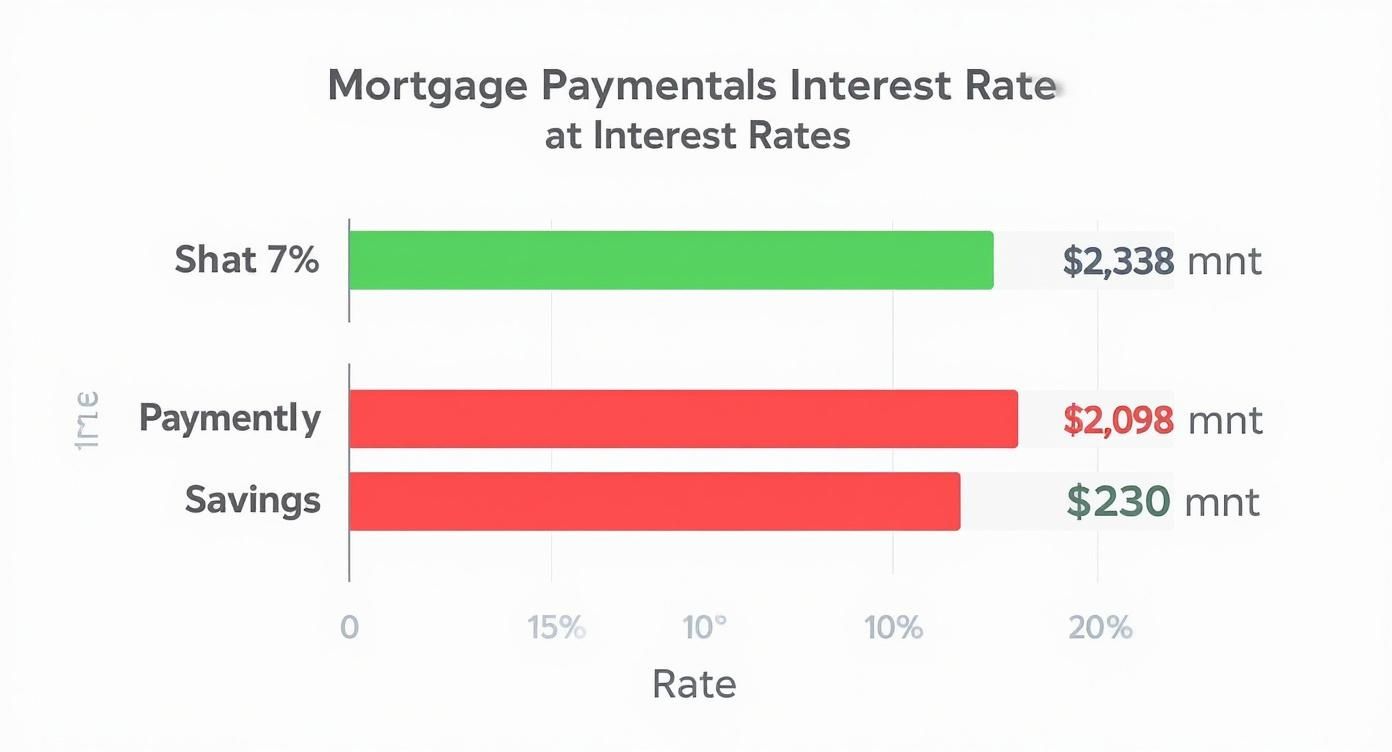
As illustrated, lowering your rate from 7% to 6% frees up $230 every single month. That's nearly $2,800 a year that can be redirected toward other critical financial goals, from investing to building an emergency fund.
To appreciate the full magnitude, let’s examine how these small rate differences compound over the entire loan term, impacting the total cost of borrowing.
How a Lower Mortgage Rate Impacts Your Total Loan Cost
This table demonstrates the significant long-term savings a lower interest rate can generate on a typical $350,000 home loan over a 30-year term.
| Interest Rate | Monthly Payment (Principal & Interest) | Total Interest Paid Over 30 Years | Total Savings vs. Higher Rate |
|---|---|---|---|
| 7.0% | $2,328 | $488,098 | — |
| 6.5% | $2,212 | $446,423 | $41,675 |
| 6.0% | $2,098 | $405,404 | $82,694 |
Even a half-percent reduction from 7.0% to 6.5% saves you over $41,000 in interest payments. This isn't just pocket change—it represents a new car, a significant contribution to a child's college fund, or a substantial boost to your retirement savings, all stemming from the diligent work you invest before signing the final loan documents.
Preparing for Your Homeownership Journey
Lenders don't arbitrarily assign rates. Their offers are the result of a calculated risk assessment based on key financial metrics: your credit score, the size of your down payment, and your debt-to-income (DTI) ratio. We will delve into the practical, actionable steps you can take to position yourself as a top-tier applicant. For a comprehensive overview, this ultimate first home buyer's guide serves as an invaluable resource.
By meticulously organizing your finances and understanding the factors lenders prioritize, you place yourself in the optimal position to secure an excellent loan. This preparatory phase is the single most effective strategy for minimizing your borrowing costs for years to come.
What Really Determines Your Mortgage Rate
To secure the best possible deal, you must first understand the anatomy of a mortgage rate. Lenders are not just picking numbers; they are conducting a sophisticated risk analysis based on both your personal financial history and the broader economic climate. The entire process of securing the best mortgage rates for first time buyers boils down to one thing: demonstrating that you are a low-risk, reliable borrower.
Think of it as assembling a complex puzzle. Lenders piece together various elements of your financial life to create a comprehensive picture of your creditworthiness. Let's deconstruct the most critical pieces of this puzzle so you know precisely where to focus your efforts long before you begin your home search.

Your Credit Score: The Financial Report Card
Your credit score is, without question, the most influential factor in determining your mortgage rate. Lenders perceive it as a direct reflection of your history with debt and your reliability as a borrower. A higher score signals lower risk, which is almost invariably rewarded with a more favorable interest rate.
For example, an applicant with an exceptional 760 credit score could secure a significantly better rate than someone with a fair 660 score. What may seem like a minor 50-point difference could ultimately save you tens of thousands of dollars in interest payments over the 30-year term of your loan. It's the most powerful signal you can send to a lender that you are financially responsible.
The Power of Your Down Payment
The amount of capital you contribute upfront—your down payment—plays a pivotal role. A larger down payment reduces the lender's exposure because it means you have more personal equity, or "skin in the game," from the outset. This immediately builds equity and lowers the loan-to-value (LTV) ratio.
Key Takeaway: A down payment of 20% or more is a significant financial milestone. It not only tends to unlock the most competitive interest rates but also allows you to avoid Private Mortgage Insurance (PMI)—an additional monthly fee that protects the lender, not you, and can add a considerable amount to your payment.
Your Debt-to-Income (DTI) Ratio
Your Debt-to-Income (DTI) ratio is a simple yet critical metric used by every lender. It compares your total monthly debt obligations (such as car loans, student loans, and credit card payments) to your gross monthly income. This provides them with a quick assessment of your capacity to comfortably handle an additional mortgage payment.
Here’s the straightforward formula:
- Step 1: Sum all of your monthly debt payments.
- Step 2: Divide this total by your gross (pre-tax) monthly income.
- Step 3: The result, expressed as a percentage, is your DTI ratio.
Most lenders prefer a DTI of 43% or less. A lower DTI makes you a more attractive borrower, which can help you secure a better rate. An effective strategy is to reduce existing debt before applying for a mortgage to improve this crucial ratio.
How the Current Market Impacts First Time Buyers
The housing market is a dynamic, ever-changing entity, and its current state directly influences your path to homeownership. Today's first-time buyers are navigating a landscape vastly different from that of just a few years ago. It's a challenging environment, but one filled with opportunities for those who approach it with a well-informed, strategic mindset.
Understanding the current market isn't about feeling intimidated—it's about becoming strategic. While the significant shift in mortgage rates has reshaped affordability for many, knowledge empowers you to make smarter moves.
The New Affordability Equation
Just a few years ago, historically low interest rates provided buyers with immense purchasing power. That favorable scenario has changed dramatically. The leap from a 3% mortgage rate to rates hovering over 7% has completely redefined the financial calculus for aspiring homeowners.
This surge means that for the exact same property, your monthly payment is substantially higher, making the quest for the best mortgage rates for first time buyers more critical than ever. This isn't a minor adjustment; it's a fundamental shift in affordability that has unfortunately priced some buyers out of the market and forced others to significantly recalibrate their expectations.
In this climate, securing the best possible fixed rate is arguably the single most important financial decision you can make. To stay ahead of these trends, it is crucial to understand expert projections. You can explore our detailed analysis of 2025-2026 mortgage forecasts to gain a clearer perspective and refine your strategy.
A Shifting Market Share
The impact of these increased costs is starkly reflected in the demographic data of who is purchasing homes today. First-time buyers have traditionally been a driving force in the housing market, but their influence has waned.
In the early 2000s, first-time homebuyers accounted for nearly 57% of all financed home purchases. By 2024, that market share had plummeted to just 24%, a substantial decline from 32% only two years prior.
This drop is a direct result of the dual pressures of soaring interest rates and persistently high home prices. Consider this: for a home priced at $495,100, an interest rate increase from 3% to 7.76% adds over $1,170 to the monthly mortgage payment—a staggering 70% increase.
This affordability crisis represents the double-edged sword facing today's buyers: higher borrowing costs coupled with elevated home values. You can delve deeper into the historical context and ongoing challenges in this comprehensive analysis on first-time homebuyers.
Navigating this market successfully requires patience, precision, and a deep understanding of these powerful economic forces, enabling you to time your purchase wisely and seize opportunities as they arise.
Strategic Steps to Secure a Lower Mortgage Rate
Understanding the factors that influence your mortgage rate is one thing; proactively improving those factors is where you gain a true competitive advantage. It’s time to transition from a passive observer to an active participant in your financial future. Consider this your personal action plan for meticulously polishing your financial profile until it gleams, making you the type of applicant that lenders actively compete to finance. This is precisely how you lock in the best mortgage rates for first time buyers.
Beginning this process months before you seriously start viewing properties will place you in the strongest possible negotiating position. It's all about making yourself an undeniably low-risk borrower in the eyes of any underwriter.
Strengthen Your Financial Foundation
Your primary objective, and the one with the most significant impact, is to elevate your credit score as high as possible. Lenders view this three-digit number as a direct indicator of your financial discipline. A higher score communicates lower risk, and they will reward that with a lower interest rate—it's a direct correlation.
Here’s your tactical focus:
- Tackle High Balances: Concentrate on paying down revolving debt, particularly credit card balances. Lowering your credit utilization ratio—the amount you owe versus your total available credit—can provide a rapid and substantial boost to your score.
- Perfect Your Payment History: This is the most heavily weighted component of your credit score. Ensure every single bill is paid on time, every time, without exception, especially in the 6-12 months leading up to your mortgage application.
- Hunt for Errors: Obtain your credit reports from all three major bureaus (Equifax, Experian, and TransUnion) and scrutinize them for inaccuracies. A single error, such as a paid-off debt still showing a balance or an account that isn't yours, could be unfairly suppressing your score.
For a more detailed strategy, consult our guide on how to improve your credit score fast. Taking these steps demonstrates to lenders that your financial house is in order, making you a prime candidate for their best rates.
Explore First-Time Homebuyer Programs
Do not attempt this journey alone. Numerous government-backed and conventional loan programs are specifically designed to provide first-time buyers with a competitive edge. These options often feature more flexible credit requirements and lower down payment thresholds, which can be a complete game-changer.
Expert Insight: Never assume you are ineligible for specialized loan programs. Options like FHA, VA, and USDA loans were created to help individuals overcome the most common barriers to homeownership, often providing a more accessible and affordable path.
Familiarizing yourself with these programs is a critical part of your preparation. To provide a clear overview, here is a comparison of some of the most popular options.
First-Time Homebuyer Loan Program Comparison
| Loan Type | Minimum Credit Score | Minimum Down Payment | Key Benefit |
|---|---|---|---|
| FHA Loan | Typically 580+ | 3.5% | More lenient credit score and debt-to-income requirements. |
| VA Loan | Varies by lender | 0% | No down payment and no private mortgage insurance (PMI) for eligible veterans. |
| USDA Loan | Typically 640+ | 0% | No down payment for homes in designated rural or suburban areas. |
Each program has unique eligibility criteria and benefits. It is essential to research the details of each to determine which aligns best with your financial situation and homeownership goals.
Consider Paying for Mortgage Points
Another strategic tool at your disposal is the option to buy mortgage points, also known as discount points. In essence, you pay an additional fee to the lender at closing in exchange for a lower interest rate for the entire life of the loan.
Typically, one point costs 1% of your total loan amount and can reduce your interest rate by approximately 0.25%.
Think of it as prepaying some of your interest upfront to secure lower monthly payments for the long term. This strategy is most beneficial if you plan to stay in the home for many years. This allows you to reach the "break-even" point, where the cumulative savings from your lower monthly payment surpass the initial cost of the points. Every payment beyond that point represents pure savings.
The Long-Term Impact of Your Interest Rate
A mortgage is not a short-term loan; it is a financial marathon that can span three decades. The interest rate you secure at the beginning dictates your financial pace for the entire journey. It is easy to become fixated on the immediate monthly payment, but the true power of securing the best mortgage rates for first time buyers is revealed over the long term.
A seemingly minor difference in your rate can have a colossal impact on the total amount you pay. Shaving off just half a percent may only slightly reduce your monthly payment, but when compounded over 30 years, this small adjustment can translate into tens of thousands of dollars in savings.

How Your Rate Shapes Your Wealth Building
Consider your interest rate as the primary determinant of your ability to build equity—the portion of your home you actually own. With a higher rate, a larger percentage of each payment is consumed by interest, especially during the initial years of the loan. This significantly slows the pace at which you build ownership.
Conversely, a lower rate means more of your money is applied directly to the principal loan balance. This accelerates your equity growth, transforming your home into a more potent financial asset for your future.
When you begin to view your interest rate not merely as a cost but as a critical lever in your wealth-building strategy, you understand why rigorous comparison shopping is non-negotiable. The effort you invest now will yield dividends for the next 30 years. You can explore how mortgage interest rates affect your monthly payment in our detailed guide.
The Real-World Cost of Higher Rates
Recent market fluctuations have cast a harsh spotlight on this long-term impact. As rates climbed above 6%, the lifetime cost of homeownership skyrocketed, creating a significant affordability challenge for many first-time buyers. For example, with an average rate of 6.89%, a borrower could pay nearly $490,000 in interest alone over 30 years on a typical loan.
This is a staggering sum that far exceeds what most buyers are prepared for, highlighting a major disconnect between market realities and consumer expectations. Recent data reveals that the average homebuying power in major U.S. cities has decreased by approximately 12% since 2005, largely due to the painful combination of rising rates and home prices.
This underscores how sensitive your total cost of ownership is to even minor rate fluctuations. Securing a rate of 6.5% instead of 6.89% could save you over $33,000 over the life of the loan. It is a powerful reminder that every fraction of a percent counts. Comparing offers and negotiating terms isn't just a recommendation—it's one of the most financially significant actions you can take.
Frequently Asked Questions (FAQ) for First-Time Homebuyers
What is the first step a first-time home buyer should take?
The absolute first step is to conduct a thorough review of your own finances. Before you even speak to a lender, you need to understand your credit score, your monthly budget, and your debt-to-income (DTI) ratio. This self-assessment allows you to identify areas for improvement and set a realistic homebuying budget.
What credit score is needed to buy a house for the first time?
While there is no single magic number, a credit score of 620 is often the minimum threshold for a conventional loan. However, to secure the best mortgage rates for first time buyers, you should aim for a score of 740 or higher. Government-backed programs like FHA loans may allow for scores as low as 580.
How much do first-time buyers typically put down on a house?
The long-standing myth of needing a 20% down payment is outdated. While 20% helps you avoid Private Mortgage Insurance (PMI), many first-time buyers utilize programs that require much less. FHA loans require as little as 3.5% down, and eligible borrowers can get VA and USDA loans with 0% down.
What Is a Mortgage Pre-Approval and Why Is It Important?
A mortgage pre-approval is a conditional commitment from a lender to loan you a specific amount, based on a comprehensive review of your financial documents. It is far more robust than a pre-qualification. It is critical because it defines your real budget, makes your offer more competitive to sellers, and significantly streamlines the closing process.
What are closing costs for a first-time buyer?
Closing costs are the various fees required to finalize the mortgage and real estate transaction, separate from your down payment. They typically range from 2% to 5% of the home's purchase price. These include lender fees, appraisal fees, title insurance, and prepaid taxes. On a $300,000 home, this could be between $6,000 and $15,000.
What is the most common mortgage for first-time buyers?
The 30-year fixed-rate mortgage is by far the most popular and generally the most prudent choice for first-time buyers. Its primary benefit is predictability; the interest rate and principal-and-interest payment remain constant for the entire life of the loan, making it easy to budget for.
Can I get a mortgage with a low credit score?
Yes, it is possible, but it will come at a cost in the form of a higher interest rate. Government-backed loans, particularly FHA loans, are specifically designed to assist buyers with lower credit scores. Lenders can often work with scores down to 580, or even lower if you can provide a larger down payment (e.g., 10%).
Fixed-Rate vs. Adjustable-Rate Mortgages: Which Is Better?
For the vast majority of first-time buyers, a fixed-rate mortgage is the safer and more strategic option. Its predictability provides financial stability. An Adjustable-Rate Mortgage (ARM) may offer a lower initial "teaser" rate, but this rate can increase significantly after the introductory period, posing a substantial risk to your budget.
How volatile are mortgage rates?
Mortgage rates can be quite volatile, influenced by economic factors like inflation and Federal Reserve policy. Historically, rates have seen extreme highs, such as 16.63% in 1981, and incredible lows, like 2.65% in 2021. This volatility is precisely why locking in a favorable fixed rate is so crucial. You can explore historical trends on a detailed mortgage rate chart.
Should I get life insurance for my mortgage?
While not required by lenders, considering a policy like mortgage life insurance can be a responsible part of financial planning. This type of insurance is designed to pay off the remaining mortgage balance if you pass away, ensuring your family is not burdened with the debt and can remain in the home.
Ready to find the best rate for your first home? At ShopRates, we make it easy to compare offers from multiple lenders, ensuring you get the most competitive terms available. Start your journey to homeownership with confidence. Explore your mortgage options on ShopRates today!


