

How to Finance a Car: An Expert’s Step-by-Step Guide for 2025
Financing a car is more than just a transaction; it's a significant financial commitment. The fundamental concept is simple: you borrow money to purchase a vehicle and repay that loan over a set period, with interest. However, the strategy you employ can mean the difference between a smart investment and a costly mistake, potentially saving you thousands of dollars over the life of the loan.
From my decades of experience as a financial advisor, the most critical piece of advice I can offer is this: secure your financing before you ever set foot on a car lot. This single act of preparation fundamentally shifts the negotiating power in your favor. It ensures you are shopping for a car that fits a pre-approved, comfortable budget, rather than falling for a vehicle that stretches your finances thin. This guide will walk you through that professional process, step by step.
Laying Your Financial Foundation Before You Shop
Before you even think about test drives, leather seats, or paint colors, the most crucial work begins at your kitchen table. A thorough assessment of your financial landscape is the single most powerful action you can take to secure favorable loan terms and a great overall deal.
Far too many buyers reverse this process. They find a car they love, become emotionally invested, and then scramble to find financing. This reactive approach often leads to accepting whatever terms the dealership offers, which is a proven recipe for overpaying. By preparing your finances in advance, you transform from a mere buyer into an empowered, informed negotiator ready to dictate the terms.
Building a Realistic Car Budget
Your first task is to construct a budget that encompasses the total cost of car ownership, not just an appealingly low monthly payment. A framework I have successfully recommended to clients for years is the 20/4/10 rule. It serves as an excellent benchmark for determining true affordability.
Here’s how it breaks down:
- A 20% Down Payment: Aim to provide a down payment of at least 20% of the vehicle's purchase price. This immediately reduces the loan principal, helps you build equity faster, and mitigates the risk of being "upside down" (owing more than the car is worth).
- A 4-Year (48-Month) Loan Term: Restrict the loan term to a maximum of four years. While longer terms offer lower monthly payments, they dramatically increase the total interest you pay over the life of the loan—a common financial trap.
- 10% of Your Monthly Income: Your total automotive expenses—including the loan payment, insurance, and realistic estimates for fuel and maintenance—should not exceed 10% of your gross monthly income.
While not an inflexible law, if a vehicle you're considering falls outside these guidelines, it should be a significant red flag that you may be overextending your budget. As you budget, carefully weigh the long-term financial implications of a new car versus buying a used car.
Your budget is your anchor in the storm of dealership sales tactics. A firm understanding of what you can afford protects you from emotional decisions and ensures your new car is a blessing, not a financial burden.
Your Credit Score: The Key to a Low-Interest Loan
In the world of auto lending, your credit score is paramount. This three-digit number is the primary metric lenders use to assess your creditworthiness and risk. An excellent score unlocks the most competitive interest rates available, whereas a poor score can cost you a substantial amount of money.
Consider this scenario: A lender might offer a borrower with a 780 credit score an interest rate of 6%. For the exact same car and loan amount, a borrower with a 650 score could be quoted 12%. Over a five-year loan, that seemingly small difference can amount to thousands of dollars in additional interest payments.
It is therefore critical to know your credit score before you begin shopping. If your score needs improvement, taking steps to boost it can yield significant returns. We offer actionable strategies in our guide on how to improve your credit score fast.
The data underscores this point. As of early 2025, the average new car loan in the U.S. climbed to $41,720, with an average monthly payment of $745. For used vehicles, the average loan amount was $26,144, with an average interest rate of 11.87%. These figures highlight the immense savings potential that a strong credit profile provides.
To navigate the loan process effectively, you must understand the language of lenders.
Quick Guide to Car Financing Key Metrics
This table defines the essential terms you will encounter. Familiarizing yourself with these concepts will provide a significant advantage when you begin reviewing loan offers.
| Financial Term | What It Means | Why It Matters to You |
|---|---|---|
| APR (Annual Percentage Rate) | The total cost of borrowing money, including interest and fees, expressed as a yearly percentage. | This is the most important number for comparing loan offers. A lower APR means you pay less over the life of the loan. |
| Loan Term | The length of time you have to repay the loan, typically shown in months (e.g., 48, 60, 72). | A shorter term means higher monthly payments but less total interest paid. A longer term does the opposite. |
| Principal | The initial amount of money you borrow to purchase the car, before any interest is added. | Your down payment directly reduces the principal, which in turn lowers your monthly payments and total interest costs. |
| Down Payment | The cash you pay upfront when buying the car. It's subtracted from the total price to determine the loan principal. | A larger down payment shows lenders you're a lower risk, can help you secure a better APR, and prevents you from being "upside down." |
| Credit Score | A three-digit number (from 300-850) that represents your creditworthiness based on your borrowing history. | This is the single biggest factor lenders use to set your APR. A higher score means a lower interest rate and significant savings. |
A solid grasp of these five pillars is non-negotiable for anyone seeking to finance a vehicle. They are the foundation upon which a smart, affordable car purchase is built. Master them, and you will be in full control of the process.
Choosing the Right Lender for Your Auto Loan
The institution from which you secure your financing can have a greater impact on your total cost than the negotiated price of the car itself. A common misconception is that all loan offers are created equal. In reality, your choice of lender directly influences your interest rate, loan terms, and overall financial outcome.
Making an informed decision begins with understanding the landscape of auto lending. The market is more diverse than many realize, with each type of lender offering distinct advantages and disadvantages. Selecting the right lending partner is as crucial as selecting the right vehicle.
The Main Players in Auto Financing
When seeking an auto loan, you will primarily encounter three categories of lenders: depository institutions (banks and credit unions), captive finance companies, and online lenders.
-
Banks and Credit Unions: These should always be your initial destinations. National and local banks are reliable sources for auto loans. However, credit unions, as member-owned, not-for-profit institutions, frequently offer some of the most competitive interest rates and flexible terms available.
-
Captive Finance Companies: These are the financial services arms owned by automotive manufacturers, such as Ford Credit or Toyota Financial Services. Their primary advantages are convenience at the point of sale and the potential for promotional offers, like 0% APR financing for highly qualified buyers.
-
Online Lenders: A growing segment of the market consists of digital-first lenders that facilitate the entire application and approval process online. They can offer highly competitive rates, but it is imperative to conduct thorough due diligence regarding their reputation and customer service standards before committing.
The auto finance market is fiercely competitive. In the first quarter of 2025, a staggering 80.5% of all new vehicle purchases in the U.S. were financed. While captive finance companies retained the largest market share at 57.1% of new car loans, their dominance has slightly eroded as banks and credit unions have become more competitive. Banks captured 24.1% of the new car financing market, with credit unions securing 10.9%. You can explore these auto finance market trends from Mercer Capital for a deeper analysis.
To help you navigate these options, here is a comparative breakdown.
Comparing Your Auto Loan Options
Deciding where to apply for your car loan can feel overwhelming. This table breaks down the most common lender types to give you a clearer picture of their typical advantages and disadvantages, helping you figure out which one is the best fit for your situation.
| Lender Type | Primary Advantage | Potential Drawback | Best For… |
|---|---|---|---|
| Banks (National & Local) | Established relationships, wide range of products. | May have stricter credit requirements. | Borrowers with good to excellent credit who value convenience and established institutions. |
| Credit Unions | Often the lowest interest rates and more flexible terms. | Membership requirements and fewer branch locations. | Members seeking the most competitive rates and personalized service. |
| Captive Lenders | Convenience (at the dealership), special 0% APR offers. | Best deals are reserved for excellent credit; may have higher rates otherwise. | New car buyers with strong credit who can qualify for promotional financing deals. |
| Online Lenders | Fast, convenient online application process. | Can be impersonal; requires careful vetting of company reputation. | Tech-savvy borrowers who prioritize speed and are comfortable with a digital-only process. |
Ultimately, the best lender is the one that offers you the most favorable terms for your financial profile. That's why getting pre-approved from a couple of different sources is such a powerful strategy.
Why Pre-Approval Is Your Secret Weapon
After decades in this business, I can tell you the single most powerful move you can make is to get a loan pre-approval from your bank or a credit union before you ever set foot in a dealership.
When you walk onto that lot with a pre-approved loan offer in your pocket, you fundamentally change the entire dynamic of the negotiation.
You are no longer just a hopeful buyer asking them for financing; you are, for all practical purposes, a cash buyer. This simple step strips the dealership of its power to mark up your interest rate or steer you into a loan that pads their bottom line more than it helps you. Remember, an auto loan is a type of secured loan, where the car itself is the collateral. Our guide on secured vs. unsecured loans explains in more detail how this all works.
A pre-approval letter is your leverage. It forces the dealership's finance office to compete for your business. Their only move is to try and beat the rate and terms you already have. Without it, you're playing their game, not yours.
A Word of Caution on Special Lenders
Beyond the primary lenders, you may encounter "Buy-Here-Pay-Here" (BHPH) dealerships. These establishments provide in-house financing, primarily catering to consumers with subprime credit or no credit history.
While they represent a viable path to vehicle ownership for those who cannot secure traditional financing, they entail significant risks. BHPH loans almost invariably feature extremely high interest rates, inflexible payment schedules, and may even include vehicle tracking devices. They should be considered an absolute last resort, and the loan contract must be scrutinized with extreme care before signing.
Securing Pre-Approval for Maximum Negotiating Power
Walking into a dealership with a pre-approved loan offer doesn't just feel smart; it completely flips the script. This single move shifts the power dynamic right into your hands. It’s your ultimate piece of leverage.
When you present yourself with financing already secured, you are no longer viewed as a loan applicant by the sales team. You are effectively a cash buyer. This simplifies the entire transaction.
The complex negotiation—where the vehicle price, trade-in value, and financing terms are often convoluted—is streamlined. Your sole focus becomes negotiating the best possible price for the car. Your loan is already in place, on your terms, not theirs.
Gathering Your Application Materials
To ensure the pre-approval process is efficient, organize your financial documentation in advance. Lenders require verification of your identity, income, and employment. Having these documents prepared will significantly expedite the process.
A standard pre-approval checklist includes:
- Proof of Income: Typically, your two most recent pay stubs or W-2 forms. If you are self-employed, be prepared to provide your last two years of federal tax returns.
- Proof of Identity: A valid, government-issued driver's license is the standard requirement.
- Proof of Residence: A recent utility bill or bank statement displaying your current address is usually sufficient.
- Employment Information: Have your employer's name, address, and phone number available, along with your length of employment.
My professional recommendation is to create digital copies (PDFs or scans) of these documents. This facilitates quick and easy submission for online applications. For a comprehensive overview, our guide on auto loan pre-approval covers every necessary detail.
The Smart Way to Rate Shop
A common and valid concern among borrowers is the potential impact of multiple loan applications on their credit score. Each application for credit can result in a hard inquiry, which may temporarily lower your score by a few points.
However, modern credit scoring models, such as FICO and VantageScore, are designed to accommodate savvy consumer behavior. They recognize the need to compare rates for significant purchases like an automobile.
The system is designed to treat all auto loan inquiries made within a focused time frame—usually 14 to 45 days—as a single event. This gives you a window to apply with your bank, a local credit union, and an online lender to compare real offers without your score taking a series of hits.
This "rate shopping window" is your green light to hunt for the most competitive loan you can find.
The graphic below lays out the common paths you can take to track down these lenders.
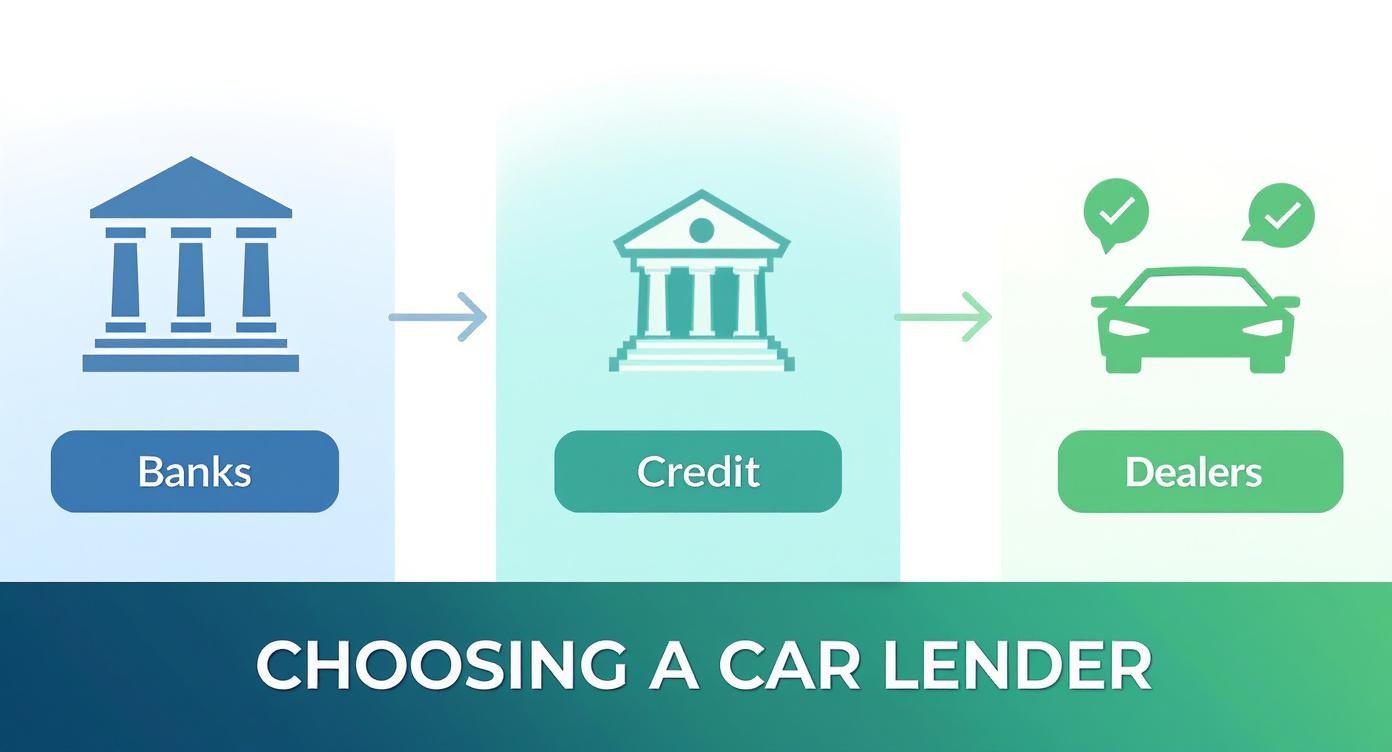
As you can see, you’ve got several avenues to explore. From the traditional banks you know and the member-focused credit unions to the convenience of dealer financing, each path has its own process.
Dissecting Your Pre-Approval Offers
Once pre-approval offers are received, it is critical to look beyond the prominently displayed monthly payment. The lowest payment does not always equate to the best deal. Lenders can easily extend the loan term to reduce the monthly obligation, a tactic that can cost you thousands in additional interest over time.
To conduct a professional comparison of your offers, focus on three critical metrics:
- The Annual Percentage Rate (APR): This is the true cost of borrowing, as it includes the interest rate and any associated fees. A lower APR is always superior.
- The Loan Term: Pay close attention to the number of months. A shorter term, such as 48 or 60 months, will result in substantial interest savings compared to a 72- or 84-month loan.
- The Total Interest Cost: This reveals the true financial impact. Calculate it by multiplying the monthly payment by the number of months in the term, then subtracting the original loan principal. This simple calculation exposes the total interest you will pay over the loan's duration.
By comparing these core elements, you will be able to identify the most financially advantageous offer with confidence, positioning you to negotiate from a position of true strength.
Decoding Loan Agreements and Dodging Hidden Fees

After hours of research and negotiation, you finally land in the finance manager's office. This is it. This is the room where a fantastic car deal can completely unravel in just a few minutes if you aren't paying close attention.
That loan contract isn't just a formality; it's a legally binding document where a few lines of fine print can cost you a fortune over the next few years. Consider this your final checkpoint. It’s your last chance to make sure the numbers you agreed to on the sales floor are the exact same ones on the paperwork.
Don’t rush this. I've seen more people overpay for their car in this single room than anywhere else on the lot. Take a deep breath, slow down, and read everything.
Understanding the Key Terms in Your Contract
A loan agreement is intentionally filled with financial jargon, but there are a few key items you absolutely must verify before you even think about signing. These terms dictate the true, total cost of your loan.
First, find the APR (Annual Percentage Rate). This is the real cost of borrowing money, as it bundles the interest rate with any lender fees. Your job is to make sure this number is an exact match for the pre-approval offer you brought with you or the rate the dealership promised. No excuses.
Next up, locate the loan term. This is simply the total number of months you’ll be making payments. A lower monthly payment might look tempting, but it's often a trick achieved by stretching the loan out to 72 or even 84 months. An 84-month term on a $32,000 loan at 6.8% APR will cost you $8,306.83 in total interest. If you cut that to a more responsible 48-month term, your total interest plummets to $4,639.07—that’s a savings of nearly $4,000!
Always insist on a simple interest loan. It’s the most straightforward type, where you only pay interest on the outstanding principal balance. And whatever you do, avoid loans with prepayment penalties, which literally charge you a fee for paying the car off early. Protecting your financial flexibility is non-negotiable.
The Pitfall of Optional Add-Ons
Once you’ve confirmed the core loan terms are correct, the finance manager will almost certainly present you with a menu of optional products. This is a massive profit center for dealerships, and the pressure can get pretty intense. Knowing what they are ahead of time is your best defense.
You'll almost certainly be offered some of these common add-ons:
- GAP (Guaranteed Asset Protection) Insurance: This covers the "gap" between what you owe and what your car is actually worth if it gets totaled. It can be useful, especially if you have a small down payment.
- Extended Warranty: This is a service contract that covers repair costs after the original manufacturer's warranty runs out.
- Credit Life Insurance: A policy designed to pay off your auto loan if you pass away.
- VIN Etching: This service etches the Vehicle Identification Number onto your windows as a theft deterrent.
While some of these products can offer real value, the dealership is almost always the most expensive place to buy them.
How to Handle the Add-On Push
Here’s your game plan: politely but firmly decline all of them at first. Your immediate goal is to finalize a clean loan for the vehicle itself, nothing more.
If you are genuinely interested in something like GAP insurance or an extended warranty, that's fine—just know you can almost always buy these products separately for a much lower cost later on.
For instance, many major auto insurance companies offer GAP coverage for just a few dollars a month on your existing policy. You can also purchase extended warranties directly from third-party providers or your own credit union, often for a fraction of the dealership's markup.
Never let a finance manager convince you that these add-ons are required for loan approval. That is simply not true. Keep the loan agreement focused solely on the car, and you’ll drive away with a much, much better deal.
Finalizing the Deal and Managing Your New Loan
You’ve made it through the toughest parts of the journey. You’ve done the hard work of assessing your budget, polishing your credit, and landing a fantastic pre-approved loan offer. Now for the final boss: the dealership’s finance office.
This is the last checkpoint, and it’s a critical one. With the keys almost in your hand, it’s incredibly tempting to just sign wherever they point and get on the road. But this is the exact moment to pump the brakes and scrutinize every single detail. A few minutes of careful review here can save you from years of financial headaches.
The Final Contract Review
Before you even think about picking up a pen, your only job is to confirm that the numbers on the contract perfectly match the loan terms you already agreed to. Don't let a fast-talking finance manager rush you or distract you with small talk.
Zero in on these three things:
- Confirm the APR: Is the Annual Percentage Rate the exact number from your pre-approval letter or the rate you negotiated? Even a tiny difference of a fraction of a percentage point will cost you real money over the life of the loan.
- Verify the Loan Amount: Does the total amount being financed line up with the vehicle's sale price, minus your down payment? Scan carefully for any surprise fees or charges you never discussed or approved.
- Check the Loan Term: Is the number of months correct? An accidental extension from a 60-month term to a 72-month term is a surprisingly common—and costly—"mistake."
If you spot any discrepancies, no matter how small, stop. Do not sign. Politely point out the error and insist that they correct the contract before you move forward. This isn't being difficult; it's being smart.
This final review isn’t about confrontation; it’s about diligence. You’re simply protecting your own financial interests and making sure the dealership honors the deal they promised. Never let anyone pressure you into signing a contract that isn't 100% correct.
Smart Loan Management From Day One
Once the paperwork is signed and the keys are yours, your focus shifts from getting the loan to managing it like a pro. Taking a proactive approach from the very first payment will not only keep you in good standing but can also save you a significant amount of money.
The simplest and most effective first step is to set up automatic payments. This one small action virtually guarantees you’ll never miss a due date, which is crucial for protecting the credit score you worked so hard to build. Nearly every lender offers this for free through their online portal.
Paying Down Your Loan Faster
If you have some wiggle room in your monthly budget, making extra payments is one of the most powerful financial moves you can make. The vast majority of auto loans are simple interest loans, which means any extra cash you send goes straight toward the principal balance. This creates a powerful one-two punch.
First, you chip away at the principal, which reduces the total amount of interest you'll pay over time. Second, you pay the car off sooner, freeing up your cash for other goals. You'd be surprised what a difference even an extra $25 or $50 a month can make. Just be sure to tell your lender that any extra funds should be applied directly to the principal.
Knowing When to Consider Refinancing
Life changes, and so do financial markets. Down the road, you might have an opportunity to refinance your auto loan for a better rate, which is a savvy move if:
- Your credit score has improved significantly since you bought the car.
- Overall interest rates have dropped since you took out the loan.
Refinancing is simple: you take out a new, better loan to pay off the old one. If you can lock in a lower APR, you could lower your monthly payment, shorten the loan term, or maybe even both. It's a strategy worth looking into after about a year to see if you can save even more money.
Answering Your Top Car Financing Questions
Having guided thousands of individuals through the complexities of auto financing, I've encountered nearly every question imaginable. The landscape is filled with industry-specific jargon and "what-if" scenarios that can create uncertainty for even the most prepared buyer.
This section is dedicated to providing clear, authoritative answers to the most frequently asked questions. My goal is to demystify the process, address common concerns, and empower you to proceed with the confidence that comes from genuine understanding.
What Is a Good APR for a Car Loan?
A "good" APR is not a static number; it's a dynamic figure influenced by your credit score, the loan term, whether the vehicle is new or used, and prevailing market conditions. Therefore, what constitutes an excellent rate for one person may be merely average for another.
As a general benchmark for 2025, borrowers with excellent credit scores (typically 781 and above) should aim for rates below 6% for new cars and below 8% for used cars. For consumers with good credit (generally in the 661-780 range), competitive rates typically fall between 7% and 10%.
The single most effective method for determining a good rate for your specific profile is to obtain pre-approvals from at least two different types of lenders (e.g., your primary bank and a local credit union) before engaging with a dealership. This provides a tangible, real-world benchmark against which you can measure any offer from the dealer.
How Much Should I Put Down?
The long-standing financial advice of a 20% down payment for a new car and a minimum of 10% for a used car remains the gold standard, for several compelling reasons.
A substantial down payment accomplishes three critical objectives:
- Reduces the Loan Principal: This is the most direct benefit. A smaller loan principal translates to a lower monthly payment and, more importantly, a significant reduction in the total interest paid over the loan's life.
- Mitigates Negative Equity: New vehicles depreciate the moment they are driven off the lot. A 20% down payment creates a financial buffer, helping you avoid an "upside-down" situation where you owe more on the loan than the car is worth. This is particularly crucial in the event of theft or a total-loss accident.
- Enhances Lender Perception: A significant down payment signals financial stability and lower risk to lenders, which can sometimes result in a more favorable interest rate.
If a 20% down payment is not feasible, contribute as much as you can comfortably afford without depleting your emergency savings.
Can I Get a Car Loan With Bad Credit?
Yes, it is possible to finance a vehicle with a poor credit history, but it requires a heightened level of diligence. Lenders perceive borrowers with subprime credit as higher risk, which is reflected in significantly higher interest rates. This makes the total cost of the vehicle substantially more expensive over time.
If time permits, the most prudent course of action is to focus on improving your credit score before applying. However, if a vehicle is an immediate necessity, your strategy should involve accumulating the largest down payment possible, selecting a reliable and affordable vehicle, and researching lenders that specialize in subprime auto loans. Crucially, you must scrutinize every word of the loan agreement to ensure it is free from predatory terms.
Will Getting Pre-Approved Hurt My Credit Score?
This is an excellent and frequently asked question. Applying for a pre-approval does generate a "hard inquiry" on your credit report, which can cause a small, temporary decrease in your credit score, typically fewer than five points.
However, sophisticated credit scoring models from FICO and VantageScore are designed for this exact consumer behavior. They "de-duplicate" or bundle multiple auto loan inquiries made within a concentrated period (usually **14 to 45 days`), treating them as a single credit-seeking event. This allows you to rate-shop with multiple lenders without sustaining multiple negative impacts. The potential savings from securing a lower APR far outweigh the minor, temporary dip in your score.
Should I Take the 0% Financing Offer from the Dealer?
The 0% APR offer is a powerful marketing tool that can be a genuinely good deal, but it requires careful analysis. These offers are almost exclusively reserved for buyers with impeccable credit scores and are often tied to a higher, non-negotiable vehicle price.
Frequently, dealerships will force a choice between 0% financing and a substantial cash-back rebate. This is where you must perform the calculation. In many cases, accepting the rebate and securing a low-interest loan from an external lender like a credit union results in a lower total cost than the 0% APR offer.
What's the Longest Loan Term I Should Even Consider?
The market has seen a proliferation of 84-month (7-year) and even 96-month (8-year) loan terms. Based on my extensive experience, I must advise you to avoid them. I strongly recommend adhering to a loan term of 60 months (5 years) or less.
Extended-term loans are a financial trap. While they offer the allure of a lower monthly payment, they cause you to pay a staggering amount of additional interest and keep you in a negative equity position for a much longer period. If the payment on a 60-month term seems unmanageable, it is a definitive indicator that the vehicle itself is beyond your affordable price range.
If you've got more questions about financing or anything else related to owning a car, feel free to check out our comprehensive FAQ page for more answers.


