
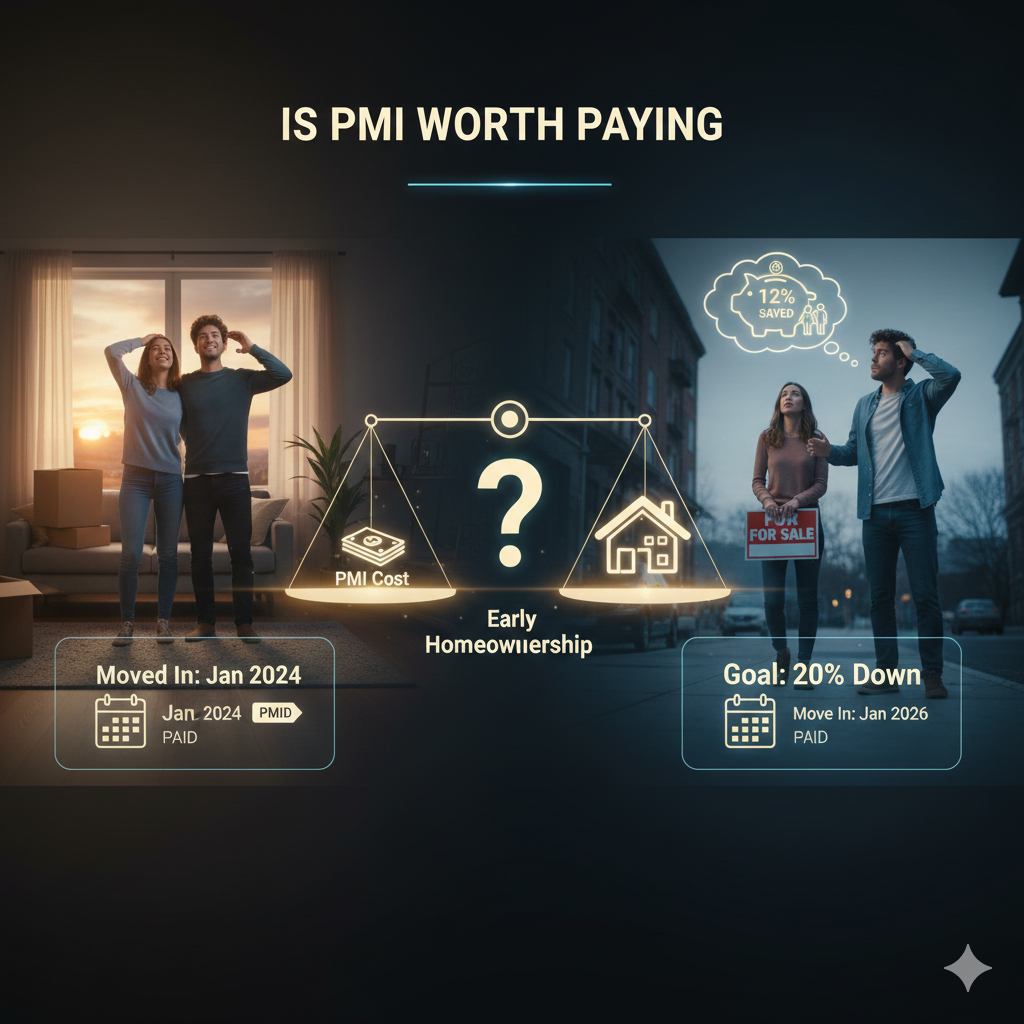
Debunking the Myth: When is PMI Worth Paying on a Home Loan?
Understanding the Real Value of Private Mortgage Insurance in Today’s Housing Market
For decades, conventional wisdom has told homebuyers to avoid Private Mortgage Insurance (PMI) at all costs. Financial advisors, real estate agents, and well-meaning relatives often repeat the same mantra: “Save 20% down to avoid throwing money away on PMI.” But is this advice still relevant in today’s rapidly changing housing market? After working with thousands of homebuyers over my 25-year career in mortgage lending and financial planning, I’ve witnessed how this oversimplified advice has cost many families the opportunity to build wealth through homeownership.
The reality is far more nuanced. While PMI does add to your monthly housing costs, dismissing it entirely ignores fundamental principles of investment timing, opportunity cost, and market dynamics. In many scenarios, paying PMI can actually be the smarter financial decision—and understanding when this applies could save you tens of thousands of dollars over your lifetime.
What Is Private Mortgage Insurance and Who Does It Really Protect?
Before we can evaluate whether PMI is worth paying, we need to understand exactly what it is and how it functions. Private Mortgage Insurance is a type of insurance policy that conventional mortgage lenders require when borrowers put down less than 20% of the home’s purchase price. This insurance protects the lender—not you, the borrower—against the risk of default.
Here’s the fundamental distinction many people miss: PMI and homeowners insurance serve completely different purposes. Homeowners insurance protects you and your property from damage, theft, and liability. Private mortgage insurance, on the other hand, protects the lender’s investment in case you stop making payments. You pay the premium, but the lender receives the benefit if you default.
This might sound like a raw deal, but there’s an important perspective shift to consider. PMI enables lenders to extend mortgages to borrowers who don’t have 20% saved, which opens the door to homeownership years earlier than it would otherwise be possible. The insurance reduces the lender’s risk, which allows them to offer these lower down payment loans in the first place.
According to Fannie Mae’s guidelines, PMI is triggered when your loan-to-value (LTV) ratio exceeds 80%. The LTV ratio is simply the loan amount divided by the property’s value. For example, if you’re buying a $300,000 home with a $30,000 down payment (10%), you’re borrowing $270,000, which creates an LTV of 90%. This 90% LTV means you’ll be required to carry PMI until your equity position improves.
How Much Does PMI Add to Your Monthly Payment?
The cost of private mortgage insurance varies considerably based on several factors, but understanding the typical range helps you make informed decisions. Most borrowers pay between 0.5% and 1.5% of the original loan amount annually, though this rate can fluctuate based on your specific situation.
Let’s break down the math with a real-world example. On a $300,000 loan with a PMI rate of 0.75% annually, you would pay $2,250 per year, or approximately $187.50 per month. That might seem like a significant expense—and it is—but context matters tremendously when evaluating whether this cost is worthwhile.
Your credit score dramatically impacts the annual cost of PMI. Borrowers with excellent credit scores (typically 760 and above) often qualify for rates on the lower end of the spectrum, sometimes as low as 0.3% to 0.5%. Conversely, those with credit scores in the 620-680 range might face rates approaching 1.5% or higher. This credit score sensitivity means that improving your credit before applying for a mortgage can save you substantial amounts on PMI premiums.
Other factors that determine the PMI rate charged by the lender include your down payment size, the type of property (single-family homes typically have lower rates than condos), and the specific PMI company the lender uses. Some lenders offer relationships with multiple PMI providers, which can create opportunities to shop for better rates.
The Critical Question: PMI Cost vs. Time Saved Buying Now
Here’s where we need to challenge conventional thinking. The question isn’t simply “Is PMI expensive?” The more important question is: “What is the opportunity cost of waiting to save 20% down?”
Consider this scenario: You’re looking at homes in a high appreciation area where property values are rising 6-8% annually. You have $30,000 saved for a down payment on a $300,000 home, which puts you at 10% down. Following traditional advice, you decide to keep renting at $2,000 per month while you save another $30,000 to reach 20% down and avoid PMI.
Let’s run the numbers. If you can save $1,000 per month, it will take you 30 months (two and a half years) to accumulate that additional $30,000. But during those 30 months, several things happen:
First, you’ll pay $60,000 in rent ($2,000 × 30 months) with zero equity building. Second, if the housing market appreciates at even a modest 5% annually during those two and a half years, that $300,000 home is now worth approximately $339,000. You’ve “saved” $30,000, but the home now requires $67,800 for a 20% down payment instead of $60,000. You’re actually further from your goal than when you started.
Third, and perhaps most significantly, you’ve missed out on 30 months of principal paydown and potential appreciation on the home you could have already owned. Even after accounting for PMI costs of roughly $187 per month ($5,610 over 30 months), you would have built substantial equity through both forced savings (principal reduction) and market appreciation.
This is why paying PMI makes sense for first time home buyers in many cases. The alternative—indefinitely renting while saving—often proves more expensive when you factor in lost appreciation and continued rent payments.
When Does Paying PMI Make Financial Sense?
Based on extensive analysis of thousands of mortgage scenarios, here are the situations where paying private mortgage insurance typically represents the better financial decision:
Rising Housing Markets: When housing prices are rising quickly, every month you wait potentially prices you out of neighborhoods or forces you to compromise on home quality. In markets experiencing 5% or greater annual appreciation, the math almost always favors buying with PMI rather than waiting. The appreciation you capture by owning the home earlier typically far exceeds the cost of PMI premiums.
Low Interest Rate Environments: When mortgage rates are historically low, locking in that rate—even with PMI—often beats waiting. If rates increase while you’re saving for 20% down, you might face a higher interest rate that costs more monthly than the PMI would have. The question “is it better to pay PMI or take a higher rate” has a clear answer: PMI is temporary and removable, but a higher rate stays with you for the life of the loan (unless you refinance, which carries its own costs).
Strong Rent-to-Own Comparison: Calculate your current monthly rent versus your anticipated total housing payment with PMI included. If the difference is minimal—say, $300 or less—paying PMI to transition from renting to ownership accelerates your wealth-building timeline significantly. Remember, rent payments build zero equity, while mortgage payments (even with PMI) contribute to principal reduction.
High Credit Score Scenarios: If your credit score is 740 or above, you’ll qualify for the lowest PMI rates available. When PMI only costs 0.4-0.5% annually, the expense becomes much easier to justify, particularly when combined with other favorable factors like market appreciation.
Career and Income Stability: When you have strong income stability and growth prospects, you’re better positioned to make extra principal payments that accelerate PMI removal. If you anticipate raises, bonuses, or other income increases, these can fund additional payments that quickly bring your LTV below 80%.
How to Avoid PMI With Less Than 20% Down
While there are certainly scenarios where paying PMI makes sense, understanding your alternatives ensures you make the most informed decision. Several strategies allow you to bypass traditional PMI even with less than 20% down:
Piggyback Mortgage (80/10/10 Loan): This structure involves taking a first mortgage for 80% of the home’s value, a second mortgage (home equity loan or HELOC) for 10%, and making a 10% down payment. The second mortgage typically carries a higher interest rate than the first, but you avoid PMI entirely. Whether this saves money depends on comparing the cost of the second mortgage’s interest against PMI premiums. This works well when interest rates on home equity products are reasonable and you plan to pay off the second mortgage aggressively.
Lender-Paid Mortgage Insurance (LPMI): With LPMI, the lender pays your mortgage insurance premium in exchange for charging you a slightly higher interest rate—typically 0.25% to 0.50% higher. This might sound like a bad deal, but there’s a crucial advantage: the higher interest rate may be tax-deductible (mortgage interest), while PMI tax deductibility has varied year to year based on legislation. The question “is LPMI a better deal than PMI” depends on your tax situation, how long you plan to keep the home, and your ability to refinance later.
Single-Premium Mortgage Insurance (SPMI): Instead of monthly PMI payments, you pay the entire premium upfront at closing. This can be paid from your own funds or, in some cases, rolled into the loan amount. Single premium mortgage insurance pros and cons include: lower total cost (since you’re paying upfront rather than in installments), but you lose that money entirely if you refinance or sell within a few years. SPMI works best when you’re confident you’ll keep the home and loan for at least 5-7 years.
VA Loans and Other Specialized Programs: If you’re a veteran or active military member, VA loans require no down payment and include no private mortgage insurance, though they do charge a one-time funding fee. Similarly, USDA loans for rural properties offer 100% financing without PMI for qualifying buyers.
PMI vs. FHA Mortgage Insurance: Understanding the Key Differences
Many borrowers confuse private mortgage insurance with FHA Mortgage Insurance Premium (MIP), but these are distinctly different products with different rules. Understanding the difference between PMI and FHA Mortgage Insurance Premium is critical for choosing the right loan type.
FHA loans require mortgage insurance regardless of your down payment size. Even if you put down 20% or more on an FHA loan, you’ll still pay MIP. Additionally, FHA’s insurance includes both an upfront premium (typically 1.75% of the loan amount) and an annual premium that’s divided into monthly payments.
The most significant difference: FHA MIP is often permanent. If you put down less than 10% on an FHA loan, you’ll pay MIP for the entire life of the loan—it never goes away unless you refinance into a conventional loan. With PMI on a conventional loan, you have clear paths to cancellation once you reach sufficient equity.
For borrowers with good to excellent credit, conventional loans with PMI typically cost less overall than FHA loans with MIP, especially when considering long-term ownership. FHA loans work best for buyers with credit challenges or those who need more lenient debt-to-income ratios.
How and When Can You Cancel PMI?
One of the most empowering aspects of private mortgage insurance is that it’s temporary—unlike rent payments or many other housing costs, PMI has a built-in expiration date. Understanding when PMI automatically cancels and how to request early cancellation puts you in control of this expense.
According to the Consumer Financial Protection Bureau, the Homeowners Protection Act (HPA) establishes clear rules for PMI cancellation:
Automatic Termination: Your lender must automatically terminate PMI when your loan balance reaches 78% of the original property value, provided you’re current on payments. This is based on your scheduled payment plan, not actual home value appreciation. You don’t need to request this—it happens automatically.
Request-Based Cancellation: You can request PMI cancellation once your loan balance reaches 80% of the original property value. However, this requires you to be current on payments with no late payments in the past year, and sometimes the lender may require a new appraisal to confirm the property value.
Appreciation-Based Removal: Here’s where strategy becomes important. Does home appreciation count toward reaching the equity required to remove PMI? Yes—but it requires proactive effort. If your home has appreciated significantly, you may have 20% equity much sooner than your payment schedule indicates. Most lenders allow you to order a new appraisal (at your expense, typically $400-600) to demonstrate sufficient equity for PMI removal. Different lenders have varying requirements for this process, including minimum time periods (often 2-5 years) before appreciation-based removal is permitted.
Legal Requirements for PMI Cancellation: Lenders must inform you annually about your PMI cancellation rights. They cannot require more than 80% LTV for cancellation unless you’ve had late payments or there are subordinate liens on the property. Understanding these mandatory mortgage insurance rules protects you from lenders who might try to keep you paying PMI longer than necessary.
Strategies to Get Rid of PMI Early
If you’ve decided that paying PMI makes sense for entering homeownership now, having a plan to eliminate it quickly maximizes the strategy’s effectiveness. Here are proven approaches to remove PMI ahead of schedule:
Accelerated Principal Payments: Making extra payments toward principal directly reduces your loan balance and builds equity faster. Even an additional $200-300 per month can shave years off the time until you reach 80% LTV. The question “is it worth making extra payments on the principal to remove PMI early” has a clear answer when you calculate the return: every dollar in extra principal immediately reduces your PMI obligation and earns you the equivalent of your mortgage interest rate as a guaranteed return.
Annual Lump Sum Payments: If your budget doesn’t allow consistent extra monthly payments, consider making one large principal payment annually using bonuses, tax refunds, or other windfall income. A $5,000 annual lump sum can dramatically accelerate your path to PMI removal.
Strategic Refinancing: While refinancing solely to remove PMI rarely makes sense due to closing costs, if you’re refinancing anyway to capture a lower interest rate, ensure the new loan brings you below 80% LTV to eliminate PMI in the process. The question “does refinancing remove private mortgage insurance” depends entirely on whether your new loan amount represents less than 80% of the home’s current value.
Home Value Monitoring: In appreciating markets, stay aware of comparable sales in your neighborhood. If you see homes similar to yours selling for prices that would push your equity above 20%, it may be time to order an appraisal for PMI removal. Some lenders offer automated valuation models (AVMs) as a less expensive alternative to full appraisals for PMI removal purposes.
Calculating the True Cost-Benefit Analysis of Private Mortgage Insurance
To determine if PMI is worth the cost for your specific situation, you need a systematic approach to weighing all factors. Here’s a framework for making this calculation:
Step 1 – Calculate Total PMI Cost: Multiply your loan amount by your PMI rate, then divide by 12 for monthly cost. Project how long you’ll pay PMI based on your extra payment strategy or scheduled amortization.
Step 2 – Calculate Rent Alternative Cost: Multiply your current monthly rent by the number of months you’d need to save enough for 20% down. Don’t forget to account for annual rent increases, which average 3-4% in most markets.
Step 3 – Calculate Market Appreciation Impact: Research your market’s historical appreciation rates (typically 3-6% annually in stable markets). Calculate the difference between today’s home prices and projected prices when you’d have 20% saved. This “home price inflation” often exceeds PMI costs significantly.
Step 4 – Calculate Principal Buildup: In the early years of a mortgage, roughly 30-40% of your payment goes to principal. Multiply your principal portion by the number of months you’d delay by saving for 20% down. This is equity you’re forfeiting by waiting.
Step 5 – Compare Total Scenarios: Add up all costs and benefits for both the “buy now with PMI” and “wait for 20% down” scenarios. The scenario with lower total cost and higher equity after accounting for all factors is your answer.
For most borrowers in appreciating markets with stable employment, buying with PMI comes out ahead by $20,000-$50,000 over a 5-7 year period compared to continuing to rent while saving.
PMI on Different Property Types and Loan Scenarios
The mechanics and costs of PMI vary based on your specific property and loan characteristics:
PMI on a Condo vs. Single-Family Home: Condominiums typically incur slightly higher PMI rates—often 0.1-0.2% more annually than single-family homes. This reflects higher risk profiles due to condo association finances and potential special assessments that might affect your ability to pay.
Investment Property PMI Rules: If you’re buying a rental property rather than a primary residence, PMI rules become more stringent. Many lenders require larger down payments (15-20%) even with PMI, and rates are higher—typically 1.5-2.5% annually. Some lenders don’t offer PMI on investment properties at all, requiring 20-25% down. The question of PMI rules for investment property highlights why investors often need stronger financial positions than primary residence buyers.
Loan Amount Considerations: Larger loan amounts can affect PMI pricing. Loans above conforming limits (currently $766,550 in most areas) fall into jumbo territory, where PMI options become more limited and expensive. Some jumbo lenders don’t offer PMI at all, requiring 20% down minimum.
Is PMI Tax Deductible in 2024?
Tax treatment of PMI premiums has fluctuated over the years based on federal legislation. The PMI tax deduction expired at the end of 2021 and has not been renewed as of early 2024, meaning PMI is generally not tax deductible for most borrowers in the current tax year.
However, tax laws change, and this deduction has been renewed multiple times in the past. If you’re paying PMI, track your payments carefully in case deductibility is reinstated. When it was deductible, borrowers with modified adjusted gross incomes below $100,000 could deduct the full amount, with phase-outs for higher incomes.
Even without tax deductibility, the overall financial analysis of paying PMI versus waiting to buy can still favor buying with PMI when market conditions and opportunity costs are properly evaluated.
Common Myths and Misconceptions About PMI
Myth: “PMI is always a waste of money” Reality: PMI enables homeownership for millions who would otherwise be permanently locked out of the market. For many buyers, the wealth built through earlier homeownership far exceeds the cost of PMI premiums.
Myth: “You’re stuck paying PMI forever” Reality: Clear legal requirements govern PMI cancellation, and proactive borrowers can remove it much earlier than the scheduled date through extra payments or appreciation-based removal.
Myth: “PMI protects me if I can’t make payments” Reality: PMI protects the lender, not you. If you default, you’ll still lose your home through foreclosure. PMI simply reduces the lender’s loss—it provides no benefit to you in a default situation.
Myth: “All PMI costs the same” Reality: PMI pricing varies dramatically based on credit scores, down payment amounts, property types, and the specific insurance provider. Shopping for the best rate and improving your credit before applying can save thousands.
Myth: “FHA loans are better than conventional loans with PMI” Reality: For borrowers with good credit, conventional loans with temporary PMI almost always cost less than FHA loans with permanent MIP, especially for long-term homeownership.
Making Your Decision: Is Paying PMI Worth It?
After analyzing thousands of homebuyer scenarios throughout my career, I’ve developed a clear framework for when paying PMI makes sense:
Pay PMI When:
- Your local housing market is appreciating 4% or more annually
- The difference between renting and owning (with PMI) is $400 or less monthly
- Your credit score is 720 or higher, qualifying you for lower PMI rates
- You have stable income and can make extra principal payments to accelerate PMI removal
- Mortgage rates are historically low and might rise while you save for 20% down
- Your current rent is high relative to potential mortgage payments
- You’re confident in your employment stability and income growth trajectory
Wait to Save 20% When:
- Your local housing market is flat or declining
- You’re uncertain about job stability or your timeline in the area
- Your credit score is below 680 and PMI rates will be prohibitively expensive
- You can save aggressively and reach 20% down within 12-18 months
- Your current rent is significantly lower than ownership costs would be
- You haven’t built an adequate emergency fund yet (aim for 3-6 months of expenses)
- The home you want is already at the high end of your affordability even without PMI
Resources for Making an Informed Decision
Making a major financial decision like purchasing a home with PMI requires reliable information. The authoritative sources for PMI rules, costs, and cancellation rights include:
- Consumer Financial Protection Bureau (CFPB): The CFPB’s guidance on PMI removal provides definitive information on your legal rights under the Homeowners Protection Act.
- Fannie Mae: Fannie Mae’s PMI resources explain the guidelines that most conventional loan servicers must follow, including requirements for PMI removal.
- Freddie Mac: Freddie Mac’s PMI breakdown offers clear explanations and calculators to help you understand costs and mechanics.
For personalized mortgage guidance and competitive rate comparisons, Shop Rates provides comprehensive tools to evaluate mortgage options specific to your financial situation.
Final Thoughts: Rethinking Traditional Wisdom
The blanket advice to “never pay PMI” oversimplifies a complex financial decision and costs many families the opportunity to build generational wealth through homeownership. While PMI does represent an additional cost that benefits the lender rather than you, dismissing it entirely ignores the tremendous opportunity cost of delaying homeownership in an appreciating market.
The right answer depends on your specific circumstances: market conditions, financial stability, credit profile, and long-term goals. By understanding exactly how PMI works, what it costs, how to remove it, and how to calculate the true opportunity cost of waiting, you can make an informed decision rather than following outdated rules of thumb.
For many buyers today, paying PMI for a few years while building equity through both principal reduction and market appreciation represents a far better financial outcome than spending years renting while housing prices rise beyond reach. The key is entering homeownership strategically, with a clear plan for removing PMI as quickly as possible, and ensuring the overall financial picture makes sense for your situation.
Remember: PMI is temporary. Missed opportunities to build home equity compound permanently.
Frequently Asked Questions About Private Mortgage Insurance
Is paying Private Mortgage Insurance (PMI) worth it, or should I wait to save 20%?
The answer depends on your local market conditions and timeline. In markets appreciating 5% or more annually, buying with PMI typically comes out ahead financially because the home equity you build through appreciation and principal paydown exceeds PMI costs. However, if you can save 20% within 12-18 months in a flat market, waiting might make sense. Calculate the total cost of continuing to rent versus buying with PMI to determine your best path.
What are the pros and cons of paying PMI versus delaying a home purchase?
Paying PMI allows you to start building equity immediately, lock in current interest rates, stop “throwing away” rent money, and benefit from potential home appreciation. The downside is the additional monthly cost (typically $100-300) and the fact that PMI protects the lender, not you. Delaying lets you avoid PMI entirely and have a lower monthly payment, but you’ll continue paying rent with zero equity buildup and risk home prices rising beyond your reach.
How much does PMI typically cost per month on a conventional loan?
PMI usually costs between 0.5% and 1.5% of the original loan amount annually, divided into monthly payments. On a $300,000 loan with 0.75% PMI, you’d pay about $187.50 monthly. The exact cost varies based on your credit score, down payment size, and property type. Borrowers with excellent credit (740+) often pay closer to 0.4-0.5%, while those with lower credit scores may pay 1.0-1.5% or more.
How does my credit score affect the annual cost of PMI?
Your credit score dramatically impacts PMI pricing. With a score of 760 or above, you might qualify for rates as low as 0.3-0.5% annually. Scores in the 700-740 range typically see rates of 0.6-0.9%. Below 680, rates often reach 1.2-1.5% or higher. Improving your credit score by even 40-60 points before applying for a mortgage can save you thousands in PMI premiums over the life of the policy.
What factors determine the PMI rate charged by the lender?
PMI rates are determined by several risk factors: your credit score (most significant factor), down payment percentage (lower down payment = higher rate), loan amount, property type (condos cost more than single-family homes), and occupancy type (primary residence vs. investment property). The specific PMI company your lender uses also affects pricing, as different insurers charge different rates.
Is PMI always a bad financial decision?
No. PMI enables homeownership for borrowers who don’t have 20% saved, allowing them to start building equity years earlier. In appreciating markets, the wealth built through earlier homeownership typically exceeds PMI costs by tens of thousands of dollars. PMI is only “bad” when it keeps you from affording the home comfortably or when waiting 12-18 months to save 20% down would be feasible without significant home price increases.
Should I pay PMI upfront (single-premium) or monthly?
Monthly PMI provides flexibility—if you refinance or sell within a few years, you stop paying it. Single-premium PMI (paid upfront at closing) costs less overall but you lose that money if you refinance or move quickly. Choose monthly if you might refinance or aren’t certain you’ll keep the home long-term. Consider single-premium if you’re confident you’ll stay put for at least 5-7 years and want lower monthly payments.
Is the cost of PMI tax deductible in the current tax year?
As of 2024, PMI is generally not tax deductible. The deduction expired at the end of 2021 and has not been renewed. However, this deduction has been reinstated multiple times in the past, so continue tracking your PMI payments in case the deduction is renewed. When it was available, borrowers with modified adjusted gross incomes below $100,000 could deduct PMI premiums, with phase-outs for higher earners.
What exactly is Private Mortgage Insurance (PMI)?
Private Mortgage Insurance is a policy that conventional mortgage lenders require when borrowers put down less than 20% of the home’s purchase price. It protects the lender (not the borrower) against losses if the borrower defaults on the loan. PMI makes it possible for lenders to offer mortgages with lower down payments by reducing their risk exposure.
Who does PMI protect—the lender or the borrower?
PMI protects only the lender. If you default on your mortgage, PMI compensates the lender for their losses—it provides no protection or benefit to you as the borrower. This can feel frustrating since you’re paying the premium, but the tradeoff is that PMI enables you to purchase a home with less than 20% down, which wouldn’t be possible without this insurance protecting the lender.
When is PMI legally required for a conventional loan?
PMI is required on conventional loans whenever the loan-to-value (LTV) ratio exceeds 80%. In other words, if your down payment is less than 20% of the home’s purchase price, you’ll need PMI. For example, putting down 15% means borrowing 85% of the home’s value, creating an 85% LTV that requires PMI coverage.
Is PMI required for all types of mortgage loans (e.g., VA, FHA)?
No. VA loans for veterans don’t require PMI (though they charge a one-time funding fee instead). FHA loans don’t have PMI but require their own insurance called Mortgage Insurance Premium (MIP), which works differently—it’s often permanent unless you refinance. USDA loans for rural properties have guarantee fees instead of PMI. Only conventional loans specifically use PMI.
What is the difference between PMI and FHA Mortgage Insurance Premium (MIP)?
The key differences: PMI (conventional loans) can be cancelled once you reach 20% equity, while FHA MIP is often permanent if you put down less than 10%. PMI is typically cheaper for borrowers with good credit. FHA charges both an upfront premium (1.75% of loan amount) and annual premiums, while conventional PMI is usually just monthly. For borrowers with strong credit, conventional loans with PMI usually cost less than FHA loans overall.
What is the difference between PMI and homeowner’s insurance?
These are completely different types of insurance. Homeowner’s insurance protects you and your property from damage, theft, liability, and disasters—you’re the beneficiary. PMI protects only the lender against losses if you default—the lender is the beneficiary even though you pay the premium. You’ll need both homeowner’s insurance and PMI (if applicable) when you buy with less than 20% down.
What is the LTV (Loan-to-Value) ratio that triggers PMI?
PMI is triggered when your LTV exceeds 80%. LTV is calculated by dividing the loan amount by the property’s value. For example, borrowing $270,000 on a $300,000 home creates a 90% LTV (270,000 ÷ 300,000 = 0.90). Any LTV above 80% requires PMI on conventional loans. You can remove PMI once your LTV drops to 80% or below.
What are the best strategies to avoid paying PMI altogether?
Several alternatives exist: (1) Save for a 20% down payment, (2) Use a piggyback mortgage (80/10/10 structure with a second loan for 10%), (3) Choose Lender-Paid Mortgage Insurance (LPMI) where the lender covers PMI in exchange for a slightly higher rate, (4) Make a larger down payment using gift funds from family, (5) Use a VA loan if you’re a veteran, or (6) Pay single-premium PMI upfront to reduce long-term costs.
How can I get rid of PMI on a conventional loan?
You have three main paths: (1) Request cancellation once your loan balance reaches 80% LTV (requires good payment history), (2) Wait for automatic termination at 78% LTV based on the original amortization schedule, or (3) Order a new appraisal to prove appreciation has brought you to 20% equity (usually requires at least 2 years of payments first). Making extra principal payments accelerates all of these timelines.
When can I request my lender to cancel PMI?
You can request PMI cancellation once your loan balance reaches 80% of the original property value and you have a good payment history (current on payments, typically no late payments in the past year). Some lenders require a written request. If your home has appreciated, you may be able to request cancellation earlier based on current value, but lenders typically require 2-5 years of payments before considering appreciation-based removal.
Does PMI automatically terminate, and if so, when?
Yes. Federal law requires lenders to automatically terminate PMI when your loan balance reaches 78% of the original property value, provided you’re current on payments. This happens based on your original amortization schedule regardless of actual home value. You don’t need to request this—the lender must cancel PMI and notify you automatically at the 78% LTV point.
Does home appreciation count toward reaching the equity required to remove PMI?
Yes, but it requires proactive effort. Lenders will consider appreciation when determining current equity, but typically only after you’ve made payments for 2-5 years (requirements vary by lender). You’ll need to order a new appraisal at your expense ($400-600) to demonstrate the home’s increased value and your resulting equity position. If the appraisal shows 20% equity, you can request PMI removal.
Can I get rid of PMI by simply refinancing the mortgage?
Refinancing eliminates PMI if your new loan amount is 80% or less of the home’s current value. However, refinancing solely to remove PMI rarely makes financial sense due to closing costs (typically 2-5% of loan amount). If you’re refinancing anyway to capture a lower interest rate and can avoid PMI on the new loan, that’s ideal. Otherwise, working to remove PMI from your existing loan is usually more cost-effective.
Is it worth making extra payments on the principal to remove PMI early?
Generally yes, especially if your PMI costs 0.75% or more annually. Extra principal payments reduce your loan balance faster, bringing you to 80% LTV sooner. Every dollar you pay toward principal essentially “earns” your mortgage interest rate plus saves you PMI costs. If your PMI is $200/month, reaching 80% LTV even six months earlier saves you $1,200, making extra payments very worthwhile.
How long do you typically have to pay PMI?
The duration varies dramatically based on your down payment and whether you make extra principal payments. With 10% down and no extra payments, PMI typically lasts 8-11 years. With 15% down, it’s usually 4-7 years. Making extra payments can reduce this significantly—an additional $300/month might cut PMI duration in half. In appreciating markets, you might remove PMI in 3-5 years even with minimal extra payments.
What is Lender-Paid Mortgage Insurance (LPMI), and is it better than standard PMI?
LPMI means the lender pays your mortgage insurance in exchange for charging you a higher interest rate (typically 0.25-0.5% higher). The benefit: the higher rate might be tax-deductible as mortgage interest, while PMI typically isn’t. The downside: the higher rate never goes away unless you refinance, while standard PMI cancels once you reach 20% equity. LPMI works best for borrowers who plan to refinance within 5-7 years or who benefit significantly from mortgage interest deductions.
How does a piggyback loan (80/10/10) help avoid PMI?
An 80/10/10 structure uses two mortgages: a first mortgage for 80% of the home’s value (avoiding PMI) and a second mortgage (home equity loan or HELOC) for 10%, combined with your 10% down payment. The second mortgage typically has a higher interest rate than the first, but you avoid PMI entirely. This strategy works best when second mortgage rates are reasonable and you can aggressively pay down the second loan. Compare the total cost of two mortgages versus one mortgage with PMI to determine the better option.


