Secured vs. Unsecured Loans: An Expert Guide to Choosing the Right Financing
When you delve into the world of borrowing, the entire conversation around secured vs. unsecured loans pivots on a single, critical concept: collateral. A secured loan is directly tied to a tangible asset you own—your home or car, for instance. If you find yourself unable to repay the loan, the lender has a legal right to take possession of that asset. Conversely, an unsecured loan is granted based solely on your financial reputation and creditworthiness, requiring no collateral whatsoever.
Understanding this fundamental difference is the first step toward making a sound financial decision. One path offers lower interest rates at the cost of putting an asset on the line, while the other provides flexibility and safety for your assets but often comes with a higher price tag. This guide, crafted from decades of financial expertise, will walk you through every nuance to help you determine which option aligns with your unique circumstances.
The Core Difference: Risk, Trust, and Collateral
At its heart, every loan application is an exercise in risk assessment for the lender. Their primary goal is to gain confidence that you will repay the borrowed funds. The presence of collateral dramatically alters this risk calculation.
When you pledge an asset, you provide the lender with a safety net. This significantly mitigates their potential loss if you encounter financial hardship and cannot make your payments. Because the loan is less risky for them, lenders are often willing to offer much more favorable terms to you, the borrower. This is the central tenet of secured lending.
An unsecured loan operates on a different principle: trust. With no asset to fall back on, the lender is taking a considerably larger gamble. They are relying exclusively on your financial track record—your credit score, income stability, and existing debt load—to determine if you are a reliable borrower. This is precisely why unsecured loans typically have more stringent approval criteria and, more often than not, carry higher interest rates.
Key Differences at a Glance
For a clear, side-by-side comparison, this table cuts straight to the chase, highlighting the fundamental distinctions between the two loan types. Grasping these points is the essential first step in figuring out which path makes the most sense for your financial situation and long-term goals.
| Feature | Secured Loans | Unsecured Loans |
|---|---|---|
| Collateral Requirement | An asset (e.g., house, car, savings) is required. | No collateral is needed. |
| Lender's Risk | Lower, as the asset can be seized to recoup losses. | Higher, as repayment relies entirely on the borrower's promise. |
| Typical Interest Rates | Generally lower due to reduced risk for the lender. | Generally higher to compensate the lender for the increased risk. |
| Approval Basis | Based on the value of the collateral and the borrower's credit. | Based primarily on the borrower's creditworthiness and income. |
| Risk to Borrower | Potential loss of the pledged asset if the loan is defaulted on. | No risk of asset loss, but credit score and financial standing are at stake. |
After reviewing the basics, it becomes evident just how pivotal the role of collateral is in the lending equation.
The presence of collateral is the single most important factor that shapes the entire lending agreement, from the interest rate you'll pay to the amount you can borrow. It fundamentally shifts the balance of risk between you and the lender.
How Secured Loans Work: Using Your Assets as Leverage
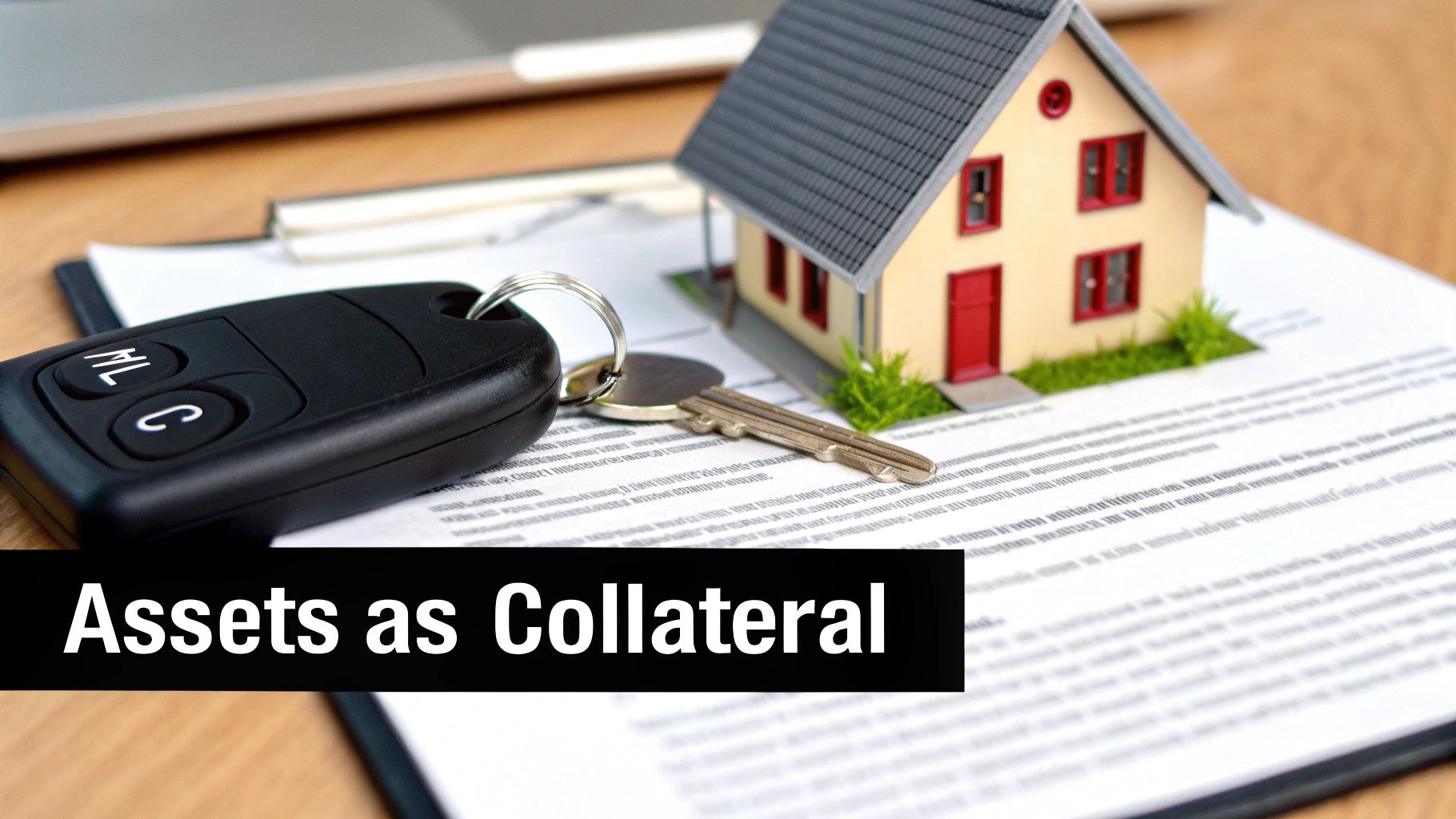
A secured loan operates on a straightforward principle: leverage. When you pledge an asset you own—whether it's your home, your car, or even a savings account—you're giving the lender a tangible guarantee that the loan will be repaid, one way or another.
This act of pledging collateral fundamentally changes the game for the lender. If you, the borrower, cannot keep up with your payments, the lender has a legal claim to that asset. They can take possession of it and sell it to recover their funds. This safety net makes the entire transaction significantly less risky from their perspective.
The Borrower's Advantage from Reduced Lender Risk
So, why should you care about the lender's risk? Because the benefits are passed directly to you. Since their potential for financial loss is much lower, lenders can offer you more favorable terms.
This usually translates into a few key advantages:
- Lower Interest Rates: Lenders don't need to charge as much interest because their investment is protected by the asset's value.
- Higher Loan Amounts: You can often borrow more money, as the loan amount is tied to the value of your collateral, not just your credit score.
- Easier Qualification: Borrowers with less-than-perfect credit often find it easier to get approved because the asset provides a strong layer of security for the lender.
A mortgage is the quintessential example of a secured loan; your home is the collateral. It’s the same story when you finance a car—the vehicle itself secures the loan. Both are prime examples of secured lending.
A secured loan isn’t just a loan; it’s a strategic agreement where your asset acts as a powerful negotiating tool, unlocking better terms than your credit history alone might achieve.
The Other Side of the Coin: The Risk of Repossession
Of course, this leverage comes with a serious responsibility. The primary drawback—and it's a significant one—is the risk of losing your asset. If you default on the loan, the lender can initiate foreclosure proceedings on your home or repossess your vehicle.
This reality underscores the critical importance of borrowing responsibly. A fascinating study by the European Central Bank that analyzed thousands of corporate loans found that the average loss for lenders on defaulted secured loans was 18%. That's substantially better than the 25% loss they observed on unsecured loans, which truly highlights how effective collateral is at reducing lender risk.
To see how assets provide leverage on a massive scale, you can explore complex financial instruments like Commercial Mortgage-Backed Securities (CMBS), which are backed by income-generating commercial properties.
Unsecured Loans: Borrowing Based on Your Financial Reputation
Unsecured loans are the polar opposite of their asset-backed counterparts. Instead of putting up your car or house as collateral, these loans are built entirely on a foundation of trust. When a lender extends an unsecured loan, they are essentially betting on your financial reputation and your promise to pay it back. There’s no physical safety net for them if things go wrong.
Because of this, your creditworthiness isn't just a part of the application—it's the cornerstone of the entire decision. Lenders will conduct a thorough review of your financial history to accurately gauge the risk they are undertaking. They need to see a proven track record of responsible debt management.
The Metrics That Truly Matter for Approval
Without an asset to secure the loan, lenders zoom in on your personal financial health. The evaluation is comprehensive and boils down to a few critical factors:
- Your Credit Score: This three-digit number provides the quickest snapshot of your financial reliability. A higher score signals to a lender that you are a low-risk borrower.
- Income Stability: Lenders need to be confident that you have a steady, predictable income stream to comfortably handle the new monthly payments.
- Debt-to-Income (DTI) Ratio: This metric shows how much of your monthly income is already allocated to other debt obligations. A low DTI indicates that you have the financial capacity to take on more.
Since the lender assumes all the risk, you can expect stricter credit requirements and higher interest rates compared to secured loans. That higher rate is their compensation for taking that leap of faith on you.
An unsecured loan is the financial world's version of a firm handshake. It’s a deal built on your reputation, backed by the story your financial history tells.
Common Examples and Their Practical Uses
You are likely already familiar with the most common types of unsecured loans: personal loans and credit cards. While they operate on the same principle of trust, they serve different needs. A personal loan provides you with a single lump sum of cash that can be used for a specific purpose, like consolidating debt or financing a home renovation.
Credit cards, on the other hand, offer a revolving line of credit. They provide flexibility for everyday spending and are well-suited for short-term financing. Both are incredibly useful financial tools, but it’s crucial to understand their differences, particularly when managing your debt. You can dive deeper into the pros and cons in our guide on personal loan versus credit card debt.
Ultimately, securing favorable terms on an unsecured loan requires a strong financial profile. Proving you're a low-risk borrower with a solid credit history and stable finances is the only way to unlock the best rates and options—all without having to pledge a single asset.
Making an Informed Decision: Key Comparison Points
Once you move beyond the textbook definitions, the real choice between a secured and an unsecured loan comes down to a practical, head-to-head comparison. To make the right call for your specific situation, you need to dissect the key factors that set these two financial tools apart in the real world. This involves a close examination of how they stack up on interest rates, qualification requirements, and the fundamental trade-off between risk and reward.
The infographic below illustrates the typical journey for obtaining an unsecured loan, where your personal financial health is the paramount consideration.
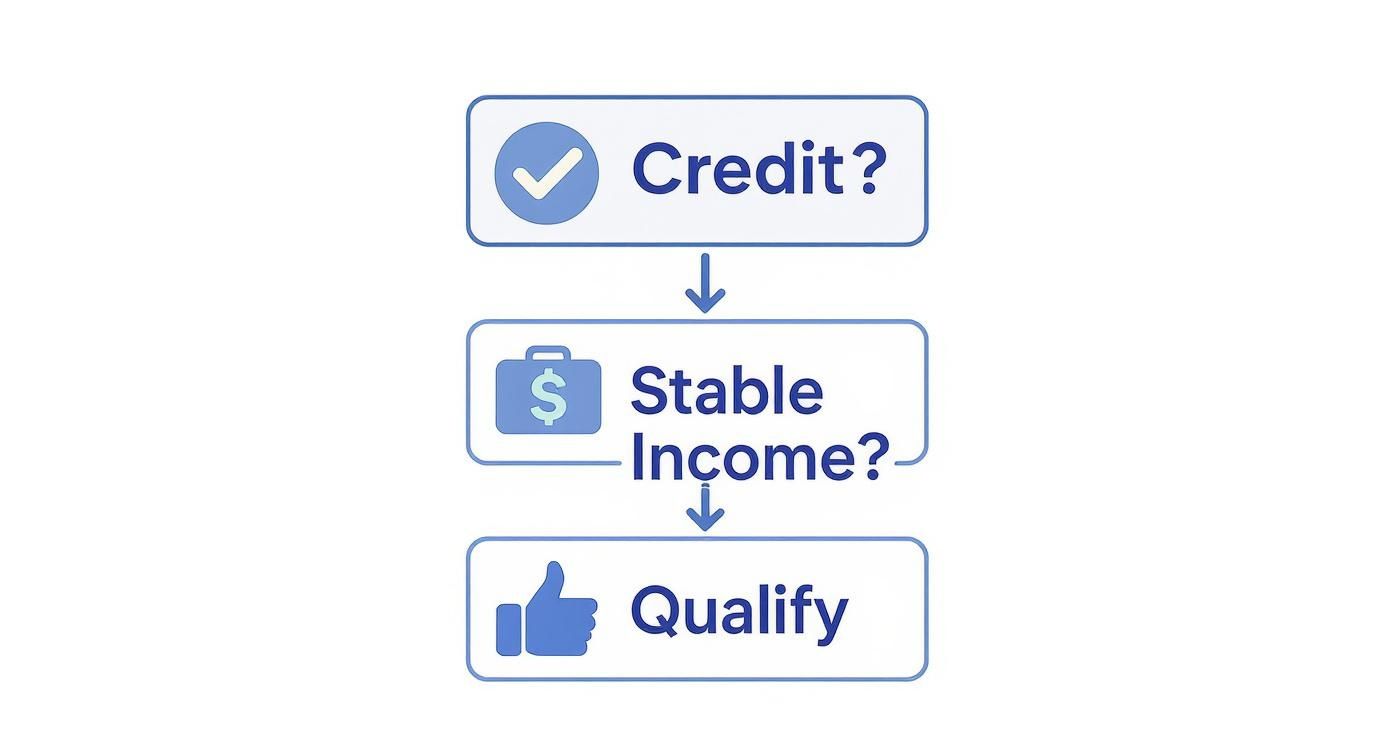
As you can see, when there’s no collateral on the line, lenders are betting entirely on your credit history and income stability to give you the green light.
Interest Rates and the Total Cost of Borrowing
The most immediate and impactful difference you'll encounter is the interest rate. It's virtually a given that secured loans will offer lower rates. The reason is simple: the collateral you provide dramatically lowers the lender's risk. If you are unable to pay, they have an asset they can claim to recoup their losses.
An unsecured loan, conversely, is a much riskier proposition for the lender. To balance out that risk, they charge higher interest rates. It's a direct trade-off. However, the lending landscape is nuanced. Research in the U.S. private credit market shows that while the secured lending market is larger, these loans often tend to be smaller, carry higher interest rate spreads, and have longer maturities—often because they are the preferred option for borrowers with less transparent financial histories.
Qualification Hurdles and Accessibility
The approval process for each loan type involves clearing entirely different hurdles. For a secured loan, the primary focus is on the asset. The value and equity of your collateral do most of the talking. If you own a valuable car or have significant home equity, you could be approved even if your credit score isn't perfect.
With an unsecured loan, the spotlight is entirely on you. Lenders will place your financial life under a microscope, looking closely at:
- Credit Score: A strong score is almost non-negotiable if you want to secure the best rates and terms.
- Income and Employment History: Lenders need verifiable proof that you have a stable, sufficient income to manage the payments.
- Debt-to-Income (DTI) Ratio: This ratio tells them if you have enough breathing room in your budget to comfortably take on a new loan payment.
Getting a handle on these foundational concepts is crucial for navigating the lending landscape. Our guide on how loans work digs even deeper into these core principles.
The decision isn't just about whether you can get approved; it's about which approval path aligns with your financial reality. A strong credit profile opens doors to unsecured loans, while a valuable asset can be the key to a secured one.
Loan Amounts and Repayment Flexibility
The amount you can borrow is also directly linked to which path you choose. With a secured loan, your borrowing limit is determined by the value of your collateral. A mortgage or auto loan, for instance, typically allows you to borrow up to the appraised value of the asset. This means you can often access much larger sums of money.
Unsecured loans, in contrast, are usually offered in smaller amounts. Lenders cap what they'll lend based on what your credit history and income suggest you can comfortably repay. This ceiling is almost always significantly lower than what you could obtain with an asset-backed loan.
Detailed Loan Feature Comparison
This table offers a comprehensive breakdown of the critical aspects of each loan type, designed to help you see exactly how they stack up and guide your decision-making process.
| Consideration | Secured Loans | Unsecured Loans |
|---|---|---|
| Primary Requirement | Valuable asset (home, car, savings) | Strong credit score and stable income |
| Lender Risk | Low (collateral reduces potential loss) | High (no collateral to seize on default) |
| Typical Interest Rates | Lower | Higher |
| Loan Amounts | Higher (based on collateral value) | Lower (based on creditworthiness) |
| Approval Focus | Value and quality of the asset | Borrower's financial health (credit, DTI) |
| Consequence of Default | Loss of the collateral | Damage to credit score, collections, potential lawsuits |
| Best For | Large purchases (home, car), borrowers with assets but weaker credit | Debt consolidation, smaller projects, borrowers with excellent credit |
As you can see, the choice hinges on your specific financial profile and what you need the money for. Each option serves a distinct purpose, and understanding these nuances is the first step toward borrowing responsibly.
When to Choose a Secured Loan
Deciding to pledge an asset like your home or car is a major financial commitment. However, in certain situations, it’s not just a good move—it’s the most strategic path forward. Secured loans are practical solutions for specific financial challenges where using an asset gives you a distinct advantage. Knowing when to leverage this option is key to making a confident and beneficial choice.
A secured loan is often the most logical choice when you need to finance a major purchase, and the item itself can serve as natural collateral. Think about buying a home or a car. These are the classic examples of secured lending for a reason. The structure is inherently sensible: the loan is used to acquire the asset, and that same asset guarantees the loan.
For Large Purchases and Building Credit
This approach unlocks the substantial capital needed for big-ticket items and almost always comes with much better interest rates than an unsecured loan could offer. It’s a practical, symbiotic relationship between the loan and the purchase.
Another prime scenario to consider a secured loan is if you're building your credit history or working to improve a lower score. If your credit profile alone doesn't meet a lender's strict criteria for an unsecured loan, an asset can bridge that gap. Pledging collateral dramatically reduces the lender's risk, making them far more willing to approve your application and offer a reasonable rate.
By leveraging an asset, you can gain access to financing that might otherwise be out of reach. It can turn a potential "no" into a "yes" and provide an opportunity to demonstrate your creditworthiness through a history of consistent payments.
Strategic Debt Consolidation
Finally, a secured loan can be an incredibly powerful tool for debt consolidation. If you're juggling high-interest debt from credit cards or other personal loans, using a home equity loan to pay them off can be a financially sound move. You’ll consolidate multiple payments into a single, lower-interest payment, which could potentially save you thousands over the life of the loan.
The numbers support this strategy. Data from 2023 shows a strong reliance on this type of borrowing, with total secured personal loan balances in the U.S. reaching $373.5 billion—nearly double the amount for unsecured loans. This highlights just how many Americans use their assets to secure the financing they need. You can find more insights in Experian's personal loan study.
When an Unsecured Loan Is the Better Option
While a secured loan's lower interest rates look attractive on paper, it's not always the right move—or even a possible one. An unsecured loan truly shines when speed, flexibility, and convenience are your top priorities.
Consider a genuine emergency, like a burst pipe flooding your kitchen or a sudden medical bill. In these situations, you don't have time to wait weeks for a lender to appraise your home. The lengthy process of asset valuation simply isn't practical. This is where an unsecured loan excels, getting you the funds you need quickly because the lender's focus is entirely on your creditworthiness, not your property.
When You Have Excellent Credit
For borrowers who have spent years building a rock-solid financial reputation, an unsecured loan is often the smarter choice. If you have an excellent credit score and a steady income, you can secure competitive interest rates without having to put your house or car on the line.
In this scenario, your strong financial history is the only security the lender needs. You get the cash you need, and your assets remain completely unencumbered and safe from risk. For financially disciplined individuals, this is a huge factor in the secured vs unsecured loans debate.
An unsecured loan isn't a compromise for someone with excellent credit; it's a reward for years of financial responsibility. It offers both capital and peace of mind.
Financing Intangible Goals
Unsecured loans are also the only practical option for goals that don't involve a physical asset. You simply can't use a wedding, a dream vacation, or a professional certification course as collateral.
For life's big moments and investments in yourself, an unsecured personal loan provides the capital to make it happen.
So, when does an unsecured loan make the most sense?
- You need money quickly for an emergency or a time-sensitive opportunity.
- Your credit score is strong enough to command a good interest rate.
- You don’t have a valuable asset to use as collateral, or you'd prefer not to risk it.
- The loan is for something intangible, like education, travel, or a major life event.
Understanding these scenarios makes it clear when the convenience and safety of an unsecured loan easily outweigh a potentially higher interest rate.
Frequently Asked Questions (FAQ)
When you're diving into the world of lending, a few key questions always seem to surface. To provide complete clarity, here are straightforward, expert answers to the most common queries people have when comparing secured vs. unsecured loans.
What is the main difference between a secured and unsecured loan?
The main difference is the requirement of collateral. A secured loan requires you to pledge an asset (like a house or car) that the lender can seize if you fail to repay. An unsecured loan is based solely on your creditworthiness and requires no collateral, making it riskier for the lender but safer for your assets.
Can I get a secured loan with bad credit?
Yes, it's often possible. This is one of the primary advantages of a secured loan. Because you're backing the loan with a valuable asset, lenders are more focused on the collateral's value than just your credit score. This provides a viable path to financing for individuals who are building or repairing their credit. However, a lower credit score may still result in a slightly higher interest rate.
Which loan is faster to get approved for?
Unsecured loans almost always win the race for speed. The application and approval process is simpler and faster because there is no need to appraise an asset—a step that can significantly slow down the timeline for mortgages or auto loans. Lenders for unsecured loans focus only on your credit profile and income, which means funds can often be disbursed within a few business days.
How do secured and unsecured loans affect my credit score?
Both types of loans impact your credit score in essentially the same way. Taking out any new loan will add a hard inquiry to your report and increase your total debt, which can cause a small, temporary dip in your score. The most important factor is your repayment behavior. Consistently making payments on time will build a positive credit history and boost your score, while missed payments or defaulting on either type of loan will cause significant damage.
Is a personal loan a secured or unsecured loan?
Personal loans can be either. The vast majority are unsecured, granted based on your credit score and income. However, some lenders offer secured personal loans, where you might use a savings account, a car, or another valuable item as collateral, typically to secure a lower interest rate or get approved with a weaker credit profile.
Is it better to get a secured or unsecured loan for debt consolidation?
It depends on your financial situation. A secured loan, like a home equity loan, will likely offer a much lower interest rate, potentially saving you a significant amount of money and simplifying your payments. However, it requires putting your home at risk. An unsecured debt consolidation loan is safer for your assets but will likely have a higher interest rate and stricter credit requirements. The best choice balances the interest savings against your comfort with the associated risk.
What happens if I default on a secured loan?
If you default on a secured loan, the lender has the legal right to seize the asset you pledged as collateral. This process is known as repossession for vehicles or foreclosure for real estate. The lender will then sell the asset to recover the outstanding loan balance.
What happens if I default on an unsecured loan?
Defaulting on an unsecured loan will severely damage your credit score. The lender will likely turn your account over to a collection agency, which will attempt to recover the debt. The lender or collection agency may also file a lawsuit against you, which could result in wage garnishment or a lien being placed on your assets.
Can I use a savings account as collateral?
Absolutely. Using a savings account or a certificate of deposit (CD) to back a loan is a savvy move known as a cash-secured loan or a savings-secured loan. For the lender, it’s an incredibly low-risk situation, and that benefit is passed on to you in the form of some of the lowest interest rates available. This is a fantastic strategy for building or repairing credit while your savings remain secure and continue to earn interest.
Are interest rates fixed or variable for these loans?
Both secured and unsecured loans can come with either fixed or variable interest rates. Fixed-rate loans have an interest rate that remains the same for the entire loan term, offering predictable monthly payments. Variable-rate loans have an interest rate that can fluctuate over time based on market indexes. Most personal loans (both secured and unsecured) and auto loans have fixed rates, while mortgages and home equity lines of credit (HELOCs) are commonly available with either option.
Ready to explore the options that fit your specific situation? At ShopRates, we simplify the process of comparing rates and terms from a nationwide network of trusted lenders. Whether your credit is spotless or you're just getting started, our mission is to provide the clarity and choices you need to achieve your financial goals.
Find your best loan rate at https://shoprates.com.


