

When to Get a Mortgage Pre Approval An Expert Guide
As a financial expert who has guided thousands of individuals through the labyrinth of homebuying, I'm often asked one critical question: "When is the perfect time to get a mortgage pre-approval?" My answer is consistently based on a strategy that positions you for success. The ideal window to secure that pre-approval letter is approximately 60 to 90 days before you intend to begin seriously touring homes.
This timeline is not arbitrary; it is a calculated move. It ensures your pre-approval letter remains valid and potent at the exact moment you discover a property you wish to purchase. More importantly, it provides a crucial buffer period, allowing you to address any unforeseen financial discrepancies without the immense pressure of a pending offer. This guide will delve deep into the strategy behind this timing, equipping you with the knowledge to navigate your homebuying journey with confidence and authority.
Why Your Pre Approval Timing Matters
Obtaining a mortgage pre-approval is one of the foundational, and arguably most impactful, steps in your homebuying expedition. Consider it the key that unlocks serious consideration in the real estate market. It elevates your status from a casual observer to a credible, empowered buyer in the eyes of both sellers and real estate professionals.
Mastering the timing of this step is paramount. If you act prematurely and secure it too early, the letter could expire before you find your ideal home, compelling you to repeat the entire application process. Conversely, if you delay, you risk finding the perfect property only to lose it to a more prepared buyer who could make a decisive, financially backed offer.
When timed correctly, a pre-approval achieves several critical objectives:
- It establishes a realistic budget. The pre-approval letter definitively states the maximum amount a lender is prepared to loan you. This eliminates guesswork and empowers you to concentrate your search exclusively on homes within your financial reach.
- It fortifies your offer. In a competitive real estate landscape, sellers overwhelmingly favor offers from buyers with verified financing. A pre-approval letter is a testament to your financial readiness and a significant competitive advantage.
- It accelerates the transaction. With your financing largely arranged, you can proceed with speed and conviction the moment you identify a property you want to make your home.
Finding the Sweet Spot
The core strategy is to synchronize your pre-approval with your transition from a passive researcher to an active home seeker. Understanding how this crucial step integrates into the broader homebuying timeline is essential. For a comprehensive overview of the entire process, these ten essential tips for buying a property provide valuable context.
This timeline offers a clear visualization of the optimal windows for obtaining pre-approval, from the initial preparatory phases to actively submitting offers.
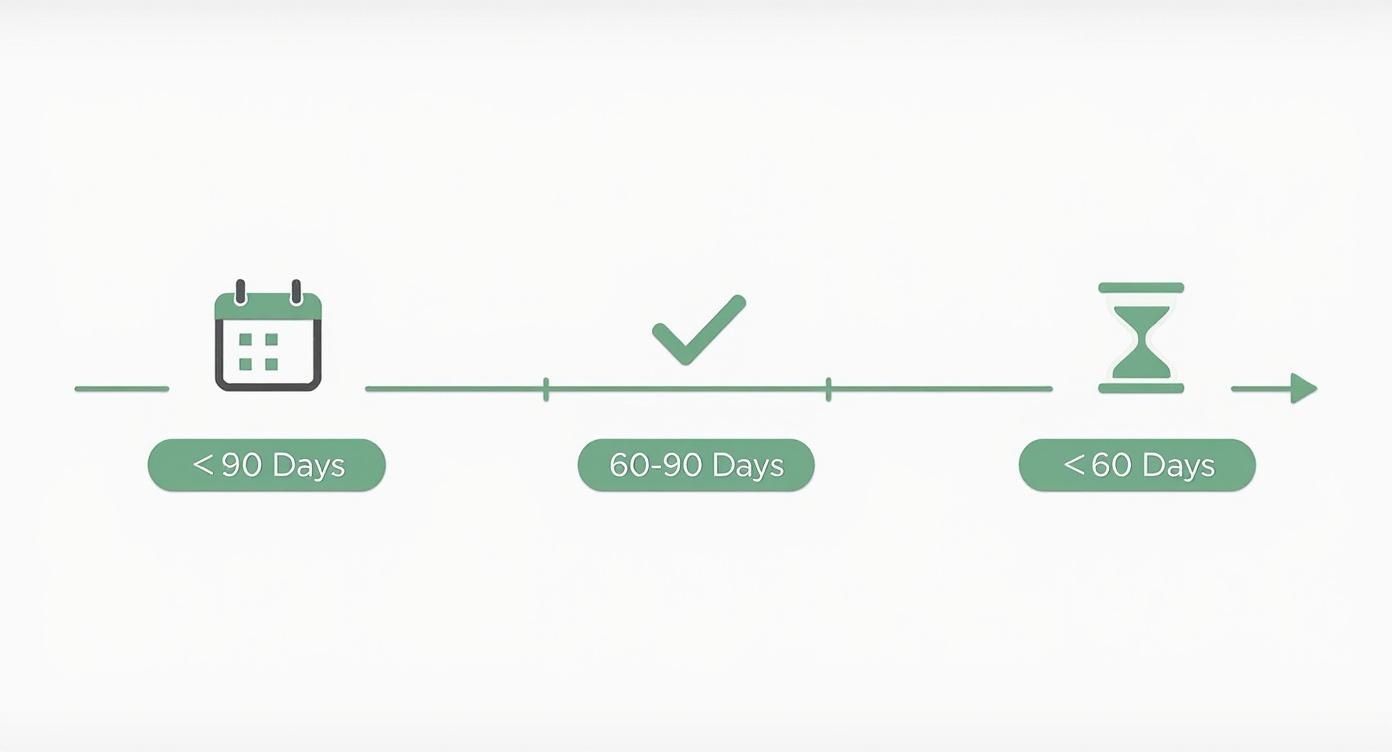
As the infographic illustrates, the 60-90 day window is the prime time. It strikes an impeccable balance between being prepared to act swiftly on a desirable property and ensuring the validity period of your pre-approval letter (typically 90 days) does not lapse.
To further clarify this, I've developed a detailed checklist to help you map out your personal timeline.
Your Pre Approval Timing Checklist
This table delineates the ideal timeline and the corresponding actions you should be focusing on at each stage of your journey.
| Timeline Before House Hunting | Key Action | Primary Goal |
|---|---|---|
| 6+ Months Out | Review your credit report meticulously. | Identify and begin rectifying any errors or credit issues. |
| 3-6 Months Out | Systematically save for a down payment & closing costs. | Build a robust financial foundation and actively reduce debt. |
| 2-3 Months Out (60-90 Days) | Formally apply for mortgage pre-approval. | Secure your official borrowing limit and a valid pre-approval letter. |
| 0-2 Months Out | Begin actively touring homes with your real estate agent. | Make a strong, credible, and competitive offer on your dream home. |
Adhering to this structured roadmap places you in a position of power. You will enter the real estate market not merely as an optimistic buyer, but as a thoroughly prepared one—and in this arena, preparation is the ultimate advantage.
What a Mortgage Pre Approval Actually Does for You

Before we dissect the when, it is imperative to have an unshakeable understanding of what a mortgage pre-approval is—and, equally important, what it is not. A pre-approval is a conditional commitment from a lending institution to loan you a specified sum of money for a home purchase. This is not a casual estimation; it is a financial green light, a formal declaration that you are a serious, qualified homebuyer.
Imagine entering a high-stakes negotiation with your funding already secured. You are no longer just browsing; you are prepared to execute a significant transaction. This process involves a lender conducting a thorough examination of your financial profile, including a detailed review of your income, assets, and existing liabilities.
More Than Just a Ballpark Figure
It is crucial to distinguish between a pre-approval and a pre-qualification. A pre-qualification is little more than a cursory, unverified estimate based on information you provide verbally. A mortgage pre-approval, in contrast, is a rigorous verification process. It requires you to submit comprehensive financial documentation.
A lender will request specific paperwork to substantiate your financial standing, such as:
- Recent pay stubs and W-2 forms to confirm your income and employment stability.
- Bank statements to verify you possess the necessary funds for a down payment and closing costs.
- Your federal tax returns from the last two years to gain a complete understanding of your financial history.
This meticulous review results in a hard credit inquiry, which will cause a minor, temporary decrease in your credit score. However, the strategic advantage and credibility this provides in the homebuying process far outweigh this small, transient impact.
A pre-approval transforms your home search from a guessing game into a strategic mission. It provides a concrete budget, empowering you to focus only on properties you can realistically afford and giving you the confidence to make a compelling offer.
This official letter demonstrates to sellers and their agents that you have the financial capacity to complete the purchase. In a competitive housing market, this is an invaluable asset. By knowing your precise budget, you avoid the potential disappointment of becoming attached to a home that is financially out of reach. It is the foundational step that positions you for a successful—and significantly less stressful—homebuying experience.
Signs You're Ready to Get Pre-Approved
Knowing the precise moment to initiate the mortgage pre-approval process is not about arbitrarily marking a date on your calendar. It's about recognizing when you have constructed a solid financial foundation. When you observe these key indicators aligning in your financial life, it's the definitive signal to proceed with confidence.
Your Financial Health Scorecard
One of the most compelling signs is a healthy down payment accumulated in your savings. Lenders are looking for more than just a specific dollar amount; they are assessing the financial discipline demonstrated by your ability to save consistently. This fund should not only cover the down payment but also be sufficient for closing costs and the inevitable unexpected expenses of new homeownership.
Another critical indicator is your credit score. Consider it your financial report card; it is one of the primary metrics a lender will evaluate. A higher score, typically 620 or above for a conventional loan, signals to a lender that you are a responsible and reliable borrower. This often translates directly into more favorable interest rates and better loan terms, saving you a substantial amount of money over the life of the loan.
Beyond your credit score, lenders will closely examine your overall debt load. They utilize a simple yet powerful metric known as the debt-to-income (DTI) ratio. This is calculated by dividing your total monthly debt payments by your gross monthly income. A low DTI demonstrates that you have sufficient financial flexibility in your budget to comfortably manage a mortgage payment. Gaining a clear understanding of what constitutes a good debt-to-income ratio for a mortgage application can provide you with a significant advantage.
Stable employment and a predictable income stream are also non-negotiable from a lender's perspective. Lenders require a consistent work history, typically reviewing the last two years. This provides them with the assurance that you have a reliable source of funds to meet your mortgage obligations each month.
The decision to buy a home is a significant financial commitment. The right time to seek pre-approval is when you've done the preparatory work: saved diligently, managed your credit responsibly, and established a steady income. It's the moment your financial discipline and homeownership ambitions intersect.
Ultimately, the most important sign originates from you. Once you have made the firm decision to purchase a home within the next six months and your financial affairs are in impeccable order, that is your definitive cue. It is the time to transition from the planning phase to proactive engagement and commence the mortgage pre-approval process.
How Market Conditions Shape Your Pre-Approval Strategy

Determining when to get a mortgage pre-approval is not solely about your personal financial readiness; it is a strategic decision that must be synchronized with the prevailing housing market conditions. The economic climate directly influences buyer competition and lender behavior, making your pre-approval an exceptionally powerful tool when timed correctly.
In a heated seller's market, where multiple offers on a single property are commonplace, a pre-approval letter is essentially your entry ticket. With homes selling rapidly and demand high, sellers will only seriously consider offers that are financially secure. In such a market, you should get pre-approved the moment you decide to begin your serious search. This enables you to act decisively and present a compelling offer without any delay.
Conversely, a volatile interest rate environment introduces another layer of strategic consideration. When rates are fluctuating or trending downward, getting pre-approved allows you to potentially lock in a favorable rate while you continue your property search. For a more detailed explanation of this strategy, our guide on how to lock in a mortgage rate clarifies how this can protect you from adverse market shifts. It is a proactive measure that can result in thousands of dollars in savings over the duration of your loan.
Reading the Market for a Competitive Edge
The demand for pre-approvals often mirrors broader market trends. For example, in the 2025 U.S. housing market, mortgage rates experienced significant fluctuation, peaking at 7.04% in mid-January before declining to 6.35% by early September.
This volatility spurred buyers into action. As rates fell, prospective borrowers generated 11.9% more pre-approval letters in the second quarter compared to the first, all aiming to capitalize on lower borrowing costs. These market dynamics demonstrate that even when home prices are escalating, the sense of urgency created by interest rate movements is a powerful motivator for homebuyers.
Your pre-approval is more than just a financial document—it's a tactical advantage. In a buyer's market, it gives you more negotiating power. In a seller's market, it makes your offer credible from the get-go.
Understanding these external economic forces helps you time your application for maximum strategic impact. Monitor interest rate forecasts and local housing inventory levels closely. This situational awareness will help you identify the perfect moment to secure your pre-approval, transforming a procedural necessity into a cornerstone of your successful homebuying strategy.
Preparing Your Finances for a Strong Pre-Approval
Approaching the mortgage pre-approval process is analogous to preparing for a comprehensive financial examination. You wouldn't attend a medical check-up after a week of unhealthy habits; you would strive to be in your best possible condition. The same principle applies here. Investing time to organize and optimize your finances before engaging with a lender is the single most effective action you can take to secure a strong pre-approval letter and a more favorable interest rate.
Lenders will place your entire financial history under a microscope, searching for specific indicators of a reliable borrower. By understanding their criteria, you can present the most compelling version of your financial narrative.
Key Financial Metrics Lenders Scrutinize
Your credit score and debt-to-income (DTI) ratio are the two headline metrics. An excellent credit score signals a consistent history of timely payments. A low DTI demonstrates ample capacity within your budget to absorb a new mortgage payment without financial strain.
Here is a strategic approach to actively improve both:
- Prioritize High-Interest Debt: Aggressively pay down credit card balances. This reduces your credit utilization ratio, which can result in a surprisingly rapid and significant improvement to your credit score.
- Implement a Moratorium on New Credit: In the months leading up to your mortgage application, refrain from applying for new car loans, credit cards, or personal loans. Each new credit application can trigger a hard inquiry, potentially lowering your score.
- Organize Your Documentation: Lenders require verification for all financial claims—income, assets, and employment. Proactively gather your W-2s and tax returns for the last two years, your most recent pay stubs, and several months of bank statements. This preparation streamlines the entire process significantly.
Getting your finances ready isn't just about crossing the finish line of getting approved. It's about maximizing your buying power. A stronger application can mean a higher pre-approval amount, which gives you more homes to choose from and a real advantage when you find "the one."
The mortgage market unequivocally rewards borrowers who have their financial affairs in meticulous order. For context, the typical conventional mortgage approval in 2025 was granted to applicants with an average FICO score of 755 and a DTI of 35%. An overwhelming 79.6% of new home loans were issued to 'super-prime' borrowers with credit scores exceeding 720, underscoring the immense value of a pristine credit history.
It is vital to have a complete understanding of the mortgage pre-approval requirements. Part of this preparation also involves familiarizing yourself with the various types of financial institutions available; you can learn more about mortgage lenders to better understand your options.
Common Pre-Approval Mistakes You Need to Avoid

Receiving your pre-approval letter is a significant milestone, and it certainly feels like a victory. However, it is not the final step. I have witnessed too many homebuyers treat this letter as an unconditional guarantee, only to make critical errors that jeopardize their ability to purchase their dream home. It's best to consider this subsequent phase a "financial quiet period"—your actions (and inactions) are of utmost importance.
One of the most common pitfalls is applying for pre-approval far too early. The excitement is understandable, but pre-approval letters have an expiration date, typically lasting only 60 to 90 days. If your home search extends beyond this period, your letter becomes invalid. This forces you to re-apply under pressure, often right when you have found the perfect property, adding considerable stress to an already demanding process.
Protecting Your Pre-Approval Status
Another frequent mistake is making a major purchase after obtaining pre-approval. Your lender will absolutely conduct a final review of your credit and finances immediately before closing. Purchasing a new car or furnishing your future home on credit can dramatically alter your debt-to-income ratio. This can result in a reduction of your approved loan amount or, in the most severe cases, an outright denial of your mortgage.
Your pre-approval is like a financial snapshot taken at one specific moment. Any major changes—opening new credit, taking on a new loan, or even switching jobs—can make that picture obsolete. It forces the lender to start all over, and the new picture might not be one they like.
Finally, avoid the novice error of accepting the first pre-approval you receive. Not all lenders operate on the same terms. Different banks, credit unions, and mortgage brokers will offer varying rates and loan conditions. Even a small difference in the interest rate can equate to thousands of dollars in savings over the life of your loan. Taking the time to compare offers from several lenders ensures you are securing the most advantageous deal available. Steering clear of these simple but consequential mistakes is key to ensuring a smooth progression from making an offer to finally holding the keys to your new home.
Frequently Asked Questions About Mortgage Pre-Approval (FAQ)
Navigating the world of mortgages can feel like learning a new language, filled with its own unique jargon and processes. It is perfectly normal to have questions. Here, we address some of the most common inquiries homebuyers have about the mortgage pre-approval process.
Does getting pre-approved for a mortgage hurt my credit score?
Yes, obtaining a formal mortgage pre-approval involves a hard credit inquiry from the lender, which typically causes a small, temporary dip in your credit score, usually by a few points. However, the strategic advantage this provides by positioning you as a serious, qualified buyer in a competitive market almost always outweighs this minor, short-term impact.
How long does a mortgage pre-approval last?
A mortgage pre-approval letter is not valid indefinitely. It typically has an expiration date, remaining valid for 60 to 90 days. Lenders impose this timeframe because key aspects of your financial profile—such as your income, debt levels, and savings—can change. If your home search extends beyond this period, you will need to provide updated financial documents to your lender to be issued a new, current pre-approval letter.
What is the difference between mortgage pre-qualification and pre-approval?
It is easy to confuse these terms, but they represent vastly different levels of financial scrutiny. A pre-qualification is a quick, informal estimate of your potential borrowing power. It's based on financial information you self-report to a lender without any verification. A pre-approval, on the other hand, is a much more rigorous and official process. The lender thoroughly verifies your income, assets, and credit history, resulting in a conditional commitment to lend you a specific amount. Sellers and their agents view a pre-approval as a far more credible indicator of your ability to purchase.
Can I get pre-approved with multiple lenders?
Not only is it possible, but it is highly recommended. Shopping for a mortgage with several different lenders is one of the most effective ways to ensure you get the best possible interest rate and loan terms. To minimize the impact on your credit score, it's crucial to conduct this "rate shopping" within a concentrated timeframe, typically 14 to 45 days. Modern credit scoring models are designed to recognize this activity as a single loan search, bundling all related hard inquiries into one event.
When is it too early to get a mortgage pre-approval?
Timing is critical. Seeking pre-approval more than 90 days before you are genuinely ready to start viewing properties and making offers is generally too early. Because the letter will expire, you would need to repeat the entire application process, including another hard credit inquiry. The optimal time—the sweet spot—is right as you transition from casual browsing to seriously engaging a real estate agent and scheduling home tours. Understanding market seasonality can also be beneficial, and you can review insights about U.S. mortgage application trends to get a better sense of these patterns.
What documents do I need for a mortgage pre-approval?
To prepare for a smooth pre-approval process, you should gather several key financial documents. Lenders will typically require your W-2s and federal tax returns from the last two years, your most recent pay stubs (usually covering a 30-day period), and bank statements from the last two to three months for all checking, savings, and investment accounts. Having these ready will significantly expedite the lender's review.
Can I be denied a mortgage after being pre-approved?
Yes, a pre-approval is a conditional commitment, not a final guarantee. A lender can still deny your mortgage application if your financial situation changes significantly between pre-approval and closing. This could happen if you take on new debt (like a car loan), change jobs, or if new, negative information appears on your credit report. It is crucial to maintain a stable financial profile throughout the entire homebuying process.
How does my debt-to-income (DTI) ratio affect pre-approval?
Your DTI ratio is a critical factor in a lender's decision. It measures your total monthly debt obligations against your gross monthly income. A lower DTI indicates to the lender that you have more financial flexibility and are a lower risk. While limits vary by loan type, most lenders prefer a DTI of 43% or lower. A high DTI is one of the most common reasons for a pre-approval denial or a lower-than-expected loan amount.
Should I get pre-approved before I find a real estate agent?
While not strictly required, it is highly advantageous to get pre-approved before you begin working seriously with a real estate agent. A pre-approval letter shows an agent that you are a serious client with a clear budget. This allows them to tailor their search to properties you can realistically afford and demonstrates that you are prepared to make a strong offer when you find the right home.
How much does it cost to get pre-approved for a mortgage?
In most cases, there is no cost to get a mortgage pre-approval. Lenders offer this service for free as a way to attract and vet potential borrowers. While the application itself is free, remember that it does result in a hard credit inquiry. Be wary of any institution that attempts to charge a fee solely for a pre-approval letter.


