
How to Lock in a Mortgage Rate Like a Pro
So, you’ve found the perfect home, signed the purchase agreement, and now you’re navigating the final steps of the mortgage process. One of the most critical decisions you'll make at this stage is when to lock in your interest rate. This move essentially freezes your rate, shielding you from any market volatility while your loan is being finalized—a process that usually takes 30 to 60 days.
As a seasoned financial professional based in Nashville, TN, I've spent decades helping homebuyers navigate this exact moment. Here at ShopRates, we believe that understanding how to lock in a mortgage rate is not just a procedural step, but a strategic financial decision that can impact your wealth for years to come.
So, What Exactly Is a Mortgage Rate Lock?
Think of a rate lock as your financial anchor in the often-turbulent sea of interest rates. It’s a formal agreement between you and your lender that guarantees a specific interest rate for a set period. Here in Nashville, we've seen firsthand how a well-timed rate lock can save our clients thousands over the life of their loan. This isn't just another piece of paperwork; it’s a powerful strategic tool.
By locking your rate, you eliminate the guesswork and anxiety that comes with watching daily market fluctuations. You can budget with certainty and focus on the other details of your move, knowing your biggest monthly expense is set in stone.
Why Locking Your Rate Is More Important Than Ever
The last few years have been a masterclass in why rate locks matter. We all saw what happened after the Federal Reserve's pandemic-era measures pushed the 30-year fixed mortgage rate below 3%. The market did a complete 180.
For context, a rate of 3.22% in January 2022 skyrocketed to over 7% by that October. That’s more than double the cost of borrowing in less than a year. This kind of volatility drives home how even small changes can dramatically impact your monthly payment and overall financial health for decades to come.
Expert Insight: A rate lock is about more than just the numbers. It’s about peace of mind. Buying a home has enough moving parts. From my years of experience, I can tell you that knowing your principal and interest payment is fixed lets you breathe easier and focus on everything else, from packing boxes to picking out paint colors, without the stress of market-watching.
The Key Pieces of a Rate Lock
When you decide to pull the trigger on a rate lock, you'll need to get familiar with a few core components. Getting these details right is fundamental to a smooth home buying experience.
To help you get comfortable with the lingo, we've put together a quick reference guide based on the terms we use with our clients every day.
Quick Guide to Mortgage Rate Lock Terms
This table breaks down the essential terminology associated with locking in a mortgage rate, providing a clear definition and explaining its importance in the home loan process.
| Term | What It Means | Why It Matters |
|---|---|---|
| The Interest Rate | The percentage that determines your borrowing cost. | This is the exact number you are protecting from market fluctuations. |
| The Lock Period | The number of days your rate is guaranteed, typically 30 to 90 days. | Must be long enough to get you to closing day without expiring. |
| Lock-in Agreement | The formal document from your lender outlining the terms of your lock. | This contract specifies your rate, any points, associated fees, and the expiration date. It is your proof of the agreement. |
Understanding these terms puts you in the driver's seat. It allows you to ask the right questions and ensure the lock you secure truly aligns with your financial goals and closing timeline.
And if you’re looking for other strategies to get the best deal possible, our team has put together some great resources on how to lower your mortgage rate.
When Is the Right Time to Lock Your Rate
Timing your mortgage rate lock can feel like a high-stakes game. Lock in too early, and you might kick yourself if rates dip. But if you wait too long in a rising market, that delay could cost you thousands over the life of your loan.
Honestly, trying to perfectly time the bottom of the market is a fool's errand. It’s more about risk management. As lenders here in Nashville, we've walked countless clients through this exact moment. My best advice, honed over decades of experience? Act when you find a rate and payment that you’re comfortable with and that fits your budget. Chasing that slightly lower rate is a gamble, and even a small increase can have a big impact on your monthly payment.
Understanding the bigger picture, like how mortgage rates impact your buying power, is key to making an informed decision you won't regret.
Reading the Market Signals
Mortgage rates don’t move in a vacuum; they’re constantly reacting to economic news and market sentiment. You don’t need to be an economist, but keeping an eye on a few key indicators can give you a real edge and help you see which way the wind is blowing.
Here’s what to watch:
- The Federal Reserve: The Fed doesn't set mortgage rates directly, but their decisions on the federal funds rate send ripples through the entire financial system. Any talk of rate hikes to fight inflation is a strong hint that mortgage rates will probably start climbing.
- Economic Reports: Big reports on inflation (like the Consumer Price Index, or CPI) and employment (the Jobs Report) are huge market movers. Good economic news can often push rates higher, while signs of a slowdown might cause them to drop.
- Bond Market Activity: Mortgage rates are closely tied to the yield on 10-year Treasury bonds. When bond prices fall, their yields go up—and mortgage rates usually follow right behind them.
A rising rate environment is your clearest signal to act. If reports show persistent inflation and the consensus is that the Fed will continue to be aggressive, waiting becomes a significant risk. Securing your rate provides a crucial buffer against this upward momentum.
The Lock-In Effect Scenario
We see the real-world impact of what economists call the "lock-in effect" all the time. Research shows that when current market rates are way higher than what homeowners are paying, they are far less likely to sell. This has been especially true since 2022, preventing an estimated 1.72 million home sales by mid-2024 simply because owners didn't want to give up their rock-bottom rates.
Just a few years ago, I had a client who was on the fence about locking. The rate was good, the payment worked, but they had a feeling it might dip just a little more. We took a look at the economic calendar together and saw a big inflation report was due out—and everyone expected it to be hot. They decided to lock.
Sure enough, the report came out the next day and rates jumped a quarter of a point. That single decision, based on market indicators instead of wishful thinking, saved them over $100 a month. That’s the power of informed timing.
Preparing Your Finances For A Rate Lock
Before you can even think about locking in a mortgage rate, your lender needs to have a crystal-clear view of your financial health. A rate lock isn’t something that happens in a vacuum; it’s directly tied to your formal loan application. Because of this, getting your finances in order isn't just a good idea—it's absolutely non-negotiable.
Think of it like preparing for a high-stakes negotiation. When you come to the table with all your financial documents perfectly organized and a strong credit profile, you’re showing the lender you're a low-risk borrower. From my experience, this single factor has a massive influence on the quality of the interest rate we can ultimately offer you.
Getting Your Financial House in Order
The first practical step is to get all your paperwork together. Being proactive here saves you from that last-minute scramble that can cause delays and even jeopardize your rate lock. A smart move is to complete the pre-approval process first, which forces you to get everything buttoned up. Using a detailed mortgage pre-approval checklist is a great way to make sure you haven't missed anything.
You're going to need a few key things:
- Proof of Income: This means your most recent pay stubs (plan on the last 30 days), along with W-2 forms and federal tax returns from the past two years.
- Asset Verification: Lenders will want to see bank and investment account statements, typically covering the last two to three months.
- Credit History: We will pull a full credit report to get a complete picture of your creditworthiness.
- Debt Information: Have all the details ready for any existing debts, like car loans, student debt, and credit card balances.
Lender Tip: I always tell my clients to create a single, organized digital folder with all these documents before we even have our first official call. When an underwriter can verify your information quickly and easily, the whole process just flies by, drastically cutting the risk of your rate lock expiring.
The Power of Your Credit Score and DTI
When it comes to the actual rate you’ll be offered, two numbers matter more than anything else: your credit score and your debt-to-income (DTI) ratio. It’s that simple.
A high credit score is your proof to lenders that you have a trustworthy history of managing debt. This translates directly into a lower-risk loan for us, and that means a better rate for you. If you’re not sure what score to aim for, check out our guide on what credit score is needed for a mortgage.
Likewise, a low DTI ratio shows that you have a healthy gap between what you earn and what you owe. This gives lenders confidence that you can comfortably take on a new mortgage payment without stretching yourself too thin. This isn’t just a local practice; it's a global principle for minimizing risk and ensuring financial stability for both the borrower and the lender.
How The Rate Lock Process Actually Works
So, you’ve done your homework, the timing feels right, and you’re ready to pull the trigger on locking your mortgage rate. What happens next? Honestly, this part is far less complicated than most people imagine. It’s simply a formal request you make to your lender—us, here at ShopRates—to secure that day's interest rate for your loan.
This isn’t just a casual handshake deal; it’s a real commitment. When you tell us, "I want to lock," we get to work preparing a rate lock agreement. Think of this document as your shield against the wild swings of the market. It clearly spells out your exact interest rate, the length of your lock period, and any associated costs or points. It's vital to read this over carefully before you sign.
Choosing Your Lock Period
One of the first decisions you'll make is how long you want your rate lock to last. The most common options lenders offer are for 30, 45, or 60 days. It's sometimes possible to get a longer lock, like for 90 days, but these usually come with a slightly higher cost, either baked into the rate itself or as an upfront fee (points).
Why the difference in price? It all comes down to risk. For a lender, a longer lock means we're on the hook for a longer time. If market rates suddenly spike, we are still legally obligated to give you that lower rate you locked in.
Here’s a quick breakdown of the usual suspects:
- 30-Day Lock: This is your best bet if you have a really straightforward purchase and feel confident about a quick, smooth closing. It typically comes with the best pricing.
- 45-60 Day Lock: For most homebuyers, this is the sweet spot. It gives you a comfortable cushion for those little "just in case" moments—like appraisal snags or last-minute requests from underwriting—without a big hit to your wallet.
Choosing your lock period is really about balancing cost against peace of mind. If your closing timeline is rock-solid, a shorter lock can save you a bit of money. But if there’s even a hint of uncertainty, that small extra cost for a longer lock is some of the cheapest insurance you can buy against the stress of an expiring lock.
Comparing Rate Lock Periods
Deciding on the right lock period can feel like a big decision. This table breaks down the common options to help you see which one might be the best fit for your specific situation.
| Lock Period | Typical Cost | Best For… | Key Consideration |
|---|---|---|---|
| 30 Days | Lowest cost or no cost | Buyers with a signed purchase contract, a clear closing date, and a straightforward loan file. | This is a tight timeline; any unexpected delay could put your lock at risk. |
| 45 Days | Slightly higher cost than a 30-day | Most standard home purchases. Provides a reasonable buffer for common delays. | The industry standard for a reason. It balances cost and safety for the average transaction. |
| 60 Days | Moderately higher cost | New construction deals, buyers anticipating underwriting hurdles, or complex transactions. | The cost is often worth the reduced stress if you foresee potential slowdowns. |
| 90 Days | Highest cost | Long-term new construction projects where the closing date is far in the future. | This is more of a specialty product; ensure the extra cost is justified for your situation. |
Ultimately, the goal is to align your lock period with your most realistic closing timeline, giving yourself just enough of a buffer without paying for time you don't need.
What If My Lock Expires?
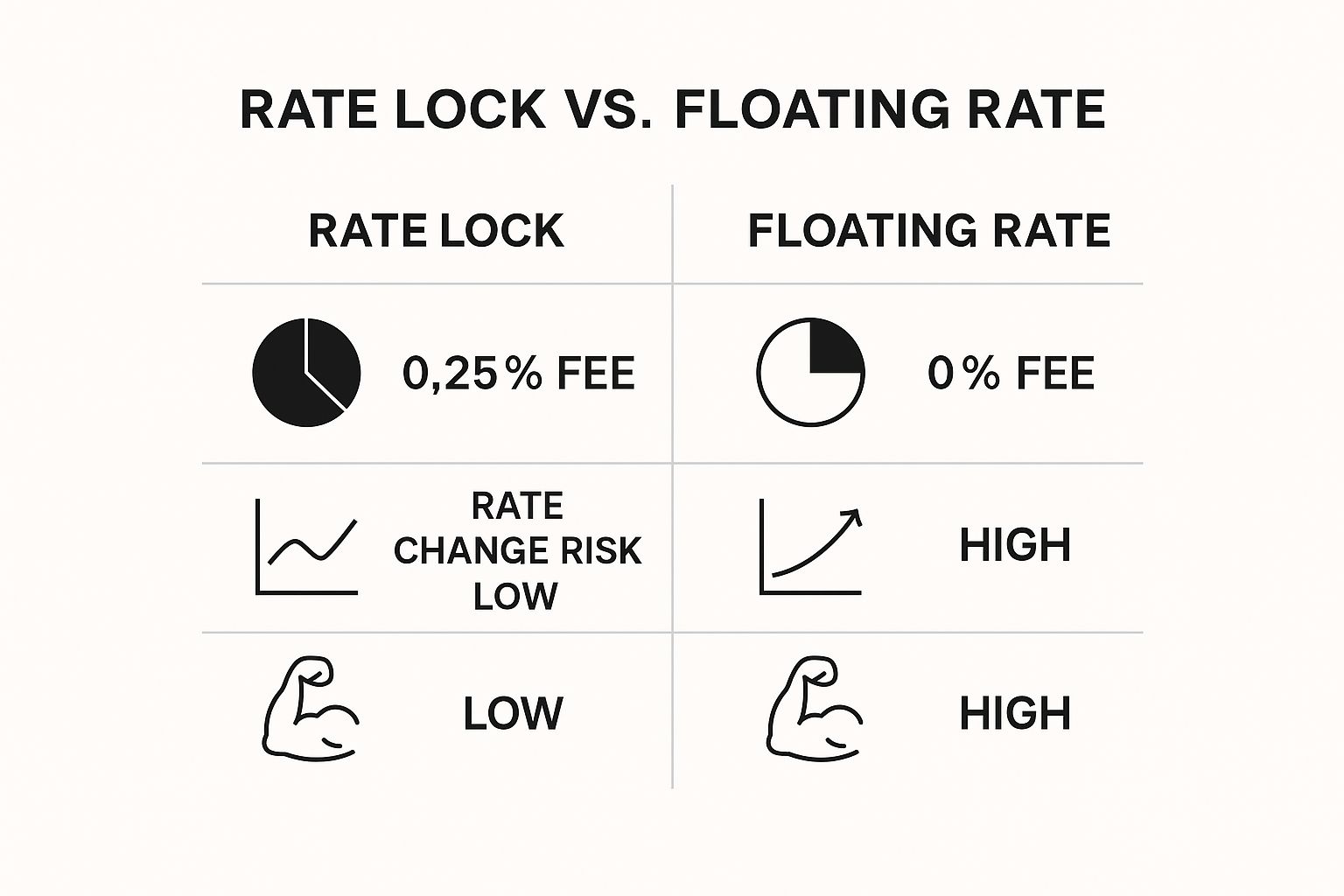
This is a common fear, but take a deep breath—it’s usually a manageable problem. If your closing gets pushed back and your lock is about to run out, you'll need to ask for a rate lock extension. These extensions almost always come with a fee, which might be a percentage of your loan amount or a flat daily charge.
Insider Tip: Communication is everything. The second you think there might be a delay, let your loan officer know. We can often see these things coming and work with you to find the most affordable solution, whether that’s a short-term extension or another strategy.
Once you've successfully navigated the rate lock, you'll head toward the finish line. This is where professional loan signing services step in to make sure every document is signed and dated correctly. It's the final, crucial step that makes your locked-in rate official and finalizes your home purchase.
Common Rate Lock Mistakes to Avoid
A mortgage rate lock feels like a finish line, but it’s really just the final lap. It provides some fantastic peace of mind, but it’s not a magic shield. Over the decades we’ve been in this business here at ShopRates, we’ve seen how simple, honest mistakes can derail an otherwise smooth home purchase.
Knowing where the landmines are is the best way to avoid them. Let’s walk through the most common pitfalls so you can protect your rate and get to the closing table without any nasty—and expensive—surprises.
Don’t Touch Your Finances
This is the cardinal rule, and I cannot stress it enough. A borrower locks their rate and breathes a sigh of relief, thinking the hard part is over. Then they go out and finance a new set of living room furniture or decide it’s the perfect time to switch to that new, higher-paying job.
Remember, the rate lock is based on the financial snapshot you provided at the beginning. The loan isn't final until it’s funded.
Expert Warning: Do not quit your job, change jobs, finance a new car, or open new lines of credit between your rate lock and closing day. Any significant change to your income or debt-to-income ratio can force the underwriter to re-evaluate your entire file. This could jeopardize your loan approval, locked rate or not.
Letting Your Rate Lock Expire
A rate lock isn’t forever; it comes with a strict expiration date. One of the classic blunders is underestimating how long the closing process will take, especially if there are any wrinkles in your application, like self-employment income or a property appraisal that comes in low.
If that lock expires, you’re thrown back into the open market, and the rates could be significantly higher. It happens.
While lenders can usually grant an extension, it will cost you. It’s always better to be proactive. Talk with your loan officer and choose a realistic lock period from the get-go. A 45 or 60-day lock often provides a smart buffer for those "just in case" delays that pop up more often than you’d think.
The Truth About Float-Down Options
Some lenders will dangle a float-down option in front of you. It sounds great on paper: you lock your rate, but if market rates happen to drop, you get a one-time chance to lower it. The catch? It almost always comes with an upfront, non-refundable fee.
Here's how to think about it: Are you willing to pay for an insurance policy you might never use? If you lock when rates are stable or rising, you’ve just paid a fee for nothing. A float-down really only makes sense in a wildly volatile market where a big drop seems plausible. Even then, it’s a calculated gamble.
Understanding the "Lock-In Effect"
Finally, it’s worth thinking about a longer-term consequence of that fantastic rate you just locked. Economists call it the "mortgage lock-in effect," and it’s a powerful phenomenon that has a real impact on the U.S. housing market. When you secure a very low rate, it can make you hesitant to move in the future, even if your life circumstances change.
Recent research has shown just how much rising rates have kept homeowners on the sidelines. People with ultra-low fixed-rate mortgages are, understandably, not eager to sell their homes only to take on a new loan at a much higher rate.
One study found that for every 1 percentage point increase in current rates over a homeowner's original rate, their likelihood of moving dropped by 7.7%. This reluctance led to an estimated 800,000 fewer home sales in the U.S. between mid-2022 and late 2023 alone. You can read more about these economic findings on mortgage rate lock-in. Keeping this dynamic in mind can help you make a more informed decision for your long-term housing plans.
Your Top Mortgage Rate Lock Questions, Answered
After decades in the lending business here at ShopRates in Nashville, we’ve fielded virtually every question imaginable. But when it comes to locking a mortgage rate, the same handful of concerns pop up again and again. Getting clear, honest answers is the first step toward feeling confident in your home-buying journey.
This isn't just generic advice you'd find anywhere. These are practical, straightforward answers drawn from thousands of real-world home loans we've guided for clients just like you.
What Happens If My Mortgage Rate Lock Expires Before I Close?
This is a really common concern, but don't panic—it’s usually a manageable situation. When your rate lock expires before the loan is finalized, you simply lose that protection against market changes. Your lender will then typically offer you their current market rate, which, of course, could be higher than what you had locked.
Most lenders, us included, will give you the option to extend your rate lock, but it’s not free. There's usually a fee involved, and the cost often depends on how long of an extension you need.
Our Advice: Communication is your best friend here. The second you sense a delay—whether it’s a holdup with the seller, an appraisal issue, or something on your end—get on the phone with your loan officer. We can often see these problems coming and help you find the most cost-effective path forward before the lock even has a chance to expire.
Can I Lock A Rate Before I Find A Property?
Generally, the answer is no. A mortgage rate lock is almost always tied to a specific property address. Lenders need a signed purchase agreement on a particular home before they can formally lock your rate. Think of it this way: the lock is part of the official loan application for that house.
Now, there are some exceptions. A few lenders offer special "lock and shop" programs that let you lock in a rate for a set amount of time while you’re still house hunting. These can be a great tool, but they come with their own set of rules, potential fees, and conditions, so it's absolutely critical to understand all the fine print. For more answers to questions like this, our comprehensive home loan guide offers a wealth of information.
What Is A Float-Down Option And Is It Worth It?
A float-down option is an add-on you can sometimes buy for your rate lock agreement. It's essentially an insurance policy that gives you a one-time chance to lower your interest rate if the market rates take a significant dip during your lock period.
So, is it worth the extra cost? Honestly, it boils down to your personal comfort level with risk and what the market is doing at the moment.
- When it might be worth it: If rates are all over the place and you think there's a real chance they could drop, paying the fee might buy you some valuable peace of mind.
- When it might not be: If rates are stable or clearly on an upward trend, you’re probably just paying for a feature you'll never get to use.
That fee is non-refundable, so it’s a calculated gamble. We always walk our clients through the pros and cons, helping them weigh the cost of the option against the real probability of actually being able to use it.
Does It Cost Money To Lock In A Mortgage Rate?
For most standard rate locks, like those for 30 or 45 days, there's no direct, out-of-pocket fee. The cost is essentially baked into the rate itself. For example, a lender might offer a slightly higher interest rate for a 60-day lock compared to a 30-day lock because they're taking on more risk for a longer stretch of time.
You will, however, almost certainly pay a direct fee in two very specific situations:
- Extending your lock beyond its original expiration date.
- Purchasing a special feature like that float-down option we just talked about.
Always ask your loan officer for a clear, written breakdown of your rate lock agreement. A good, transparent lender will make sure you see every potential cost associated with your lock, so there are no unpleasant surprises on your path to owning a home.


