

What Is Conditional Approval for a Loan? A Seasoned Expert’s Guide
So, you’ve been navigating the loan process, and you’ve just heard the term that signifies a pivotal moment in your journey: conditional approval. What does that actually mean for you, and where do you go from here?
Think of it as the lender giving you a firm, promising handshake and saying, "We're on board to give you this loan… as long as you take care of these last few items for us." It's a huge step forward. You've officially moved past the initial checks and balances, and a human expert has deemed your financial profile strong enough for the loan you’re seeking.
This isn't a maybe. It's a provisional "yes," a powerful signal that you are on the final path to securing your financing.
What Conditional Loan Approval Really Means for Borrowers
Getting a conditional approval means you've graduated from the earlier stages, like pre-qualification or even pre-approval. At this point, a real person—an underwriter—has rolled up their sleeves and done a deep dive into your financial life. They've scrutinized your income, assets, debts, and credit history, and they've concluded that you meet their core lending criteria.
That's a massive green flag. To get a better feel for everything the lender has reviewed up to this point, it's helpful to understand the typical mortgage pre-approval requirements.
This stage is far more meaningful than any automated check. It’s the lender’s way of committing to you, but they just need you to tie up a few loose ends. These "conditions" are usually straightforward, like providing your most recent pay stubs, waiting for the property appraisal to come through, or submitting final paperwork. The loan is essentially yours to lose, pending the successful submission of these final items.
The path from this point to closing is all about checking off those final boxes. This infographic breaks down exactly how it works.
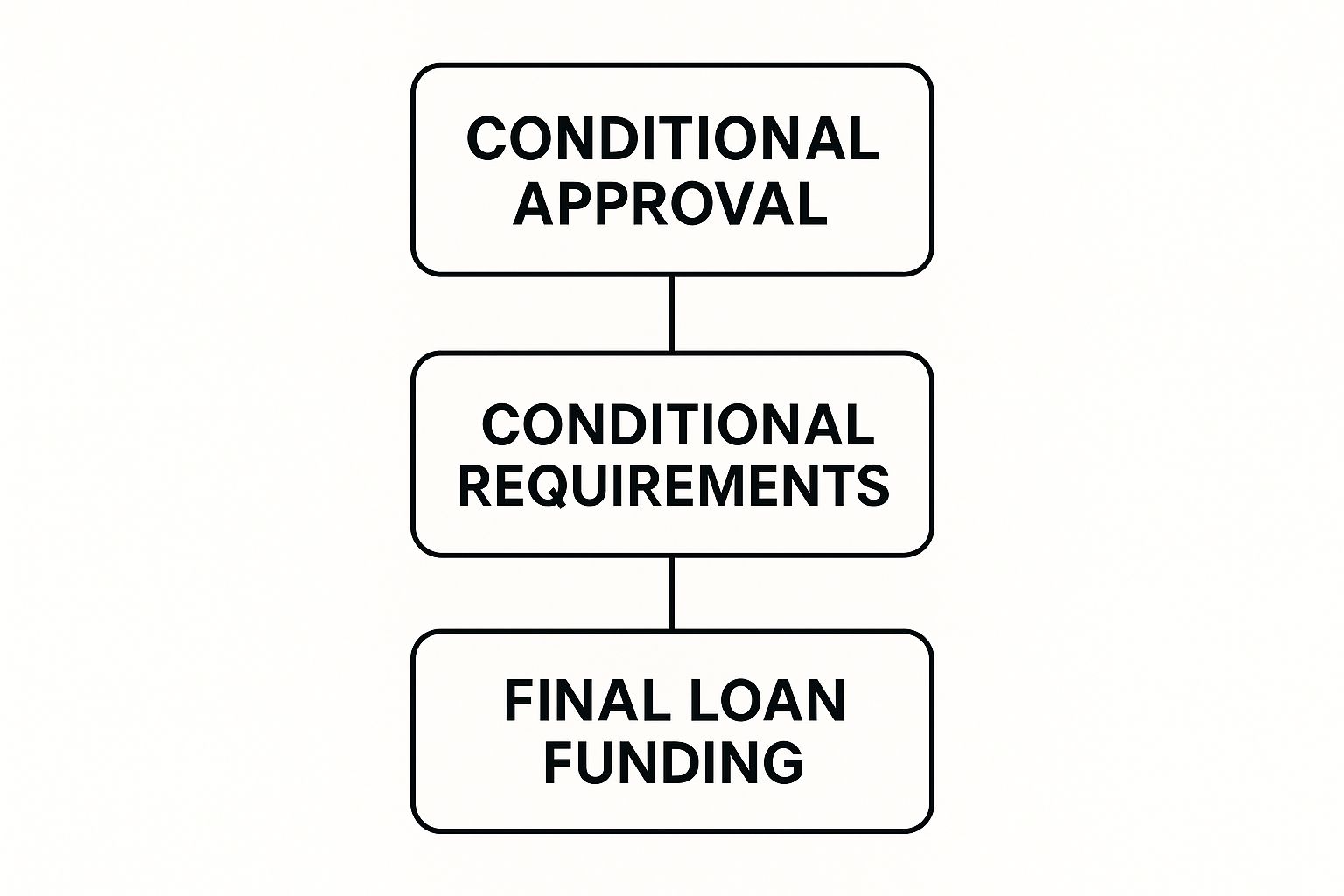
As you can see, satisfying your lender's conditions is the critical bridge you have to cross to get from their initial commitment to the final funding. It’s the last real hurdle before you get the final, unconditional "cleared to close" notice.
The Milestones of Loan Approval: Where Conditional Approval Fits
It helps to see where conditional approval fits into the bigger picture. The journey from just browsing for a loan to having the funds in hand has several key milestones, each with a different level of commitment from the lender. Understanding these stages illuminates just how significant this step is.
| Stage | Lender's Commitment Level | What They've Reviewed |
|---|---|---|
| Pre-Qualification | Low | A quick, unverified snapshot of your self-reported finances. It’s a ballpark estimate. |
| Pre-Approval | Medium | A verified review of your credit report, income, and assets based on documents you provide. |
| Conditional Approval | High | A thorough manual review by an underwriter; your file is approved with specific conditions to be met. |
| Final Approval / Clear to Close | Highest | All underwriter conditions have been met, and the loan is officially ready to be funded at closing. |
Seeing it laid out like this makes it clear just how far you've come by the time you hit conditional approval. It's the home stretch, where the lender has done their heavy lifting and is now waiting on you to provide the final pieces of the puzzle.
The Underwriter's Role: From Pre-Approval to Conditional Approval

To really get why conditional approval is such a big deal, you have to look at the journey from a simple pre-approval. Think of pre-approval as a quick, often automated, handshake. It’s based on the financial details you provide and a solid look at your credit. It’s a fantastic starting point, but conditional approval is where the real deep dive begins.
That’s when a loan underwriter steps in. This is the financial detective whose job is to verify every single detail you’ve claimed. A pre-approval basically says you probably qualify for a loan. A conditional approval, on the other hand, confirms you do qualify—as long as a few final conditions are met. Understanding the mortgage underwriting process is key to seeing how an application truly transforms from a possibility into an approved loan.
The Human Element in Loan Verification
The biggest difference here is the human touch. An underwriter isn’t just an algorithm; they are a seasoned professional who manually combs through your entire financial life. Their goal is simple but crucial: to build a complete, verified picture of your ability to repay the loan, leaving no stone unturned. It's a much more rigorous step than the initial stages, and you can really see the contrast when you look at a step-by-step guide to the mortgage pre-approval process.
The underwriter meticulously digs into documents like:
- Tax Returns: They want to see consistent income over the last couple of years.
- Bank Statements: This is to check your assets, cash flow, and where your down payment is coming from.
- Pay Stubs and W-2s: This confirms your current job and how much you're making.
- Credit History: They'll analyze your debt-to-income ratio and look at your payment patterns.
This detailed review is what elevates your loan application from a possibility to a near-certainty. It’s a critical check for lenders, especially when you consider that the average personal loan debt per borrower in the U.S. is $11,676. This in-depth analysis is their way of ensuring you’re a reliable borrower. By the time this review is done, the underwriter has built a solid risk profile that gives the lender the green light to move forward with confidence.
Decoding Common Loan Conditions You Can Expect

When you get that conditional approval letter, it comes with a list of things your lender still needs. Don't panic! This isn't a surprise test or a sign of trouble. It's just the final, logical part of the verification process.
Think of it as the lender's final checklist to button everything up. Each condition is a specific request designed to close any small gaps in your financial profile or finalize the details on the property you’re buying. Understanding why they're asking for each item can turn a daunting list into a clear, straightforward plan to get to the finish line.
Documentation and Financial Verification Conditions
This is the most common bucket of conditions, and it’s all about making sure nothing significant has changed since you first applied. The underwriter needs a final, up-to-the-minute snapshot of your finances to confirm you're still in a great position to handle the loan.
You'll likely be asked for things like:
- Final Pay Stubs: The lender wants your most recent pay stubs to get a final confirmation of your income and stable employment right before you close.
- Updated Bank Statements: This shows you still have the funds ready for your down payment and closing costs. It also proves no large, unusual deposits or withdrawals have popped up that could affect your financial standing.
- Gift Letters: Is a family member helping with the down payment? Lenders require a signed letter confirming the money is a true gift, not a loan you have to repay. This keeps your debt-to-income ratio accurate.
Property-Specific Conditions (For Mortgages)
While your finances are getting a final look, the property itself is also under review. The lender needs to be 100% certain that the home they're financing is a sound, secure, and valuable asset. These conditions are standard procedure for any loan backed by real estate.
Key property-related requests include:
- The Appraisal: An independent appraiser has to confirm the home's market value is at least as much as the purchase price. This is a critical protection for the lender, ensuring they aren't loaning more than the asset is actually worth.
- Title Search and Insurance: A title company dives into public records to make sure the property has a clean history with no surprise ownership claims or liens. Lenders will always require you to get title insurance to protect their investment against any future disputes.
- Proof of Homeowners Insurance: You’ll need to provide a paid-up policy that covers the home against fire, storms, and other potential damage. This is a non-negotiable step that safeguards both your and the lender's stake in the property.
A lender always sees the property as the collateral for the loan. Fulfilling these conditions is all about proving that the collateral is secure, valuable, and free of any hidden risks that could jeopardize their investment.
This part of the process isn't about creating hoops to jump through. It's about a mutual interest in confirming that the home you're about to own is a solid investment from every possible angle.
Why Lenders Need These Specific Loan Conditions
To give you a clearer picture, it helps to see the condition and the lender's reasoning side-by-side. The table below breaks down some of the most common requests you’ll encounter.
| Condition Type | Example Request | The Lender's Goal |
|---|---|---|
| Income Verification | "Provide your most recent pay stub." | To confirm your employment and income are stable right up to the closing date. |
| Asset Verification | "Submit your latest bank statement." | To ensure you still have sufficient funds for closing and that no large, unverified debts have been taken on. |
| Gift Funds | "A signed gift letter from your relative." | To document that the money for your down payment is a gift, not an undisclosed loan that affects your debt ratio. |
| Property Value | "A satisfactory appraisal report." | To verify that the property's market value supports the loan amount, protecting their investment. |
| Clear Ownership | "A clear title search and title insurance policy." | To ensure there are no legal claims or liens on the property that could threaten their collateral. |
| Property Protection | "Proof of homeowners insurance." | To guarantee the asset (the home) is protected against damage, safeguarding both your and their financial interest. |
As you can see, every request has a clear purpose tied directly to ensuring the loan is a sound financial decision for everyone involved. By providing these final pieces, you’re simply helping the lender connect the last few dots before handing you the keys.
Your Action Plan After Getting Conditional Approval
So, you've got your conditional approval. Congratulations! It’s a huge milestone, but this is no time to pop the champagne just yet. Think of this as the final sprint in a marathon. Your focus and speed right now are what get you smoothly across the closing table.
When that list of conditions from the underwriter lands in your inbox, your mission is simple: give them exactly what they’ve asked for, as quickly and cleanly as possible. Responding promptly and accurately shows you’re a reliable borrower, which goes a long way in building confidence with your lender.
Assemble and Submit Your Documents Promptly
First things first, don't let the list overwhelm you. Break it down. Create a simple checklist of every single item the underwriter needs. I find it helps to group similar documents together—all the income stuff in one pile, all the asset statements in another. It makes the task feel much more manageable.
Make sure you're sending the complete document for each item. If they ask for a bank statement, send every single page, not just the summary. For a solid idea of what lenders are looking for, a complete mortgage document checklist is a great resource to have on hand. And here’s a pro tip: bundle everything into one complete package for your loan officer. Sending documents piecemeal is a recipe for confusion and delays.
The Critical "What Not to Do" List During This Time
Just as important as what you do right now is what you absolutely don't do. The underwriter approved your loan based on a very specific financial snapshot. If you change that picture, you risk sending your entire file back for a full, painstaking review—and potentially even a denial.
Consider this your financial quiet zone. You need to follow these rules without exception until the loan is officially closed and funded:
- Do Not Make Major Purchases: This is not the time to buy a new car, finance a living room set, or rack up credit card debt on electronics. Any new debt messes with your debt-to-income ratio, a critical number the underwriter has already signed off on.
- Do Not Change Jobs: Stability is king. Even if you get a better offer, switching jobs now introduces a huge new variable. The underwriter will have to re-verify everything, causing major delays.
- Do Not Apply for New Credit: Every application triggers a hard inquiry on your credit report. Lenders almost always do a final "soft pull" on your credit right before closing, and any new activity will raise a massive red flag.
- Do Not Make Large, Undocumented Deposits: Moving big chunks of cash around looks suspicious. Every dollar going toward your down payment and closing costs needs a clear, documented source.
Your number one priority is to keep your financial life as stable and boring as possible. Any deviation from the profile you first presented can derail the whole process, so just hang tight. You’re almost there.
Potential Roadblocks That Could Affect Final Loan Approval

Getting conditional approval is a huge milestone, no doubt about it. You can almost hear the moving trucks. But it's not quite an unbreakable guarantee. Think of it as getting the green light, but you still need to drive carefully through the last few intersections before you’re officially home free.
Successfully navigating this final stretch is all about staying vigilant and keeping your financial picture consistent. Even borrowers with fantastic profiles can hit unexpected snags. This isn't to cause alarm, but to prepare you for the common hurdles that can pop up at this late stage.
Common Hurdles in the Final Loan Stage
Certain events can send your loan application right back to the underwriting department or, in a worst-case scenario, lead to a denial. Knowing what they are is the best way to steer clear of them.
- A Low Property Appraisal: This is a big one. If the appraiser determines the home is worth less than what you agreed to pay, the lender will only finance the lower, appraised value. This creates a funding gap you'll have to cover.
- Undisclosed Debts or New Credit: Lenders do one last credit check right before closing. If they spot a new car loan or a maxed-out credit card that wasn't on your original application, it can throw your whole debt-to-income ratio out of whack.
- A Sudden Drop in Credit Score: Even a small dip can be a problem. A late payment on a credit card or opening new lines of credit can knock your score down just enough to disqualify you from the loan terms you were approved for.
- Changes in Employment Status: Losing your job, having your hours reduced, or switching from a salaried role to a commission-based one can all be major red flags that force the underwriter to reassess your ability to repay the loan.
Beyond these common issues, some financial situations are inherently more complex and can introduce extra scrutiny, like those found in high-risk banking scenarios. It's crucial to maintain complete transparency and stability until the keys are in your hand.
Frequently Asked Questions About Conditional Loan Approval
Once you get into the final stages of the loan process, a lot of specific questions tend to pop up. It's totally normal. To give you some clarity and confidence, we've put together answers to the most common questions we hear about conditional approval.
How long does conditional approval last for a mortgage?
You can typically expect your conditional loan approval to be good for 30 to 90 days. This isn't just a random timeframe; it's directly linked to how long the documents in your file—like your credit report or pay stubs—are considered valid. Lenders need to work with current information to make their final decision. If you can't get all your conditions sorted out within that window, they'll likely have to pull fresh reports, which could potentially change your approval status.
Can I make an offer on a house with conditional approval?
Yes, you absolutely can, and you should feel great about it! Walking into a negotiation with a conditional approval letter is a massive advantage. It’s a powerful signal to sellers that you're not just window shopping; your finances have already been through a tough review by an underwriter.
An offer backed by conditional approval is a game-changer. It’s often seen as nearly as strong as a cash offer because it tells the seller your financing is practically a sure thing, dramatically lowering the risk of the deal falling apart.
In a competitive market where sellers are looking at multiple bids, this can easily be the thing that pushes your offer to the top of the pile.
What is the difference between conditional approval and clear to close?
Here’s a simple way to think about it: conditional approval is like passing your final exam, but you still have a couple of small assignments to hand in before you can graduate. The big test is over, but there are still a few boxes to check. Clear to close is the graduation certificate itself. It’s the official, final green light from the lender, confirming you’ve met every single condition they asked for. The underwriter has given their last sign-off, and all that's left is to schedule your closing and get the keys.
Is it possible to negotiate the conditions of a loan approval?
Some conditions are set in stone, while others might have a little wiggle room. Things like a satisfactory property appraisal or providing proof of homeowners insurance are non-negotiable—they're fundamental protections for the lender's investment. However, if you're struggling to track down a specific document, you might be able to work with your loan officer to find an alternative. For instance, if you're self-employed and don't have W-2s, providing tax returns and profit-and-loss statements is the standard solution. The best approach is always open and honest communication with your loan officer; they can help you find a way forward.
How likely is a loan to be denied after conditional approval?
While a loan denial after conditional approval is uncommon, it can happen. Denials at this stage are almost always caused by a significant negative change in the borrower's financial profile. This could be a new, large debt, a job loss, or a sudden drop in credit score. As long as you maintain your financial stability and provide the requested documents promptly, your chances of reaching the closing table are very high.
Can you be denied a loan after clear to close?
It is extremely rare to be denied a loan after receiving a "clear to close" status. This would typically only occur in cases of discovered fraud or a last-minute catastrophic event, like the property being destroyed. Clear to close means the lender is fully committed and prepared to fund the loan.
What are 'prior to document' conditions?
"Prior to document" (PTD) conditions are items that the underwriter needs you to resolve before they will draw up the final loan documents for you to sign at closing. These are usually the last few pieces of the puzzle, such as providing a final bank statement or proof of insurance.
Does conditional approval mean the underwriter has seen my file?
Yes, absolutely. Conditional approval is direct evidence that a human underwriter has performed a thorough review of your entire loan file. Unlike a pre-approval, which can sometimes be generated by an automated system, a conditional approval signifies that your financial details have passed a rigorous manual inspection.
What happens if the home appraisal comes in low?
If the appraisal comes in below the purchase price, you have a few options. You can try to renegotiate a lower price with the seller, pay the difference in cash out of pocket, or challenge the appraisal if you believe there are valid errors. If none of those work, you may have to walk away from the deal.
Should I lock my interest rate with conditional approval?
Many borrowers choose to lock their interest rate at or around the time they receive conditional approval. Since you are now very close to closing, locking the rate protects you from market fluctuations that could increase your monthly payment. Discuss the best timing with your loan officer based on current market trends and your estimated closing date.
At ShopRates, we’re firm believers that an informed borrower is an empowered one. Our platform is built to give you the clarity and tools you need to find the best financing with total confidence. You can compare straightforward offers from multiple lenders and find the loan that’s perfect for your journey. Explore your loan options with ShopRates today.


