

Steps to Buying Your First House: A Practical Guide for Today’s Market
Embarking on the path to homeownership is one of the most significant financial milestones in a person's life. But the real work doesn't begin with open houses or endlessly scrolling through online listings. The journey truly starts long before that, right at your own kitchen table, with an honest and thorough examination of your finances. This initial stage is the most critical: building a rock-solid financial foundation.
This means taking a deep, analytical dive into your credit history, understanding the nuances of your debt-to-income ratio, and committing to a disciplined savings plan for both the down payment and the often-overlooked closing costs. Mastering this preparatory phase is what positions you as a reliable, top-tier borrower in the eyes of any lender, transforming your dream of homeownership into an achievable reality.
Step 1: Building Your Financial Foundation for a Mortgage

Before any financial institution will consider extending a six-figure loan, they require concrete proof that you are a responsible steward of your finances. Think of this phase as your personal financial bootcamp. It’s about conditioning your entire financial profile to comfortably manage the responsibilities of homeownership. This process goes far beyond simply accumulating savings; it involves meticulously sculpting a financial identity that streamlines the mortgage approval process and secures the most favorable terms.
While the down payment often gets the most attention, lenders conduct a holistic review. They analyze your debt management strategies, your consistency in meeting payment obligations, and your capacity to cover the full spectrum of housing costs—not just the monthly mortgage payment.
Master Your Debt-to-Income Ratio
Your Debt-to-Income (DTI) ratio is one of the most critical metrics lenders use to assess your financial health. It provides a clear, immediate snapshot of your ability to manage monthly payments. To calculate your DTI, sum up all your recurring monthly debt payments (student loans, auto loans, credit card minimums, etc.) and divide that total by your gross monthly income (your income before taxes).
For example, if your gross monthly income is $6,000 and your total monthly debt obligations amount to $1,800, your DTI is 30% ($1,800 ÷ $6,000).
A lower DTI signals to lenders that you have sufficient income to handle a mortgage payment without financial strain. While specific requirements vary by loan program, most conventional lenders prefer a DTI of 43% or less.
To improve your DTI, consider these strategies:
- Accelerate Debt Repayment: Prioritize paying down high-interest debt, such as credit card balances. Eliminating even one monthly payment can significantly improve your ratio.
- Increase Your Income: While challenging, boosting your income through a salary increase, side hustle, or other revenue streams will directly and positively impact your DTI.
Strengthen Your Credit Score
Your credit score serves as your financial report card. A higher score not only increases your likelihood of loan approval but is also the key to unlocking lower interest rates. This difference can translate into tens of thousands of dollars in savings over the life of your mortgage. Lenders typically require a minimum score of 620 for a conventional loan, but the higher your score, the more advantageous your loan terms will be.
Here are actionable steps to enhance your credit score:
- Review Your Credit Reports: Obtain free copies of your reports from the three major credit bureaus—Equifax, Experian, and TransUnion. Scrutinize them for inaccuracies and formally dispute any errors you find.
- Maintain Flawless Payment History: Your record of on-time payments is the most influential factor in your credit score. Automate your bill payments to ensure you never miss a due date.
- Manage Your Credit Utilization: Aim to use less than 30% of your available credit on each credit card. For a card with a $10,000 limit, strive to keep the outstanding balance below $3,000.
To help you organize your efforts, the following checklist outlines the essential financial benchmarks you should aim to meet before seeking mortgage pre-approval.
First-Time Home Buyer Financial Readiness Checklist
This table details the key financial areas lenders will evaluate and provides clear, attainable targets.
| Financial Area | Target Goal | Action Items |
|---|---|---|
| Credit Score | 620+ (higher is better) | Pull free reports from all 3 bureaus. Dispute errors. Pay all bills on time. |
| Debt-to-Income Ratio | Below 43% | Calculate your current DTI. Pay down high-interest debt. Avoid new loans. |
| Down Payment Savings | 3-20% of home price | Open a dedicated high-yield savings account. Set up automatic transfers. |
| Closing Cost Savings | 2-5% of home price | Research typical closing costs in your area. Save this fund separately. |
| Emergency Fund | 3-6 months of expenses | Build a cash reserve for unexpected home repairs or job loss. |
| Income Verification | Stable, documented income | Gather your last 2 years of W-2s, tax returns, and recent pay stubs. |
Completing these items will not only facilitate a smoother pre-approval process but also demonstrate to lenders that you are a serious and well-prepared homebuyer.
Demystifying the Down Payment
One of the most persistent myths in real estate is the necessity of a 20% down payment. While achieving a 20% down payment is advantageous because it eliminates the need for Private Mortgage Insurance (PMI), it is by no means a mandatory requirement for securing a loan.
The reality is that saving for a down payment remains a significant challenge for first-time buyers. While the median down payment for all homebuyers is approximately 18%, this figure decreases to just 9% for first-time purchasers. With the median U.S. home price hovering around $414,000, this still translates to an average down payment of nearly $37,000 for new buyers. A disciplined, dedicated savings strategy is paramount. For a detailed roadmap, explore our article on how to save for a down payment in two years or less.
Prepare for the Hidden Costs of Homeownership
A truly prepared homebuyer understands that the financial obligations extend far beyond the down payment. Lenders assess your total monthly housing cost, commonly referred to as PITI, which encompasses these ongoing expenses:
- Property Taxes: Levied by local governments, these taxes are typically integrated into your monthly mortgage payment via an escrow account.
- Homeowners Insurance: Required by lenders, this insurance protects their investment (and your property) against damage or loss.
- HOA Fees: If you purchase a property within a condominium complex, townhouse community, or certain planned neighborhoods, you will likely be responsible for monthly or annual Homeowners Association fees.
Failing to budget for these recurring costs can transform an affordable home into a significant financial burden. By investing the time now to build a robust financial foundation, you are setting the stage for a future where your first home is a source of security and pride, not financial stress.
Step 2: Secure Your Mortgage Pre-Approval with Confidence

With your finances meticulously organized, it's time to take the definitive step that transforms you from a prospective buyer into a serious contender: obtaining a mortgage pre-approval. This document is far more than a formality; it is the "golden ticket" that signals to sellers and real estate agents that you are a credible and qualified buyer.
Many first-time buyers confuse pre-qualification with pre-approval, but the two are fundamentally different. A pre-qualification is a preliminary, non-binding estimate based on self-reported financial information. While a useful starting point, it holds little authority when you are ready to submit an offer.
A pre-approval, conversely, is a conditional commitment from a lender to loan you a specific amount. To issue a pre-approval, the lender conducts a thorough underwriting process: verifying your income, examining your assets, and performing a hard inquiry on your credit history. This pre-approval letter serves as tangible proof that you have the financial capacity to close the deal.
Why Pre-Approval Is Your Secret Weapon
Consider a scenario where a seller receives two similar offers. One is from a buyer with a pre-approval letter, demonstrating that a lender is prepared to finance the purchase. The other buyer has only a pre-qualification. The pre-approved offer invariably appears as the more reliable and certain option.
A strong mortgage pre-approval is more than just a document; it's a strategic tool. It clearly defines your budget, strengthens your negotiating position, and allows you to move quickly when you find the perfect home.
This enables you to conduct your home search with a firm, lender-verified budget, preventing you from wasting time on properties outside your financial reach. It also communicates to your real estate agent that you are a serious client ready to act. For a more detailed exploration, consult our step-by-step guide to the mortgage pre-approval process.
Understanding Your Loan Options
Mortgage products are not one-size-fits-all. The optimal loan for your situation will depend on factors such as your credit score, down payment amount, and even the location of the property.
Here is a summary of the most common loan types:
- Conventional Loans: These are not insured or guaranteed by the federal government. They typically require a higher credit score (generally 620 or above) and a substantial down payment. If your down payment is less than 20%, you will be required to pay Private Mortgage Insurance (PMI).
- FHA Loans: Insured by the Federal Housing Administration, these loans are highly popular among first-time homebuyers due to their more lenient credit requirements and low down payment option, which can be as little as 3.5%.
- VA Loans: An exceptional benefit for eligible veterans, active-duty service members, and surviving spouses. VA loans often require no down payment and do not have PMI, providing a significant financial advantage.
- USDA Loans: Designed for properties in designated rural or suburban areas, these loans also offer a no-down-payment option for borrowers who meet specific income criteria.
What's the Deal with Mortgage Rates?
Mortgage rates are in a constant state of flux, influenced by macroeconomic factors like inflation and Federal Reserve policies—variables beyond your control. However, the specific interest rate a lender offers you is highly personalized.
The most significant factor you can influence is your credit score. A higher score indicates lower risk to lenders, who will reward you with a more favorable interest rate. This can result in substantial savings over the full term of the loan. Your down payment size and the type of loan you choose also play crucial roles. For a comprehensive overview, this guide to home loan pre-approval is an excellent resource.
How to Shop for the Best Lender
Never commit to the first lender you encounter. The most effective way to secure a competitive loan is to shop around. Obtain quotes from a minimum of three to five different lenders, including national banks, local credit unions, and mortgage brokers.
Each lender is legally obligated to provide you with a standardized "Loan Estimate" form. This document is specifically designed for easy comparison of offers. Look beyond the interest rate alone; compare lender fees, estimated closing costs, and the Annual Percentage Rate (APR), which reflects the total cost of borrowing. A loan with a slightly higher interest rate but significantly lower fees may be the more financially prudent choice.
Step 3: Assembling Your Professional Team for the House Hunt

With your mortgage pre-approval letter secured, you have officially transitioned into the role of a serious homebuyer. However, attempting to navigate the complex real estate landscape alone is a perilous endeavor. The next essential action is to assemble a team of experienced professionals who will advocate for you, provide expert guidance, and safeguard your interests throughout the entire transaction.
This is not about a cursory online search; it's about deliberately selecting partners who understand your goals and have a proven track record. These experts will act as your strategic advisors, transforming an overwhelming process into a structured and manageable experience. The right team is the difference between a successful purchase and a costly mistake.
Finding the Right Buyer's Agent
Your buyer's agent is the quarterback of your home-buying team. This professional serves as your chief strategist, local market expert, and lead negotiator. A truly great agent does far more than schedule viewings; they offer invaluable market insights, identify potential property issues you might overlook, and know how to structure a compelling offer that wins in competitive situations.
When interviewing potential agents, be thorough and direct. This is a critical professional relationship. Prepare to ask insightful questions:
- Experience: "How long have you been a full-time agent? How many first-time buyers have you successfully guided in the past year?"
- Local Knowledge: "What are the current market trends in the specific neighborhoods I am considering? Is it a buyer's or seller's market?"
- Communication: "What is your preferred method and frequency of communication? How will you keep me informed of new listings and market changes?"
- Strategy: "In a multiple-offer scenario, what is your strategic approach to crafting a winning bid?"
Seek an agent who demonstrates exceptional listening skills. Their primary role is to understand and serve your needs, not to pressure you into a quick transaction.
The Other Key Players on Your Team
While your agent leads the charge, two other professional roles are indispensable for protecting your investment as you approach a deal.
- The Home Inspector: This individual is your ultimate safety net. Their job is to perform an impartial, comprehensive evaluation of the property's condition, from the foundation to the roof. A detailed inspection report can uncover significant, costly problems, providing you with the leverage to negotiate for repairs, request a price reduction, or withdraw from a deal involving a potential "money pit."
- The Real Estate Attorney or Title Company: Depending on state regulations, either an attorney or a title company will manage the closing process. Their responsibilities include conducting a thorough title search to ensure the property is free of liens or ownership claims and verifying that all legal documentation is accurate and complete. They provide the final assurance that you are acquiring a clear and marketable title to the home.
A well-chosen team—agent, inspector, and legal expert—doesn't just help you buy a house; they create a system of checks and balances that protects you from serious financial and legal mistakes. This is non-negotiable for a first-time buyer.
From Wishlist to Realistic Search
Now, the exciting phase begins: the house hunt. Before you dive into online listings and property tours, it's crucial to translate your dream-home vision into a practical and effective search strategy. This involves a clear-eyed assessment of your "must-haves" versus your "nice-to-haves."
Organize your priorities into two distinct categories:
- Must-Haves: These are your non-negotiable requirements. Examples include a minimum number of bedrooms, a fenced yard for a pet, or a commute time under a specific limit. A property that fails to meet these criteria is automatically disqualified.
- Nice-to-Haves: These are desirable features that are not essential. This list might include granite countertops, a finished basement, or a two-car garage.
This simple exercise provides immense clarity and focus to your search. It prevents you from being swayed by cosmetic features in a home that is fundamentally unsuited to your lifestyle. It also gives your agent a precise blueprint of what to look for, maximizing the efficiency of your search.
Understanding your readiness for homeownership is part of a larger demographic trend. The median age of first-time homebuyers has risen to an all-time high of 38, up significantly from 30 in 2010. This shift reflects the modern challenges of low housing inventory and rising costs, underscoring the critical importance of a well-defined, strategic approach to buying a home. You can discover more insights about first-time homebuyer trends on Visualcapitalist.com.
Step 4: Making a Smart, Competitive Offer That Stands Out
You have done the diligent preparatory work. Your finances are in order, your pre-approval is secured, and after countless property tours, you have found the perfect home.
The initial excitement is quickly followed by a pivotal question: what's next? This is the moment your home search transitions from exploration to strategic action. Crafting a winning offer is a sophisticated blend of art and science, combining hard market data with psychological insight to persuade the seller that yours is the most advantageous bid.
The offer your agent prepares is a comprehensive legal proposal, not just a price. It details the purchase price, your financing method, and includes specific conditions, known as contingencies, that must be satisfied for the sale to proceed. A thoughtfully constructed offer can often prevail over a higher but more complicated bid.
The Anatomy of a Winning Offer
Before determining a price, your real estate agent will conduct a Comparative Market Analysis (CMA). This report is your essential guide to establishing fair market value. It analyzes recent sales of comparable homes in the immediate area, providing a data-driven foundation to prevent you from overpaying in a competitive market or submitting an offer so low that it's not taken seriously.
With this data, you will structure the core components of your offer:
- Offer Price: The primary figure. Based on the CMA and current market dynamics, you and your agent will determine a competitive and realistic price.
- Earnest Money Deposit: A good-faith deposit, typically 1-2% of the purchase price, submitted with your offer. It demonstrates your seriousness and is held in a neutral escrow account until closing.
- Contingencies: These are your contractual safety nets—clauses that permit you to withdraw from the contract without forfeiting your earnest money if specific conditions are not met.
The infographic below illustrates how these essential elements of a competitive offer are integrated.
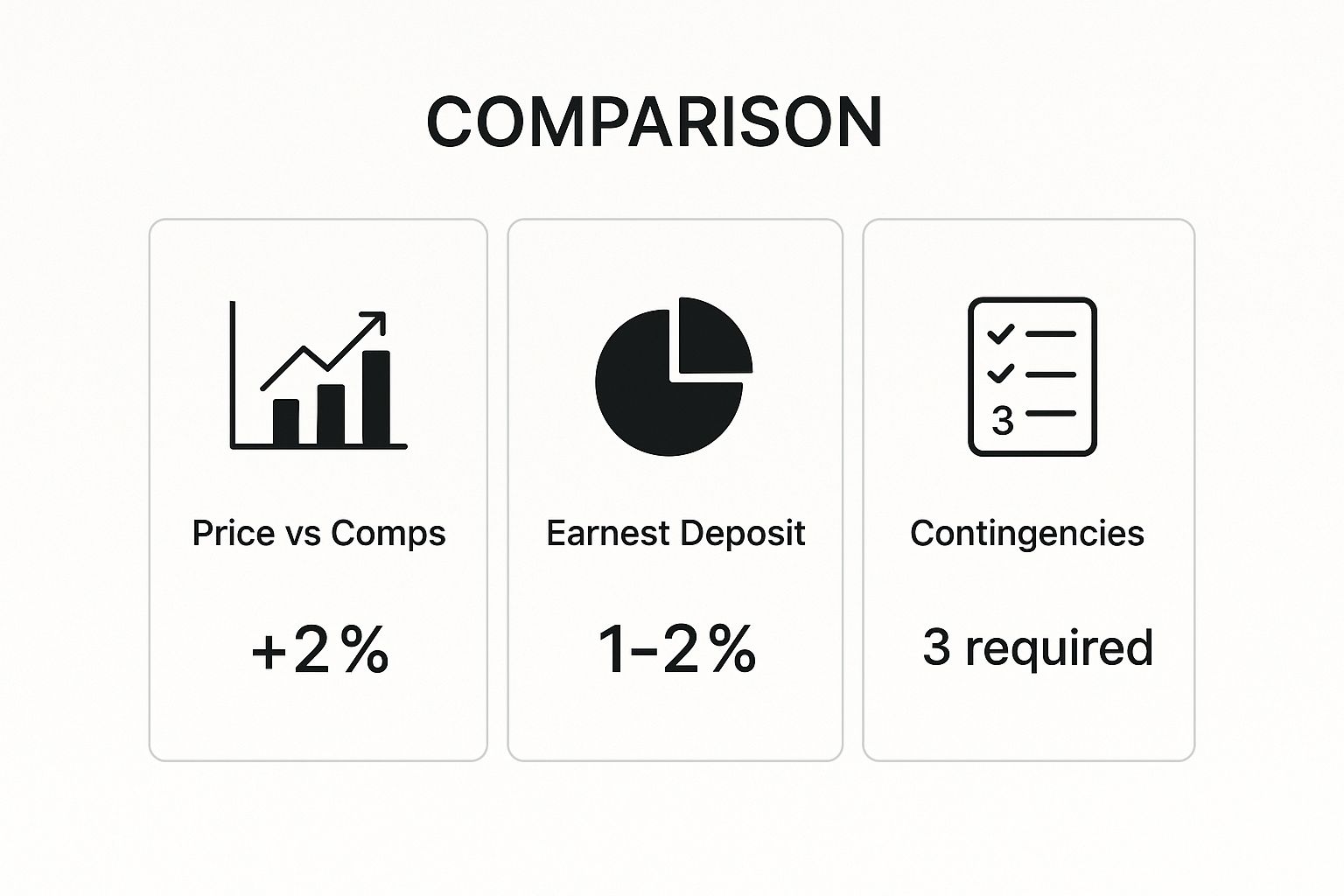
This visual representation highlights that a strong offer is not solely about the highest price but is a balanced proposal that assures the seller of your commitment while protecting your interests.
Your Non-Negotiable Safety Nets: Offer Contingencies
In a competitive market, you may be tempted to waive contingencies to make your offer seem more appealing. As a seasoned financial expert, my advice is unequivocal: do not. For a first-time homebuyer, these protections are indispensable.
These clauses are your legal escape hatches, shielding you from financial catastrophe if unforeseen issues arise.
Key Home Offer Contingencies Explained
The following table explains the most common contingencies and their critical functions.
| Contingency Type | Purpose | Typical Timeframe |
|---|---|---|
| Inspection Contingency | Allows you to hire a professional to inspect the home for hidden issues. | 7-14 days |
| Financing Contingency | Protects you if your final mortgage approval is denied by the lender. | 21-30 days |
| Appraisal Contingency | Lets you renegotiate or back out if the home appraises for less than your offer price. | 14-21 days |
| Home Sale Contingency | Makes your offer conditional on selling your current home first (less common for first-timers). | 30-60 days |
Waiving these contingencies is a high-stakes gamble that a first-time buyer cannot afford to take. An undiscovered foundation issue or a low appraisal could quickly turn your dream home into a financial nightmare.
Think of contingencies as the essential terms and conditions of your offer. They aren't signs of weakness; they are signs of a smart, protected buyer who understands the risks involved in such a significant transaction.
The Art of Negotiation and Flexibility
After submitting your offer, the seller will either accept it, reject it, or issue a counteroffer. This initiates the negotiation phase, a delicate process requiring both flexibility and a clear understanding of your walk-away points.
Adaptability is crucial in today's housing market. Faced with high home prices and mortgage rates, successful first-time buyers are employing flexible strategies. Recent data indicates that nearly 75% of first-time homebuyers successfully negotiated seller concessions, demonstrating that strategic flexibility can yield significant financial advantages. These tactics are vital in an economy where the median home price-to-income ratio has risen from approximately 1.3x in 1984 to over 5.2x today. You can read the full report on first-time home buyer trends from The Mortgage Reports.
Success is not always about offering the highest price. A seller may prioritize a quick and seamless closing. A well-written personal letter explaining your connection to the home can also create a powerful emotional appeal, distinguishing your offer from others. Your agent's expertise is invaluable here; they will help you interpret the situation and formulate a response that advances your goals while protecting your interests.
Step 5: Navigating the Final Steps from Contract to Closing
Having your offer accepted feels like a major victory, but it marks the beginning of the final, intensive phase of the transaction. Welcome to the escrow period—the critical timeframe, typically 30 to 45 days, between signing the purchase agreement and receiving the keys. During this period, a flurry of essential behind-the-scenes activities takes place.
A neutral third party, such as a title company or escrow agent, manages this process. They securely hold all funds and legal documents, ensuring that every contractual obligation is met before the property ownership is transferred. This phase involves inspections, appraisals, and the lender's final underwriting. Here’s a breakdown of what to expect in these crucial final weeks.
The Home Inspection: Your Moment of Truth
This is, without question, one of the most critical steps in protecting your investment. A home inspection is a comprehensive, deep-dive examination of the property's condition, conducted by a licensed professional. Their objective is to uncover any potential defects, from minor issues like leaky faucets to major concerns like structural foundation problems.
The inspector will meticulously evaluate all major systems and components of the home:
- Structural Integrity: Foundation, walls, framing, and roof.
- Essential Systems: HVAC, plumbing, and electrical systems.
- Major Appliances: Water heater, furnace, and any other appliances included in the sale.
- Safety Concerns: Signs of water damage, mold, or pest infestations.
You will receive a detailed report, complete with photographs, documenting all findings. It is normal for this report to be lengthy, as no home is perfect. Your task, with your agent's guidance, is to distinguish between minor, manageable repairs and significant deal-breakers. This report is a powerful negotiating tool, allowing you to request repairs, ask for a closing credit, or, if the issues are severe enough, withdraw from the purchase.
The Appraisal and Final Underwriting
Simultaneously, your lender will be focused on the property's value. They will commission an independent appraisal to confirm that the home is worth the price you have agreed to pay. This is a mandatory step to protect the lender from loaning more than the asset's market value.
If the appraisal meets or exceeds the offer price, the process moves forward. However, if the appraisal comes in low, you have several options:
- Renegotiate: Request that the seller lower the purchase price to match the appraised value.
- Cover the Difference: If you have the financial means, you can pay the difference between the appraised value and the offer price out of pocket.
- Dispute the Appraisal: While challenging, you can contest the appraisal if there are demonstrable errors in the report.
During this time, your loan will enter the final underwriting stage. The lender's team will conduct a final review of your financial profile to ensure no significant changes have occurred since pre-approval. It is imperative that you avoid making any major financial changes during escrow. Do not open new lines of credit, finance a vehicle, or change employment, as any such actions could jeopardize your loan approval at the last minute.
Title Search and Closing Disclosures
While these processes are underway, the title company performs a title search. They examine public records to verify that the seller has legal ownership of the property and that there are no outstanding liens or claims against it. This culminates in the issuance of a title insurance policy, which protects both you and your lender from future ownership disputes.
Approximately three business days before closing, you will receive a five-page document called the Closing Disclosure (CD). This document is the final, detailed accounting of your loan. It itemizes every cost, from your interest rate and monthly payment to all closing fees.
Carefully compare the Closing Disclosure with the Loan Estimate you received initially. This is your final opportunity to identify and address any discrepancies. The CD will state the exact amount of money you need to bring to the closing. Our complete guide to mortgage closing costs for new homebuyers provides a detailed breakdown of these figures.
Typically 24 hours before closing, you will conduct a final walk-through. This is your last chance to verify that the property is in the agreed-upon condition and that any negotiated repairs have been completed. After signing the extensive paperwork at the closing table, you will officially become a homeowner. Using an ultimate new homeowner checklist can be invaluable for navigating the initial weeks of homeownership.
Frequently Asked Questions (FAQ) for First-Time Homebuyers
Entering the world of homeownership is an exciting endeavor, but it naturally comes with a multitude of questions. It's completely normal to feel overwhelmed by the complexity of the process. This FAQ section is designed to provide clear, expert answers to the most common questions and challenges that first-time buyers face, empowering you to move forward with confidence.
How much money do I really need for a down payment?
The long-standing myth that you must have a 20% down payment is one of the biggest misconceptions in real estate. While a 20% down payment is an excellent goal because it allows you to avoid paying for Private Mortgage Insurance (PMI), it is not a requirement for most buyers.
There are several highly accessible loan programs designed for first-time buyers:
- FHA Loans: These government-backed mortgages are extremely popular, often requiring a down payment of just 3.5%.
- Conventional Loans: Many conventional loan products are available with down payments as low as 3-5%.
To illustrate, on a $400,000 home, a 20% down payment is a substantial $80,000. In contrast, a 3.5% FHA down payment is only $14,000. The trade-off for a lower down payment is a monthly PMI premium, which you will typically pay until you have built approximately 20% equity in the home. It's also wise to research state and local down payment assistance programs, as many offer grants or low-interest loans to help cover these initial costs.
What are closing costs and how much should I budget?
Closing costs are the fees associated with finalizing the real estate transaction and are entirely separate from your down payment. A reliable estimate is to budget between 2% and 5% of the home's purchase price to cover these expenses.
For a $350,000 home, you should plan for closing costs ranging from $7,000 to $17,500. These fees cover a variety of services, including lender origination fees, appraisal costs, title insurance, prepaid property taxes, and attorney fees. Your lender is required to provide a Loan Estimate that outlines these costs, and you will receive a final, itemized list on your Closing Disclosure just before the closing date.
Pro Tip: In certain market conditions, it's possible to negotiate for the seller to cover a portion or all of your closing costs. This is known as a "seller concession" and can significantly reduce the amount of cash you need at closing.
What is the real difference between pre-qualification and pre-approval?
Understanding the distinction between these two terms is crucial for being perceived as a serious buyer. A pre-qualification is an informal, preliminary estimate of how much you might be able to borrow. It is based solely on financial information you provide to a lender, without any verification.
A pre-approval, however, is a formal, conditional commitment from a lender to loan you a specific amount. To grant a pre-approval, the lender conducts a thorough underwriting review, verifying your income, examining bank statements, performing a hard credit inquiry, and assessing your debt. A pre-approval letter is a powerful tool that demonstrates to sellers that you are a credible, financially vetted buyer, giving your offer a significant competitive edge.
How important is a home inspection?
Let me be unequivocally clear: a professional home inspection is absolutely essential and non-negotiable. It is your single most effective defense against purchasing a property with hidden, costly defects—a "money pit."
An inspector examines the property's core systems, including the foundation, roof, HVAC, plumbing, and electrical. The resulting detailed report provides you with critical information and powerful negotiating leverage. You can use it to request that the seller make repairs, negotiate a lower price, or, if the problems are substantial, withdraw your offer. Waiving the inspection contingency to make your offer more attractive is an extremely high-risk strategy that can lead to years of financial hardship and regret.
What credit score do I need to buy my first house?
While a higher credit score will always secure better loan terms, you don't necessarily need a perfect score to qualify. For a conventional loan, most lenders look for a minimum credit score of 620. For an FHA loan, the requirements are more flexible, with some lenders approving scores as low as 580, provided you can make a 3.5% down payment. Scores below 580 may require a 10% down payment. Keep in mind that these are general minimums; individual lender requirements can vary.
Can I buy a house with student loan debt?
Absolutely. It is very common for first-time homebuyers to have student loan debt. Lenders are accustomed to this and will factor your monthly student loan payments into your Debt-to-Income (DTI) ratio. As long as your total debt (including the new mortgage) doesn't push your DTI above the lender's threshold (typically 43%), your student loans should not prevent you from qualifying for a mortgage.
How long does the home buying process take?
From the initial financial preparation to closing day, the entire process typically takes several months. The active house-hunting and offer phase can last anywhere from a few weeks to a few months, depending on market conditions. Once your offer is accepted, the escrow or closing period usually takes between 30 and 45 days. To be safe, it's wise to plan for a total timeline of 3 to 6 months.
What is Private Mortgage Insurance (PMI)?
Private Mortgage Insurance (PMI) is a type of insurance required by lenders when a homebuyer makes a down payment of less than 20% on a conventional loan. It protects the lender in case you default on the loan. PMI is typically paid as a monthly premium that is added to your mortgage payment. The good news is that once you have built up about 20% equity in your home, you can request to have the PMI removed.
What happens on closing day?
Closing day is the final step in the home buying process. You will meet with your agent, the seller's agent, and a closing agent (from the title company or an attorney's office). You will review and sign a large number of legal documents, including the final loan documents and the deed. You will also provide a certified or cashier's check for the closing costs and any remaining down payment funds. Once all the paperwork is signed and the funds are transferred, you will receive the keys to your new home.
Should I get a fixed-rate or adjustable-rate mortgage (ARM)?
For most first-time homebuyers, a fixed-rate mortgage is the safer and more predictable option. With a fixed-rate loan, your interest rate remains the same for the entire life of the loan (typically 15 or 30 years), meaning your principal and interest payment will never change. An Adjustable-Rate Mortgage (ARM) offers a lower introductory interest rate for a set period (e.g., 5 or 7 years), after which the rate adjusts based on market conditions. While an ARM can be attractive initially, it carries the risk that your payments could increase significantly in the future.
Ready to take the next step toward your first home? At ShopRates, we simplify the mortgage process by connecting you with trusted lenders who compete for your business. Compare rates, understand your options, and find the perfect loan for your needs. Visit https://shoprates.com to get started today.


