

Your Essential Mortgage Document Checklist for 2025: A Financial Expert’s Guide
Securing a mortgage can often feel like you're trying to solve a complex puzzle in the dark. But what if you had a clear, step-by-step guide to illuminate the path to homeownership? Over my decades of experience in the financial industry, I've guided countless individuals and families through this very journey. The most crucial lesson I've learned is that the secret to a smooth, stress-free mortgage experience isn't luck—it's preparation.
Being organized is more than just good advice; it's a strategic advantage. When you present a well-ordered file, you're sending a powerful message to lenders like us at ShopRates, a nationwide lender based right here in Nashville, TN. You're demonstrating that you are a reliable, serious, and capable borrower. This comprehensive mortgage document checklist is the roadmap I've developed to help you do just that. It's meticulously crafted to demystify the requirements, sidestep common delays, and empower you with the confidence of a seasoned professional. We will break down each document, explaining not just what it is, but why it's so critical for securing your loan. Let's begin building your file for success.
1. Pre-Approval Letter: Your Golden Ticket
A pre-approval letter isn't just a piece of paper; it's your golden ticket in the competitive world of homebuying. This is an official document from a lender, like Shop Rates, that confirms the maximum loan amount you're likely to be approved for after they’ve conducted a preliminary but thorough review of your credit, income, and assets. It signals to real estate agents and sellers that you are a serious, financially capable buyer, giving your offer significant weight, especially when multiple bids are on the table.

Unlike a pre-qualification, which is essentially a rough estimate based on information you provide, a pre-approval involves actual verification. This rigor makes it an indispensable first item on any truly comprehensive mortgage document checklist.
Why It's Essential
Holding a pre-approval letter allows you to shop for homes confidently within your real budget, preventing the heartache of falling in love with a property you ultimately can't afford. Imagine this scenario: a first-time buyer in a hot Nashville neighborhood uses their pre-approval to make a swift, credible offer. This single document allows them to compete effectively against all-cash buyers, instantly elevating their standing.
Actionable Tips for Your Pre-Approval:
- Shop Smart: To find the best rate without damaging your credit score, submit all your mortgage applications within a focused 14-day window. Modern credit scoring models typically recognize multiple inquiries for the same type of loan within a short period as a single event.
- Maintain Financial Stability: After receiving your pre-approval, it is crucial to avoid opening new credit cards, taking out other loans, or making large, un-vetted purchases. Any significant change to your debt-to-income ratio could jeopardize your final loan approval.
- Stay in Communication: Transparency is key. Immediately inform your loan officer of any changes to your employment status, income, or if you receive a large financial gift. Open communication ensures a smoother, more predictable underwriting process.
2. Loan Application (Form 1003): The Foundation of Your File
The Loan Application, officially known as Form 1003 or the Uniform Residential Loan Application (URLA), is the foundational document of your entire mortgage request. This standardized form captures a comprehensive snapshot of your financial life. It details everything from personal information and two years of employment history to all sources of income, your assets, and your liabilities. Lenders like Shop Rates use this form as the primary tool to begin the underwriting process and determine your eligibility for a home loan.
Whether you complete it online through a secure lender portal or sit down with a loan officer, the information you provide becomes the definitive basis for your entire file. Accuracy and completeness on this form are paramount, making it a critical component of your mortgage document checklist.
Why It's Essential
This application serves as the single source of truth for your lender. It is a legally binding document where you attest, under penalty of law, that the information provided is accurate. Any inconsistencies between what you state on Form 1003 and what your supporting documents (like pay stubs or bank statements) show can cause significant delays or even an outright denial. For instance, a Nashville-based entrepreneur applying for a loan must carefully list all income derived from their business, ensuring it aligns perfectly with the figures on their submitted tax returns.
Actionable Tips for Your Loan Application:
- Be Thorough: Do not leave any fields blank unless they are truly not applicable. An incomplete application is one of the most common reasons for processing delays. Take your time to fill out every section with precision and care.
- Declare All Income: List all legitimate and verifiable sources of income. This includes not just your salary, but also overtime, bonuses, part-time jobs, or side business revenue. This provides the underwriter with a complete picture of your ability to repay the loan.
- Review and Verify: Before you sign, meticulously review every single entry. Double-check Social Security numbers, addresses, and all financial figures. A simple typo on this legal document can jeopardize your entire mortgage approval.
3. Income and Employment Verification Documents: Proving Your Repayment Ability
Your income and employment history form the bedrock of a lender's decision-making process. These documents serve as tangible proof that you have a stable, reliable financial inflow sufficient to handle monthly mortgage payments. Lenders, including us at Shop Rates, meticulously analyze this information to calculate your debt-to-income (DTI) ratio and assess the overall risk associated with your loan. This verification is an absolute non-negotiable step in any thorough mortgage document checklist.
Proving your ability to repay the loan is paramount. Whether you are a traditional W-2 employee, self-employed, or retired, providing clear and complete documentation is crucial for a smooth underwriting experience and timely approval.
Why It's Essential
Lenders require a predictable and consistent source of repayment. For example, a freelance graphic designer in Nashville must demonstrate consistent earnings over the past two years via tax returns and profit-and-loss statements to qualify. In contrast, a salaried employee might only need to provide recent pay stubs and W-2s. This evidence assures the lender that your financial situation is not a temporary fluke but a stable foundation for a long-term loan commitment.
Actionable Tips for Your Income Docs:
- Gather Recent Pay Stubs: Collect your two most recent pay stubs. Ensure they clearly show your name, your employer's name, your pay rate, and year-to-date earnings.
- Organize Tax Documents: Have the last two years of your complete federal tax returns (all pages and all schedules) and W-2s ready to go. If you're self-employed, this must include your business returns and all relevant schedules, like Schedule C.
- Document All Income: If you receive income from other sources such as rental properties, investments, alimony, or retirement accounts, gather all relevant documentation. This could include 1099s, lease agreements, or award letters.
- Maintain Job Stability: It is highly advisable to avoid changing jobs or becoming self-employed during the mortgage application process. If a change is unavoidable, discuss it with your lender immediately to understand the potential impact.
4. Asset and Bank Statements: Demonstrating Financial Health
Asset and bank statements serve as the financial bedrock of your mortgage application. They provide concrete proof to lenders like Shop Rates that you possess the necessary funds for a down payment, closing costs, and the required cash reserves. These documents offer a transparent view of your financial health, verifying your ability to manage the initial costs of homeownership and comfortably handle future payments. They are a non-negotiable component of any thorough mortgage document checklist.
Lenders scrutinize these statements meticulously to trace the source of your funds, ensuring they come from legitimate, documented sources and are not undisclosed loans. This verification process confirms your financial stability and readiness to complete the purchase transaction.
Why It's Essential
Providing clear, comprehensive statements builds a lender’s confidence in your application and prevents underwriting headaches. For instance, a buyer receiving a down payment gift from a family member must provide a signed gift letter alongside the bank statement showing the deposit. This demonstrates that the funds are a true gift, not a loan that needs to be repaid. This level of documentation prevents underwriting delays and strengthens your position as a reliable borrower.
Actionable Tips for Your Statements:
- Provide Complete Documents: You must submit every single page of your statements, even the blank ones. Incomplete documents are a very common cause of processing delays, so ensure nothing is omitted.
- Source Large Deposits: If you have to make a large, non-payroll deposit, be prepared to document its source immediately. Have a clear paper trail ready, such as a bill of sale for a sold vehicle or a gift letter from a relative.
- Organize and Consolidate: If your funds are spread across multiple accounts, organize your statements chronologically for each one. To simplify the documentation process significantly, consider consolidating the necessary funds into a single account a few months before you apply.
5. Credit Report and Credit Documentation: Your Financial Story
Your credit report is the financial story you tell lenders. It details your entire history of managing debt. This comprehensive document, a cornerstone of any mortgage document checklist, provides a full view of your payment history, current debts, credit inquiries, and any public records like bankruptcies or liens. Lenders like Shop Rates scrutinize this report to gauge your reliability as a borrower and to determine the interest rate and terms they can offer you.
A strong credit history acts as irrefutable proof of your financial discipline. For example, a homebuyer in Austin with a FICO score over 780 will likely secure the most competitive interest rates available, a difference that could save them tens of thousands of dollars over the life of their loan. This vividly demonstrates why understanding and preparing your credit profile is so critical.
The infographic below highlights the key components that shape your credit score, offering a quick reference for where to focus your efforts.
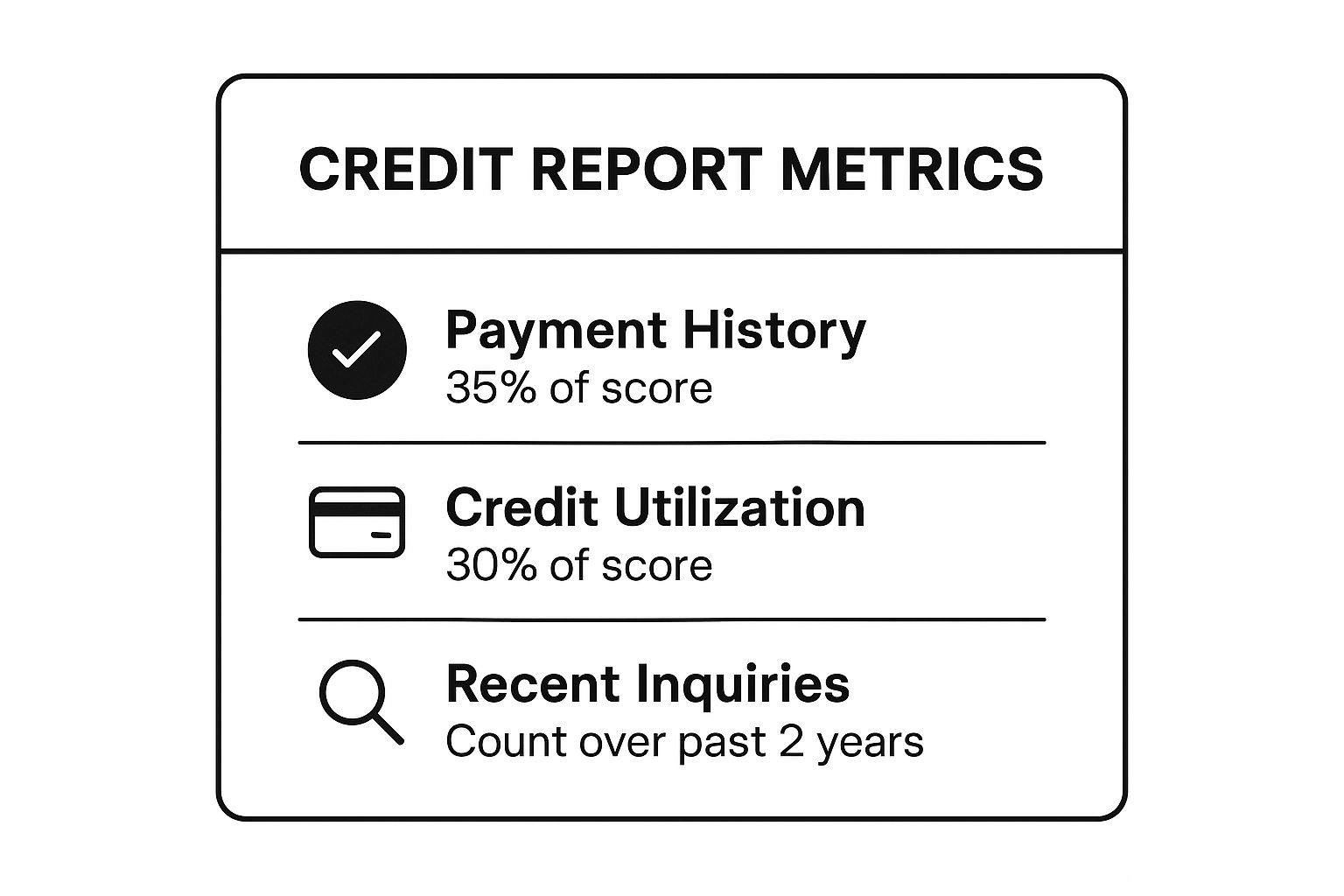
As the data shows, consistent on-time payments and maintaining low credit card balances are by far the most influential factors in building a strong credit score for your mortgage application.
Why It's Essential
Your credit report directly impacts not only your ability to secure a mortgage but also the ultimate cost of that loan. Lenders use it to assess risk; a higher credit score signals lower risk, which translates directly to better loan terms and a lower interest rate. Even first-time buyers with a limited credit history can use alternative documentation or specific loan programs to get approved, but a clean, well-established report is the clearest and most effective path to approval. You can learn more about what credit score is needed for a mortgage on shoprates.com.
Actionable Tips for Your Credit:
- Review Early and Often: Pull your credit reports from all three major bureaus (Equifax, Experian, and TransUnion) at least 3-6 months before you plan to apply. This gives you ample time to identify and dispute any errors, which are surprisingly common.
- Maintain the Status Quo: During the application and underwriting process, it is vital to avoid opening new credit accounts or closing old ones. Closing an old account, even one you don't use, can shorten your credit history and potentially lower your score.
- Lower Your Utilization: Actively pay down credit card balances to reduce your credit utilization ratio—the percentage of your available credit that you're currently using. For the best results, aim to keep this ratio below 30% on each card and overall.
6. Property Documentation and Purchase Agreement: The Deal Blueprint
Once your offer on a home is accepted, the purchase agreement—also known as the sales contract—becomes the centerpiece of your mortgage application. This legally binding contract outlines all the specific terms of the sale, including the price, closing date, property address, and any contingencies (like inspection and appraisal). It serves as the official blueprint for the transaction, providing the lender with the crucial details needed to structure and underwrite your loan.

This document, along with any property disclosures and addendums, must be meticulously reviewed and submitted to your lender promptly. It's a non-negotiable item on any serious mortgage document checklist because it validates the collateral for the loan: the property itself.
Why It's Essential
The purchase agreement is the lender's proof of a valid, arms-length sale and the property's value proposition. For instance, a contract for a new construction home in Texas will include a detailed completion timeline, which the lender uses to schedule appraisals and the final funding. Similarly, an investor's contract might include projected rental income, which directly impacts their debt-to-income ratio calculations. This document is a critical part of the home buying process that ties your financing directly to the specific property you intend to buy.
Actionable Tips for Your Purchase Agreement:
- Verify All Signatures: Ensure every single page is initialed and all signature lines are properly signed and dated by all parties involved (all buyers and all sellers). A missing signature is a simple mistake that can cause significant delays.
- Review Every Addendum: Carefully read all addendums and amendments to the contract. These documents can alter key terms, such as agreed-upon inspection repairs or seller concessions for closing costs, all of which your lender needs to know about.
- Communicate Changes Instantly: If any terms of the contract are renegotiated after the initial signing, you must provide the updated and fully executed documents to your lender immediately. Even small changes can directly impact your loan approval.
- Track Your Deadlines: Be vigilant about all contingency deadlines outlined in the contract, such as those for home inspections, appraisals, and financing. Missing a deadline could put your earnest money deposit at risk or even void the entire contract.
7. Homeowners Insurance and Property Insurance Documentation: Protecting the Investment
Your lender sees your new home not just as your future residence but as their collateral—a significant financial investment. To protect this asset, they require proof of homeowners insurance. This documentation confirms the property is adequately covered against perils like fire, theft, and natural disasters, ensuring the lender’s financial stake is secure. You must have this policy in place and paid for (or have arrangements to pay the first year's premium at closing) before the loan can be finalized.
This proof, often called an "insurance binder" or "declarations page," is a non-negotiable item on your mortgage document checklist, serving as a critical safeguard for both you and your lender. It must list the lender as a "loss payee" or "mortgagee."
Why It's Essential
Without adequate insurance, a catastrophic event could leave you without a home and your lender with a worthless asset. Consider this: a buyer in a designated flood zone in Florida must secure a separate flood insurance policy in addition to their standard homeowners policy. Failing to provide this specific documentation to the lender would halt the closing process indefinitely, potentially causing the entire deal to collapse.
Actionable Tips for Your Property Insurance:
- Shop and Bundle: Obtain quotes from at least three different insurance carriers to compare rates and coverage levels. You can often find significant savings by bundling your home and auto insurance policies with the same provider.
- Verify Coverage Amounts: Ensure the "dwelling coverage" amount on your policy is sufficient to cover the full replacement cost of the home. This amount must also meet or exceed your total loan amount.
- Adjust Your Deductible: Consider opting for a higher deductible to lower your annual premium. However, before doing so, make sure you have enough cash reserves to comfortably cover that deductible in the unfortunate event you need to file a claim.
8. Loan Estimate and Closing Disclosure: Your Transparency Tools
The Loan Estimate (LE) and Closing Disclosure (CD) are two of the most critical documents you will receive from your lender during the mortgage process. These federally mandated, standardized forms are designed to protect you, the borrower, by providing clear, easy-to-understand details about your loan terms, projected monthly payments, and total closing costs. They empower you to make an informed financial decision without any last-minute surprises at the closing table.
These documents are a cornerstone of any thorough mortgage document checklist. The Loan Estimate arrives within three business days of your application, giving you a baseline for comparison shopping. The Closing Disclosure is provided at least three business days before your scheduled closing date, offering a final, definitive look at the numbers before you sign.
Why It's Essential
These forms are your primary tools for comparing loan offers and verifying costs. For example, a homebuyer in Nashville can lay out Loan Estimates from three different lenders side-by-side to compare not just interest rates, but also lender fees and third-party charges line by line. Later, they can check their final Closing Disclosure against the initial Loan Estimate to spot any significant changes and demand explanations, ensuring they aren't being overcharged.
Actionable Tips for Your Disclosures:
- Compare Line by Line: Don't just glance at the interest rate or monthly payment. Scrutinize Section A (Origination Charges) on your Loan Estimates, as these are direct lender fees and can vary significantly between offers.
- Understand Cost Tolerances: Know which closing costs can change and which cannot. Fees paid directly to the lender or their affiliates have zero tolerance for increases between the LE and CD. Some third-party service fees have a 10% tolerance, while others can change.
- Act Immediately: Review your Closing Disclosure the moment you receive it. The mandatory three-day review period is your final chance to identify discrepancies or ask questions. Contact your loan officer immediately if something doesn't look right. For an in-depth breakdown, you can learn more about mortgage closing costs on shoprates.com.
Mortgage Document Checklist Comparison
| Item | Implementation Complexity 🔄 | Resource Requirements ⚡ | Expected Outcomes 📊 | Ideal Use Cases 💡 | Key Advantages ⭐ |
|---|---|---|---|---|---|
| Pre-Approval Letter | Moderate – requires credit checks and document submission | Requires credit report, income verification, pay stubs, tax returns | Provides a verified loan amount; strengthens offers | Serious buyers competing in hot markets; narrowing home search | Shows financing capability; speeds closing process; early credit issue detection |
| Loan Application (Form 1003) | High – detailed, lengthy form completion | Extensive documentation on income, assets, debts, property | Comprehensive borrower profile; legal loan application | All borrowers submitting mortgage applications | Standardized and legally binding; streamlines underwriting |
| Income and Employment Verification Documents | Moderate to High – gathering multiple income proofs | Recent pay stubs, tax returns, W-2s, employment letters | Confirms income stability; helps max loan qualification | W-2 employees, self-employed, commission-based borrowers | Validates income and employment; reduces fraud risk |
| Asset and Bank Statements | Moderate – requires collecting several months of statements | 2-3 months bank, investment, retirement account statements | Verifies funds for down payment and reserves | Buyers needing to prove financial stability; gift fund recipients | Demonstrates saving ability; verifies transaction funds |
| Credit Report and Credit Documentation | Moderate – credit pulls and review required | Credit reports from 3 bureaus, monitoring for errors | Reveals creditworthiness; affects rate and terms | Borrowers aiming for best rates; error dispute cases | Comprehensive credit overview; identifies issues early |
| Property Documentation and Purchase Agreement | Moderate – legal documents collection and review | Signed purchase agreement, disclosures, addendums, tax records | Establishes sale terms; informs lender of property details | Transactions requiring clear legal frameworks | Protects parties; defines contingencies and timeline |
| Homeowners and Property Insurance Documentation | Low to Moderate – collecting policy proof and coverage details | Insurance policy, premium payment proof, hazard coverage if needed | Protects property; required for closing | All buyers; properties in hazard zones needing special insurance | Ensures lender protection; liability coverage; potential discounts via bundling |
| Loan Estimate and Closing Disclosure | Low – review standard lender-provided forms | Loan terms, cost breakdown, APR, closing costs | Clear understanding of loan costs; aids comparison shopping | Borrowers comparing loan offers; preparing for closing costs | Standardized format; legal protections; avoids surprises |
From Checklist to Closing: Your Next Steps with ShopRates
You have now navigated the complete mortgage document checklist, transforming what once seemed like a daunting list of requirements into a manageable, actionable plan. This process is about more than just paperwork; it's about piecing together the financial narrative that proves your readiness for homeownership. From verifying your income with W-2s and pay stubs to documenting your assets with detailed bank statements, each item you gather builds a stronger, more compelling case for your loan approval.
Think of this checklist as your strategic roadmap to success. By proactively gathering your Loan Application (Form 1003), credit history documentation, and the purchase agreement, you eliminate last-minute stress and position yourself as the organized, reliable borrower that every lender wants to work with. This level of preparation does more than just satisfy underwriter requests; it empowers you, giving you control and clarity throughout the entire mortgage process. In my experience, a well-prepared file can significantly accelerate your timeline from application to closing, bringing you to your new front door faster than you thought possible.
The journey to owning a home is a marathon, not a sprint, and your diligent preparation is the training that ensures you cross the finish line successfully. Understanding the purpose behind each document, from the initial Loan Estimate to the final Closing Disclosure, is the key to navigating the process with confidence. You are no longer just a passive applicant but an informed, active participant in one of the most significant financial decisions of your life.
Your dream home is waiting. Armed with this comprehensive mortgage document checklist, you are more prepared than ever to make it a reality. At ShopRates, we firmly believe that an educated homebuyer is an empowered one. You have laid the groundwork, and the next step is to put your preparation into action.
Ready to take your meticulously organized documents and find the best mortgage for your new home? Visit ShopRates today to instantly compare competitive loan offers from a nationwide network of trusted lenders. Let our platform connect your preparation with the perfect financial partner. ShopRates is your direct path from checklist to closing.


