

7 Lenders With the Best Home Equity Loan Rates for 2025
Your home is more than just a place to live; it's a significant financial asset. Tapping into your home's equity can provide a powerful, low-cost source of funding for major expenses like home renovations, debt consolidation, or educational costs. The key to maximizing this financial tool lies in securing the lowest possible interest rate. Finding the best home equity loan rates can save you thousands of dollars over the life of the loan, but navigating the crowded marketplace of lenders is often overwhelming and time-consuming.
This guide simplifies that process. As a seasoned financial analyst, I’ve spent decades helping homeowners like you navigate complex lending landscapes. I’ve done the heavy lifting to provide a clear, comprehensive comparison of the top platforms and direct lenders available today. You'll get an inside look at how each lender operates, what rates they currently offer, and the specific borrower profiles they cater to. For each option, we provide direct links and visual examples to streamline your research. This article is designed to help you quickly identify the right lender for your financial situation, whether you have excellent credit or are working to improve it. We'll break down the factors that influence your rate and give you actionable strategies to position yourself as a prime applicant. My goal is to empower you with the knowledge needed to confidently unlock your home’s value on the most favorable terms possible.
1. ShopRates: Best for Comparing Competing Offers
For homeowners looking to tap into their equity, securing the best home equity loan rates is paramount to minimizing long-term borrowing costs. ShopRates distinguishes itself not as a direct lender but as a powerful online marketplace designed to create a competitive environment among lenders. This approach empowers borrowers by putting them in control, allowing them to compare multiple, real-world offers side-by-side to find the most advantageous terms for their financial situation.
The platform's core strength lies in its streamlined, single-application process. Instead of filling out numerous forms for different banks and credit unions, you submit one secure application. ShopRates then matches you with up to five vetted lenders from its extensive network, who compete for your business. This model inherently drives down rates and fees, as lenders must present their most attractive offers to stand out. It’s an efficient system that saves significant time and has the potential to yield substantial savings over the life of the loan.
Key Strengths and How They Benefit You
ShopRates excels by combining a user-friendly interface with a robust suite of value-added services, making it a comprehensive resource for any borrower.
- Strategic Lender Competition: The platform’s primary advantage is its "match and compare" system. By receiving up to five competing quotes, you gain immediate transparency into the market and leverage that competition to your benefit. This is far more effective than approaching lenders individually, where you have less negotiation power.
- Broad Financial Product Access: While you might be focused on a home equity loan, ShopRates serves as a one-stop shop for a wide array of financing needs. This includes HELOCs, cash-out refinances, mortgages, and even personal or business loans, making it a valuable long-term financial partner.
- Complimentary Financial Wellness Tools: ShopRates goes beyond just loan comparison by offering free tools to support your financial health. These include credit monitoring services, personalized budgeting guidance, and a library of expert content. This ecosystem helps you not only secure a loan but also manage your finances more effectively.
- Transparency and Support: The platform emphasizes a secure, encrypted application process and provides access to live loan specialists. This human support layer is crucial for navigating the complexities of home equity financing, ensuring you can get answers to your questions from application through funding. You can explore their dedicated resources to learn more about the specifics of today's home equity loan rates on ShopRates.com.
What to Keep in Mind
While the competitive marketplace model is a significant advantage, it’s important to understand its nuances. ShopRates does not list specific rates on its website because final offers are customized by lenders based on your individual credit profile, debt-to-income ratio, and property value. Consequently, the final terms and potential savings are not guaranteed and will vary. Be prepared for lenders to include their own fees, such as origination or appraisal fees, which should be carefully reviewed in each offer.
2. LendingTree
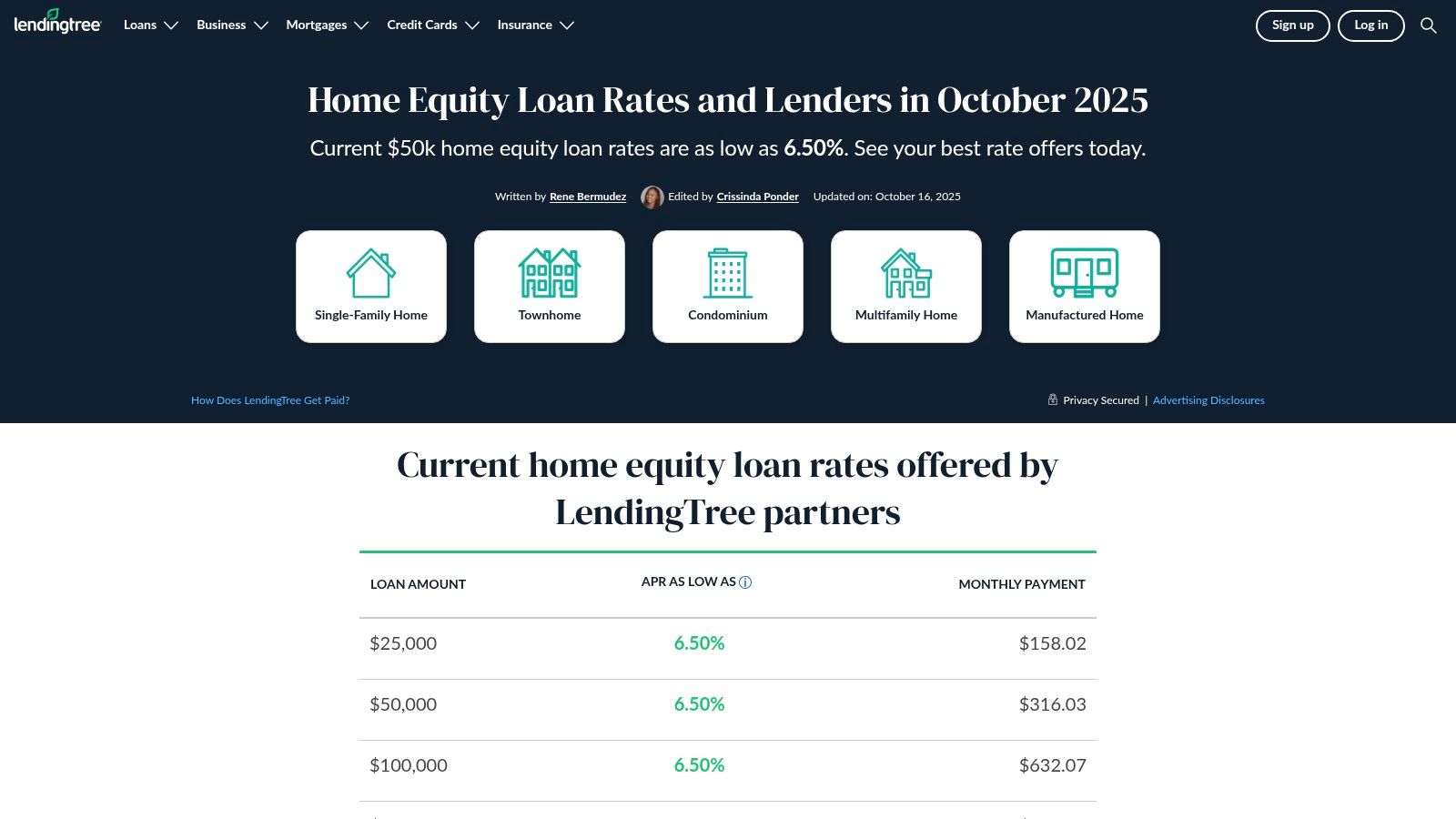
For homeowners who want to maximize their chances of securing the best home equity loan rates, comparison shopping is non-negotiable. LendingTree streamlines this crucial step by functioning as a large online loan marketplace. Instead of applying to multiple lenders one by one, you complete a single, brief form on their platform, and they match you with potential lenders from their extensive network.
This approach saves a significant amount of time and effort. Within minutes of submitting your information, you can receive multiple, personalized loan offers to compare side-by-side. This competitive environment often encourages lenders to present more attractive rates and terms than they might otherwise offer, directly benefiting you, the borrower.
Why LendingTree Stands Out
What makes LendingTree a powerful tool is its combination of a vast lender network and valuable educational resources. The platform not only connects you with lenders but also equips you with the information needed to make a smart decision. This includes regularly updated average rate data, which provides a benchmark to evaluate your offers against. Additionally, they provide a full suite of home equity and affordability calculators to help you model different scenarios.
The user experience is designed for speed and efficiency. The initial form is straightforward, guiding you through the necessary questions about your property, finances, and loan requirements. For those weighing different financial tools, understanding the nuances between tapping equity and refinancing is key. You can explore a detailed comparison to see which option best aligns with your goals by reviewing the differences between a home equity loan and a mortgage refinance.
Key Features and Considerations
| Feature | Description |
|---|---|
| Loan Marketplace | Access a wide network of lenders for both home equity loans and HELOCs. |
| Side-by-Side Offers | Easily compare personalized rates, terms, and fees from multiple lenders. |
| Rate Transparency | Publishes current average home equity loan rates and historical trends. |
| Financial Tools | Offers free home equity calculators and lender reviews to inform your decision. |
Pros:
- Efficient Rate Shopping: Get multiple competitive offers from one application, saving time.
- Transparency: Clearly explains how the marketplace works and how lenders are presented.
- Broad Access: Connects you with a diverse range of national and local lenders.
Cons:
- Multiple Inquiries: Submitting your form may result in contact from several lenders.
- Not Exhaustive: The platform doesn't include every lender in the market.
3. NerdWallet
For homeowners who prioritize research and education before committing, NerdWallet serves as a comprehensive hub for comparing home equity loan rates and lenders. Rather than acting as a direct marketplace, it functions as an editorially driven financial resource that lists, reviews, and rates a wide range of national and regional lenders. This approach empowers you to browse options at your own pace and understand the landscape before seeking pre-approval.
The platform provides a structured, data-rich environment where you can easily see key details like minimum credit score requirements, maximum loan amounts, and available states for each lender. This at-a-glance information is invaluable for quickly eliminating lenders that don't match your financial profile, saving you from applying for loans you are unlikely to qualify for. The ability to filter results helps you zero in on the most relevant options, making your search for the best home equity loan rates more targeted and efficient.
Why NerdWallet Stands Out
What distinguishes NerdWallet is its powerful combination of lender data and expert educational content. The site is designed to arm you with knowledge, featuring in-depth articles, guides, and calculators that explain the nuances of home equity products. This focus on financial literacy helps ensure you are making a well-informed decision, not just choosing the lender with the lowest advertised rate.
The user experience is clean and intuitive, presenting complex information in a digestible format. You can start with a broad overview of top lenders and then use filters to narrow the list based on your credit score, desired loan amount, and location. While NerdWallet is not a direct lender, it provides clear pathways to apply directly on the lender’s website, offering a seamless transition from research to action. You can find their home equity loan comparison tool by visiting NerdWallet's home equity loan page.
Key Features and Considerations
| Feature | Description |
|---|---|
| Lender Ratings | Provides expert ratings and at‑a‑glance criteria for each lender listed. |
| Advanced Filtering | Allows you to sort and filter lenders by credit score, state, and loan amount. |
| Educational Content | Offers a rich library of articles and guides on home equity loans and HELOCs. |
| Direct Application Links | Connects users directly to lenders' official application pages for convenience. |
Pros:
- Easy Comparison: Consistent data points across lenders make for simple side-by-side evaluation.
- Informative Resources: Excellent educational content helps users understand their options fully.
- Helpful Filters: Efficiently surfaces relevant lenders based on your personal financial profile.
Cons:
- Rates Not Always Live: Not all lenders display their current, live rates on the platform.
- Partner-Focused: The list of lenders includes a mix of advertisers and editorial choices.
4. U.S. Bank
For homeowners who value the stability and resources of a large national institution, U.S. Bank offers a compelling and transparent path to securing home equity financing. As one of the country's largest banks, it provides both traditional home equity loans and HELOCs, supported by a robust digital platform and an extensive network of physical branches. This combination appeals to borrowers who want the convenience of online tools alongside the option for in-person support.
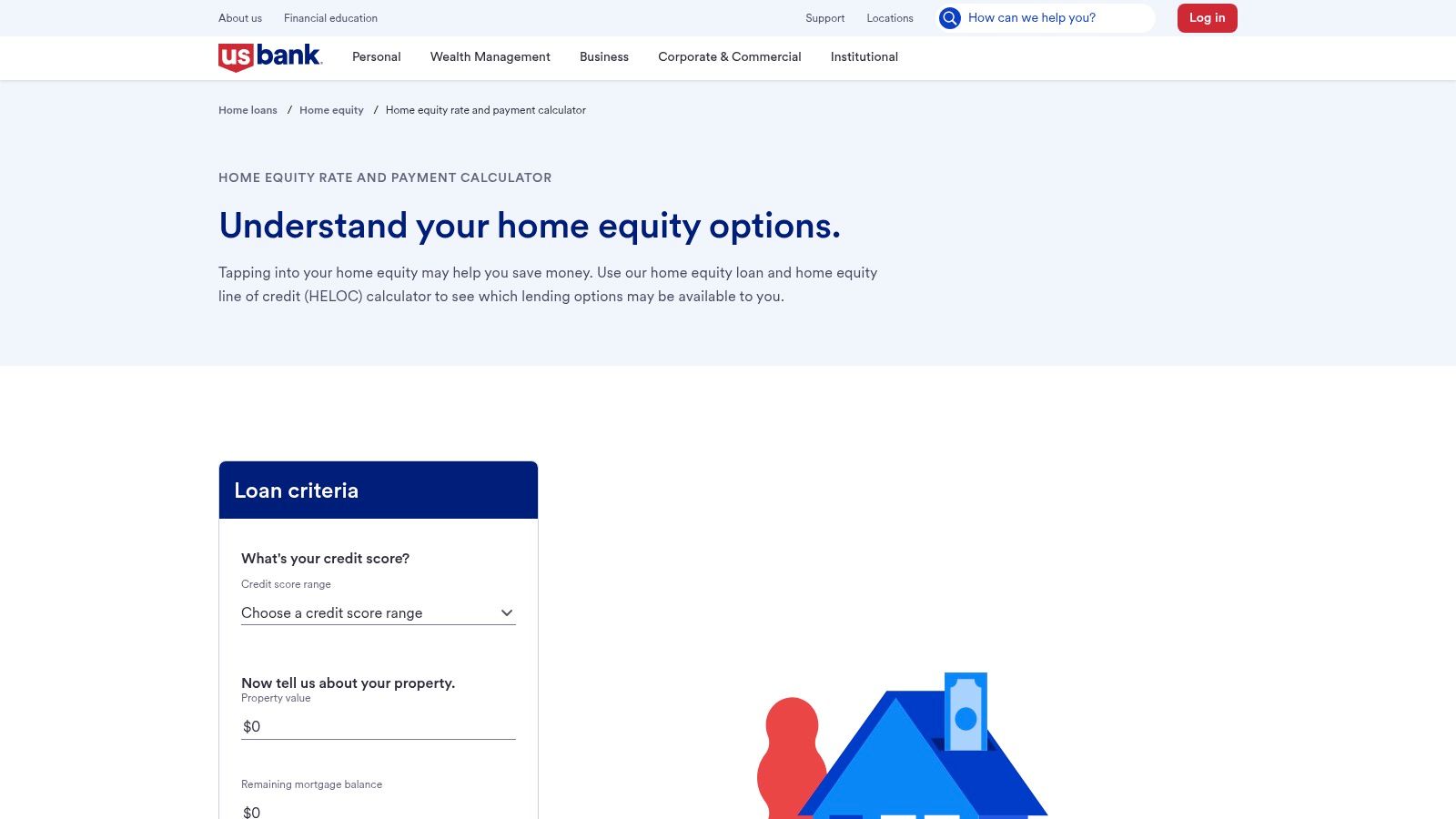
U.S. Bank demystifies the process by publishing clear example APRs and payment scenarios directly on its website. This transparency allows prospective borrowers to set realistic expectations for their potential rates and payments before they even begin an application. By providing these upfront details, the bank helps consumers make more informed decisions about leveraging their home's equity.
Why U.S. Bank Stands Out
What distinguishes U.S. Bank is its blend of upfront rate transparency with the tangible benefits of a major financial institution. Its online home equity rate and payment calculator is a particularly powerful tool, allowing users to model different loan amounts and terms to see estimated monthly payments and APRs. This helps you understand how different variables could impact your borrowing costs.
Furthermore, U.S. Bank offers tangible rate discounts for eligible customers. For example, setting up automatic payments from a U.S. Bank checking or savings account can often lead to a lower interest rate, directly reducing the long-term cost of the loan. This focus on relationship benefits, combined with clear disclosures about fees and rate assumptions, makes it a reliable choice for finding some of the best home equity loan rates.
Key Features and Considerations
| Feature | Description |
|---|---|
| Example APRs | Publishes example rates and payment estimates based on loan term and amount. |
| Online Calculator | Provides a dynamic tool to model different loan scenarios and estimate costs. |
| Autopay Discounts | Offers potential interest rate reductions for setting up automatic payments. |
| Branch Network | Access to in-person support and expertise at physical bank locations nationwide. |
Pros:
- Clear Disclosures: Provides transparent information on fees and rate assumptions upfront.
- National Footprint: Combines powerful digital tools with the support of a large branch network.
- Helpful Scenarios: Example rates and payments help set clear expectations before you apply.
Cons:
- Strict Conditions: The lowest advertised rates require specific credit scores, LTV ratios, and autopay enrollment.
- State Variations: Product availability and terms may differ depending on your location.
5. Figure
For homeowners who prioritize speed and a fully digital process, Figure offers a compelling fintech alternative to traditional lending. This platform specializes in a streamlined, online Home Equity Line of Credit (HELOC) application that can often be completed in minutes. Their approach leverages technology to minimize paperwork and reduce the friction commonly associated with securing home equity financing.
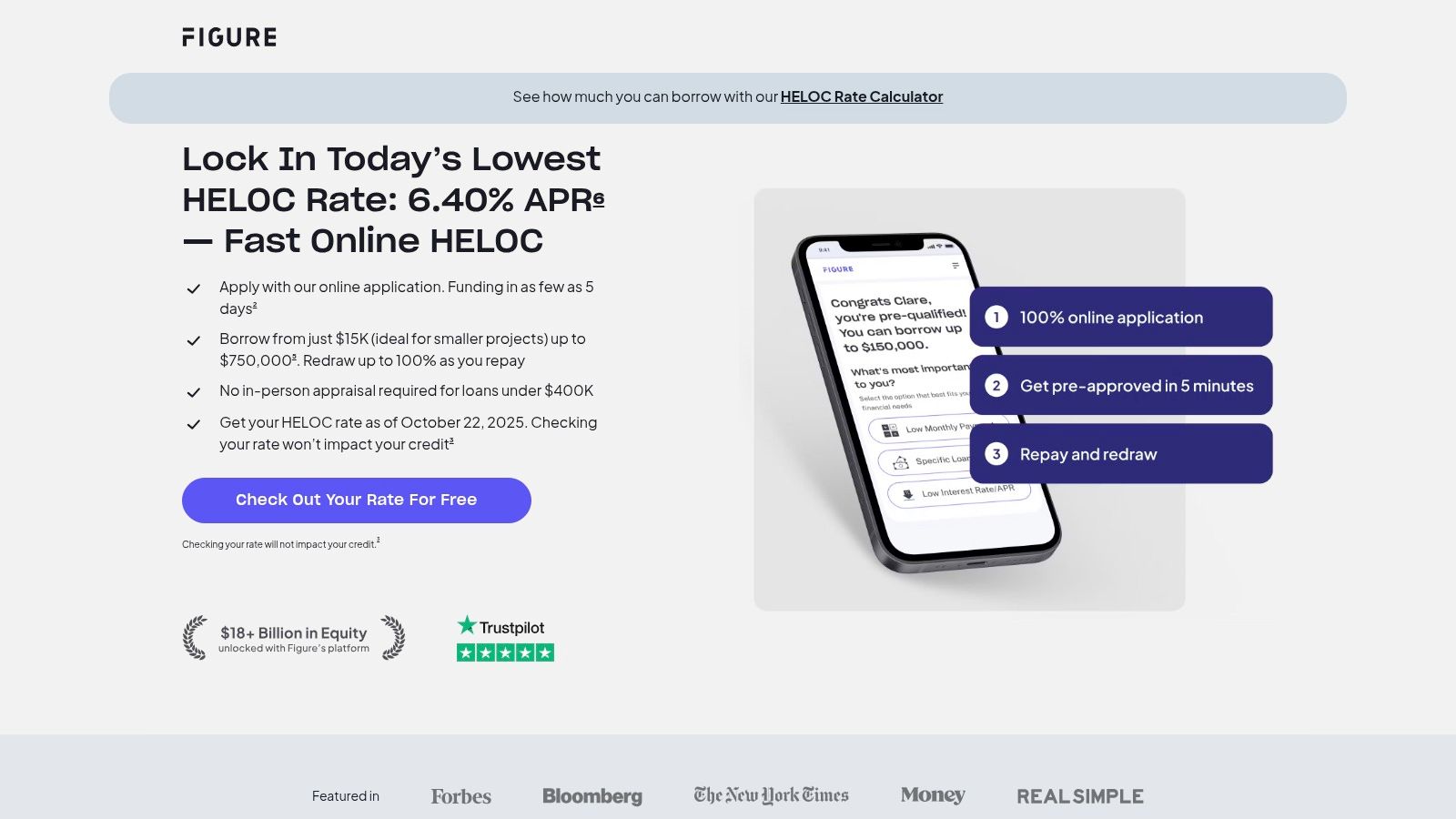
The process begins with a quick online pre-qualification that uses a soft credit pull, meaning it won't impact your credit score. This allows you to see your potential rate and line amount upfront. For many applicants, Figure's automated system can verify property value and financial details without requiring a traditional in-person appraisal, which is a major factor in their ability to provide funding in as little as five days for eligible borrowers.
Why Figure Stands Out
Figure's primary advantage is its technology-first model, which is designed for efficiency and transparency from start to finish. The platform is ideal for tech-savvy borrowers who are comfortable managing their finances through an app-driven interface. Their website prominently displays current promotional APRs, often with date-stamped banners, giving prospective applicants a clear idea of what to expect before they even begin the process.
This digital-first approach significantly accelerates the funding timeline compared to many traditional banks. By automating many of the verification and underwriting steps, Figure removes common bottlenecks, making it one of the fastest ways to access home equity. For borrowers needing quick access to funds for a major purchase, home renovation, or debt consolidation, this speed is a game-changer.
Key Features and Considerations
| Feature | Description |
|---|---|
| Digital HELOC Application | A completely online, secure process from pre-qualification to closing. |
| Fast Funding | Capable of funding a HELOC in as few as five business days. |
| Soft-Pull Pre-Qualification | Check your potential rate and loan amount without affecting your credit score. |
| High Loan Amounts | Offers significant credit lines, and you can redraw funds as you repay the balance. |
Pros:
- Exceptional Speed: The fully digital process offers one of the fastest funding timelines available.
- User-Friendly Experience: A streamlined, intuitive online application makes it easy to apply.
- Rate Transparency: Prominently advertises current rates for quick comparison.
Cons:
- Variable-Rate Product: HELOCs have variable rates that can change, although fixed-rate lock options may be available.
- Promotional Rates: The lowest advertised rates require excellent credit and a strong LTV ratio.
6. Spring EQ
For homeowners who need to access a significant portion of their home's value, Spring EQ stands out as a specialty lender focused exclusively on home equity products. Unlike traditional banks that offer a wide array of financial services, Spring EQ concentrates on providing home equity loans and HELOCs, often with more flexible qualification criteria, such as higher loan-to-value (LTV) ratios. This specialization makes them a go-to option for borrowers looking to maximize their borrowing power.
Their process is designed for the modern borrower, emphasizing a streamlined digital application that can lead to faster closing times compared to many larger institutions. By focusing their expertise, they can often underwrite and approve loans that might fall outside the strict guidelines of more conventional lenders, providing a crucial funding avenue for those with substantial equity.
Why Spring EQ Stands Out
Spring EQ’s primary advantage lies in its generous lending limits and high combined loan-to-value (CLTV) allowances, which can reach up to 90% for qualified homeowners. This is significantly higher than the 80-85% cap imposed by many other lenders, allowing borrowers to tap into more of their home’s equity. This makes them an excellent choice for funding large-scale projects like major home renovations or consolidating high-interest debt.
The platform offers both fixed-rate home equity loans for those who prefer predictable monthly payments and variable-rate HELOCs for those needing flexible access to funds. Understanding the core differences between these two products is vital for making an informed decision, and you can get a clearer picture by exploring the distinctions between a home equity loan and a HELOC. This product flexibility, combined with a modern digital workflow, solidifies its position as a top contender for securing competitive home equity loan rates.
Key Features and Considerations
| Feature | Description |
|---|---|
| High LTV Options | Allows a combined loan-to-value (CLTV) of up to 90% for qualified applicants. |
| Large Loan Amounts | Offers home equity loans and lines of credit up to $500,000. |
| Product Specialization | Focuses exclusively on home equity loans and HELOCs, including interest-only options. |
| Digital Process | A streamlined online application and underwriting process for potentially faster funding. |
Pros:
- Maximizes Equity: Ideal for homeowners needing larger loan amounts or higher LTVs.
- Product Flexibility: Provides both fixed-rate loans and variable-rate HELOCs.
- Efficient Workflow: A digital-first approach can accelerate the closing timeline.
Cons:
- Rate Transparency: Specific rates and fees are typically provided after pre-qualification.
- Limited Availability: Services are not available in all U.S. states.
7. Third Federal Savings & Loan
For homeowners who prioritize transparency and publicly posted rates, Third Federal Savings & Loan offers a refreshingly direct approach. Unlike marketplaces or lenders who require personal information before revealing rates, Third Federal publishes its home equity loan and HELOC rates directly on its website, updated daily for all visitors to see. This makes it an excellent starting point for rate-focused shoppers who want to establish a baseline for comparison.
This bank’s model is built on providing some of the best home equity loan rates upfront, with clear tables that allow you to select your state and county to view precise offerings. Their commitment to competitive pricing is backed by a "Lowest Rate Guarantee," where they promise to beat a competitor's HELOC rate or pay you $1,000, showcasing a high level of confidence in their market position.
Why Third Federal Savings & Loan Stands Out
Third Federal’s standout feature is its radical transparency. The platform eliminates the guesswork often associated with the initial stages of rate shopping. You can immediately see the available fixed-term loan rates, corresponding APRs, and the margins used for their HELOCs relative to the Prime Rate. This directness empowers borrowers to quickly assess if the bank’s offerings align with their financial expectations without submitting an application first.
The user experience is straightforward and data-driven. The website provides robust online calculators and detailed product pages that clearly explain terms, potential fees, and payment scenarios. This educational approach, combined with easily accessible rate information, helps you make a well-informed decision. For those looking to secure the most competitive terms, starting your search at Third Federal provides a powerful benchmark to measure all other offers against.
Key Features and Considerations
| Feature | Description |
|---|---|
| Daily Rate Publication | Publishes exact home equity loan and HELOC rates online, updated daily. |
| Lowest Rate Guarantee | Pledges to beat a competitor’s qualified HELOC offer or pay the applicant $1,000. |
| Transparent Pricing | Clearly displays margins, APRs, and loan terms in easy-to-read tables by location. |
| No Closing Costs | Offers home equity products with no closing costs or annual fees on certain loans. |
Pros:
- Exceptional Transparency: See real, current rates without providing personal information.
- Highly Competitive: The Lowest Rate Guarantee incentivizes them to maintain low rates.
- User-Friendly Tools: Simple online interface with helpful payment and rate calculators.
Cons:
- Limited Availability: Services are not available nationwide; rates are specific to state and county.
- Requires Self-Service: You must navigate to your specific location to find applicable rates.
Top 7 Home Equity Loan Rates Comparison
| Product | Process Complexity 🔄 | Requirements & Eligibility ⚡ | Expected Outcomes 📊 | Ideal Use Cases 💡 | Key Advantages ⭐ |
|---|---|---|---|---|---|
| ShopRates | Streamlined online marketplace that matches applicants with up to five lenders | Varies by lender and borrower; supports broad credit profiles; no upfront fixed pricing | Potentially lower rates via lender competition; results vary by credit and lender fees | Rate‑shopping across many loan types (mortgage, HELOC, auto, business) | Aggregated lender competition, vetted network, calculators and credit tools |
| LendingTree | Single short form returns multiple lender offers quickly | Depends on participating lenders; may trigger outreach from multiple lenders | Fast personalized offers and rate trends; not exhaustive of market | Quick side‑by‑side shopping for home equity and HELOC offers | Large lender network, updated average rates, lender reviews |
| NerdWallet | Editorial comparison hub with filters and outbound links to lenders | Displays lender criteria (min credit score, max amounts); live rates often not posted | Better informed comparisons and narrowed options; not always direct offers | Researching lenders, learning product differences and eligibility | Consistent data points, strong educational content and filters |
| U.S. Bank | Traditional bank application with branch and digital support | Best advertised rates often require autopay, specific LTV/credit conditions; state‑specific rules | Transparent example APRs and payment scenarios; predictable bank‑backed terms | Borrowers preferring a national bank, branch access, and clear disclosures | Clear fee/APR disclosures, calculators, branch support and relationship perks |
| Figure | Fast, fully digital application with soft‑pull prequalification | Rates depend on credit and LTV; promotional APRs are time‑sensitive | Rapid funding timelines for eligible borrowers; competitive promo APRs | Borrowers prioritizing speed and a streamlined app‑driven process | Very fast funding, soft‑pull prequal, clear rate marketing |
| Spring EQ | Digital specialist workflow; underwriting may require more documentation (~3 weeks) | Supports high CLTV (up to ~90%) and large lines for qualified borrowers; limited states | Access to larger loan amounts and higher CLTVs; outcomes depend on prequal | Borrowers needing large cash amounts or higher combined LTVs | High CLTV limits, product flexibility, specialist home‑equity focus |
| Third Federal Savings & Loan | Online daily rate screens and applications; select state/county for exact rates | Location‑dependent availability; not all counties supported | Frequently posts low advertised rates and offers a Lowest Rate Guarantee | Rate‑focused shoppers who compare daily posted rates by location | Transparent daily rates, Lowest Rate Guarantee, clear calculators and disclosures |
Your Next Steps to Securing the Lowest Home Equity Loan Rate
Navigating the world of home equity loans can feel complex, but with the right strategy, you can confidently unlock the value in your home at the most favorable terms. This guide has provided an in-depth comparison of top lenders and tools, from the comprehensive marketplace of ShopRates to direct lenders like U.S. Bank and innovative platforms like Figure. Now, it's time to translate that knowledge into action.
The key takeaway is that securing the best home equity loan rates is not a passive activity. It requires preparation, diligent comparison, and a clear understanding of what lenders are looking for. Your credit score, debt-to-income ratio, and the amount of equity you hold are the primary levers you can influence to command a lower interest rate.
Preparing Your Financial Profile
Before you submit a single application, take the time to strengthen your financial standing. This preparatory phase is the most critical step in ensuring you receive competitive offers rather than just accepting the first one that comes along. Successfully securing the best home equity loan rate also involves a structured approach to your financial choices, similar to mastering the investment decision-making process, ensuring you evaluate all options thoroughly.
Here are the most impactful actions you can take:
- Review Your Credit Report: Obtain free copies of your credit reports from all three major bureaus (Equifax, Experian, and TransUnion). Dispute any inaccuracies, as even small errors can drag down your score.
- Lower Your DTI: Focus on paying down high-interest revolving debt, like credit card balances. This lowers your DTI and demonstrates responsible credit management to lenders, directly impacting the rates you're offered.
- Organize Your Documentation: Lenders will require proof of income (pay stubs, W-2s), asset statements (bank accounts, investments), and information about your existing mortgage. Having these documents ready will streamline the application process.
Strategic Comparison Shopping
Once your finances are in order, the next step is to compare lenders strategically. Never assume the first quote is the best. Using a marketplace tool allows you to see multiple offers side-by-side, giving you negotiating power and a clear view of the market.
Remember to look beyond the advertised interest rate. Pay close attention to the Annual Percentage Rate (APR), which includes fees and provides a more accurate picture of the loan's total cost. Inquire about origination fees, appraisal costs, and potential prepayment penalties. These details can significantly alter the long-term affordability of your loan. A slightly higher rate from a lender with zero closing costs might be a better financial decision than the lowest rate saddled with thousands in upfront fees. This comprehensive evaluation is central to finding the truly best home equity loan rates for your unique situation.
Frequently Asked Questions About Home Equity Loan Rates
What is a good home equity loan rate today?
A "good" rate is relative and depends on the current prime rate set by the Federal Reserve, as well as your personal financial profile. Generally, a competitive rate will be a few percentage points above the current prime rate. Borrowers with excellent credit (740+ FICO), low debt-to-income ratios, and significant home equity will secure the lowest rates. To know what’s truly good for you, it’s essential to compare multiple personalized offers from different lenders.
How do lenders determine my home equity loan rate?
Lenders consider several key factors. Your credit score is the most significant, followed by your debt-to-income (DTI) ratio, and your combined loan-to-value (CLTV) ratio. A higher credit score, lower DTI, and lower CLTV (meaning you're borrowing less against your home's total value) will result in a lower interest rate because you represent less risk to the lender. The loan term you choose also plays a role; shorter terms often have lower rates but higher monthly payments.
Can I get a fixed interest rate on a home equity loan?
Yes, this is one of the primary features of a standard home equity loan. Unlike a Home Equity Line of Credit (HELOC), which typically has a variable rate, a home equity loan provides a lump-sum payment with a fixed interest rate. This means your monthly principal and interest payment will remain the same for the entire life of the loan, offering predictability for budgeting.
Is it better to get a home equity loan from a bank or a credit union?
Both have their advantages. Large national banks often offer sophisticated online tools and a wide range of products, while local credit unions are non-profits known for personalized service and potentially lower rates and fees for their members. The best choice depends on your priorities. It's wise to get quotes from both types of institutions to ensure you're getting the most competitive terms available.
Will applying for a home equity loan hurt my credit score?
The initial pre-qualification process with many online lenders (like Figure) uses a soft credit inquiry, which does not affect your credit score. However, once you formally apply for a loan, the lender will perform a hard credit inquiry, which can cause a temporary, minor dip in your score (usually a few points). Shopping for rates within a short period (typically 14-30 days) is often treated as a single inquiry by credit scoring models, minimizing the impact.
What are the average closing costs for a home equity loan?
Closing costs for a home equity loan typically range from 2% to 5% of the total loan amount. These can include appraisal fees, origination fees, title search fees, and other administrative costs. However, many lenders offer no-closing-cost options by either waiving the fees or rolling them into the loan's interest rate, so be sure to compare the Annual Percentage Rate (APR), not just the interest rate.
How much equity do I need to qualify for a home equity loan?
Most lenders require you to retain at least 15% to 20% equity in your home after the loan is issued. This means your combined loan-to-value (CLTV) ratio cannot exceed 80% to 85%. To calculate your available equity, subtract your current mortgage balance from your home's current market value. For example, if your home is worth $400,000 and you owe $200,000, you have $200,000 in equity. Lenders would likely allow you to borrow up to an amount that keeps your total debt (mortgage + new loan) at or below $340,000 (85% CLTV).
How can I improve my chances of getting the best home equity loan interest rates?
To secure the best possible rates, focus on improving your financial profile before you apply. The most impactful steps are: boosting your credit score by paying bills on time and reducing credit card balances, lowering your debt-to-income ratio by paying down existing debt, and verifying your home's value to ensure your equity calculation is accurate. Finally, always compare offers from at least three to five different lenders.
What is the difference between APR and interest rate?
The interest rate is the cost of borrowing the money, expressed as a percentage. The Annual Percentage Rate (APR) is a broader measure of the loan's cost. It includes the interest rate plus other charges and fees, such as origination fees, closing costs, and points. Because it reflects the total cost of borrowing, the APR is a more accurate tool for comparing loan offers from different lenders.
Should I choose a home equity loan or a HELOC?
Choose a home equity loan if you need a specific amount of money in one lump sum for a large, one-time expense (like a major renovation or debt consolidation) and prefer the stability of a fixed interest rate and predictable monthly payments. Choose a HELOC if you need flexible, ongoing access to funds for intermittent expenses (like medical bills or tuition) and are comfortable with a variable interest rate. A HELOC functions more like a credit card secured by your home.
Ready to find your best rate? Instead of navigating multiple lender websites on your own, let ShopRates do the heavy lifting. Our platform connects you with a network of pre-vetted lenders, allowing you to compare personalized home equity loan offers in minutes, all in one place. Visit ShopRates to start your comparison and take control of your financial future today.


