
Decoding Auto Loan Rates for Used Cars: A Comprehensive Guide
When you begin the exciting process of shopping for a used car, the sticker price is merely the opening act. The main event, and often the more complex part of the financial equation, is the auto loan interest rate. Rates for used cars can fluctuate dramatically, ranging from as low as 6.82% for an individual with an impeccable credit history to well over 21.58% for borrowers navigating significant credit challenges.
While the broader economic climate establishes a general baseline for interest rates, it's your personal financial health that serves as the single most influential factor in determining the final deal a lender will offer you.
Your Definitive Guide to Navigating Used Car Loan Rates
Welcome to a real-world, expert-led guide on used car financing. As a seasoned financial professional, I've seen firsthand the sticker shock that many buyers experience when they discover how much loan rates can vary—even for two people attempting to purchase the exact same vehicle. This guide is designed to pull back the curtain on the lending process and illuminate what truly drives those numbers.
Leveraging decades of award-winning financial expertise, we're sharing the insider knowledge that lenders rely on when they construct a loan offer. We will meticulously break down how your credit score, the vehicle's age, the loan's duration, and your choice of lender all interconnect to shape your final interest rate.
Understanding the Current Rate Landscape
Our primary goal here is simple: to elevate you beyond generic advice and provide you with a practical, deep-seated understanding of how used car loans truly operate. In the first quarter of 2025, the national average interest rate for a used car loan settled at 11.87%. However, this average figure masks a vast and significant range.
Borrowers with "super prime" credit (scores from 781–850) were securing rates as low as 6.82%. At the opposite end of the spectrum, individuals with "deep subprime" credit (scores from 300–500) were faced with rates that escalated past 21.58%. You can explore these automotive finance trends in greater detail at Experian.com.
Our mission is to arm you with actionable strategies that you can implement to lock in the most favorable terms possible. We are committed to helping you drive away not only with a great car but with an even better financial deal. To get a preliminary idea of where you might stand, we recommend reviewing our guide on today's auto loan interest rates.
Think of your interest rate as the price you pay for borrowing money. A pristine, collectible car costs more than a daily driver. In the same way, a borrower with a flawless financial history pays a lower "price" (their interest rate) than someone who looks like a bigger risk to the lender.
To provide a quick baseline of what you can anticipate, the table below breaks down the average rates categorized by credit score. This is an indispensable starting point for comprehending how lenders will likely perceive your application.
Average Used Car Auto Loan Rates by Credit Score
Here’s a concise overview of typical APR ranges you can expect for a used car loan based on standard credit score tiers.
| Credit Score Tier | Score Range | Average APR |
|---|---|---|
| Super Prime | 781 – 850 | 6.82% |
| Prime | 661 – 780 | 8.55% |
| Nonprime | 601 – 660 | 12.18% |
| Subprime | 501 – 600 | 17.21% |
| Deep Subprime | 300 – 500 | 21.58% |
Source: Experian State of the Automotive Finance Market, Q1 2025
Seeing these numbers laid out makes it unequivocally clear: the single most powerful action you can take to secure a lower rate is to improve your credit score. This directly translates into saving hundreds, or even thousands, of dollars over the life of your loan.
How Your Credit Score Shapes Your Loan Offer
Think of your credit score as your financial reputation, distilled into a single, potent number. It’s the very first metric a lender examines, and it tells them a detailed story about how you manage your financial obligations. This goes beyond the simple axiom of "good credit equals low rates"; this score is a direct measure of the risk a lender undertakes by providing you with capital. This entire concept is known as risk-based pricing, and it is the bedrock of the entire lending industry.
From a lender's perspective, a loan is an investment. They are putting their money on the line, trusting you will repay it with interest. Like any prudent investor, they aim to minimize risk. An individual with a 780 credit score has a demonstrated track record of timely payments and responsible debt management, making them a low-risk proposition. Conversely, a borrower with a 620 score might have a history that includes late payments or high credit card balances, signaling a greater probability of encountering financial difficulties.
Lenders price this risk directly into your interest rate. The borrower with the 780 score receives the most competitive rates because their history inspires confidence. The borrower with the 620 score is offered a higher rate to compensate the lender for assuming that additional risk.
The Anatomy of a Credit Score Lenders Care About
When a lender accesses your credit profile, they see far more than just the three-digit score; they analyze all the underlying data. While a FICO score comprises five major components, lenders place particular emphasis on three specific areas when you're applying for auto loan rates for used cars.
These are the elements that paint the clearest picture of your financial habits and best predict your ability to handle a recurring car payment.
- Payment History (35% of your score): This is the paramount factor. It is a straightforward record of one simple question: did you pay your past obligations on time? Any missteps—such as late payments, accounts sent to collections, or bankruptcies—will significantly lower your score and act as a major red flag for lenders.
- Credit Utilization (30% of your score): This metric is all about the proportion of your available credit you are currently using. If you have a $10,000 limit on a credit card and a $9,000 balance, your utilization is 90%. High utilization suggests that you might be financially overextended and heavily reliant on debt, which portrays you as a riskier borrower.
- Length of Credit History (15% of your score): A longer credit history provides lenders with more data to evaluate your reliability. An account you've managed responsibly for ten years is a much stronger indicator of dependability than one you just opened six months ago.
The infographic below illustrates how these key factors—along with others—converge to determine the rate you ultimately receive.
As you can see, while your credit score is the central focus, factors like the vehicle's age and even the type of lending institution you choose also exert a tangible influence on your final auto loan rate.
Taking Control of Your Credit Profile
The empowering news is that understanding these components puts you firmly in control. You can take direct, meaningful steps to enhance your profile long before you ever visit a dealership. Even if your score is not perfect, there is always a path toward improvement.
The most powerful move a borrower can make is to shift from being reactive to proactive. By checking your credit report months before you plan to buy a car, you give yourself time to dispute errors, pay down balances, and put your best foot forward. This preparation can save you thousands.
Even modest improvements can have a substantial impact. Simply moving from a "subprime" to a "nonprime" credit tier can reduce your interest rate by several percentage points. For those facing more significant credit challenges, the initial step is to understand the available options. To delve deeper, explore our detailed guide on how to get loans with bad credit. By focusing on these critical areas, you’re not just chasing a number—you're building a rock-solid case for why you're a dependable borrower who deserves the best possible auto loan rates for used cars.
Why Vehicle Age and Loan Term Matter to Lenders
Beyond your credit score, two of the most significant levers that influence your interest rate are the car itself and the duration of your repayment period. Lenders view a used car as more than just your next mode of transport; it is the collateral that secures their loan. Understanding their perspective on this is crucial to grasping why the car's specific characteristics and your loan's timeline can so dramatically alter your rate.
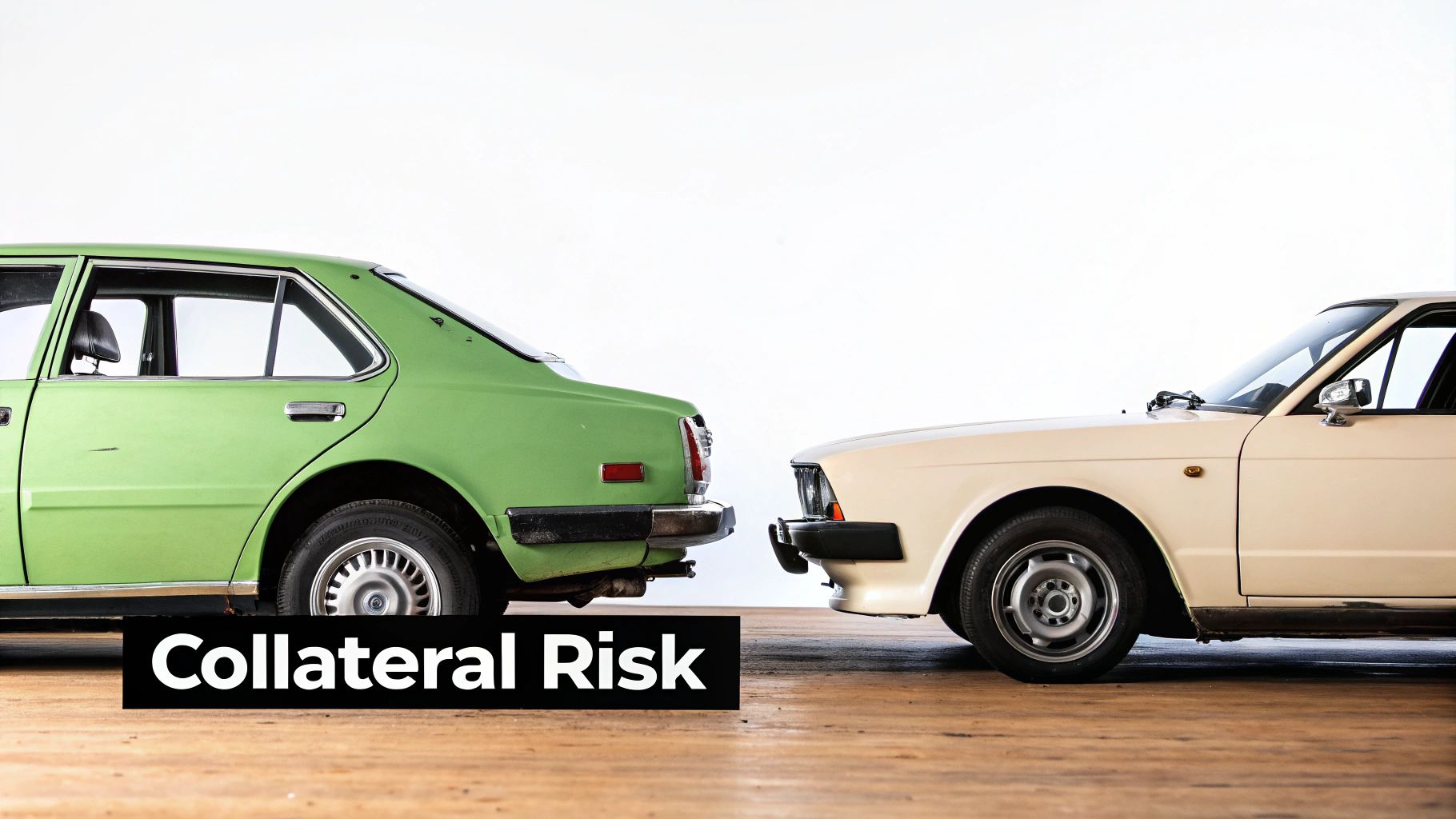
A car's age and mileage create their own distinct risk profile, entirely separate from yours. A newer used car with low mileage is a known quantity, a predictable asset. However, an older vehicle with 100,000+ miles on the odometer presents a much larger question mark for a lender. It has a higher probability of experiencing expensive mechanical failures, which could strain a borrower's budget and, in a worst-case scenario, their ability to maintain payments. This added risk is passed directly to you in the form of higher auto loan rates for used cars.
The Depreciation Dilemma for Lenders
Depreciation—the rate at which a car loses its value—is a constant concern for lenders. From the moment they approve your loan, they are meticulously tracking the loan-to-value (LTV) ratio. Their objective is to ensure that the amount you owe does not significantly outpace the car's actual market worth.
Older cars exhibit more erratic depreciation patterns and simply have less residual value, making them less stable collateral. If a borrower defaults on a loan for a 10-year-old car, the lender might only recover a fraction of the outstanding balance after repossessing and selling it.
To a lender, a car's depreciation curve is a risk meter. A steep and unpredictable curve on an older vehicle means higher risk, which they offset by charging a higher interest rate. It’s their financial safeguard against a rapidly declining asset.
Recent market volatility has only amplified this complexity. As of August 2025, used car prices in the U.S. surged by 6.0% year-over-year—a much faster rate than the 0.7% increase for new cars. This trend has inflated the average used car loan amount to $26,795, compelling lenders to exercise extra caution when predicting a vehicle's long-term value. For a deeper analysis of these trends, you can explore the latest auto debt statistics on LendingTree.com.
The Trade-Offs of a Longer Loan Term
Selecting a loan term is a classic balancing act: lower monthly payments versus the total cost of borrowing. It is tempting to extend a loan to 72 or even 84 months to reduce the monthly payment, but this convenience comes at a significant long-term cost.
Lenders almost invariably charge higher interest rates for longer terms. The logic is straightforward: more time equates to more risk. Over six or seven years, your financial circumstances could change, the car will continue to age and depreciate, and their capital is tied up for a much longer period. To compensate for this extended risk, they increase the APR.
The result? You end up paying substantially more in total interest. While a smaller monthly bill feels manageable in the short term, opting for the shortest loan term you can comfortably afford is one of the most powerful money-saving strategies at your disposal. You'll not only secure a better rate but also pay off the car faster, build equity, and free up your cash flow sooner.
Observe how powerful this effect is on a typical used car loan.
Loan Term Impact on a $25,000 Used Car Loan
The table below illustrates exactly how different loan terms can alter the financial outcome of a hypothetical $25,000 used car loan with a 9% APR. The difference is eye-opening.
| Loan Term | Monthly Payment | Total Interest Paid | Total Cost of Loan |
|---|---|---|---|
| 48 Months | $622 | $4,866 | $29,866 |
| 60 Months | $519 | $6,123 | $31,123 |
| 72 Months | $450 | $7,419 | $32,419 |
As you can see, stretching the loan from 48 to 72 months might lower your payment by $172, but it will cost you an additional $2,553 in pure interest. This is a perfect illustration that the most "affordable" loan isn't always the one with the lowest payment, but rather the one with the shortest term you can comfortably manage.
Comparing Lenders: Banks, Credit Unions, and Online Options
Determining where to secure your car loan is just as critical as your credit score or the specific vehicle you've chosen. One of the most costly mistakes consumers make is passively accepting whatever financing the dealership offers without exploring alternative options. To truly obtain the best auto loan rates for used cars, you must create a competitive environment where lenders vie for your business.
This means becoming familiar with your primary choices: traditional banks, member-owned credit unions, and the burgeoning field of online lenders. Each operates with a different model, bringing its own set of advantages and disadvantages that may align perfectly—or poorly—with your financial situation.
Traditional Banks
For many people, large national banks and local community banks represent the default starting point. This is understandable; they are familiar, convenient, and if you already have a checking or savings account with one, you may be eligible for loyalty benefits or a more streamlined application process.
However, it is essential to remember that banks are for-profit institutions with shareholders to satisfy. This pressure often results in more stringent lending criteria and less flexibility on terms, especially if your credit is less than perfect. While they offer a sense of stability, their rates are not always the most competitive available.
Credit Unions
Credit unions are the not-for-profit counterparts in the financial world. They are owned by their members, a structural difference that changes everything. Instead of pursuing profits for external investors, they reinvest their earnings back to their members in the form of lower interest rates, reduced fees, and often, a more personalized and understanding approach to lending.
For a lot of used car buyers, credit unions are the hidden gem. They consistently offer some of the lowest auto loan rates you'll find and are generally more willing to work with folks who have a few bumps on their credit report. The only catch is that you have to be eligible to join, which is usually tied to where you live, who you work for, or an organization you belong to.
Online Lenders
The internet has completely revolutionized the auto loan industry, introducing a new wave of online-only lenders and marketplaces. Their primary selling points are speed, convenience, and intense competition. Platforms like ShopRates allow you to complete a single, straightforward application and receive multiple offers from various lenders within minutes.
This approach saves a significant amount of time and effort, presenting you with a full menu of auto loan rates for used cars for which you qualify instantly. As you compare your options, it's also wise to understand the broader market context; grasping the latest trends in auto loan availability and interest rate strategies among major lenders provides valuable insight. The only real drawback for some is the absence of a physical branch if you prefer face-to-face interaction.
Ultimately, the "best" lender is simply the one that provides the most advantageous deal for your specific situation. A savvy car buyer will not limit their search to a single channel. By obtaining pre-approval from a bank, a credit union, and an online marketplace, you acquire the ultimate bargaining chip. You reverse the traditional power dynamic, ensuring you walk onto the dealership lot holding all the cards.
Your Step-by-Step Plan to Secure the Lowest Rate
Understanding how rates are determined is one thing, but having a concrete action plan is what truly saves you money. This is your strategic playbook for transforming knowledge into tangible savings.
Following these steps before you even consider visiting a dealership will completely change the narrative. It places you in command of the financing process, rather than being at its mercy.
This process isn't about finding a car. It's about meticulously preparing your finances so you can secure the best possible deal on that car. Let's walk through the strategic moves that distinguish smart borrowers from the rest.
Step 1: Solidify Your Credit Foundation
Your real work should begin months before you start browsing car listings. The absolute first action you must take is to pull your complete credit report from all three major bureaus—Equifax, Experian, and TransUnion.
Scrutinize every single line item with the precision of a detective. A simple error, such as an old account that has been paid off but still shows an outstanding balance, can depress your score and cost you a fortune in interest. If you discover any inaccuracies, dispute them immediately. You would be astonished at how much this simple act of financial housekeeping can elevate your score.
Step 2: Secure Your Pre-Approval Leverage
I cannot overstate the importance of this step: it is the single most critical action in the entire process. Obtaining pre-approval for a car loan from several different lenders before you shop is your ultimate weapon. It instantly transforms you from a hopeful applicant into what dealerships perceive as a cash buyer.
When you walk in with a pre-approval letter, you have already established the interest rate ceiling. You know what constitutes a competitive offer. Our guide on auto loan pre-approval simplifies this, helping you collect offers directly from your home.
A pre-approval isn't just a rate quote; it's negotiating power. It allows you to confidently walk into a dealership's finance office and say, "Beat this," forcing them to compete for your business on your terms.
Step 3: Calculate Your True Budget
A successful car purchase is about more than just being able to afford the monthly payment. You must calculate the total cost of ownership. This includes not just the loan payment, but also insurance, fuel, routine maintenance, and the inevitable repairs—all of which tend to be higher for used vehicles.
Using a reliable car payment calculator is a non-negotiable part of this preparation. Input different loan amounts, interest rates, and term lengths. Observe exactly how these variables affect your monthly payment and, more importantly, the total interest you will pay over the life of the loan. This clarity prevents you from getting trapped with a payment that slowly constricts your budget.
Step 4: Strategize Your Down Payment
A substantial down payment sends a powerful signal to lenders. It demonstrates your financial stability and immediately lowers their risk by reducing the loan-to-value (LTV) ratio on the vehicle. A lower LTV often translates directly into a lower interest rate.
Your goal should be a down payment of at least 20% of the used car's purchase price. Not only will this help you secure better loan terms, but it also provides a critical buffer against depreciation. It is the most effective way to avoid being "upside down" on your loan, a situation where you owe more than the car is actually worth.
Answering Your Top Used Car Loan Questions
Navigating the world of used car financing can often leave you with more questions than answers. Even after you've grasped the fundamentals—credit scores, loan terms, and lender types—the practical "what if" scenarios begin to emerge. This section is dedicated to addressing those common, persistent questions we hear from borrowers every day.
Consider this your final confidence-building checklist. We’ve compiled the most frequently asked questions about auto loan rates for used cars to resolve any lingering confusion and ensure you have all the information needed to make an intelligent financial decision.
What Is a Good Interest Rate for a Used Car Loan?
That is the pivotal question, and the most honest answer is: it depends. A "good" rate is entirely relative to your credit profile and the current economic conditions. What is an exceptional rate for one person might be merely average for another.
To provide you with a solid benchmark, here’s how the numbers typically break down by credit score:
- Super-Prime (781+): If your score is in this top tier, any rate under 7% is a fantastic achievement.
- Prime (661-780): For this large group of borrowers, a rate between 7% and 9% is considered very competitive.
- Near-Prime (601-660): You should aim for a rate somewhere in the 10% to 14% range.
- Subprime (Below 600): Rates will be higher, but securing a loan under 18% from a reputable lender is a solid outcome.
Currently, the national average for a used car loan is hovering around 11-12%. If you can obtain a rate significantly below the average for your credit bracket, you are in an excellent position. The only way to know for sure is to get multiple offers from different lenders and compare them directly.
Can I Get a Used Car Loan with Bad Credit?
Yes, absolutely. It is entirely possible to secure a used car loan with a credit score below 600, but it is crucial to approach the process with realistic expectations. Lenders view these loans as higher risk, which directly translates to higher interest rates and sometimes more restrictive terms, such as a lower cap on the loan amount or a shorter repayment period.
The key is to work with lenders that specialize in the subprime auto market. To maximize your chances of approval and obtain the best possible terms, focus on these three things:
- Provide a larger down payment. Putting down 20% or more drastically reduces the lender’s risk.
- Choose a more affordable vehicle. A smaller loan amount makes your application appear much stronger.
- Show proof of stable income. Lenders need to see you have a consistent, reliable means to make the payments.
Your most strategic move is to get pre-approved before you ever visit a dealership. This establishes a firm budget and protects you from being persuaded into a disadvantageous deal on the lot.
A single percentage point can feel small, but its impact over the life of a loan is massive. On a $25,000 used car loan over 60 months, the difference between a 9% APR and an 8% APR is substantial. At 9%, your monthly payment is about $519, and you'll pay $6,123 in total interest. Drop that to 8%, and your payment becomes $507, with total interest falling to $5,435. That 1% difference saves you nearly $700.
Why Are Used Car Loan Rates Higher Than New Car Rates?
This often perplexes buyers, but from a lender's perspective, the logic is quite straightforward. Auto loan rates for used cars are almost always higher because they represent a greater risk, and it all comes down to the car’s value as collateral.
A new car’s value is a known quantity, and its depreciation follows a predictable trajectory. A used car, conversely, has a variable history, condition, and value. Lenders are concerned that if the borrower defaults, an older car with higher mileage will not have sufficient resale value to cover the outstanding loan balance. This increased risk is priced directly into your interest rate, providing the lender with a financial buffer.
Is It Better to Get Financing from a Dealership or My Bank?
The optimal strategy is not to choose one over the other—it is to make them compete for your business. Always, without exception, obtain a pre-approval from your own bank, a local credit union, or an online lender before you begin car shopping.
That pre-approval serves as your baseline offer and your single most powerful negotiating tool. When you find a car you want at the dealership, you can walk into the finance office, present your pre-approved rate, and ask one simple question: "Can you beat this?" Dealerships work with a vast network of lenders and can often find a better deal, but without your own offer in hand, you have no way of knowing if what they're offering is truly competitive.
Does a Car's Mileage Affect the Interest Rate?
Yes, it absolutely does, often just as much as the car's age. High mileage is a direct indicator of wear and tear, which points to a higher probability of mechanical issues in the future. To a lender, a car with 120,000 miles is simply riskier collateral than the same model with only 40,000 miles.
This increased risk of breakdowns and more rapid value depreciation means the lender will charge a higher interest rate to compensate. In fact, many lenders have strict cutoffs and will not finance vehicles with over 100,000 or 125,000 miles at all, making loans for high-mileage cars both more expensive and more difficult to obtain.
Ready to find the best auto loan rate for your next used car? At ShopRates, we make it easy. Our marketplace connects you with multiple lenders who compete for your business, ensuring you get the transparent, competitive financing you deserve. Compare offers in minutes and take control of your car-buying journey today. Visit ShopRates.com to get started.


