A Complete Guide to Bad Credit Debt Consolulation Loans
Feeling buried under a mountain of debt is an isolating experience. When you add a low credit score to the mix, it can feel like you're stuck in a financial hole with no clear path out. Juggling multiple bills—from credit cards and personal loans to lingering medical expenses—each with its own punishing interest rate and due date, creates a chaotic mess that’s nearly impossible to manage.
This guide is designed to be your first step toward regaining control. As a financial expert who has guided thousands of people through these exact challenges, I'm here to demystify a powerful strategy: bad credit debt consolidation loans. Think of it as a strategic move to gather all those scattered, high-cost debts and consolidate them into one single, manageable payment.
How to Escape the Debt Cycle with a Low Credit Score

The concept behind a debt consolidation loan is refreshingly straightforward. You secure one new loan and use the funds to pay off all your other high-interest balances. Instantly, you're no longer juggling five or six different payments. Instead, you have one predictable monthly payment to a single lender, on a set schedule.
For anyone navigating the complexities of a less-than-perfect credit history, this approach can be a financial game-changer. It establishes a clear path forward and offers several tangible, immediate benefits.
- Simplified Finances: Remembering one due date is infinitely easier than tracking half a dozen. This simplification alone dramatically reduces the risk of accidentally missing a payment and further damaging your credit score.
- Potential for Significant Savings: If you can secure a loan with an interest rate lower than the average of your current debts, you stand to save a substantial amount of money over the life of the loan. This means more of your payment goes toward the principal, not just interest.
- A Clear Opportunity for Credit Rebuilding: Every on-time payment you make on the new consolidation loan is reported to the major credit bureaus. This consistent, positive payment history is the single most powerful factor in rebuilding your credit score over time.
A consolidation loan doesn't magically erase your debt—it intelligently restructures it into a smarter, more sustainable repayment plan. The ultimate goal is to put you back in control, stabilize your financial footing, and begin the crucial work of improving your creditworthiness for the long term.
We'll cut through the financial jargon to provide a realistic, expert look at how these loans work, who qualifies, and what potential pitfalls to avoid.
Of course, securing a loan is only one piece of the puzzle. To truly break free from the debt cycle, you must commit to improving your financial habits and credit health. Diving into these eight tips to repair bad credit is a fantastic starting point. And for those looking to make a swift impact, learning how to improve your credit score fast can provide the momentum needed to qualify for even better loan terms in the future.
Understanding How Debt Consolidation Really Works
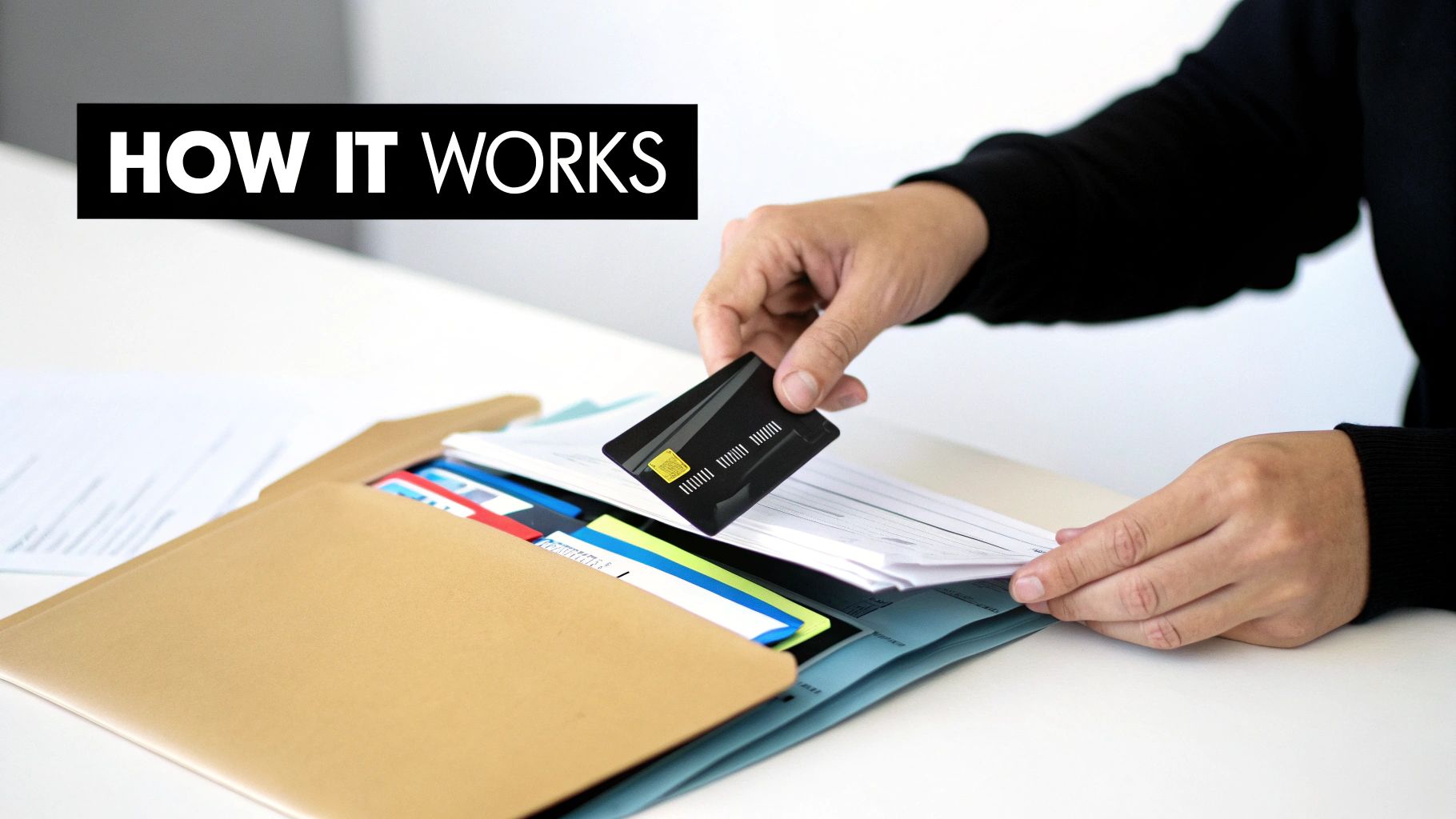
At its core, a bad credit debt consolidation loan is a tool designed to bring order to financial chaos. Imagine your finances as a cluttered desk piled high with various bills—credit card statements, a nagging medical bill, perhaps an old personal loan. Each of these represents a separate due date and, more importantly, a high-interest rate that drains your resources. It’s a stressful and inefficient way to manage money.
Now, picture a single, organized file box. A debt consolidation loan is that box. You use this one new loan to sweep all that clutter—all those scattered, high-interest debts—off the desk and into one streamlined place.
The result? You are left with one predictable monthly payment to a single lender, typically with a fixed interest rate and a clear end date. That overwhelming pile of bills is transformed into a straightforward, manageable action plan.
Why Would a Lender Offer a Loan to Someone with Bad Credit?
It might seem counterintuitive. Why would a financial institution lend money to someone who has experienced credit challenges? The reality is that lenders specializing in loans for people with bad credit understand that a credit score is a snapshot of the past, not a definitive prediction of the future.
These lenders dig deeper, analyzing your current financial stability to determine if you can responsibly handle a new loan today.
- Stable Income: They require verifiable proof of a steady income stream. This demonstrates that you have the consistent cash flow necessary to make your monthly payments.
- Employment History: A stable job history serves as a strong indicator of financial reliability and future earning potential.
- Debt-to-Income (DTI) Ratio: This crucial metric measures how much of your monthly income is already allocated to existing debt payments. Lenders need to ensure that a new loan payment won't overextend your budget.
Lenders in this specialized field are essentially underwriting your present ability to repay, not just your past credit missteps. By demonstrating a solid income and a manageable existing debt load, you can often secure a loan despite a low credit score.
Secured vs. Unsecured Consolidation Loans
As you explore your options, you'll encounter two primary types of bad credit debt consolidation loans. Understanding the distinction is vital for choosing the right path for your circumstances.
Unsecured Loans
This is the most common type of personal loan for debt consolidation. An unsecured loan does not require you to provide any collateral. The lender grants the loan based solely on their assessment of your financial profile and ability to repay. Because the lender assumes more risk, these loans may come with slightly higher interest rates compared to secured options.
Secured Loans
A secured loan is backed by an asset you own, such as your car or equity in your home. This asset serves as collateral. If you fail to repay the loan, the lender has the right to take possession of the asset to recoup their losses. Because the collateral significantly reduces the lender's risk, you may qualify for a larger loan amount or a lower interest rate, even with a challenging credit history.
Weighing the Benefits and Risks of Consolidation
Let's be direct: taking on a new loan to manage existing debt is a significant financial decision, especially when your credit history is less than perfect. A bad credit debt consolidation loan can be an incredibly effective tool for seizing control of your finances, but it is not a cure-all. It's imperative to understand both the powerful advantages and the potential pitfalls to make a choice that genuinely benefits you in the long run.
This is about more than just shuffling numbers. It's about fundamentally changing your approach to debt management. Let's delve into what that means from a clear, balanced, and expert perspective.
The Clear Advantages of Consolidating Debt
The most immediate and impactful benefit is simplicity. Juggling multiple due dates, varying interest rates, and different minimum payments is not only stressful—it's a system ripe for error. A consolidation loan eliminates that complexity.
- A Single Monthly Payment: Instead of tracking several bills, you have one predictable payment. This organizational shift dramatically lowers the risk of a late payment, which is critical when you are actively working to protect and rebuild your credit score.
- Potential for a Lower Interest Rate: The interest on high-rate credit cards can feel like you're treading water financially. If you can secure a consolidation loan with an APR that is lower than the weighted average of your current debts, you will save money and make tangible progress on paying down the principal balance.
- A Structured Path to Better Credit: Every on-time payment you make on this new installment loan is reported to the credit bureaus. This consistent, positive payment history is a primary driver in improving your credit score over time. Furthermore, paying off revolving credit card balances can drastically lower your credit utilization ratio—another key component of your credit score's health.
Understanding the Potential Downsides
While the benefits are compelling, it is just as important to approach this strategy with your eyes wide open to the risks. This is not a passive solution; it requires genuine discipline to succeed.
The single greatest pitfall is the temptation to reuse the credit cards you've just paid off. Clearing those balances can create a false sense of financial freedom. Before you know it, you could be accumulating new debt on top of the consolidation loan, digging a deeper hole than the one you started in.
A consolidation loan restructures your existing debt; it does not eliminate it. Success hinges on your commitment to changing the spending habits that led to the debt in the first place.
To help you evaluate your options, here is a straightforward comparison of the pros and cons.
Pros vs Cons of Bad Credit Debt Consolidation Loans
| Potential Advantages (Pros) | Potential Disadvantages (Cons) |
|---|---|
| Streamlined Finances with one predictable monthly payment. | Potentially Higher Interest Rates than loans for applicants with good credit. |
| Lower Overall Interest Costs if your new rate is better than your average current rate. | Risk of Accumulating New Debt by reusing paid-off credit cards. |
| Improved Credit Score through consistent, on-time payments and lower credit utilization. | Origination Fees that can be deducted from your loan proceeds, reducing the amount you receive. |
| Fixed Repayment Schedule provides a clear end date for your debt and a predictable budget. | Longer Loan Terms could mean you pay more in total interest over the life of the loan. |
Ultimately, a bad credit debt consolidation loan is a strategic financial instrument. When used responsibly, it can provide the structure and breathing room necessary to finally get out of debt and rebuild your credit. However, if it isn't coupled with a firm budget and a genuine commitment to avoiding new debt, it can backfire and worsen your financial situation. The key is to be brutally honest with yourself about your financial habits and ensure you're prepared for the discipline required.
How to Qualify for a Debt Consolidation Loan
When you're dealing with a low credit score, it's easy to assume that number is the only thing lenders care about. But for those of us who specialize in financial solutions like bad credit debt consolidation loans, we know that's a narrow view. Lenders in this space have learned to look beyond the score to assess the complete financial picture of the individual.
Think of the qualification process less as a pass/fail exam and more as a holistic review of your current financial stability. Lenders understand that a low score often reflects past hardships, not your ability to manage payments today. To truly gauge your chances of approval, you need to see your application from their perspective and understand what they are truly evaluating. This is what can give you a strong opportunity for approval, even with a credit score below 600. It's all about demonstrating that you are a reliable borrower now, irrespective of past financial challenges.
Beyond the Score: What Lenders Really Look For
Ultimately, lenders need to answer one fundamental question: can you reliably repay this new loan? To determine this, they examine several key areas of your financial life that paint a far more detailed picture than a three-digit score alone.
Here’s what is actually being scrutinized:
- Verifiable and Stable Income: This is the cornerstone of your application. Lenders need to see concrete proof of consistent income. This means providing recent pay stubs, bank statements showing regular deposits, or tax returns. A steady employment history is a significant asset as it signals financial stability.
- Debt-to-Income (DTI) Ratio: Your DTI is a simple percentage that shows how much of your gross monthly income is already committed to existing debt payments. Lenders use this to determine if you can comfortably afford another payment. While a DTI below 43% is often preferred, don't be discouraged if yours is higher—some lenders are more flexible, particularly if you have a strong, consistent income.
Lenders are fundamentally assessing your present capacity, not just your past performance. Proving you have a stable income and manageable existing debts is your most powerful tool for securing a loan with a less-than-perfect credit history.
Preparing Your Documentation for Success
To build a compelling case, you need to have your paperwork in order. Gathering these documents before you apply not only streamlines the process but also demonstrates to the lender that you are organized and serious about improving your financial situation.
You can expect to be asked for the following:
- Proof of Identity: A valid driver’s license, passport, or other government-issued photo ID.
- Proof of Income: Typically, your two most recent pay stubs, W-2 forms, or bank statements.
- Proof of Residence: A recent utility bill or a copy of your lease or mortgage statement.
- Information on Existing Debts: A clear, detailed list of each creditor, the total amount owed, and your account numbers.
Understanding these broader requirements is crucial. For a more in-depth look, this guide on how to get loans with bad credit can provide additional insights into the entire process. By focusing on these core elements, you build a much stronger application and can approach lenders with the confidence that you are presenting your best financial self.
Your Step-by-Step Application Guide
Applying for a bad credit debt consolidation loan can feel daunting, but it doesn't have to be. The key is to break the process down into a simple, manageable roadmap that keeps you in control from start to finish.
View this not as a test of your worth, but as a strategic plan of action. By following these steps methodically, you'll demystify the process and build confidence as you move from consideration to action.
Step 1: Organize Your Debts
Before you do anything else, you must gain a crystal-clear understanding of your total debt load. This step is non-negotiable. Grab a notepad, open a spreadsheet, or use a budgeting app—whatever works best for you—and create a master list of every single debt you intend to consolidate.
For each debt, you must accurately record these details:
- The creditor's name (e.g., Chase, Discover, a specific medical provider)
- The exact current balance you owe
- The annual percentage rate (APR) for each account
This comprehensive list is your most valuable tool. It tells you the total loan amount you need to seek and, crucially, highlights the high-interest "predatory" debts that are costing you the most money each month.
Step 2: Review Your Credit Report
Next, it's time to review what lenders will see when they evaluate your application. You are legally entitled to a free credit report every 12 months from each of the three major credit bureaus: Equifax, Experian, and TransUnion. Pull all three reports and scrutinize them carefully.
You are looking for inaccuracies—accounts you don't recognize, payments incorrectly marked as late, or negative items that are too old to be listed. The Federal Trade Commission has found that a significant percentage of consumers have errors on their reports. Identifying and disputing these errors before you apply can provide a meaningful boost to your score and help you secure a more favorable loan offer.
This infographic highlights the primary factors lenders assess during the qualification process.
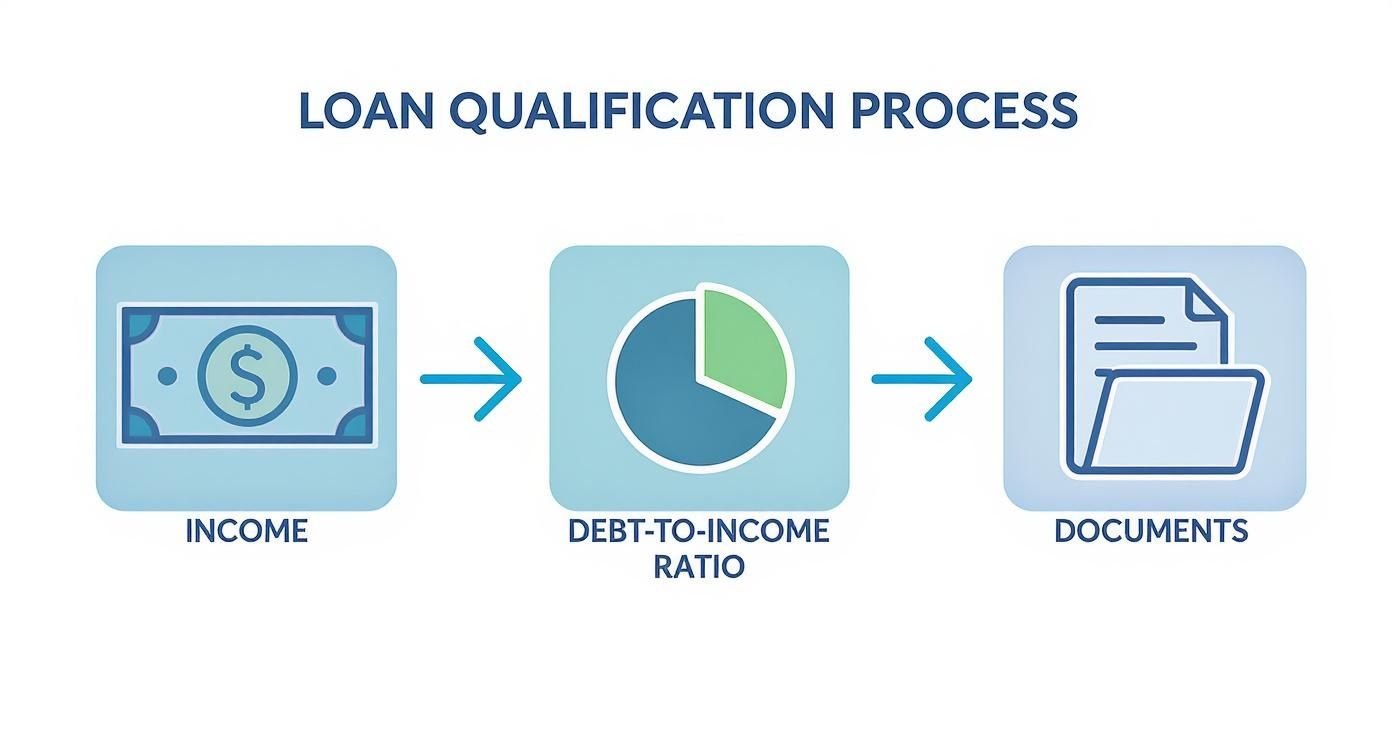
As you can see, lenders are just as interested in your current financial stability—your income, your existing debts, and your paperwork—as they are in your past credit missteps.
Step 3: Research and Pre-Qualify
Now you can begin shopping for a lender. It's essential to focus your search on financial institutions that explicitly work with individuals in your credit tier, such as many online lenders and local credit unions.
The single most important part of this stage is pre-qualification. This process allows you to see potential loan offers, including interest rates and terms, based on a soft credit inquiry. The key benefit? A soft inquiry does not impact your credit score.
Aim to get pre-qualified with at least three to five different lenders. This is the only way to effectively compare offers side-by-side and identify the most affordable loan without negatively affecting your credit. This is smart, strategic shopping.
Step 4: Apply and Analyze the Offer
Once you've identified the best pre-qualified offer, it's time to gather your documents and submit the formal application. This is the step that will trigger a hard credit inquiry, which may cause a small, temporary dip in your credit score.
If you are approved, resist the urge to sign immediately. You must carefully review the final loan agreement. Pay meticulous attention to the final APR, check for any origination fees, and confirm the exact monthly payment and the total loan term. Ensure that everything in the final offer aligns with your budget and financial goals before you formally commit.
Exploring Smart Alternatives to Consolidation Loans
While bad credit debt consolidation loans are a powerful tool for regaining financial control, they are not the only solution available. A truly informed financial decision involves evaluating every viable option on the table.
In some cases, a different strategy may be a better fit for your unique circumstances, especially if the idea of taking on a new loan feels counterproductive. Let's explore some of the most effective alternatives for managing debt that don't necessarily involve borrowing more money.
Nonprofit Credit Counseling and DMPs
One of the most reputable and effective alternatives is to partner with a nonprofit credit counseling agency to enroll in a Debt Management Plan (DMP). This is not a loan, but rather a structured, professionally administered repayment program designed to make your existing debts more manageable.
Here’s the process: You make a single, consolidated monthly payment to the credit counseling agency. The agency then distributes that payment to your various creditors on your behalf. The key benefit is that the agency negotiates with your creditors to significantly reduce your interest rates, which can lower your total monthly payment and help you become debt-free years sooner.
Crucially, a credit check is not required to enroll in a DMP, making it an excellent option if a low credit score is a major obstacle. It's always wise to weigh all your choices, from DMPs to various personal loans for debt consolidation, to determine the best path forward for your financial health.
Debt Settlement Cautions
You will undoubtedly encounter advertisements for debt settlement companies, but I urge you to approach this option with extreme caution. The sales pitch is alluring: a company will negotiate with your creditors to allow you to pay back only a fraction of what you owe.
While this sounds appealing, the process can be devastating to your credit score. To achieve these settlements, you are typically instructed to stop paying your creditors and instead deposit money into a separate savings account. This intentional default wrecks your payment history and sends a massive red flag across your credit report.
For those in truly dire financial straits, especially homeowners at risk of losing their property, it becomes critical to understand how Chapter 13 bankruptcy can stop foreclosure and provide a structured, legal path forward when other options are insufficient.
Self-Directed Payoff Strategies
If you have the discipline and a reasonably stable income, you can absolutely architect your own successful debt payoff plan. This requires a systematic approach. The two most popular and proven methods are the debt snowball and the debt avalanche.
-
Debt Snowball: With this method, you list all your debts from the smallest balance to the largest. You continue to make minimum payments on all debts, but you allocate every extra dollar you can find to the smallest debt. Once it's paid off, you "roll" the payment you were making on it over to the next-smallest debt. This creates a powerful "snowball" of momentum and provides quick psychological victories to keep you motivated.
-
Debt Avalanche: This strategy involves listing your debts by interest rate, from the highest APR to the lowest. You focus all your extra payments on the debt with the highest interest rate first. While it may take longer to get the first "win," this method is mathematically guaranteed to save you the most money in interest payments over the long term.
Frequently Asked Questions (FAQs) About Bad Credit Debt Consolidation Loans
Navigating the world of debt consolidation loans, especially with a challenging credit history, naturally brings up a lot of questions. Over my decades in finance, I've heard nearly every concern imaginable from people just like you. My goal here is to provide clear, direct answers to the most common questions, cutting through the financial jargon to give you the clarity you need to move forward with confidence.
1. Will a debt consolidation loan hurt my credit score?
This is a common concern, and the answer involves a short-term dip for a potential long-term gain. When you formally apply, the lender performs a "hard inquiry," which can temporarily lower your score by a few points. However, the long-term effects are overwhelmingly positive if managed correctly. Making consistent, on-time payments on the new loan builds a strong payment history—the most important factor in your credit score. Additionally, paying off credit card balances drastically lowers your credit utilization ratio, which provides another significant boost to your score.
2. What is the minimum credit score needed for a bad credit debt consolidation loan?
There is no single "magic number," as requirements vary by lender. Large traditional banks often look for scores of 670 or higher. However, many online lenders and credit unions that specialize in loans for bad credit are willing to work with applicants who have scores as low as 580. They place greater emphasis on factors like your income stability and your debt-to-income ratio, focusing on your current ability to repay the loan rather than solely on past credit mistakes.
3. Can I consolidate all types of debt with one loan?
Generally, you can consolidate most forms of unsecured debt. This includes common debts like credit card balances, medical bills, and high-interest personal or payday loans. You typically cannot include secured debts, such as your mortgage or a car loan, as these are tied to specific collateral. Student loans may or may not be eligible depending on the lender's specific policies, so it's always best to ask.
4. What happens if I miss a payment on my consolidation loan?
Missing a payment is a serious issue that should be avoided. The immediate consequence is usually a late fee from the lender. If the payment becomes more than 30 days past due, the lender will report it to the credit bureaus, causing significant damage to your credit score and undermining your rebuilding efforts. Continued missed payments can lead to the loan going into default, which results in severe credit damage and potential collections action. It is absolutely critical to ensure the monthly payment fits comfortably within your budget before accepting the loan.
5. Are there any hidden fees with these loans?
It's important to look for "origination fees." This is a one-time fee some lenders charge for processing the loan, typically ranging from 1% to 8% of the total loan amount. The fee is usually deducted from the loan proceeds before the funds are disbursed to you. Always read the loan agreement carefully and ask the lender to clarify all fees—including origination fees, late payment fees, and any prepayment penalties—before you sign.
6. How quickly can I get the funds from a bad credit consolidation loan?
Many online lenders have streamlined their application and approval processes. After you submit your application and required documents, you can often receive a decision within one business day. If approved, the funds can be disbursed either directly to your bank account or, in some cases, directly to your creditors, within a few business days.
7. Can I get a debt consolidation loan without a job?
It is very difficult, but not impossible. Lenders need to see a source of regular, verifiable income to ensure you can repay the loan. If you are unemployed, you would need to show proof of other consistent income sources, such as disability benefits, retirement income, alimony, or investment returns. Without a demonstrable ability to make payments, your application is unlikely to be approved.
8. What's the difference between a debt consolidation loan and debt settlement?
A debt consolidation loan is a tool to repay your debts in full under more manageable terms. You borrow money to pay off your existing creditors and then repay that single new loan over time. Debt settlement is a process where a company negotiates with your creditors to accept a lower amount than what you actually owe. While it may reduce your debt, it severely damages your credit score because it requires you to stop making payments, causing your accounts to go into default.
9. Can a co-signer help me get approved for a bad credit loan?
Yes, applying with a co-signer who has a strong credit history and stable income can significantly improve your chances of approval. A co-signer legally agrees to take responsibility for the loan if you are unable to make payments. This reduces the risk for the lender, which can also help you qualify for a lower interest rate than you would on your own.
10. Does consolidating my debt automatically close my old credit card accounts?
No, the consolidation loan simply pays off the balances on your credit cards. The accounts themselves will remain open unless you or the credit card company closes them. While it can be tempting to use the newly available credit, financial experts strongly advise against it. The most effective strategy is to keep the accounts open (which helps your credit history length) but avoid using them while you focus on paying down your new consolidation loan.
Ready to stop juggling bills and start moving forward? At Shop Rates, we connect you with lenders who understand that a credit score doesn't tell the whole story. We specialize in helping people find manageable financial solutions, even with bumps in their credit history. You can compare real, personalized loan offers in minutes to find a plan that truly works for you. Explore your options at https://shoprates.com and take the first concrete step toward a simpler, more secure financial future.


