
How to Get Startup Funding: A Seasoned Founder’s Guide
Knowing how to get startup funding isn't merely about having a revolutionary idea. It's about demonstrating, with irrefutable proof, that your business is a rock-solid investment. In my decades as a financial expert, I've seen countless pitches. The ones that succeed present a bulletproof case for their company, backed by a meticulous business plan, realistic financial projections, and a crystal-clear understanding of their unique place in the market.
Building Your Foundation for Investor Readiness
Before a single email is drafted to a potential investor, the foundational work must be complete. I can state with certainty, after reviewing thousands of proposals, that the founders who secure capital are not just selling a dream. They are presenting a meticulously planned business that instills immediate confidence.
Consider this the process of getting your own house in order long before you ask for the keys to someone else's vault. This preparatory phase is your first—and most critical—test. It demonstrates to investors that you are a serious, capable leader who comprehends what it truly takes to build a company from the ground up.
Crafting a Compelling Business Plan
Your business plan is far more than a formal document; it's the strategic roadmap for your company's future. It must tell a powerful, data-driven narrative about the problem you solve, the market you serve, and the precise methodology for generating significant returns. Forget the generic mission statements; it's time to get down to the details that investors scrutinize.
- Executive Summary: This is your hook. It must be a concise, powerful overview of your entire plan. While written last, it's the first thing an investor reads. Make every word count.
- Market Analysis: Prove you've done the rigorous homework. Detail the total addressable market (TAM), your specific target audience, and a competitive analysis. Use hard data and market research, not assumptions.
- Products & Services: Be specific about your offering. Crucially, explain the "pain point" it eliminates for your customer. What problem ceases to exist because of your solution?
Developing Realistic Financial Projections
This is a common stumbling block for many founders. Wildly optimistic or vague financials are an immediate red flag for any seasoned investor. You must construct detailed projections that showcase a complete command of the numbers driving your business's growth and, ultimately, its profitability.
I can tell you from decades of experience, a founder who can confidently walk an investor through their P&L, cash flow statement, and balance sheet is ten times more likely to secure a second meeting. It demonstrates expertise and fundamentally lowers the perceived risk of the investment.
Your financial model should map out a realistic three- to five-year forecast. Be prepared to rigorously defend your core assumptions for revenue streams, customer acquisition costs, operational expenses, and your growth trajectory. Organizing these documents now also provides a significant head start on the paperwork required when you formally apply for capital, which is a key component of most business loan requirements.
Defining Your Unique Value Proposition
Finally, you must be able to articulate what makes you different in a single, sharp sentence. Your Unique Value Proposition (UVP) is the core of your pitch and your marketing. It must answer the simple question: "Why should a customer choose you over every other alternative?"
A strong UVP is not a catchy slogan; it is a clear, quantifiable promise of value. For instance, instead of a weak statement like, "We sell eco-friendly coffee," a much stronger UVP would be, "We deliver sustainably sourced, single-origin coffee to your door within 48 hours of roasting, guaranteeing peak freshness and flavor." That is the kind of benefit-driven message that cuts through the market noise and forces investors to take notice.
Where in the World Is the Money? Understanding the Global Startup Funding Landscape

To raise capital successfully, you must learn to think like an investor. This means knowing precisely where the money is flowing. The world of startup funding is not a level playing field; it's a dynamic global map where hotspots of opportunity constantly shift based on economic trends, investor risk appetite, and governmental support.
Founders who master these geographical currents gain an immense strategic advantage. It's not just about who you pitch, but also where you look for capital. A dose of global awareness can completely reshape your fundraising strategy and unlock doors you never knew existed.
The Shifting Tides of Capital
For what felt like an eternity, Silicon Valley was the undisputed epicenter of the startup universe. While it remains a dominant force, the landscape has broadened and become far more interesting. We are now witnessing an incredible surge in ecosystems far beyond the United States, particularly in the Asia-Pacific region.
This is no minor shift. While the U.S. startup scene saw respectable growth of 18.2%, some international markets have exploded past that figure. Singapore’s ecosystem, for example, expanded by a phenomenal 44.9%, while China’s national growth reached a staggering 45.9%.
This momentum is fueled by a perfect storm of massive capital injections, state-of-the-art infrastructure, and intelligent government programs designed to attract elite entrepreneurs. The bottom line for you? Your search for funding should not be constrained by national borders.
In my work advising founders, those who adopt a global mindset from day one often secure capital faster and on more favorable terms. They aren't just competing for a slice of the local pie; they're tapping into a much larger, more diverse pool of international investors hungry for the next disruptive innovation.
What This Global View Means for Your Strategy
Observing these international trends is more than just an interesting data point—it's actionable intelligence for your fundraising campaign. This knowledge should directly inform how you position your company and where you concentrate your efforts.
Consider these strategic implications:
- International VC Interest: Does your business possess global appeal? If so, targeting VCs in rapidly expanding markets like Singapore or Dubai could be an incredibly astute move.
- Cross-Border Partnerships: You might discover strategic partners or even your first major clients in these booming economies. Securing an international partner can make your startup far more attractive to investors everywhere.
- Strategic Relocation: For some entrepreneurs, moving the business to an emerging startup hub can provide direct access to unique funding programs, specialized talent pools, and world-class mentorship.
Regardless of your industry, understanding the different types of business loans and equity options available both domestically and abroad is critical. Knowing where capital is flowing allows you to fish where the fish are, putting your startup in the strongest possible position to secure the funding it needs to scale.
When you hear "startup funding," your mind likely jumps straight to Venture Capital (VC). It's often portrayed as the ultimate prize, but having analyzed these deals for my entire career, I can assure you—it's an exceptionally demanding and exclusive path.
What VCs are truly seeking boils down to a few core tenets: a business capable of massive scale, a concept that fundamentally disrupts a market, and a credible plan for them to achieve a lucrative exit. It is never just about a great idea; it's about a finely-tuned business model engineered for explosive, exponential growth.
The capital flowing into this space is staggering. A crucial part of learning how to get startup funding is understanding this world. In 2024, global venture capital investment reached $337 billion, the third-highest total ever recorded. And in the first quarter of 2025 alone, there were 23 separate funding rounds that each exceeded $1 billion. The significant capital is available, especially for startups in tech and AI that can truly earn an investor's confidence.
Angel Investors: The First Believers
Long before a VC firm will even consider a meeting, many startups receive their first meaningful capital from angel investors. These are not institutions; they are high-net-worth individuals who invest their personal funds, typically in exchange for an equity stake.
Unlike VCs who answer to a board, angels are often driven by a genuine passion for an industry or a desire to mentor the next generation of entrepreneurs. They are the ones who write those first critical checks, providing the runway to transform a concept into a viable product. The relationship often feels more personal, but make no mistake—their expectations for execution are just as rigorous. They are betting on you.
To provide a clearer picture of how this early-stage funding operates, consider the differences between pre-seed and seed rounds, which are typically fueled by angels.
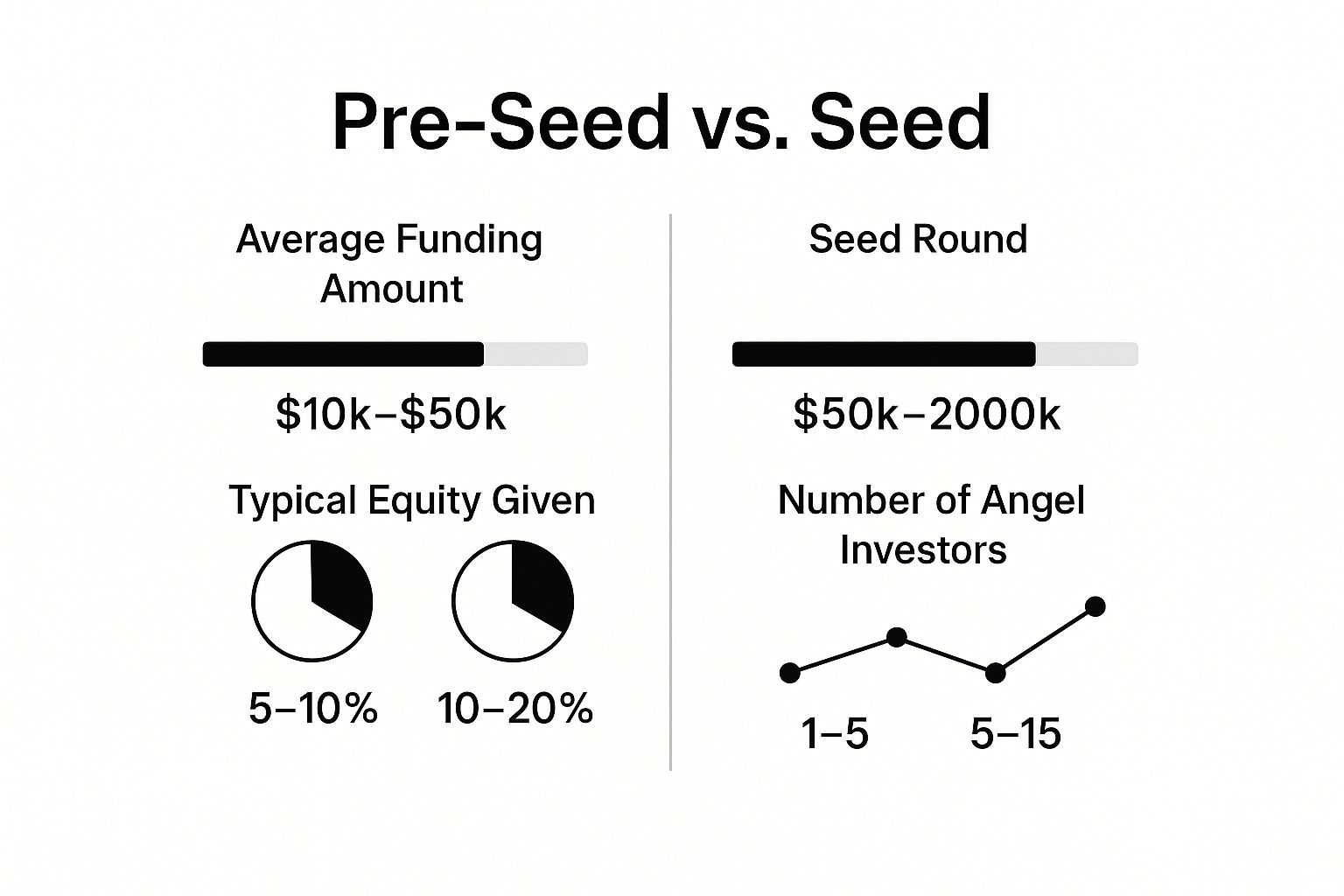
As this illustrates, progressing from a pre-seed to a seed round involves not just more capital but also more investors around the table. Consequently, this also means you will likely be relinquishing a larger percentage of your company.
The World of Venture Capital
Securing a check from a VC is a completely different endeavor. These firms manage enormous pools of capital from their limited partners (LPs) and are under immense pressure to deliver massive returns. This means they are hunting for businesses that can realistically scale to a $100 million valuation or more. Anything less is often a non-starter.
From my professional vantage point, the most significant error founders make when approaching VCs is underestimating the power of the network. A warm introduction from a trusted source—another founder, a corporate lawyer, or an industry contact—can be the deciding factor between your pitch deck being reviewed or being instantly deleted.
When weighing your funding options, you must be brutally honest about the trade-offs. VC money can be like rocket fuel for your growth, but it comes with intense expectations, board seats, and relentless pressure to scale at a breakneck pace. There are many avenues for financing for startups, and selecting the right one depends entirely on your specific business model, your current stage, and your long-term vision.
Overcoming Systemic Hurdles in Startup Funding

Let's be direct. Understanding the mechanics of getting startup funding is one thing. But for too many founders, the path to capital is riddled with obstacles that others never have to consider. It’s a difficult reality, but systemic biases are a persistent and very real challenge in the world of venture capital.
Acknowledging this isn't about lodging a complaint—it's about developing a superior strategy. It is the first step toward building a game plan to succeed despite the odds.
For decades, I've watched these dynamics play out. From the "old boys' club" network biases to investors subconsciously pattern-matching for founders who look and sound like their last successful investment, the playing field is simply not level. The most glaring example is the gender disparity in funding, and the statistics tell a story that cannot be ignored.
The gender funding gap is more than a headline; it's a massive economic drag. In 2024, for example, startups with all-male founding teams attracted $156.2 billion in VC funding. Meanwhile, companies led exclusively by women secured just $28.1 billion.
This isn't merely an equity issue. It represents a missed global economic opportunity valued at over $5 trillion. As a result, many brilliant women-led startups have become masters at navigating these challenging waters by tapping into a mix of alternative funding sources. For a deeper dive, review the research on the state of funding for female founders.
Actionable Strategies for Triumph
Recognizing the problem is where you begin. Building a playbook to overcome it is how you succeed. This isn't about waiting for the system to correct itself—it's about arming yourself with strategies that achieve results now. Founders from underrepresented backgrounds are achieving incredible success by being smarter, more targeted, and more creative in their quest for capital.
In my experience, the founders who triumph over these obstacles don't just have a great pitch; they have a superior strategy. They actively seek out investors and platforms that value their unique perspective as a competitive advantage, not a liability.
Here are a few powerful and proven approaches that are working today:
- Target Specific Funds: Do not waste time on VCs who do not understand your vision. Instead, seek out venture funds and angel investor groups with an explicit mission to invest in women, minority, or other underrepresented founders. Their entire investment thesis is built around discovering the incredible talent that others overlook.
- Embrace Impact Investing: Connect with impact investors who prioritize social or environmental returns alongside financial ones. If your startup has a strong mission at its core, these investors will see immense value where a traditional VC might not.
- Leverage Community Crowdfunding: Platforms like Republic or WeFunder are game-changers. They allow you to raise capital directly from your community and customer base. This does more than just fill your bank account—it builds a loyal army of brand evangelists who are literally invested in your success.
Ultimately, breaking through these systemic hurdles is about building a powerful and diverse network. It’s about finding mentors who have walked this path before and learning to frame your startup's unique story as its greatest strength. It’s about turning what some might perceive as a disadvantage into your most compelling asset.
A Practical Guide to Your ShopRates Application

After all the late nights, detailed planning, and perfecting your pitch, you’ve reached the final step: securing the capital to bring your vision to life. This is where the rubber meets the road. As a nationwide lender headquartered right here in Nashville, TN, we at ShopRates designed our application process with one person in mind—the serious entrepreneur. Our goal is to get you the funding you need to grow, without the classic corporate runaround.
I’ve seen thousands of applications cross my desk over the years. The ones that sail through underwriting always have one thing in common: they’re complete, organized, and tell a clear story of where the business is and where it’s headed. We’ve made our system as straightforward as possible, but coming prepared makes all the difference.
What Our Underwriters Look For
When our team reviews your application, they’re not looking for perfection. They’re trying to understand the fundamental health and potential of your business. It's less about a flawless financial history and more about demonstrating a rock-solid plan for the future.
Think of it as a final exam where showing your work is half the grade. We focus on a few key areas:
- Consistent Revenue: A proven track record of cash flow, even if it's modest, shows us there’s a real market for what you do. It validates your business model.
- A Clear Use of Funds: We need to see exactly how this capital will generate more revenue. Will it fund a game-changing marketing campaign, purchase essential new equipment, or allow you to buy inventory in bulk? Be specific.
- Manageable Debt: We’ll look at your existing financial obligations to make sure a new loan is a smart move that won't over-leverage your operations. It’s about sustainable growth.
Insider Tips for a Stronger Submission
To sidestep common delays and make your application truly stand out, treat it like your final, most important pitch. Every document should be clean, accurate, and easy for our underwriters to digest. My best advice? Get everything organized before you even start filling out the online form.
In all my years in finance, I can tell you that a well-organized application package signals a well-organized founder. It immediately builds trust and shows us you’re serious about managing your business and our capital responsibly.
Here’s a simple checklist to get you ready:
- Gather Your Financials: Have your recent bank statements, profit and loss statements, and balance sheet ready to upload. Digital copies are perfect.
- Write a Brief Summary: A quick, one-paragraph summary of your business and how you plan to use the funds provides invaluable context for our team.
- Check for Accuracy: This one is huge. Double-check all numbers, names, and addresses. A simple typo is the most common reason for an unnecessary delay.
Approaching the ShopRates application with this level of preparation puts you on the fast track to a funding decision. You're not just filling out a form—you're taking a definitive step toward achieving your startup's biggest goals.
Answering Your Top Startup Funding Questions
Founders all wrestle with the same big questions when it's time to raise money. Over the years, I've sat across the table from countless entrepreneurs, and believe me, I've heard every question imaginable.
I've put together the most common and critical ones right here. Think of this as getting straight-to-the-point advice to help you walk into your funding journey with real confidence, not just hope.
How Much Funding Should I Ask for in My First Round?
This is the million-dollar question—sometimes literally. Forget pulling a number out of thin air. The most solid, battle-tested approach is to secure enough capital for 18 to 24 months of runway. Why that long? Because it gives you a real window to execute your plan, hit meaningful milestones, and grow the business without the constant, draining pressure of your next fundraising round looming over you.
To get to that number, you absolutely must know your monthly burn rate. And I don't mean a rough guess. I mean a calculated figure that accounts for every single dollar going out the door—salaries, marketing campaigns, software subscriptions, rent, you name it. Once you have that monthly burn, multiply it by 18 to 24 to find your target range.
A huge pitfall I see founders fall into is asking for too little because they're afraid of seeming greedy. Let me be clear: a well-justified "ask" backed by a detailed, realistic financial model doesn't look greedy. It signals that you've done your homework and you genuinely understand what it will take to scale this business.
What Is the Biggest Mistake Founders Make When Pitching Investors?
Hands down, the single biggest mistake is being obsessed with the product and forgetting to talk about the business. Yes, your idea, your app, your widget—it has to be compelling. But investors aren't just buying a cool product; they are buying into a business model that has a credible path to generating a massive return on their investment.
Your pitch has to be the complete package, convincingly articulating the entire business case.
- Market Size: How big is this pond, really? Show them the true size of the opportunity.
- Go-to-Market Strategy: What's your playbook for acquiring customers without burning through all their cash?
- Financial Projections: What does the journey to profitability actually look like? Be realistic.
- The Team: This is huge. Why are you and your co-founders the only people on the planet who can pull this off?
Passion for your product is the entry ticket. But a deep, demonstrated understanding of the business is what gets the check written.
Should I Seek Debt Financing or Equity Financing?
The classic "debt vs. equity" question is fundamental, and the answer depends entirely on your business model, your current stage, and where you want to be in five years. There’s no universal "right" answer, only the right fit for your specific company.
Equity financing, where you sell shares of your company, is the standard route for high-risk, high-growth startups. Think of the ventures aiming for that explosive growth that can generate 10x or 100x returns for investors. This is the world of angel investors and venture capital.
On the other hand, debt financing, like a business loan from a lender such as ShopRates, is often a much smarter fit for businesses with predictable, established revenue streams. The biggest advantage here is that you keep full ownership of your company. No dilution. Sometimes, a savvy founder will use a hybrid approach, strategically using both to fuel growth.
How Important Is a Warm Introduction to an Investor?
In the exclusive world of startup funding, a warm introduction isn't just nice to have—it's extremely important. You could argue it's one of the most critical factors in even getting a chance to make your case.
Top-tier VCs and serious angel investors are absolutely flooded with cold emails and unsolicited LinkedIn messages every single day. A warm introduction from a trusted person in their network instantly lifts you out of that deafening noise.
This introduction could come from:
- A founder of another company they've backed.
- A lawyer or accountant they work with regularly.
- A respected industry expert they know and trust.
This intro acts as a powerful, pre-vetting signal. It tells the investor, "Hey, someone I trust thinks this person and their company are worth my time." Building your professional network isn't just a side hustle; it's a core function of fundraising.
Ready to explore your funding options and take that next step? The team at ShopRates is here to cut through the complexity. We make the lending process straightforward so you can get the capital you need to grow your business. Apply now and see what you qualify for.


