The Ultimate Guide to Business Loan Requirements for 2024
When you’re ready to seek financing for your business, getting inside a lender's head is the most powerful first step you can take. As a financial expert who has spent decades helping businesses in Nashville and across the country secure capital, I can tell you that lenders, at their core, are driven by a straightforward question: "What is the likelihood we will be paid back?" The answer to that question is found in your credit history, your company's financial stability, and your proven ability to generate enough cash to repay the loan. Lenders are making an investment in your company's future, and they need to see a solid track record and a clear, believable path forward to feel confident in that decision.
This guide is built on decades of experience, designed to give you, the entrepreneur, the E-E-A-T (Experience, Expertise, Authoritativeness, and Trustworthiness) you need to navigate the process successfully. We'll demystify the jargon and show you exactly how to build a case that gets a resounding "yes."
Thinking Like a Lender: The Core Loan Requirements
Trying to secure a business loan can often feel like solving a complex puzzle with half the pieces missing. You possess the vision, the passion, and the drive, but lenders communicate in a different language—one filled with terms like risk assessment, debt-service coverage ratios, and mountains of paperwork. The secret isn't merely knowing what documents to gather, but deeply understanding why lenders ask for them in the first place.
Consider your loan application the story of your business. The lender is your most critical reader, and they must be convinced the story has a happy ending—one where your business thrives, and they are repaid on time and in full. To reach that conclusion, they evaluate your story using a time-tested framework.
This visual provides a high-level overview of the main pillars every lender, from a traditional bank to a modern online financer, will examine.
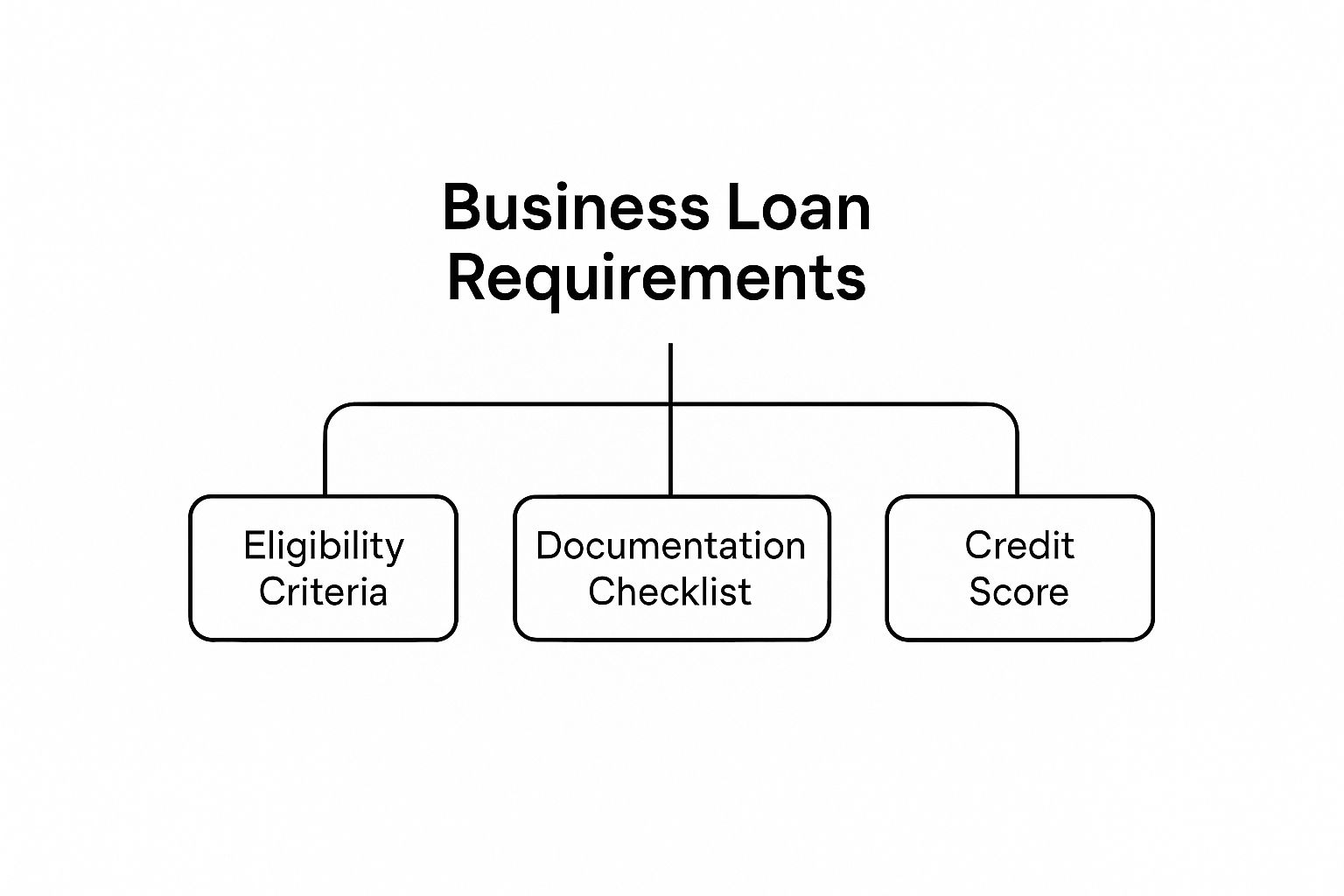
As you can see, it all begins with your eligibility, the documentation you can provide, and your credit profile. These are the foundational elements upon which the rest of your case is built.
Before we delve into each specific requirement, it's helpful to see how these concepts interconnect. The table below summarizes the main categories lenders scrutinize during the application process.
Quick Guide to Core Business Loan Requirements
| Requirement Category | What Lenders Look For | Why It Matters for Approval |
|---|---|---|
| Credit History | Personal and business credit scores, payment history, and public records. | Demonstrates your reliability and track record of managing debt responsibly. It’s your financial report card. |
| Financial Health | Revenue, profitability, cash flow, and existing debt. | Proves your business is stable and generates enough real income to handle new payments without strain. |
| Collateral | Business or personal assets (real estate, equipment, inventory) to secure the loan. | Reduces the lender's risk by providing a tangible way for them to recoup their investment if you default. |
| Business Plan | Clear mission, market analysis, financial projections, and detailed use of funds. | Shows you have a strategic roadmap for growth and a concrete plan to turn the loan into increased revenue. |
This framework provides a clear picture of the narrative you need to construct with your application. Now, let's break down the classic model lenders have used for generations to make their decisions.
The Five C’s of Credit
For generations, lenders have relied on a simple yet powerful framework known as the "Five C's of Credit." It’s their trusted blueprint for assessing risk. If you can understand and confidently address each of these five pillars, you're well on your way to building a loan application that earns a "yes."
- Character: This is about your financial reputation. Lenders will pull your personal and business credit history to see how you've handled debt in the past. Are you dependable? Do you pay your obligations on time? This is where your history speaks for you.
- Capacity: This is a hard analysis of your ability to repay the loan. By examining your business's cash flow and your debt-to-income ratio, they determine if you have sufficient cash coming in to comfortably cover a new loan payment.
- Capital: This refers to the amount of your own money you’ve personally invested in the business. A significant personal investment—what we call "skin in the game"—shows lenders you’re deeply committed to your venture's success.
- Collateral: These are tangible assets (like real estate, vehicles, or equipment) that you pledge to secure the loan. Collateral acts as a safety net for the lender; if you cannot repay the loan, they can seize the asset to cover their loss.
- Conditions: This covers the "what" and "why" of your loan request—its specific purpose, the amount, and the current economic climate. Lenders need to see a clear, strategic plan for the funds that will ultimately strengthen the business and lead to repayment.
Imagine these five elements as the legs of a table. If one leg is a bit wobbly, the others need to be exceptionally strong to keep the entire structure stable.
The Role of Your Business Plan
If the numbers tell the "what," your business plan tells the "why" and "how." It's your strategic narrative, the place where you bring your vision to life and prove you have a concrete roadmap for success. A lender isn't just funding an idea; they're funding a well-researched, meticulously thought-out plan.
In my experience, the business plan is the single most important document for telling your story. It demonstrates that you understand your market, your competition, and, most importantly, how you will convert a lender’s capital into a profitable return.
A powerful business plan goes beyond a simple mission statement. It must include a detailed market analysis, a clear organizational structure, and realistic, well-supported financial projections. It must answer the single most important question on a lender's mind: "How will this loan help the business grow and generate the revenue needed for repayment?"
Ultimately, a strong plan transforms your request from a simple ask for money into a compelling investment opportunity. For a lender in Nashville, TN, or anywhere else, a detailed plan is a clear signal that they're dealing with a serious, organized, and forward-thinking entrepreneur.
Your Financial Story: The Numbers Lenders Actually Look At

If your business plan is the exciting trailer for your company's future, your financial statements are the director's cut—the hard evidence of where you've been and where you are right now. Lenders dive deep into these documents for one simple reason: numbers don't lie. They tell the unvarnished truth about your business's health and how you manage it day-to-day.
Think of it as a mechanic running diagnostics on a race car before a major event. A lender needs to see your company's vital signs—your income, expenses, assets, and debts—to know if it’s robust enough to handle a new loan. Getting these documents in order isn't just about checking a box; it's your opportunity to build a rock-solid, data-driven case for why you're a creditworthy borrower.
The Three Core Financial Statements
At the heart of any loan application, you'll find three crucial reports. Each one provides a lender with a different, but equally vital, perspective on your business performance.
- Profit and Loss (P&L) Statement: Also known as an income statement, this is a straightforward summary of your revenues and expenses over a specific period, such as a quarter or a year. It answers the lender's most fundamental question: Is this business profitable?
- Balance Sheet: This is a snapshot of your company’s financial health at a single moment in time. It lays out your assets (what you own) and your liabilities (what you owe), along with your owner's equity. Lenders use it to understand your net worth and overall financial stability.
- Cash Flow Statement: From my professional standpoint, this is often the most scrutinized document of all. It tracks the actual cash moving in and out of your business. Why is it so critical? Because profit on paper doesn't pay bills. Lenders must see that you have enough real, liquid cash to cover daily operations and—most importantly—your new loan payments.
These three documents must tell a cohesive and consistent story. A stellar P&L is great, but if the cash flow statement reveals that your "profit" is tied up in uncollected invoices, that's a massive red flag for any lender.
Key Metrics Lenders Analyze
Lenders don't just read your statements; they run the numbers through specific financial ratios to get an objective measure of your stability and repayment ability. Familiarizing yourself with these metrics allows you to see your business through their eyes and identify potential weaknesses before you even apply.
One of the most critical calculations is the Debt-Service Coverage Ratio (DSCR). This ratio compares your company's annual net operating income to its total annual debt payments, including the proposed new loan.
For most lenders, a DSCR of 1.25 or higher is the gold standard. It signifies that for every dollar you owe in yearly debt payments, you’re generating at least $1.25 in net income to cover it, leaving a healthy cushion for unexpected expenses.
If your DSCR falls below 1.0, it tells a lender that you aren't generating enough cash to cover your existing debts plus the new loan. That is almost always a deal-breaker.
Organizing Your Financials for Success
I cannot overstate this: presenting clean, organized, and accurate financial documents is non-negotiable. Sloppy or incomplete records are a giant red flag for lenders. This doesn't just cause delays; it signals poor management, which can sink your application before it even gets a serious review.
Here’s a simple game plan to get your financial story straight:
- Gather Your Documents: Plan on providing at least two to three years of financial statements and the corresponding business tax returns. For newer businesses, bring what you have and supplement it with well-researched financial projections.
- Ensure Accuracy: Triple-check that the numbers across your P&L, balance sheet, and tax returns are consistent. Any discrepancy, no matter how small, will be questioned and can erode the lender's trust.
- Be Ready to Explain: A lender will absolutely ask about significant swings in revenue, a sudden jump in expenses, or any other anomalies. Have clear, honest, and data-backed answers prepared.
When you meticulously prepare and understand your own financials, you change the entire dynamic of the application process. You're no longer just handing over a pile of papers and hoping for the best. You're confidently presenting a narrative of stability, profitability, and readiness for growth—a crucial step toward securing the funding you need.
The Power of Your Credit Score for Business Funding
When you're asking a lender for capital, your credit score is their first look into your financial character. It's your reputation, condensed into a single, powerful number that tells a story of how you've managed financial obligations in the past. Think of it this way: before someone trusts you with tens or even hundreds of thousands of dollars, they need to see evidence that you're a good bet.
A strong score can open doors to better loan terms, lower interest rates, and higher funding amounts. A weaker one can slam them shut just as quickly. It’s the ultimate trust signal in the world of finance, offering a detailed track record of your past promises and your follow-through.
Lenders will typically pull both your personal credit score and, if available, your business credit score. For new businesses, startups, and sole proprietors, your personal credit often carries the most weight. Without a long, established history for the business itself, the lender is fundamentally betting on you, the owner.
Personal vs. Business Credit: What Lenders See
It’s crucial to understand the distinction between these two scores. While they serve a similar purpose, they are built and evaluated in entirely different ways.
Your personal credit score (such as FICO or VantageScore, with a range of 300 to 850) is a direct reflection of your individual financial habits. It’s shaped by a few key factors:
- Payment History: Do you consistently pay your bills on time? This is the single largest component.
- Amounts Owed: Lenders examine your credit utilization—the percentage of your available credit you're currently using. High balances can signal financial stress.
- Length of Credit History: A longer track record of responsible borrowing is always viewed favorably.
- Credit Mix: Having a healthy variety of credit types, like credit cards and installment loans (e.g., an auto loan), demonstrates you can manage different financial products responsibly.
On the other hand, your business credit score is tied to your company’s Employer Identification Number (EIN). These scores, compiled by agencies like Dun & Bradstreet, Experian, and Equifax, typically range from 0 to 100. This score is built on how your business handles its own financial obligations, such as paying suppliers, vendors, and its own credit lines.
A common question we receive from entrepreneurs is how a business loan will impact their personal finances. For many small business loans, especially those requiring a personal guarantee, the two are intrinsically linked. We created a detailed guide explaining how a business loan can affect your personal credit, which is essential reading for any owner.
Together, these two scores create a comprehensive financial picture for the lender. A strong personal score indicates you are a responsible individual, while a good business score proves your company is a financially sound entity in its own right.
What Is a Good Credit Score for a Business Loan?
There's no single number that guarantees loan approval, as every lender has its own risk tolerance. However, we can break it down into general tiers to give you a clearer idea of where you stand.
| Credit Score Tier | Personal Score Range | Business Score Range (Typical) | Lender Perspective |
|---|---|---|---|
| Excellent | 740+ | 80+ | You're a prime candidate. Lenders will compete for your business, offering the best rates and terms. |
| Good | 680 – 739 | 60 – 79 | You are a very strong applicant for most traditional bank loans and nearly all online loans. |
| Fair | 620 – 679 | 40 – 59 | You'll likely qualify for financing from online lenders, but expect higher interest rates and more stringent terms. |
| Poor | Below 620 | Below 40 | Traditional banks will be a tough sell. Your best options are with specialized lenders who look beyond the score. |
Even if your credit isn't perfect, don't assume funding is out of reach. Lenders like us at Shop Rates understand that a score is just one piece of the puzzle. Strong, consistent cash flow or valuable collateral can often compensate for a less-than-stellar credit history.
Turning a Weaker Score into a Strength
A few blemishes on your credit report are not a life sentence. If you are proactive, you can absolutely improve your standing and make your loan application significantly stronger.
- Review Your Reports: First, pull copies of both your personal and business credit reports. A surprising number contain errors, and successfully disputing a mistake can give your score a quick, meaningful boost.
- Pay Down Balances: If you carry high-interest credit card debt, focus on paying it down. Lowering your credit utilization ratio is one of the fastest ways to improve your score.
- Establish Business Credit: If you don't have a business credit profile yet, start building one immediately. Open accounts with vendors and suppliers who report payments to the business credit bureaus, and always pay on time.
- Be Transparent with Lenders: Don't hide from past credit issues. Be prepared to explain the circumstances and, more importantly, what steps you've taken to correct them. This kind of honesty shows responsibility and can actually build trust.
At the end of the day, your credit score is a dynamic tool, not a static label. By actively managing it, you’re not just chasing a number. You're building a more compelling story of financial reliability—one of the most critical business loan requirements a lender evaluates.
Securing a business loan isn't just about a snapshot of your company’s financials or your personal credit. The reality is that your loan application doesn't exist in a vacuum. It lives and breathes within the larger, ever-shifting ecosystem of the economy.
Think of it this way: your business's financial health is like a well-built ship. But no matter how sturdy that ship is, you're still sailing on the open ocean. The economic winds and tides—factors like interest rates and market confidence—will have a major say in how smooth your journey is.
As a business owner, understanding these external forces is a strategic advantage. It’s what separates the passive applicant who simply crosses their fingers from the savvy borrower who knows how to read the market currents. Knowing when to sail and when to stay in port can make all the difference in getting the funding you need on terms that actually help your business grow.
When the economy is strong, lenders become optimistic. They see growth opportunities everywhere and are more comfortable taking on risk. This typically translates to more flexible business loan requirements, better interest rates, and a greater appetite to fund expansion.
Conversely, when the economic forecast looks stormy, lenders tend to become more conservative. They tighten their lending criteria, reserving their capital for only the most stable, time-tested businesses.
The Big Picture Economic Factors
Several key economic dials directly influence the lending climate. Keeping an eye on them gives you a massive advantage because you'll understand why you're being offered certain rates and terms. It provides crucial context for the entire process.
Here are the primary ones to watch:
- Central Bank Policies: When institutions like the Federal Reserve adjust interest rates, it sends ripples across the entire financial system. If the Fed hikes rates to combat inflation, your cost of borrowing will inevitably rise.
- Inflation Rates: High inflation is a double-edged sword. It erodes your profit margins by increasing your costs and makes lenders nervous about your long-term ability to repay debt in real terms. They monitor this metric vigilantly.
- Overall Economic Growth (GDP): A healthy, growing economy is a green light for lenders. It signals stability and a promising future for businesses. On the flip side, a flat or shrinking economy makes them highly cautious about what lies ahead.
The connection between the global economy and your loan application is direct and powerful. Macroeconomic policies that seem distant are what shape the environment where lenders like us at Shop Rates make decisions every single day. A smart business owner recognizes this.
This isn’t just textbook theory; it’s the market we operate in. The global business loan market itself illustrates this. Valued at roughly $8 trillion in 2023, it is projected to reach approximately $12.5 trillion by 2032. That growth underscores how essential lending is to the economic engine.
But that growth is not a smooth, linear path. We have all felt the recent turbulence from supply chain disruptions, economic fluctuations, and global events. These have directly impacted lending conditions, causing borrowing costs to vary. For instance, the careful interest rate strategies used to manage inflation have kept loan costs elevated, pushing businesses to reassess their financial plans. You can dive deeper into these trends in this comprehensive business loan market analysis.
Timing Your Application Strategically
So, what do you do with this information? You use it to navigate the process more intelligently.
If you see warning signs of a tightening economy—such as climbing interest rates and cautious economic news—it’s likely a good time to focus inward. Polish your financials, pay down existing debt, and get your business in peak condition before you apply.
On the other hand, if the economic climate feels positive and lenders seem optimistic, you may have more negotiating power. That could be the perfect moment to pursue that large loan for an expansion or a major equipment purchase.
By aligning your funding needs with the rhythm of the market, you dramatically increase your odds of not just getting a "yes," but getting a "yes" with terms that truly empower your business.
Why Small Businesses Face Unique Funding Hurdles
Small and medium-sized businesses are the true lifeblood of the American economy. Yet, when it comes to securing capital, they often face the steepest and most frustrating challenges. A large corporation can walk into a major bank armed with a long operational history and massive assets, but a smaller enterprise is telling a very different story.
It’s a classic Catch-22. Traditional banks have historically been cautious about lending to smaller companies, which ultimately boils down to a simple risk calculation. Smaller businesses typically have shorter track records, less collateral to offer, and more volatile cash flow than their larger counterparts, making them appear to be a much riskier bet on paper.
The Traditional Lending Gauntlet
For any small business owner, attempting to get a conventional bank loan can feel like running an arduous gauntlet. The requirements are incredibly rigid and, frankly, often seem designed for a different class of borrower altogether.
- Extensive Operating History: Many banks won't even consider an application without a minimum of two, sometimes even three, years in business. This rule immediately excludes promising startups and young, high-growth companies.
- High Collateral Demands: Banks frequently demand significant assets—such as commercial real estate—to back the loan. But what about a service-based business or a digital startup? They simply don’t possess that kind of collateral to pledge.
- Slow, Paper-Intensive Process: The application itself can be a marathon of paperwork, taking weeks or even months to receive a final decision. That glacial pace is unworkable when you need to act on a time-sensitive opportunity.
This reality creates a massive financing gap. Even within a thriving market for business credit, a staggering number of small business owners find themselves on the outside looking in.
The Reality of the Modern Market
The scale of this challenge is immense. The global market for unsecured business loans was valued at around $5.5 trillion in 2024 and is projected to swell to an estimated $9.3 trillion by 2030. Despite this enormous pool of capital, a huge portion of SMEs struggle to access it. In a recent Goldman Sachs survey, 80% of small business owners reported difficulties accessing affordable capital, and 53% stated that current interest rates were simply unaffordable. These figures paint a clear picture of the demand for financing in the face of significant roadblocks, a trend you can explore further by reviewing these insights into SMB lending trends.
The gap left by traditional lenders is not just a problem; it's an opportunity. This is precisely the space where modern, alternative lenders have emerged to provide the flexible, realistic solutions that small businesses desperately need.
How Alternative Lenders Fill the Gap
We saw these hurdles and knew there had to be a better way. Alternative lenders like us at Shop Rates have completely reimagined our approach to business loan requirements. We’ve learned to look beyond a rigid checklist to see the complete, real-time picture of a business's health.
We understand that a three-digit credit score doesn't tell the whole story. For instance, we know many Nashville entrepreneurs run into brick walls with traditional financing, which is exactly why we've developed specific, real-world approaches for securing Nashville business loans even with bad credit.
This new model of lending prioritizes what truly matters for a small business today:
- Speed and Efficiency: Applications are digital, streamlined, and can result in a decision in hours or days, not months.
- Focus on Cash Flow: Instead of getting bogged down in historical profits or collateral, we place a heavy emphasis on your recent and consistent revenue. Strong sales are a powerful indicator of a healthy, viable business.
- Flexible Requirements: A lower credit score or a shorter time in business isn't an automatic disqualification. If other aspects of your business, like consistent revenue, are strong, we see that as a major positive.
This fundamental shift has been a lifeline for countless entrepreneurs, providing them with the capital they needed to hire, expand, and thrive when traditional doors were closed to them.
Assembling Your Application for a Faster "Yes"
A well-organized loan application does more than just check boxes; it sends a powerful, non-verbal signal to the lender. I've seen it time and again in my career—a thoughtfully prepared package demonstrates that you are professional, prepared, and respectful of their time. Those qualities can absolutely tip a borderline decision in your favor.
Think of it this way: your loan package is the physical manifestation of your business’s story. A sloppy, incomplete submission suggests a disorganized business. Conversely, a meticulously prepared file makes an underwriter's job easier, and that’s always a strategically sound move. Your goal is to build an application so clear and compelling that it answers questions before they’re even asked.
Your Essential Document Checklist
While the exact list can vary slightly between lenders and loan types, nearly every application package is built on the same core documents. Getting these items in order before you apply will dramatically accelerate the process.
Here’s a practical checklist of what you'll need on hand:
- Business Plan: This is your strategic roadmap. It requires an executive summary, a detailed description of your business, solid market analysis, and—most importantly—a crystal-clear explanation of how this loan will be used to generate more revenue.
- Business Financial Statements: Lenders need verifiable proof of your company's financial health. Be ready to provide two to three years of profit and loss (P&L) statements and balance sheets.
- Business and Personal Tax Returns: To verify the income you've reported, you’ll need at least two years of both your business and personal tax returns.
- Bank Statements: Providing three to six months of recent business bank statements gives lenders a real-time view of your daily cash flow and how you manage your working capital.
- Legal and Ownership Documents: This includes your articles of incorporation, business licenses, partnership agreements, and any commercial leases. These papers prove your business is a legitimate, properly structured entity.
A complete and organized application package isn't just about meeting business loan requirements; it’s a strategic tool. It demonstrates your seriousness and managerial competence, building the lender’s trust from the very first interaction.
Crafting a Narrative That Connects
Simply handing over a stack of documents isn't enough. The most successful applications I've reviewed are those that weave these elements together into a powerful and cohesive story. Your executive summary is the perfect place to start.
This should be a concise, one-page overview that immediately grabs the lender’s attention. Use it to briefly explain your business, the purpose of the loan, the exact amount you need, and how you plan to repay it. This summary sets the stage for all the detailed financial data that follows.
Furthermore, savvy borrowers tailor their submission to the lender. A traditional community bank might place more weight on your local ties and character. In contrast, a nationwide online lender might focus more heavily on your recent cash flow data. Understanding your audience is key. For those considering asset-based financing, understanding the specific paperwork is crucial. You can find detailed guidance by reviewing the typical hard money loan application process, which highlights the kind of documentation needed for secured loans.
By assembling a thoughtful, comprehensive, and well-told story, you present an undeniable case for your business. This level of preparation doesn't just meet the requirements—it elevates your application, paving the way for a swift and positive decision.
Your Business Loan Questions Answered
Diving into the world of business financing can feel like learning a new language. You have questions, and as seasoned financial experts who have been in the trenches with business owners just like you, we have straightforward answers. Our mission is to cut through the jargon and give you the confidence to take the next step.
Here, we tackle the questions we hear most often—the tough ones about personal credit, collateral, and the dreaded application denial. Think of this as your go-to guide for real, actionable advice you can put to use immediately.
What Is the Minimum Credit Score for a Business Loan?
There's no single magic number, as the credit score requirement can vary significantly depending on the lender and the specific loan product. Traditional banks, for example, often look for a personal credit score of 680 or higher before they’ll seriously consider an application.
But that’s not the whole story. Many online lenders, like those you'll find through ShopRates, and other alternative financing sources are much more flexible. They may approve applicants with scores in the low 600s or sometimes even the 500s. These lenders have learned to evaluate the bigger picture, balancing a lower score against other signs of a healthy business, such as strong monthly revenue or consistent cash flow. Your credit score is just one piece of the puzzle, not the final word.
Do I Need Collateral to Get a Business Loan?
Not necessarily. While it’s true that classic term loans from a bank almost always require you to pledge collateral—like real estate, inventory, or equipment—many modern financing options are completely unsecured.
Unsecured loans do not require you to pledge specific assets. Instead, the lender is making a decision based on your business's cash flow, credit history, and overall financial strength. They might carry slightly higher interest rates to compensate for the lender's increased risk, but they have opened the door to funding for countless businesses without major physical assets to offer.
This shift has been a game-changer, especially for service-based companies, digital startups, and other businesses whose value isn't tied up in heavy machinery or property. It allows them to secure the capital they need based purely on the strength of their operations.
What Should I Do If My Loan Application Is Denied?
First and foremost, don't panic or get discouraged. It happens to more businesses than you might think. Your most important move is to ask the lender for the specific reasons behind the denial—in most cases, they're legally required to provide this information. This feedback is pure gold.
You'll likely hear one of a few common reasons:
- Your credit score fell below their minimum threshold.
- They felt your current cash flow couldn't support an additional payment.
- Your business simply hasn't been in operation long enough to meet their criteria.
Take that feedback and turn it into a concrete action plan. You can focus on improving your business credit, work on boosting your monthly revenue, or flesh out your business plan with more detailed projections. From there, you can either reapply with the same lender down the road or, better yet, find alternative lenders whose requirements are a much better match for where your business is today.
Ready to see what you qualify for? At ShopRates, we simplify the process by connecting you with trusted lenders who understand the needs of businesses like yours. Compare your personalized loan options today!


