

Your Definitive Guide to Financing for Startups
Welcome. At Shop Rates, headquartered in the heart of Nashville, TN, we've spent decades navigating the intricate world of capital for new ventures. This isn't just a guide; it's a distillation of real-world experience, a financial roadmap crafted by seasoned experts. We understand that securing the right financing for startups is more than a transaction—it's the pivotal moment that can define a company's trajectory.
Your Blueprint for Startup Financing Success
Let's cut through the jargon and the noise. The goal here is to demystify the entire process, laying out the primary pathways to fund your dream. Think of this as a candid conversation with a trusted financial advisor, one dedicated to arming you with the confidence and clarity needed to make strategic decisions for your company’s long-term health.
First, let's establish a foundational truth: getting capital isn't merely about cashing a check. It’s about securing the right kind of capital for the right stage of your business. A mismatch here can be catastrophic, leading you to surrender too much equity too early or burden your fledgling company with unmanageable debt.
This is precisely why a deep understanding of your options transforms from a nice-to-have into your most powerful strategic asset.
As a nationwide lender, we've reviewed thousands upon thousands of business plans. A pattern has emerged: the most successful founders are not just evangelists for their product; they become dedicated students of their financial options. They internalize the critical difference between smart capital and expensive capital.
Getting the Lay of the Land
The world of startup financing can feel like a labyrinth, especially for first-time founders. With a dizzying array of choices, it's easy to feel overwhelmed. Before we delve into the granular details of equity, debt, and alternative funding, let's zoom out to the 30,000-foot view. Understanding the common routes and typical funding figures provides a realistic benchmark for your own capital-raising journey.
The infographic below illustrates some crucial statistics on the origins of startup capital and the average amounts raised at various stages.
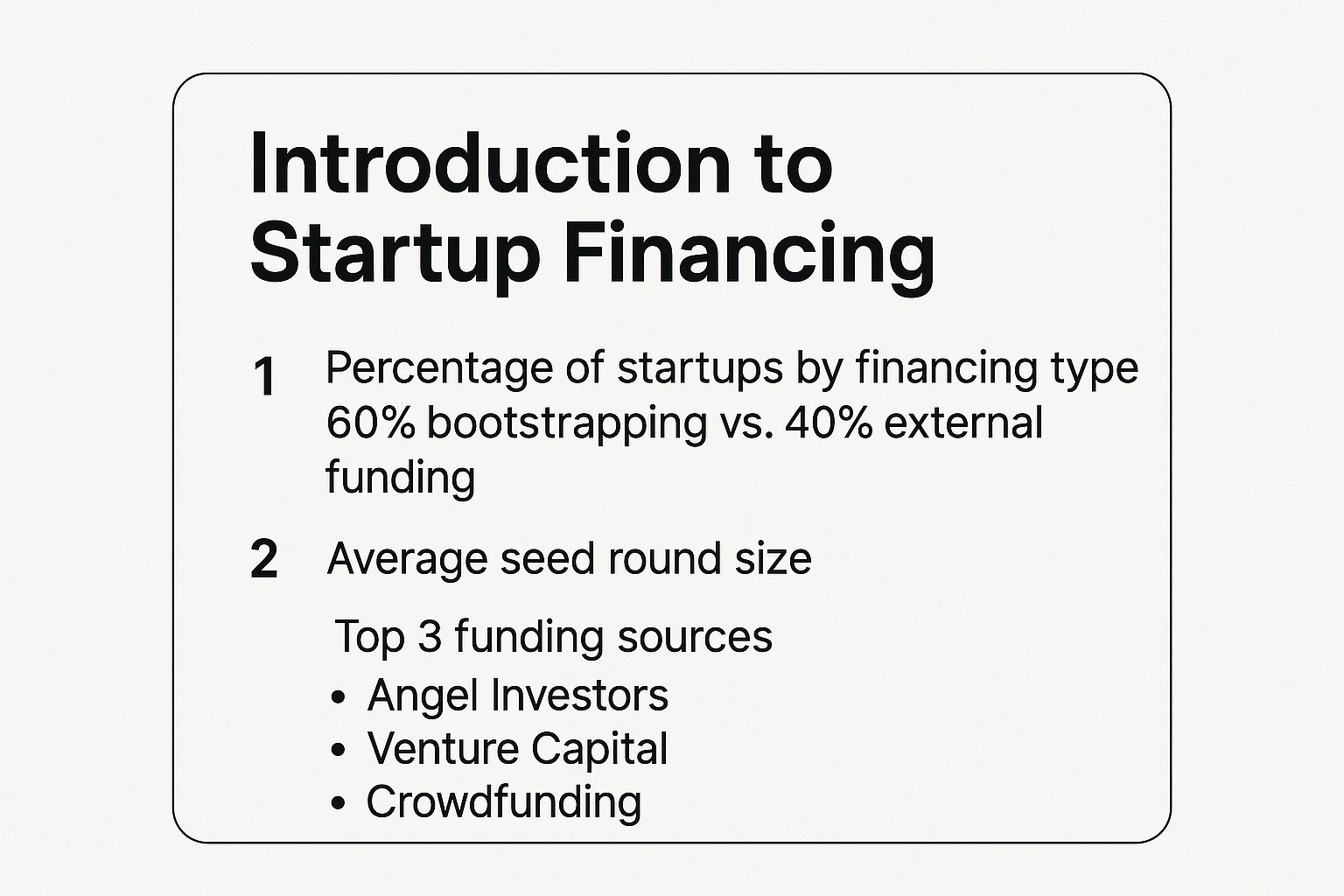
As the data suggests, while many ventures begin life through bootstrapping, a significant number eventually seek external capital from angel investors or venture capitalists to truly ignite their growth engine.
To give you a clearer picture of your main choices, here’s a quick overview of the most common financing types.
Startup Financing Options at a Glance
| Financing Type | Best For | Key Consideration |
|---|---|---|
| Equity Financing | High-growth potential startups requiring substantial capital to scale. | You are selling a percentage of ownership in your company for cash. |
| Debt Financing | Businesses with established, steady revenue that want to retain full ownership. | The loan must be repaid, with interest, according to a fixed schedule. |
| Grants | Mission-driven or research-intensive startups in highly specific industries. | Extremely competitive and often comes with stringent rules on fund usage. |
| Alternative Financing | Startups that don't fit traditional molds (e.g., crowdfunding, RBF). | Can be an excellent fit but requires a strong community or niche appeal. |
This table serves as a high-level summary. Now, let’s explore the fundamental philosophies that separate these paths.
The Two Core Paths: Equity vs. Debt
When you peel back all the layers, nearly every financing option available to a startup falls into one of two fundamental categories. Your choice between them will profoundly influence how you operate your business, manage your finances, and chart your course for the future.
-
Equity Financing: This is the act of selling ownership—shares in your company—in exchange for capital. It is the preferred path for startups with monumental growth ambitions, but it inherently means your ownership stake will decrease over time. You are, quite literally, giving up a slice of the pie.
-
Debt Financing: This is the more formal term for borrowing money. You receive the capital you need today and agree to repay it, plus interest, over a predetermined period. The immense advantage? You retain 100% ownership of your enterprise, making it an attractive option for businesses that have already achieved a degree of predictable income.
Throughout the remainder of this guide, we will dissect both of these paths in detail, arming you with the practical, actionable insights necessary to select the one that aligns with your vision.
Understanding the Modern Startup Funding Landscape

The world of financing for startups is not a placid, predictable pond. It's a vast ocean, subject to powerful, ever-shifting currents. Before you even contemplate launching your vessel, you must first understand these tides—where capital is flowing, the reasons behind its movement, and the velocity of the shift. This knowledge is paramount to positioning your business to catch a wave of opportunity rather than being capsized by one.
The past several years have provided a masterclass in this very volatility. Global events, seismic economic shifts, and fluctuating investor sentiment can trigger dramatic swings in capital availability. One year might feel like a deluge of cash, while the next ushers in a "funding winter," where investors guard their checkbooks with newfound conservatism.
Think of it like a seasoned farmer meticulously studying the weather almanac. You cannot control the rain, but knowing the forecast empowers you to decide the optimal time to plant your seeds. Similarly, understanding the funding climate helps you determine the most effective timing and strategy for seeking investment.
This isn't an exercise in trying to time the market perfectly—an endeavor destined for failure. It's about being informed, agile, and adjusting your approach to align with the current reality. This strategic alignment makes your pitch infinitely more resonant with the individuals you need to persuade.
The Recent Ebb and Flow of Early-Stage Capital
For a perfect case study in this volatility, one need only look at the recent past. We witnessed early-stage funding skyrocket to a breathtaking, all-time high of $229.3 billion in 2022. It was a period of unprecedented exuberance. Then, the inevitable correction arrived, and funding levels contracted sharply to $103 billion in 2023. This data, which you can explore in greater detail through reports on startup funding trends, serves as a stark illustration of how quickly the financial weather can change, underscoring the need for founders to remain nimble.
These fluctuations are not random. They are propelled by tangible real-world factors like interest rate adjustments, public market performance, and geopolitical instability. When a market correction occurs, investors don't simply cease investing—they become laser-focused. Their diligence intensifies, and they begin to prioritize startups with unimpeachable fundamentals, a clear and plausible path to profitability, and founders who demonstrate a mastery of their domain.
Following the Money: Sector-Specific Investment Trends
Even when the overall funding environment tightens, certain sectors consistently remain hotbeds of activity. These areas continue to attract a disproportionate share of investor attention and capital. By closely observing where capital is concentrating, you gain a valuable cheat sheet into the current priorities of the investment community.
Two sectors, in particular, have served as magnets for investment capital in recent years:
- Fintech: The financial technology space has been on an absolute tear, attracting $31.1 billion in investment between 2022 and 2024. The relentless drive to innovate across banking, payments, and wealth management ensures this sector remains a focal point for investors.
- Artificial Intelligence (AI): The AI revolution is undeniable. Between 2016 and 2020, funding for AI-centric startups surged by an astonishing 327%. This momentum has only accelerated, as virtually every industry now scrambles to integrate AI into its core operations.
If your startup operates within one of these domains, you benefit from a natural tailwind. However, if your venture lies elsewhere, do not be discouraged. It simply means you must work more diligently to construct an irrefutable business case built on validated market need, tangible traction, and a bulletproof strategic plan. The key is to leverage this market intelligence to sharpen your narrative and refine your strategy.
Equity Financing: Are You Ready to Sell a Piece of the Pie?
So, your startup is built on a massive vision. You can clearly see the path to explosive, market-defining growth, but you require a significant injection of capital to turn that vision into reality. This is the juncture where the conversation invariably turns to equity financing.
Let's be unequivocally clear: this is not a loan that you simply repay over time. It is a profound strategic partnership. You are trading a percentage of ownership in your company—a literal slice of your creation—for the capital required to scale.
Consider this analogy: you've constructed a sturdy ship, but your ambition is to cross a vast ocean, not merely sail around the local harbor. Equity financing is akin to bringing on a crew of seasoned, well-funded explorers. They provide the fuel (capital) and the navigational charts (mentorship and network access) to help you reach a treasure-laden island you could never discover alone. In return for their contribution, they claim a share of the treasure and a hand on the ship's wheel.
This is the very model that fueled the ascent of many of the technology giants we know today. It is designed for high-growth enterprises that require far more cash than a traditional lender would ever provide. But it represents a fundamental trade-off: you gain the resources to achieve greatness, but you relinquish a measure of control and a portion of your company's future profits.
The Key Players in an Equity Deal
As you embark on this path, you will encounter several distinct types of investors. Understanding who they are, what motivates them, and what they expect is absolutely critical.
-
Angel Investors: These are often your first true believers. Typically, they are successful entrepreneurs or high-net-worth individuals who invest their personal funds into very early-stage companies. They frequently bring invaluable industry expertise and mentorship to the table, alongside checks that can range from a few thousand to several hundred thousand dollars.
-
Venture Capital (VC) Firms: VCs represent the institutional big leagues. These are professional firms managing enormous pools of capital on behalf of institutions like pension funds, university endowments, and foundations. They are on a hunt for startups with the potential for massive, 10x or even 100x returns, and they write substantially larger checks. When a VC invests, they are not a passive passenger; they take a board seat and become deeply involved in shaping your company's strategic direction.
An angel investor might help you transform a napkin sketch into a functional prototype. A VC firm comes in later to pour jet fuel on the fire and help you achieve global scale.
Demystifying the Funding Rounds
Equity financing is rarely a singular event. It typically occurs in distinct stages, or "rounds," which are strategically aligned with your company’s major milestones. This journey usually follows a well-established path:
- Friends and Family: This is precisely as it sounds. It is often the very first money into the business, coming from people who are betting on you as an individual more than the specific business concept. The terms are often informal, providing just enough capital to get the ball rolling.
- Seed Round: This marks your first official, structured fundraising round, frequently led by angel investors. The objective here is to raise sufficient capital—typically in the range of $500,000 to $2 million—to build out your product, acquire your first real customers, and definitively prove that you have a solution the market genuinely desires.
- Series A, B, C, and Beyond: Once you have a proven product-market fit and are generating meaningful revenue, you will pursue a Series A round from VCs to scale up your team and marketing efforts. Subsequent rounds (Series B, C, etc.) are all about fueling hyper-growth, such as expanding into new international markets or acquiring smaller competitors.
What do investors truly look for? It extends far beyond a clever idea. They are fundamentally betting on the jockey, not just the horse. A world-class founding team with deep domain expertise, a massive market ripe for disruption, and tangible proof of early traction—these are the three pillars that support nearly every successful investment pitch.
The Pros and Cons of Selling Equity
Accepting equity investment is one of the most consequential decisions a founder will ever make. It carries long-term implications, so you must enter into it with your eyes wide open.
| Pros of Equity Financing | Cons of Equity Financing |
|---|---|
| Access to Significant Capital: Raise sums of money that are simply unattainable through debt. | Ownership Dilution: Each new round of investment means your personal stake in the company shrinks. |
| Powerful Networks: High-quality investors open doors to potential customers, partners, and top-tier talent. | Loss of Control: Investors, particularly VCs, will gain a board seat and have a say in major decisions. |
| Shared Risk: If the business ultimately fails, you do not owe them their investment back. They lose alongside you. | Intense Pressure to Perform: You are now accountable for delivering rapid growth and a massive return on their investment. |
| Expert Guidance and Mentorship: Seasoned investors have witnessed this journey before and can offer priceless strategic advice. | A Long, Costly Process: Fundraising is a distracting, all-consuming process that involves substantial legal fees. |
Ultimately, whether equity financing is the right choice for you boils down to the scale of your ambition. If your goal is to build a comfortable, profitable "lifestyle" business, this is unequivocally the wrong path. But if your objective is to build a category-defining company that dominates a vast market, it may well be the only way to get there.
Debt Financing: The Power of Borrowing Smart

While the high-profile equity deals often capture the media spotlight, debt financing is the quiet, diligent workhorse that powers countless successful startups. It represents a straightforward, highly effective method for acquiring the cash you need without signing away a portion of your company.
Think of debt financing as renting money. You borrow capital to accelerate your business growth—perhaps to purchase a critical piece of equipment, build up your inventory for a peak season, or launch an ambitious marketing campaign. In exchange, you pay "rent" in the form of interest and eventually return the original amount borrowed. The most compelling feature? Once the debt is repaid, your obligation is completely fulfilled. You retain 100% ownership and control of your destiny.
This path is especially attractive for businesses that have already found their footing and can demonstrate a predictable stream of revenue. Lenders, by their nature, seek assurance of repayment. This makes debt an outstanding tool for financing specific, measurable growth initiatives without diluting your hard-earned equity.
Navigating Your Debt Financing Options
Not all debt is created equal. The true art lies in meticulously matching the right type of loan to your specific objective. Each option possesses its own unique structure, terms, and ideal application.
Here is a look at the most prevalent forms of debt financing for startups:
- Traditional Bank Loans: These are the classic term loans offered by banks and credit unions. You receive a lump sum of capital upfront and repay it over a fixed period with consistent monthly payments. They are often the preferred choice for major, one-time investments like acquiring real estate or heavy machinery.
- SBA Loans: Backed by a guarantee from the U.S. Small Business Administration, these loans are inherently less risky for lenders. This advantage often translates into more favorable terms and lower interest rates for the borrower. They represent a phenomenal option, but be prepared for a more rigorous and document-intensive application process.
- Business Lines of Credit: This is one of the most flexible tools in the financial arsenal, functioning much like a credit card for your business. You are approved for a specific capital limit and can draw funds as needed, paying interest only on the amount you actually use. It is perfect for managing cash flow fluctuations or seizing unexpected opportunities.
- Revenue-Based Financing (RBF): A more modern and adaptable approach to borrowing. You receive a cash advance in exchange for a percentage of your future monthly revenues. Repayments automatically adjust with your sales, which can be a lifesaver for businesses with strong but seasonally variable income.
To explore these options in greater depth, our comprehensive guide on the different types of business loans provides a thorough breakdown to facilitate your comparison.
Preparing a Loan Application That Gets Approved
From our extensive experience as a lender, we can tell you with certainty that a strong loan application does far more than just present numbers—it weaves a compelling narrative of reliability, foresight, and meticulous planning. Its core purpose is to prove you are a responsible and capable steward of capital.
A lender's primary concern is remarkably simple: what is the likelihood we will be repaid? Your application's sole job is to systematically erase any doubt and build unwavering confidence by presenting a clear, data-supported plan for how your business will generate the cash flow necessary to meet its obligations.
To assemble an application that earns a "yes," you must focus on these essential components:
- A Rock-Solid Business Plan: Clearly articulate your business model, define your target market, and outline your strategic growth plan.
- Detailed Financial Projections: Provide realistic and well-reasoned forecasts for revenue, expenses, and cash flow for a minimum of the next three years.
- Clean Personal and Business Credit: Your credit history serves as a direct reflection of your financial discipline and track record.
- Proof of Profitability or Strong Cash Flow: Demonstrate to lenders that your business is already generating the cash needed to comfortably handle loan payments.
Avoiding Common Debt Pitfalls
Debt is a powerful tool, but like any tool, it can cause significant damage if misused. The single greatest mistake we observe is startups taking on too much debt too soon, which can suffocate their cash flow with burdensome monthly payments.
It is crucial to maintain a healthy debt-to-equity ratio. This simple metric, which compares what your company owes to what it owns, is a key indicator of your financial stability. By borrowing intelligently, selecting the right loan product for the job, and adhering to a disciplined repayment plan, you can leverage debt to fuel incredible growth—all on your own terms.
Navigating the Competitive World of Startup Capital

While staggering sums of money flow into startups each year, securing a piece of that pie is an intensely competitive endeavor. Think of it less like a free-for-all and more like attempting to secure a reservation at the most exclusive, Michelin-starred restaurant in town—a healthy appetite is not enough. You need a well-honed strategy.
This reality check is not meant to dissuade you. It's about providing a realistic, on-the-ground perspective of the funding ecosystem so you can enter the arena prepared and confident, not discouraged. The unvarnished truth is that a great idea, in isolation, is rarely enough to get funded. Success hinges on a masterful pitch, a robust network, and a crystal-clear understanding of what motivates different types of funders.
Securing financing is less like playing the lottery and more like a series of high-stakes job interviews. Investors and lenders are making a calculated bet on you and your team. Your primary job is to make that bet feel as safe and as intelligent as humanly possible.
It's also about maintaining perspective. The vast majority of startups will never receive a dollar of venture capital. But that is perfectly acceptable—VC is far from the only game in town.
Understanding the Funding Divide
The landscape of startup financing is anything but a level playing field. Venture capital firms, for instance, are notoriously selective. A typical firm might review over a thousand proposals annually just to make a handful of investments, generally focusing only on opportunities that require a minimum of $250,000.
This inherent selectivity is a primary reason why debt financing—including loans, credit cards, and lines of credit—actually accounts for approximately three-quarters of all funding for new firms.
Furthermore, significant funding disparities persist. Consider the gender funding gap. In a recent year, male-founded startups raised an astounding $156.2 billion in VC funding, while their female-founded counterparts secured just $28.1 billion. With roughly a quarter of all businesses reporting an inability to obtain the capital they needed, these figures paint a stark picture of the fierce competition.
The strategic implication is clear: you cannot afford to place all your hopes in a single basket. A flexible, multi-faceted funding strategy is your most effective defense against reaching a dead end.
Actionable Strategies for Overcoming Barriers
Recognizing the challenges is one thing; overcoming them is another entirely. Securing startup financing is a marathon, not a sprint, and it rewards meticulous preparation and unwavering persistence above all else.
Here are some concrete, actionable steps you can take to dramatically improve your odds of success:
- Perfect Your Pitch Deck: This is your first impression, and you only get one shot. It must be sharp, concise, and utterly compelling. Masterfully articulate the problem you solve, the size of your market, your team's unique expertise, and any tangible traction you have already achieved.
- Build Your Network Deliberately: Do not wait until you are desperate for cash to begin networking. Actively participate in industry events, seek out mentors who have navigated this path before, and focus on building genuine, mutually beneficial relationships. A warm introduction from a trusted contact is worth a thousand cold emails.
- Strengthen Your Financials: If you are pursuing the debt financing route, your numbers are paramount. Lenders demand a solid history of financial responsibility and projections that are both ambitious and believable. Understanding the specific business loan requirements before you apply can be a decisive advantage.
- Explore Alternative Routes: If venture capital and traditional bank loans are not panning out, do not concede defeat. Investigate other avenues like revenue-based financing, crowdfunding platforms, or industry-specific grants. The right funding partner for your unique business is out there.
By approaching fundraising with a clear-eyed view of the competitive landscape and a smart, diversified strategy, you give your startup the fighting chance it truly deserves.
For the longest time, the startup playbook was geographically limited: Silicon Valley. If you harbored ambitions of building something big, you went to California. That map, however, has been completely and irrevocably redrawn. Today, a founder whose perspective is solely domestic is already operating at a disadvantage. The entire world of startup financing has globalized, and new hubs of innovation and opportunity are emerging at an astonishing pace.
It’s like witnessing the global economic map morph in real time. The traditional powerhouses remain influential, of course, but new, energetic cities are rising with incredible velocity. For a founder contemplating international expansion or raising capital from beyond their home borders, understanding this new geography is not a mere "nice-to-have"—it is a core component of a modern growth strategy.
New Innovation Hubs Are on the Rise
This is not a slow, gentle evolution; it's an explosion of activity. While the United States continues to be a major force, its growth has moderated. Recent data indicates the U.S. startup ecosystem grew at a respectable 18.2%.
Now, compare that to the dynamism seen in the Asia Pacific region. Singapore’s ecosystem surged by an incredible 44.9%, while China’s national growth reached 45.9%. This remarkable surge propelled Beijing into the top 5 global startup cities. The message here is crystal clear: innovation and capital are becoming increasingly distributed. You can delve deeper into these figures by reviewing the comprehensive report on global startup ecosystem dynamics.
Here’s the essential takeaway: your next game-changing investor, strategic partner, or target market may not be in New York or San Francisco. They could just as easily be in Singapore, Berlin, or São Paulo. Adopting a truly global mindset unlocks a world of possibilities that your more parochial competitors might be completely overlooking.
What’s Fueling This Global Shift?
Several powerful macro-trends are driving this decentralization of startup power. If you can understand and harness them, you can position your company to ride these global waves of opportunity.
- Talent is everywhere: Top-tier technical and business talent is no longer concentrated in a handful of coastal cities. The rise of remote work and the strengthening of local universities means you can now find brilliant people all over the globe.
- Governments are getting in the game: Many national and local governments are rolling out the red carpet for entrepreneurs. They are actively offering grants, tax incentives, and streamlined visa programs designed to attract innovative founders and foreign investment.
- Local problems, massive opportunities: Founders in emerging markets possess a distinct home-field advantage. They have an intimate, firsthand understanding of local challenges and are uniquely positioned to build targeted solutions for vast, often underserved, populations.
This global shift represents more than just new places to find a check. It signifies a fundamental change in how great companies are built. The founders who recognize this new reality and adapt their strategies accordingly will gain a significant competitive edge, unlocking new pools of capital, talent, and customers for years to come.
Frequently Asked Questions About Startup Financing
Navigating the world of startup funding can often feel like trying to learn a new language under pressure. As a lender based here in Nashville, we've fielded nearly every question imaginable from founders. So, let's address some of the most common and critical inquiries we hear every day.
What Is the Best Type of Financing for an Early-Stage Startup?
The most honest answer is this: it depends entirely on your specific business. There is no single "magic bullet" or one-size-fits-all solution. The "best" financing option is the one that aligns perfectly with your specific goals, your business model, and the pace at which you intend to grow.
For example, if you are building a technology company with the potential for massive, rapid scaling, venture capital could be an excellent fit. You will give up a portion of ownership, but in return, you gain access to substantial capital and the invaluable strategic guidance of your investors.
Conversely, if your business has already established a predictable revenue stream and you are determined to maintain full control, a business loan or a line of credit is often the more prudent path. You get the capital you need for growth without diluting your ownership stake. It's all about matching the funding vehicle to the company's unique DNA, not chasing the latest funding trend.
How Much Money Should I Ask for in My First Funding Round?
This is a common pitfall for many founders. They often choose a large, round number that sounds impressive but lacks strategic justification. A far more effective and credible approach is to ask for precisely what you need to achieve your next major, tangible milestone.
As a rule of thumb, you should aim to raise enough capital to cover your operating expenses for a runway of 12-18 months. Calculate your monthly "burn rate" (the net amount of cash you are spending) and then add the specific costs associated with reaching a clear, measurable objective—such as launching your product, achieving a specific user acquisition target, or successfully entering a new market.
Asking for too little means you'll be forced back into the time-consuming fundraising process far too soon. Asking for too much can signal to investors that you haven't developed a sufficiently disciplined financial plan.
What Do Lenders and Investors Look for Besides a Good Idea?
A great idea is merely the price of admission; it gets you in the door, but it won't secure you a check. Both lenders and investors need to see concrete evidence that you can execute and transform that idea into a viable, successful business. They are primarily focused on three key areas:
- The Team: Do you and your co-founders possess the right combination of experience, resilience, and deep industry knowledge to overcome the inevitable challenges? They are betting on you just as much as, if not more than, the idea itself.
- The Market: Is the problem you are solving significant enough? They need to see a large, addressable market that can realistically support the kind of growth you are projecting.
- Traction: This is all about proof. Have you built anything yet? Do you have early customers, a growing waitlist, a signed pilot project, or a completed Minimum Viable Product (MVP)? Any signal of forward momentum is invaluable.
For lenders, the analysis ultimately boils down to one critical question: can you repay the loan? Because of this focus, your personal credit history often plays a significant role, so it is wise to understand how a business loan can affect your personal credit before you begin the application process.
Ready to explore financing that lets you keep your equity? ShopRates offers a clear, simple marketplace where you can compare business loan offers from top-tier lenders. Find the capital you need on terms that actually work for you and your business. Get the right funding for your startup today at https://shoprates.com.


