
How to Apply for a Business Loan: Your Path to Approval in Today’s Market
Securing a business loan boils down to three critical steps: telling a compelling financial story, finding the right lending partner, and executing a flawless application. As a financial expert with decades of experience, I’ve seen countless entrepreneurs succeed or fail based on how deeply they understood what lenders truly care about before they even started the process. My goal here, speaking from my experience at Shop Rates in Nashville, TN, is to arm you with the insider knowledge to make your application stand out and get approved. It’s about ensuring every document you submit screams "stability" and proves beyond a doubt that you can honor the loan.
What Lenders Are Actually Looking For Right Now

Before you even think about filling out a form, you need to get inside a lender's head. This isn’t about generic advice; it's a look at what people on the other side of the desk—from big banks to online platforms like us at Shop Rates—are prioritizing in the current market. Knowing what they're looking for helps you frame your entire application to check the boxes that matter most.
The economic climate always sets the tone for how lenders assess risk. When uncertainty is high, they tighten the reins. Suddenly, those ambitious growth projections you’re so proud of take a backseat to proven stability and resilience. Lenders want to see a business that can take a punch and keep standing.
This isn't just a feeling; the data backs it up. Lending standards have gotten stricter, especially in the U.S. The Federal Reserve's latest survey showed that for small businesses with less than $50 million in annual sales, a significant portion of banks tightened their lending standards. The message is clear: your application needs to be rock-solid to even get a second look.
It's All About Cash Flow and a Stable Industry
In today’s lending world, cash flow is king. A lender’s number one question is simple: can you make your payments on time, every time? Profitability is great, but a healthy income on paper means nothing if your bank account is always running on fumes.
I can't stress this enough: from a lender's point of view, predictable revenue and positive cash flow are the gold standard. It proves your business generates enough real, liquid cash to cover daily operations and take on new debt without breaking a sweat.
Lenders are going to dig into your bank statements and financial projections to see:
- Consistency: Is your revenue steady month-to-month, or is it a rollercoaster?
- Operating Cushion: After you pay all your bills, how much cash is left in the bank?
- Debt Service Coverage Ratio (DSCR): This is a big one. It compares your cash flow to your total debt payments. Most lenders want to see a ratio of at least 1.25x—it’s a key benchmark for a healthy business.
Proving Your Business Is a Safe Bet
Beyond the raw numbers, lenders are sizing up your industry. Businesses in stable sectors, like healthcare or essential services, tend to have an easier time securing funds. If you’re in a more volatile industry, like hospitality or discretionary retail, you’ll face more scrutiny, especially when the economy is shaky.
This is where you need to build a rock-solid case for your business. Show that you understand your market inside and out and have a clear plan to navigate any potential storms. Your business plan is your best tool here. Use it to highlight your competitive edge and explain exactly how you’ll handle industry-specific risks. Getting these things in order ahead of time shows you’re a serious, organized, and reliable partner—exactly the kind of person a lender wants to work with.
Assembling Your Financial Story

When you apply for a business loan, you’re doing more than just filling out forms. You're telling your company's financial story. As a lender, we at Shop Rates don’t just see a pile of documents; we see a narrative. A truly compelling application paints a clear picture of a well-run, stable business that knows where it's going. Getting that story right is often what separates an approval from a rejection.
This isn't about simply gathering papers. It's about strategically presenting your financial history to showcase your strengths, prove your ability to handle new debt, and build a powerful case for your creditworthiness. A clean, professionally organized application inspires confidence and makes our decision as a lender straightforward.
The Essential Documents Lenders Require
Let's start with the non-negotiables. While every lender’s checklist might vary slightly, there's a core set of documents that will almost always be requested. Having these ready to go—organized and error-free—before you even start an application will put you miles ahead of the competition and seriously speed up the process.
Here are the foundational documents you'll need:
- Business Tax Returns: Lenders will want to see the last two to three years of your business's federal tax returns. This gives us a verified, high-level view of your revenue, expenses, and profitability over time.
- Personal Tax Returns: Especially for sole proprietorships, partnerships, or newer LLCs, your personal finances are directly tied to the business's health. Plan on providing two to three years of personal tax returns as well.
- Business Bank Statements: Be ready to submit at least the last three to six months of statements from every business bank account. Underwriters look closely at these to verify your revenue claims and analyze your cash flow patterns, including your average daily balance.
- Legal & Formation Documents: This is the proof of your business's existence. You'll need your Articles of Incorporation, LLC Operating Agreement, Partnership Agreement, or any relevant business licenses. These documents confirm you are a legitimate, properly registered entity.
Think of these as the basic facts of your story. They establish who you are as a business and what you've done.
The Story Inside the Numbers: Financial Statements
Once the basics are covered, the real story begins to unfold in your financial statements. This is where an underwriter spends the majority of their time, digging for clues about your operational health and the skill of your management team.
The numbers on your P&L and balance sheet are just the beginning. A seasoned underwriter is looking for trends, ratios, and red flags. They want to see not just what you earned, but how you managed it.
These key statements reveal the most:
- Profit and Loss (P&L) Statement: Also called an income statement, your P&L shows revenue and expenses over a set period. A lender is looking for consistent profitability and a firm grasp on your costs.
- Balance Sheet: This is a snapshot of your company’s financial health at one moment in time, showing your assets, liabilities, and equity. In short, it shows what you own versus what you owe.
- Cash Flow Statement: This document is absolutely critical. It shows how cash moves in and out of your business, proving you have the liquidity to manage daily operations and take on a new loan payment.
It is vital that these documents are accurate. Having them prepared by a professional bookkeeper or accountant signals that you run a tight ship. This is more important now than ever. The global business loan market is massive—valued around USD 8 trillion and still growing—but lenders have become more discerning. With tighter credit and higher interest rates, only the most well-prepared applicants are getting funded. To understand the current climate better, learn more about the evolving business loan market and its trends and position your application for success.
Building a Business Plan That Inspires Confidence

If your financial statements tell the story of your past, your business plan tells us the story of your future. It’s where a lender looks to understand the “why” behind your funding request. Speaking as a lender at Shop Rates, I can tell you this document is your single best opportunity to convince us that your vision isn't just a dream, but a calculated, viable investment.
A well-crafted business plan does more than just check a box; it anticipates a lender’s questions and answers them proactively. This isn't about finding a generic template online. It’s about building a rock-solid case that addresses our primary concern: getting repaid.
The Mission and Executive Summary
This is the very first thing a lender reads, so it has to be powerful and concise. The executive summary is your entire business plan distilled into a single, compelling page. Think of it as the 30-second elevator pitch for your company.
Your summary must clearly articulate:
- Your Mission: What problem does your business solve, and for whom?
- The Ask: State exactly how much funding you need and what you'll use it for.
- Key Strengths: Briefly touch on your competitive advantage, the experience of your leadership team, and your top-line financial projections.
After reading this section, I should have a crystal-clear understanding of your business and why you're a good candidate for a loan.
Market Analysis That Shows Your Advantage
Next, you need to prove there's a real, paying market for what you offer. A weak market analysis is a major red flag for us. We need to see that you've done your homework and aren't just walking blindly into a saturated or shrinking market.
Your analysis has to go beyond simply stating that your industry is growing. It should demonstrate a deep, granular understanding of your specific niche.
- Target Audience: Who are your ideal customers? Get specific. We want to see demographics, needs, and buying habits.
- Competitive Landscape: Who are your direct and indirect competitors? What are their strengths and weaknesses? Most importantly, what makes you different—and better?
- Market Size & Potential: How big is the opportunity? Use credible data to show the size of the addressable market and what your realistic slice of that pie looks like.
This section proves you're not just passionate; you're a strategist who understands the terrain. It builds our confidence that you can not only survive but thrive.
A business plan without a thorough market analysis is like a ship without a rudder. It might look impressive, but it has no direction and is likely to run into trouble. We want to see the map you've drawn to navigate your market successfully.
Operational Strategy and Management Team
This is where you detail the "how." How, exactly, will you deliver your product or service? Your operational plan needs to cover your day-to-day processes, supply chain, location, and staffing needs. If you're asking for funds to buy a new piece of equipment, this is where you explain precisely how that machine will boost efficiency or output.
Just as important is the team executing the plan. Lenders invest in people as much as they invest in ideas. We want to see the expertise and track record of your key team members. Highlight relevant industry experience that proves your team has the chops to manage growth and navigate inevitable challenges. This is your chance to show us that the right people are steering the ship.
This comprehensive approach to planning is something entities like the SBA consistently emphasize, as a solid, well-thought-out plan is the foundation for any successful business venture.
Choosing the Right Lender and Loan Product
Okay, you've got your financial house in order and a solid business plan in hand. Now comes the moment of truth: picking the right lender and the right loan. This isn't a decision to take lightly. I've seen business owners get this wrong, and it can be a costly mistake—leading to brutal terms, a miserable application process, or a flat-out rejection for a loan they should have gotten.
To avoid that, you need to be strategic. It's all about matching your business's needs with the right financial partner and the right kind of capital. The lending world isn't a one-size-fits-all place; each institution plays by a different set of rules.
The Main Players in Business Lending
When you start your search for funding, you’ll quickly find there are a few major types of lenders out there. Understanding what makes each one tick is the key to focusing your energy and not wasting time on applications that are a dead end from the start.
-
Traditional Banks: These are the big names you see on every corner. They often have the most attractive interest rates, but they’re also famous for their strict requirements and a paper-heavy application process that can drag on for weeks, or even months. Banks are usually the best fit for established businesses with rock-solid credit and a long, profitable track record.
-
Credit Unions: Since they're member-owned nonprofits, credit unions can sometimes offer a more personal touch and slightly more flexible terms than the banking giants. They're a fantastic option for businesses with deep roots in their community, though their loan product offerings might be less diverse than what you'd find at a larger institution.
-
SBA Lenders: The Small Business Administration (SBA) doesn't hand out money directly. Instead, it guarantees a chunk of a loan made by an approved partner (like a bank), which lowers the lender's risk. This program is a lifeline for businesses that might not quite meet the criteria for a traditional loan, but be warned: the application process is notoriously long and complex.
-
Online Lenders: This is where modern fintech companies and direct lenders like us at Shop Rates come in. We're built for speed and efficiency, often delivering decisions and funding in just a fraction of the time it takes a traditional bank. The trade-off can sometimes be higher rates, but for businesses that need capital now or have a less-than-perfect credit history, online lenders fill a critical gap.
The business loan market is massive and getting bigger. Yet, small and medium-sized enterprises (SMEs)—which account for 90% of all businesses worldwide—still struggle to get the funding they need. In fact, access to credit is still the second biggest obstacle holding SMEs back from growth. You can discover more insights about these challenges facing SMEs on Biz2x.com.
Comparing Business Loan Sources
This table breaks down the common sources for business loans to help you decide where to apply based on what matters most to you: speed, cost, or flexibility.
| Lender Type | Typical Interest Rates | Approval Speed | Best For |
|---|---|---|---|
| Traditional Banks | Low to Moderate | Slow (weeks to months) | Established businesses with strong credit and collateral. |
| Credit Unions | Low to Moderate | Moderate to Slow | Businesses with community ties or who prefer personalized service. |
| SBA Lenders | Competitive (often low) | Very Slow (months) | Businesses that don't qualify for traditional loans but are stable. |
| Online Lenders | Moderate to High | Fast (hours to days) | Businesses needing quick cash, with lower credit scores, or in newer industries. |
Each path has its pros and cons. A bank might save you money on interest in the long run, but an online lender can get cash in your account by Friday. Knowing your priorities is half the battle.
Matching the Loan Product to Your Business Need
Choosing the right loan product is just as crucial as picking the right lender. Applying for the wrong type of financing is a rookie mistake, and it screams to a lender that you haven't done your homework. You wouldn't use a wrench to hammer a nail, right? The same logic applies here.
The infographic below gives you a glimpse into what the typical application journey looks like.
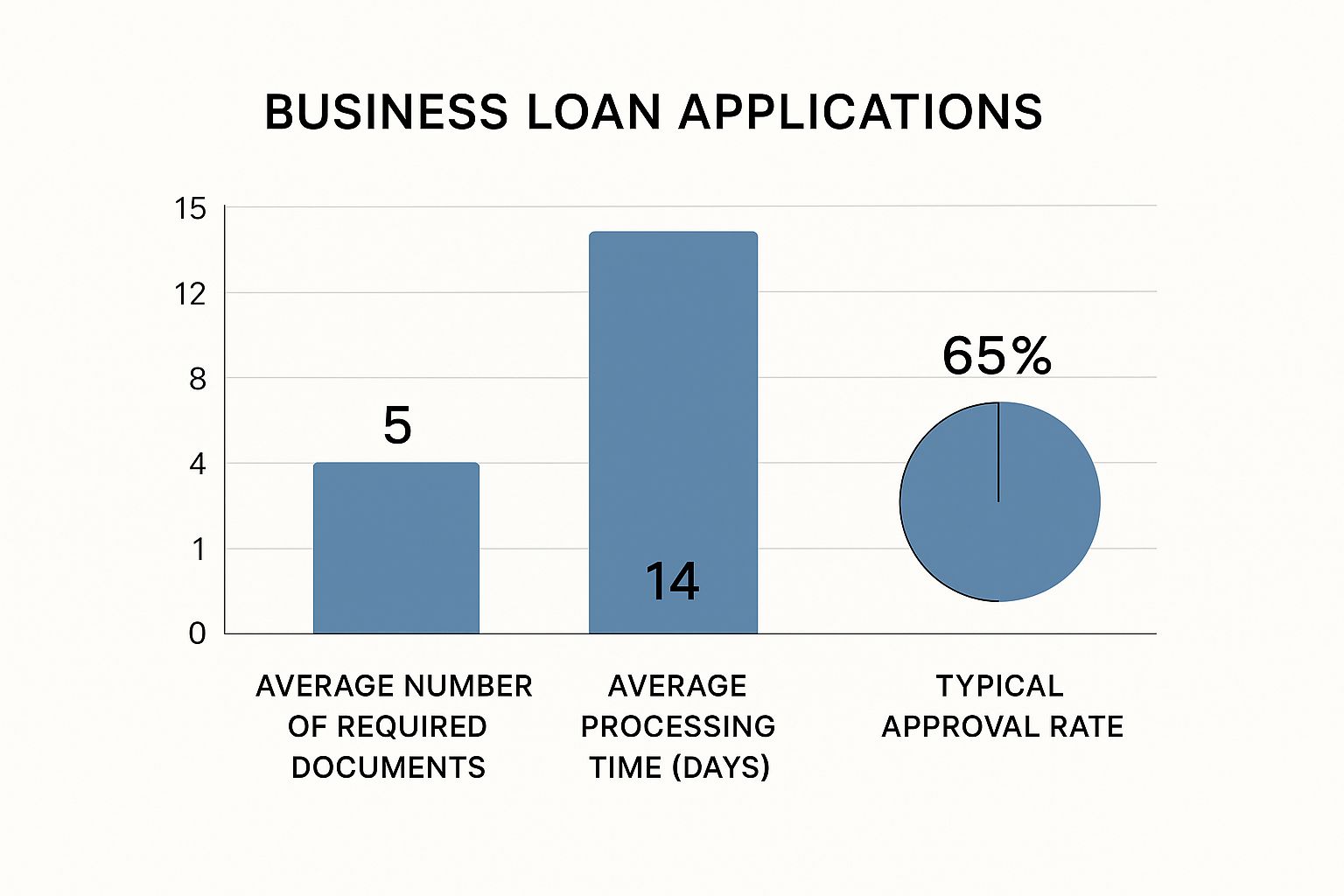
As you can see, even when the paperwork seems straightforward, the waiting game can be long, and getting that final "yes" is never a sure thing.
The core principle is simple: match the financing term to the asset's lifespan. Short-term needs require short-term funding solutions, while long-term investments demand long-term loans.
Here’s a quick rundown of the most common loan types you'll encounter:
-
Term Loans: This is the classic business loan. You get a lump sum of cash upfront and pay it back, with interest, over a set period. It's the go-to for big, one-off investments like buying a major piece of equipment or funding an expansion project.
-
Business Line of Credit: Think of this as a credit card for your business. It gives you a pool of funds you can draw from whenever you need it, and you only pay interest on the money you actually use. It’s perfect for managing cash flow hiccups, covering unexpected bills, or stocking up on seasonal inventory.
-
Equipment Financing: This is a specific loan used to buy machinery or vehicles. The equipment itself usually acts as collateral, which can make these loans a bit easier to qualify for.
-
Invoice Factoring: Does your business suffer from clients who take forever to pay? Invoice factoring lets you sell your outstanding invoices to a company for a small discount. You get cash immediately, and the factoring company takes on the job of collecting from your customer.
Getting these distinctions right is vital. This clarity ensures you're applying for a financial solution that solves your current problem—without creating a new one down the road.
Time to Execute: Nailing the Application and Follow-Up
You’ve done the heavy lifting. Your financial story is polished, your business plan is compelling, and you’ve zeroed in on the right lender and loan product. Now, it’s time for the final push—submitting your application with absolute precision and following up like a seasoned professional. The quality of your execution in this last stage can truly make or break your chances.
The moment you hit "submit" isn't the finish line; it’s just the start of a new, equally critical phase. How you handle the application form, respond to inquiries, and even navigate a potential rejection will define the outcome.
Precision in Every Single Field
Think of the application form as the final exam. After all your prep work, a simple mistake here can be incredibly costly. I’ve seen strong, well-qualified applicants get delayed or even denied because of rushed, incomplete, or inconsistent information.
Treat every field with the care it deserves.
- Double-Check Everything: Before you submit, review every single entry. Make sure names, addresses, and your EIN match your legal documents perfectly. A single typo can create verification headaches that bring the entire process to a screeching halt.
- Consistency is King: The numbers you enter on the application must align exactly with your financial statements and business plan. If your P&L statement shows $500,000 in annual revenue, the application form must also say $500,000, not "around half a million." Discrepancies are a massive red flag for underwriters.
- Be Honest and Transparent: Never, ever try to hide or downplay negative information. If your credit took a hit or you had a tough year, it's far better to be upfront. A good loan officer can often work with you if they understand the context, but discovering something you tried to obscure is one of the fastest ways to destroy trust.
Mastering the Art of the Follow-Up
Once your application is in, the waiting game begins. Your approach here requires a delicate balance—you want to show you're engaged and serious without coming across as impatient or, worse, desperate.
My best advice? Set a clear timeline right from the start. When you submit your application, simply ask your loan officer, "What are the next steps, and when can I expect to hear from you?" This creates a reasonable expectation for both sides.
If that date passes without an update, a polite, concise email is your best move. Something as simple as this works wonders: "Hi [Loan Officer Name], I'm just checking in on the status of my application submitted on [Date]. Please let me know if you need any additional information from me. Thanks!" It’s professional, not pushy.
Your follow-up communication should always be about adding value. If a lender requests more information, see it as a positive sign. It means they're actively working on your file and just need a bit more data to get to a decision. Respond to these requests as quickly and thoroughly as you possibly can.
Turning a "No" into Fuel for Success
Getting a loan rejection is tough. There’s no sugarcoating it. But it's not the end of the road. In fact, it can be one of the most valuable learning experiences you’ll have as a business owner.
Don’t just accept the rejection and walk away. Instead, treat it as direct, actionable feedback.
Politely ask the lender for the specific reasons behind their decision. Was it your credit score? Your cash flow? Time in business, or something else entirely? Understanding the "why" is absolutely crucial. Many lenders, including those highlighted by the SBA, actually encourage this kind of feedback loop. It's a fundamental part of building financial literacy and growing your business.
Use this information to build a clear action plan. If your cash flow was too low, your new focus is improving profitability and building up cash reserves. If your business plan was unclear, refine it with the lender’s feedback top of mind. A rejection today can become the exact roadmap you need for an approval tomorrow.
Frequently Asked Questions About Business Loans
Over my years in finance, and now leading the team here at Shop Rates, I've seen business owners hit the same roadblocks and ask the same questions time and again. It's completely understandable. The business loan process can feel like a maze, but getting clear, straight-to-the-point answers is the first step toward moving forward with confidence.
That's exactly what this section is for. These aren't generic questions; they're the real-world concerns we hear every day. I'll break them down with the kind of practical advice you can actually use on your funding journey.
What Is the Minimum Credit Score for a Business Loan?
This is easily the most common question I get, but the truth is, there's no single magic number. The minimum credit score for a business loan really hinges on the type of lender and the specific loan you're after. Big, traditional banks are known for their great rates, but they're also the most selective. They typically want to see a personal FICO score of 680 or higher. If you're looking at SBA-backed loans, there's a bit more wiggle room; they often look for a score somewhere in the mid-600s.
On the other hand, alternative and online lenders—the world we operate in at Shop Rates—are built to work with a much wider range of credit profiles. We get that a credit score is just one part of your business's story. It’s absolutely possible to get approved with scores in the low 600s, or even the high 500s, especially if your business can show strong, consistent revenue and healthy cash flow.
Remember, lenders are evaluating your entire financial picture. A history of fantastic cash flow or several years in business can often balance out a credit score that's less than perfect. It’s about the whole story, not just one number.
How Long Does It Take to Get Approved for a Business Loan?
The timeline for loan approval can be anything from a few hours to a couple of months. The biggest factor, by far, is the type of lender you approach.
- Online Lenders: Fintech platforms and direct online lenders are built for speed. Many can give you a decision and have funds in your account within 24 to 48 hours.
- Traditional Banks: This is a more methodical, paper-heavy process. You should plan for a timeline of two to six weeks from the day you apply to the day you're funded.
- SBA Loans: These are the most extensive. Because of the government guarantee and the deep underwriting involved, the process can take anywhere from 30 to 90 days.
Your own preparedness makes a huge difference here. If you have all your documents—financials, tax returns, your business plan, and legal paperwork—organized and ready to go before you apply, you can shave a significant amount of time off the process, no matter where you go.
Can I Get a Business Loan with Bad Credit?
Yes, it's definitely possible to get a business loan even if your credit isn't great. Just know that your options will be a bit more limited, and the cost of borrowing will almost certainly be higher. When an applicant's credit is a weak point, lenders naturally shift their focus to other areas of the business to feel comfortable with the risk. They will be looking for undeniable proof of:
- Strong, consistent revenue over a solid period.
- Healthy positive cash flow that shows you can easily handle a new loan payment.
- Significant time in business, usually at least one to two years.
You’ll likely find more success with alternative online lenders, as they specialize in these kinds of situations. It's also worth exploring products like invoice financing or a merchant cash advance, which are less about your credit score and more about the volume of your daily or monthly sales. Your application has to tell a powerful story of repayment ability. And on a related note, it's smart to understand how a business loan can affect your personal credit, as that knowledge is key to making a fully informed decision.
What Are the Most Common Reasons for Loan Rejection?
Understanding why applications get turned down is the single best way to avoid those pitfalls yourself. In my experience, rejections almost always come down to a handful of key issues.
- Poor Credit History: This goes for both your personal and business credit reports.
- Insufficient Cash Flow: A lender will say no if the numbers show your business can't comfortably afford the new monthly payment.
- A Short Time in Business: Many lenders have a minimum cutoff, often one or two years, to see a proven track record.
- A Weak or Unconvincing Business Plan: If your plan is vague or has wildly unrealistic projections, it just doesn't inspire confidence.
- Incomplete or Inaccurate Application: Simple things like typos, mistakes, or missing documents can trigger an immediate denial.
Sometimes, the problem is just a bad fit—you might have applied for the wrong type of loan for your actual needs or approached a lender whose risk appetite doesn't match your business profile. Proactively thinking about and addressing these potential weak spots is your most effective strategy for getting to "yes."
Navigating the world of business financing can be challenging, but you don't have to do it alone. At ShopRates, we're committed to helping entrepreneurs like you find the right funding with clarity and confidence. Our platform connects you with a network of trusted lenders, empowering you to compare options and secure the best possible terms for your business.
Ready to take the next step? Explore your business loan options with ShopRates today.


