

Your Expert Guide to Self-Employed Home Loans in 2024
As an entrepreneur, you've built a business from the ground up, navigating challenges and celebrating successes. But when it comes to securing a home loan, the very financial savvy that helps your business thrive can suddenly feel like a roadblock. It doesn't have to be. Getting a home loan when you're self-employed is not just possible; it's a well-trodden path when you understand the landscape. The key distinction? Proving your income through the actual cash flow demonstrated in your bank statements, rather than the W-2s and pay stubs of traditional employment. For the modern business owner, the journey to homeownership is paved with consistent revenue, not just the adjusted gross income reported to the IRS.
The Entrepreneur's Mortgage Challenge: Why Traditional Loans Fall Short
As a seasoned business owner, you've mastered the art of maximizing profitability while minimizing your tax liability. It's smart business. You meticulously track expenses, take legitimate deductions, and reinvest in your company's growth. This strategic financial management is fundamental to your success. Yet, this very practice creates a significant hurdle when you approach a conventional mortgage lender.
Traditional lenders operate within a rigid framework, one heavily reliant on W-2 income and the net figures on your tax returns. Their underwriting systems are automated to analyze the adjusted gross income—the exact number you've legally and intelligently worked to reduce. This creates a frustrating paradox: your flourishing business, with its robust and consistent cash flow, becomes practically invisible in their assessment, making it appear as though you can't afford the very home you know is well within your means.
The Underwriting Mismatch for Business Owners
At its heart, the issue is a fundamental mismatch between the one-size-fits-all model of conventional lending and the dynamic reality of entrepreneurship. Automated underwriting systems are not programmed to comprehend the nuances of self-employment, such as fluctuating monthly income, seasonal trends, or the strategic reinvestment of profits back into the business.
This problem is particularly acute in entrepreneurial hubs where self-employment is a major economic driver. Consider New York, for instance, where over 1.3 million individuals are self-employed. For this massive segment of the workforce, the underwriting disconnect is a common and deeply frustrating experience. Countless successful entrepreneurs with impressive cash flow are initially rejected by automated systems that cannot see beyond a minimized taxable income. This has fueled a significant shift, pushing more business owners toward specialized loan products designed to evaluate the complete financial picture. You can delve deeper into the data on why New York's self-employed borrowers are shifting to alternative loans to grasp the scale of this trend.
This is the classic entrepreneur's dilemma: the very tax strategies that make your business financially sound can make you appear less qualified on a standard mortgage application.
A Better Path Forward for Entrepreneurs
The great news is that this systemic challenge does not bar you from homeownership. Far from it. It simply means you require a more sophisticated financing tool—one that is fluent in the language of business.
This is precisely where alternative documentation loans, particularly bank statement mortgages, revolutionize the process. These products were specifically engineered for successful entrepreneurs like you. Instead of fixating on your tax returns, they empower lenders to assess the true financial vitality of your business by analyzing your bank deposit history and actual cash flow.
The focus shifts from what you report to the IRS to what your business genuinely earns. By adopting this more holistic perspective, you can finally present an accurate financial narrative and secure the self-employed home loan you rightfully deserve.
Exploring Your Mortgage Options Beyond a W-2
When the conventional mortgage path proves to be a dead end, it's not a signal to give up—it's an invitation to explore a route better suited to your unique financial journey. For entrepreneurs, this means venturing into the world of specialized home loans meticulously designed to recognize your true financial strength, not just the figures on your tax documents.
Imagine a traditional loan as a rigid, unbending ruler, capable of measuring income in only one specific way (W-2s). In contrast, the loans we're about to explore are like a flexible, adaptable measuring tape, able to conform to the unique contours of your business's cash flow to provide a truly accurate assessment.
The Power of Bank Statement Loans
The most prominent and effective solution in this arena is the Bank Statement Loan. This product is a genuine game-changer, as it allows lenders to calculate your qualifying income based on the consistent deposits flowing into your business bank accounts, effectively bypassing your tax returns altogether.
Instead of scrutinizing your net income after all those strategic write-offs, an underwriter will typically:
- Review 12 to 24 months of your business bank statements.
- Calculate the total of all qualified, business-related deposits.
- Apply a standard "expense factor" to determine your qualifying income. For example, if you consistently deposit $20,000 per month and the lender applies a 50% expense factor, your qualifying income for the loan is $10,000 per month.
This method provides lenders with a clear, real-world view of your business's revenue stream. It inherently understands that intelligent tax planning is the hallmark of a savvy business owner, not an indicator of insufficient income.
The required documentation shifts accordingly, as illustrated in this straightforward comparison.
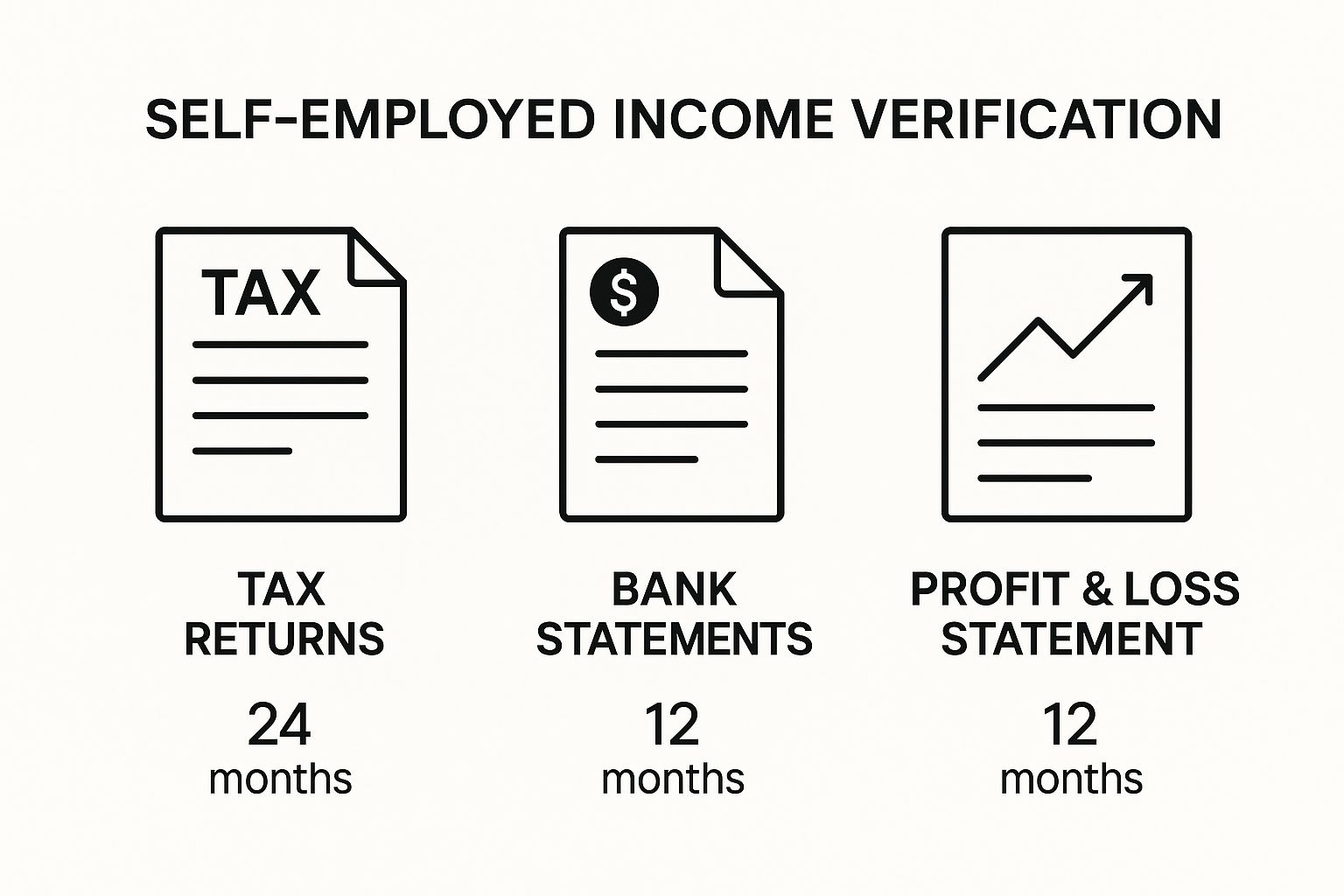
This visual starkly highlights how bank statement loans pivot the focus from your long-term tax history to your recent, verifiable cash flow.
Understanding Non-QM Loans
Bank statement loans are part of a broader category known as Non-Qualified Mortgages (Non-QM). While the term may sound technical, the concept is straightforward. A "Qualified Mortgage" (QM) must adhere to a strict set of government-mandated rules. A Non-QM loan operates outside these rigid confines, granting lenders the essential flexibility needed to serve a wider range of creditworthy borrowers.
Non-QM loans are not subprime; they are customized solutions for strong borrowers with unconventional income situations. They represent a commonsense approach to lending in a world where not everyone earns a steady paycheck.
These loans are ideal for borrowers who are financially robust but don't fit into the conventional W-2 mold. Because they permit greater underwriting flexibility, lenders can use alternative documentation to verify your ability to repay the loan. If you're seeking more adaptable financing, you can learn more about how non-traditional home loans can cater to your specific circumstances.
A Look at Your Home Loan Choices
To fully grasp your options, it's helpful to compare these loan types side-by-side. Each is structured for a different type of borrower, with its own methodology for evaluating your income and overall financial profile.
| Loan Type | Primary Income Verification | Typical Credit Score Range | Best For |
|---|---|---|---|
| Bank Statement Loan | 12-24 months of business bank account deposits | 620+ | Business owners with high revenue but significant tax write-offs that lower their net income. |
| Conventional Loan | 2 years of personal and business tax returns | 620+, but 740+ for best rates | Self-employed individuals with a long, consistent history of high net income after deductions. |
| FHA Loan | 2 years of tax returns showing stable or rising income | 580+ (sometimes lower) | Borrowers with lower credit scores or those needing a smaller down payment (3.5% minimum). |
| VA Loan | 2 years of tax returns demonstrating consistent income | Varies by lender, often 620+ | Eligible veterans, service members, or spouses who want to take advantage of $0 down financing. |
This table provides a solid framework for identifying the most suitable path for your situation. As you can see, while tax returns remain relevant in certain scenarios, they are by no means the only way to prove your creditworthiness.
Can You Still Get Government-Backed Loans?
Absolutely. Government-backed mortgage programs are fully accessible to self-employed individuals, though their documentation requirements are typically more stringent than those for W-2 employees.
- FHA Loans: Renowned for their low down payment options (as little as 3.5%) and more accommodating credit score requirements, FHA loans are a popular choice. To qualify as a self-employed borrower, you will generally need to furnish two years of tax returns that demonstrate stable or increasing income.
- VA Loans: Available exclusively to eligible veterans, active-duty service members, and surviving spouses, VA loans offer unparalleled benefits, including no down payment and no private mortgage insurance (PMI). Similar to FHA guidelines, you'll need to provide at least two years of tax returns showing consistent self-employment income.
The essential takeaway is that you have a diverse range of options. From specialized bank statement programs to flexible government-backed mortgages, the right loan for your entrepreneurial journey is available. The objective is to identify the one that best aligns with your business structure, financial strategy, and homeownership aspirations.
Putting Together Your Self-Employed Document Checklist

Applying for a mortgage can often feel like a documentation scavenger hunt, particularly when you're the one signing the paychecks. However, with strategic preparation, it can be a smooth and efficient process. The secret lies in getting organized well before you submit your application.
Think of this as assembling a professional portfolio for your business's financial health. By transforming a potential mountain of paperwork into a clear, concise package, you not only accelerate the underwriting process but also signal to the lender that you are a serious, well-prepared borrower. Lenders value organization, and a meticulously prepared file makes their job easier, which can only strengthen your application.
This process extends far beyond simply locating your last tax return. For most self employed home loans, the focus shifts to a different set of documents that narrate the true financial story of your business.
The Core Documents for a Bank Statement Loan
When pursuing a bank statement loan, the lender's primary interest is your cash flow—the actual money moving in and out of your business. This places your bank statements at the center of the application, supported by a few other key documents.
Here is the essential checklist to begin with:
- 12-24 Months of Business Bank Statements: This is the cornerstone of your application. Lenders require every single page of your statements for the last one to two years. Ensure they are the official, unaltered versions downloaded directly from your bank, free of any handwritten notes.
- Profit and Loss (P&L) Statement: A clear and concise P&L demonstrates your business's revenue, costs, and net profit. This doesn't need to be a complex, audited report; a self-prepared statement is often sufficient to provide context for your bank deposits.
- Proof of Business Existence: Lenders must verify that your business is a legitimate, active entity. This can typically be established with documents such as business licenses, articles of incorporation, or a professional license.
- Letter from a CPA (Sometimes Required): In some cases, a lender might request a brief letter from your accountant. This letter typically confirms the duration you've been in business and verifies your self-employment status.
Presenting your financial documents in a neat, organized fashion is a powerful non-verbal signal to the underwriter. It demonstrates professionalism and financial discipline—qualities every lender wants to see in a borrower.
Tips for Professional Document Presentation
The manner in which you present your paperwork is nearly as important as the information it contains. An underwriter faced with a disorganized jumble of files is more likely to return the application with questions, causing unnecessary delays.
To make a strong first impression, follow these simple guidelines:
- Create a Simple P&L: If you don't already have one, you can easily create one using a spreadsheet. List your total gross revenue for the past 12 months, then subtract your major business expenses (e.g., advertising, supplies, rent). The resulting figure is your net profit.
- Keep Statements Clean: Ensure your business bank statements clearly show all deposits. Avoid large, irregular cash deposits, as these can raise red flags. If you have an unusual transaction, be prepared to provide a brief written explanation.
- Organize Files Logically: When uploading your documents, use clear and consistent file names (e.g., "Business_Bank_Statement_May_2024.pdf"). This small organizational step significantly improves the experience for the person reviewing your application.
Assembling this package is a crucial step in your home-buying journey. For a more exhaustive list covering all potential requirements, our comprehensive mortgage document checklist is an invaluable tool.
By treating document gathering as a strategic component of the process, you set the stage for a smoother, faster, and more successful application for your self employed home loan.
How to Strengthen Your Mortgage Application
Securing a mortgage as a self-employed individual is not a sprint; it's a marathon of preparation. The groundwork you lay in the months leading up to your application can be the decisive factor between receiving the keys to your dream home and facing a frustrating denial. The goal is to construct an application so robust that it unequivocally demonstrates your financial stability and creditworthiness.
Consider your mortgage application as the final exam for your business's financial health. You wouldn't cram the night before. You would prepare meticulously, ensuring every detail is polished and ready for the lender's thorough review.
Optimize Your Credit Score
Your credit score is arguably the most influential factor in your application. For a lender, it provides an immediate snapshot of your financial reliability. A high score signals that you manage debt responsibly, which in turn lowers their risk and almost always results in a more favorable interest rate. A better rate can save you tens of thousands of dollars over the life of your loan.
Begin by obtaining your credit reports from all three major bureaus—Equifax, Experian, and TransUnion. Scrutinize them for any inaccuracies and promptly dispute any errors. Then, focus on the fundamentals: pay every bill on time, without exception. Payment history accounts for 35% of your FICO score, making it paramount. Additionally, work to pay down credit card balances to bring your credit utilization ratio below 30%. To understand the target range, consult this guide on what credit score is needed for a mortgage to benchmark your standing.
Build Your Cash Reserves and Down Payment
In the mortgage world, especially for entrepreneurs, cash is king. Lenders need to see that you have sufficient liquid assets to cover not only the down payment and closing costs but also a financial cushion for unforeseen circumstances after you move in. This buffer is known as cash reserves.
Aim to save more than the minimum required down payment. A larger down payment reduces the lender’s risk and lowers your loan-to-value (LTV) ratio, which can help you avoid private mortgage insurance (PMI). Having several months' worth of mortgage payments readily available in a savings account provides underwriters with a tremendous sense of security. Demonstrating that you are prepared for all homeownership costs, including understanding homeowners insurance requirements, proves you are a responsible and forward-thinking borrower.
A strong application isn't just about showing you can make the monthly payment; it's about proving you can weather financial storms. Substantial cash reserves are the clearest way to send that message.
Clean Up Your Debt-to-Income Ratio
Your debt-to-income (DTI) ratio is a critical metric lenders use to assess your capacity to take on a new monthly payment. The calculation is straightforward: your total monthly debt payments divided by your gross monthly income. For the self-employed, however, this can be complicated by business debts that can blur the financial picture.
Before applying, conduct a thorough review of your debts. Prioritize paying down or, if possible, eliminating high-interest credit cards, car loans, or personal loans. If you carry significant business debt, be prepared to explain its purpose and demonstrate how it contributes to your company's profitability. Reducing your DTI by even a few percentage points can dramatically improve your approval odds for a self employed home loan.
Separate Business and Personal Finances
Commingling business and personal funds is a significant red flag for underwriters. It makes it incredibly difficult for them to determine your true income and accurately assess your business's financial stability. If your business bank statements are cluttered with personal expenses like groceries and entertainment, it creates confusion and undermines your professionalism.
Establish a clear and unwavering separation between your finances:
- Pay yourself a regular salary from your business account to your personal account.
- Use a dedicated business credit card for all business-related expenses.
- Confine all personal spending to your personal cards and accounts.
This financial discipline not only simplifies the underwriter's job but also showcases your professionalism and business acumen.
Time Major Purchases Carefully
The months before and during your mortgage application process should be a financial "quiet period." Refrain from making any large purchases, such as a new vehicle, expensive business equipment, or accumulating new credit card debt. Any significant new debt will alter your DTI ratio and could jeopardize your loan approval at the final stage, when the lender performs their last credit check. Postpone all major financial moves until the home loan has officially closed and the keys are in your hand.
Understanding Rates and Terms for Your Loan

It’s the question every self-employed homebuyer eventually asks: "Will my interest rate be higher?" It’s a valid concern, and the honest answer is, sometimes, yes. But it’s crucial to understand why and to know that it’s not an automatic penalty for being an entrepreneur.
The rates for non-QM and bank statement loans are based on a concept called risk-based pricing. Lenders see income that doesn't come from a steady W-2 paycheck as carrying a slightly higher degree of uncertainty. It's not a judgment on your success; it's simply a different risk calculation for them.
Think of it like this: a W-2 employee is like a train on a fixed track, arriving at the same station with the same amount of pay every two weeks. A self-employed professional is more like a cargo ship—it moves a huge amount of value, but its path can vary based on market currents and business cycles. To account for that variability, the lender charges a small premium.
Factors That Directly Influence Your Rate
The great news is that you are not a passive participant in this process. You have significant control over the factors that determine your final interest rate and loan terms. Your financial strength can easily offset the lender’s perceived risk.
The three most powerful levers you can pull are:
- Your Credit Score: This is your financial report card, and a high score (think 740+) is the fastest way to signal to a lender that you are a low-risk borrower. It demonstrates a long history of responsible debt management.
- Down Payment Size: A larger down payment reduces the loan-to-value (LTV) ratio. Putting down 20% or more significantly lowers the lender's risk, often resulting in a much better interest rate.
- Cash Reserves: Having several months of mortgage payments saved up after your down payment and closing costs are paid is a huge confidence booster for underwriters. It shows you can handle unexpected expenses without missing a payment.
These elements work together to paint a picture of your financial stability. A strong applicant with a high credit score and a substantial down payment can often secure a rate that is very competitive with conventional loans.
Strategies for Securing the Best Possible Terms
Knowing what lenders look for is only half the battle; the other half is taking action to position yourself for success. A different loan type doesn't have to mean a bad deal if you approach it strategically.
Your rate is not just a number; it's a reflection of the lender's confidence in your ability to repay the loan. Your job is to build that confidence through a meticulously prepared application.
Start by shopping around with lenders like ShopRates that specialize in self-employed home loans. An expert who understands your unique financial situation can advocate for you and find programs that reward your strengths. Be prepared to explain your business's revenue consistency and growth trajectory.
It's also helpful to understand the broader market you're stepping into. The global home loan market is substantial, valued at around USD 5.82 trillion and projected to grow significantly. Within this market, banks still hold a majority share, but non-bank lenders and fintech companies are the fastest-growing source of loans—and they often offer the exact flexibility self-employed borrowers need. As housing costs rise, loans with longer terms are also becoming more popular because they help lower monthly payments, a trend that could benefit entrepreneurs managing fluctuating cash flow. You can explore more insights into the global home loan market dynamics to see how these trends create opportunities.
Ultimately, securing favorable terms is about proving your financial health in a language the lender understands. By focusing on your credit, savings, and the overall strength of your business, you empower yourself to negotiate from a position of knowledge and confidence.
Your Self-Employed Home Loan Questions Answered
When you're self-employed, the path to a home loan can feel like it has a few extra twists and turns. Your finances are more complex than a W-2 employee's, and it's completely normal to have specific questions pop up. We get it.
This section is dedicated to answering the most common questions we hear from entrepreneurs, freelancers, and small business owners just like you. Let's clear up the confusion so you can move forward with confidence.
Can I Get a Home Loan with Only One Year of Self-Employment History?
While the gold standard for lenders is a two-year track record, getting a mortgage with just one year of self-employment is definitely on the table. It just means the rest of your application needs to be rock-solid.
Lenders will look for "compensating factors" to balance out the shorter business history. Think of it as showing strength in other areas to prove you're a reliable borrower.
These factors usually include:
- A strong credit score, typically 720 or higher.
- A larger down payment, often 20% or more.
- Plenty of cash reserves left in the bank after closing.
Your application gets even stronger if your new venture is a natural next step from your previous job. For example, if you were a salaried graphic designer who went freelance, lenders see that as a stable career move, not a risky leap into the unknown. A good loan officer can be your best advocate here, helping to tell that story to the underwriter.
How Do Lenders Calculate My Income From Bank Statements?
When you apply for a bank statement loan, lenders throw the old tax-return math out the window. Instead, they dive into 12 to 24 months of your business bank statements to get a clear picture of your actual revenue.
Here’s how it generally breaks down: The lender will add up all the qualified deposits from your business accounts over that period. Then, they apply an "expense factor"—this is a pre-set percentage meant to represent the average overhead costs for your line of work.
Let's say you're consistently depositing $30,000 a month into your business account. If the lender's expense factor for your industry is 40%, they'll calculate your qualifying monthly income as $18,000 ($30,000 – $12,000 in assumed expenses).
If you can prove your actual overhead is lower than the industry standard, providing a clean Profit & Loss (P&L) statement prepared by your CPA can sometimes convince the lender to use a lower expense factor, boosting your qualifying income.
Do My Business Write-Offs Hurt My Chances of Getting a Mortgage?
This is the classic entrepreneur's dilemma, isn't it? For a traditional mortgage that hinges on your tax returns, the answer is a big, resounding "yes." Every dollar you write off shrinks your taxable income, and that directly reduces the amount you can borrow.
But here’s the game-changer: for a bank statement loan, your business write-offs are completely irrelevant.
The whole point of this loan is to sidestep your tax returns and qualify you based on your business’s real-world cash flow. It’s a solution built for the reality of running a business, allowing you to stay tax-savvy without torpedoing your chances of buying a home.
Are Interest Rates for Self-Employed Home Loans Always Higher?
It’s true that rates for specialized loans, like bank statement mortgages, can be a tick higher than conventional rates for W-2 borrowers. This isn't a penalty; it's simply risk-based pricing. Lenders are using a different method to verify your income, and the rate reflects that.
However, it's not a hard-and-fast rule. A fantastic credit score, a hefty down payment (which lowers the loan-to-value ratio), and solid assets can help you land a very competitive rate, often getting you close to conventional pricing.
Think of it as a trade-off. You might pay a slightly higher rate in exchange for the massive advantage of qualifying with your true cash flow. As a self-employed individual, you're also likely thinking about protecting your family and this new major asset. It's smart to learn about how life insurance can cover mortgage debts as you build your complete financial plan.
Ready to explore the self-employed home loan options that fit your business? The team at ShopRates specializes in helping entrepreneurs like you navigate the mortgage process with clarity and confidence. Get started today and let us help you turn your homeownership goals into a reality.


