How Do Loans Work? Your Comprehensive Guide to Borrowing
At its core, a loan is a straightforward financial agreement. A lender provides you with a sum of money, and you agree to repay that amount, plus an extra charge, over a predetermined period. This simple exchange is the foundation of modern finance, enabling everything from buying a home to launching a business.
The extra fee you pay is called interest, and it's the lender's compensation for the risk they take and for allowing you to use their capital. Understanding this fundamental transaction is the first step toward navigating the world of borrowing with confidence. This guide, brought to you by the experts at ShopRates, is designed to demystify the process, empowering you to make informed decisions that align with your financial goals.
The Simple Mechanics of How Loans Work
The easiest way to think about a loan is that you're 'renting' money. You, the borrower, need funds for a specific purpose—perhaps a down payment on a house, a new vehicle, or consolidating higher-interest debt. A financial institution, the lender, has the capital and is willing to provide it to you under a specific set of rules.
This entire transaction is formalized in a loan agreement, a legally binding contract that outlines every detail of the arrangement. It clearly states how much you're borrowing, the interest rate you'll pay, the length of the repayment period, and the schedule for your payments. Getting comfortable with these key components transforms a potentially confusing process into a manageable financial tool.
The Four Pillars of Any Loan
Every single loan, regardless of its size or purpose, is built on four fundamental concepts. Mastering these will give you a solid foundation for evaluating any loan offer that comes your way. These elements collectively determine the total cost and structure of your borrowing, so it's essential to understand them before you sign any documents.
| Component | What It Means for You |
|---|---|
| Principal | This is the actual amount of money you borrow. If you get a $10,000 auto loan, the principal is $10,000. It's the starting point of your debt. |
| Interest | This is the lender's fee for letting you use their money, expressed as a percentage of the principal. This is the primary cost of borrowing. |
| Term | This is the lifespan of the loan—the total time you have to pay everything back. For a car loan, a common term is 60 months (five years). For a mortgage, it could be 30 years. |
| Payment | This is the fixed amount you pay the lender regularly (usually monthly) that goes toward covering both the principal and the interest. |
Wrapping your head around these four pillars is the key to understanding how loans work. They are interconnected and define the entire borrowing experience, from the impact on your monthly budget to the total amount you’ll ultimately pay back.
The Borrower and Lender Relationship
The relationship between a borrower and a lender is a two-way street, built on a delicate balance of risk and trust. From the lender’s perspective, their primary concern is assessing the risk that you might not be able to repay the loan. To do this, they will conduct a thorough review of your financial history, income streams, and overall creditworthiness.
A loan isn't just a transaction; it's a partnership. The lender trusts you to repay the funds, and you trust the lender to provide them under fair and transparent terms.
As the borrower, your role is to demonstrate that you are a reliable candidate, which will help you secure the most favorable terms possible. This means presenting a stable financial track record and proving you have the capacity to handle the required monthly payments. When both sides operate with this mutual understanding and transparency, the lending process functions smoothly and effectively.
Principal and Interest: The Two Sides of Your Payment
Every single time you make a loan payment, you’re tackling two distinct financial components: the principal and the interest. It doesn't matter if it's for a car, a house, or a personal loan; your payment is a single stream of money that splits the moment it reaches the lender. One portion goes toward reducing what you actually owe, and the other portion is the fee you pay for the privilege of borrowing.
Think of the principal as the core of your debt—it’s the exact amount of money you borrowed in the first place. If you took out a $20,000 personal loan, your principal is $20,000. Every dollar from your payment that gets applied to the principal chips away at that original debt, bringing you closer to owning your asset free and clear.
On the flip side, interest is simply the cost of borrowing that money. It's how the lender generates profit and mitigates the risk of lending to you over an extended period. This cost is calculated as a percentage of your remaining loan balance.
The Amortization Seesaw
Now, here’s where the mechanics get truly interesting. The way your payment is split between principal and interest isn't static; it changes dramatically over the life of the loan. This process is called amortization, and it functions much like a seesaw.
When you first begin making payments, that seesaw is tipped heavily to one side. A significant portion of your payment goes directly to paying off interest. However, as the months and years pass, the seesaw slowly begins to tilt in the other direction.
With each payment, you're not just sending money; you're shifting a financial balance. Initially, you're paying mostly for the privilege of borrowing. Eventually, you're paying for the asset itself.
This means that toward the end of your loan term, the vast majority of your payment is dedicated to reducing the principal balance. Understanding this dynamic is a game-changer because it reveals the incredible power of making even small extra payments early on. Since your interest is calculated on a smaller principal, you can save a substantial amount of money and potentially shorten your loan term by years.
Before we delve deeper, it’s worth remembering that understanding principal and interest is only part of the puzzle. You must first select the right type of loan for your specific financial journey.
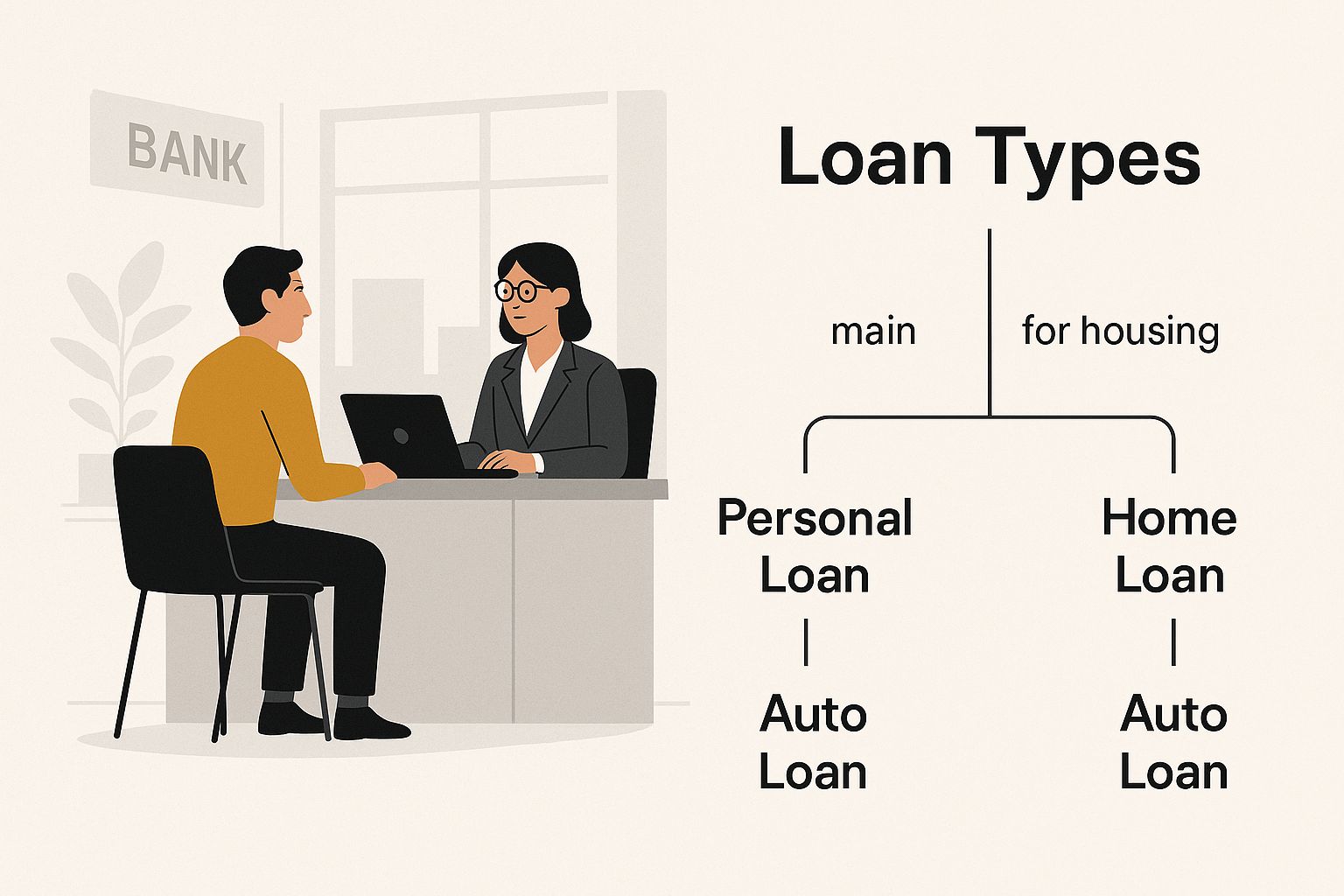
This visual is a great reminder that your loan choice sets the stage for everything that follows.
Visualizing Your Payment Breakdown
The best way to see amortization in action is to review an amortization schedule. This is a detailed table that breaks down every single payment you'll make over the loan's life, showing precisely how much is allocated to principal and how much to interest. It removes all guesswork.
Let's use a simplified example to make this crystal clear for a long-term loan:
- Payment 1: Your $1,000 payment might be split into $700 for interest and only $300 for principal.
- Payment 180: Fast forward several years, and that same $1,000 payment could look like $200 for interest and $800 for principal.
Your monthly payment amount stays consistent, but the internal allocation changes completely over time. This gradual shift is the core of how most installment loans work. If you truly want to get into the details and understand the real cost of borrowing, learning how to calculate interest on a loan will provide even greater clarity.
The relationship between interest rates and what you ultimately pay is especially critical for large-scale purchases like mortgages. Our guide on how mortgage interest rates affect my monthly payment explains how even a minor change in your rate can equate to tens of thousands of dollars over decades. Mastering these concepts isn't just about crunching numbers—it’s about empowering yourself to make smarter, more cost-effective financial decisions.
Navigating The Different Types of Loans
Once you've grasped how principal and interest work, the next critical realization is that not all loans are created equal. The world of lending is vast, filled with diverse products designed for very specific circumstances. Selecting the right type of loan is one of the most important financial decisions you'll make, as it directly influences your interest rate, your repayment structure, and the level of risk you're undertaking.
The simplest way to begin sorting through the options is to divide them into two primary categories: secured and unsecured. This single distinction shapes the entire relationship between you and the lender, making it the first thing you need to understand.
Secured Loans: The Power of Collateral
A secured loan is exactly what it sounds like: a loan that is backed by a tangible asset you own. This asset is called collateral, and it essentially serves as the lender's safety net. If, for any reason, you are unable to repay the loan as agreed, the lender has the legal right to take possession of that collateral to recover their funds.
You are likely already familiar with these. Common examples include:
- Mortgages: The house you are purchasing serves as the collateral.
- Auto Loans: The new car you are driving is the collateral.
- Home Equity Lines of Credit (HELOCs): Your home's equity secures the loan.
Because the lender is assuming significantly less risk, they can typically offer more favorable terms. This often translates to lower interest rates, higher borrowing limits, and longer repayment periods. The trade-off, of course, is substantial—you risk losing a valuable asset if you default on your payments.
Unsecured Loans: Your Word Is Your Bond
On the other side of the spectrum, an unsecured loan is not backed by any physical asset. Instead, the lender extends credit based entirely on your financial reputation—your credit history, income, and overall creditworthiness. They are essentially trusting your promise to repay the debt.
Personal loans and student loans are the most common types of unsecured loans. With no collateral to fall back on, the lender is taking on a much larger gamble. To compensate for that increased risk, unsecured loans almost always come with higher interest rates and more stringent qualification standards than secured loans.
An unsecured loan is a testament to your financial discipline. The lender is betting on your reliability, making a strong credit score your most valuable asset.
This is where your credit history truly takes center stage. An excellent credit score signals to lenders that you are a reliable bet, making them more willing to offer you a competitive rate. A lower score, however, may result in a higher interest rate or even an outright denial of your application.
Secured vs. Unsecured Loans At A Glance
To truly understand how loans work, it often helps to see the core differences side-by-side. The choice between secured and unsecured financing impacts everything from the rate you pay to the consequences if you cannot make your payments. This table breaks down the essentials.
| Feature | Secured Loans | Unsecured Loans |
|---|---|---|
| Collateral Required | Yes (e.g., home, car) | No |
| Lender Risk | Lower | Higher |
| Typical Interest Rates | Lower | Higher |
| Typical Loan Amounts | Higher | Lower |
| Credit Score Impact | Important, but collateral helps | Extremely important |
| Default Consequence | Lender seizes the collateral | Legal action, credit damage |
Ultimately, determining which path is right for you depends on your personal financial situation, the assets you have to offer as collateral, and your comfort level with the risks involved.
Matching the Loan to Your Goal
Beyond the secured versus unsecured divide, loans become even more specialized. A personal loan, for instance, is the Swiss Army knife of borrowing. You can use the funds for almost anything, from consolidating high-interest credit card debt to financing a major home renovation. For a deeper look, check out our guide on how personal loans can be tailored to fit your financial needs.
Other loans are laser-focused on a single purpose:
- Mortgages are strictly for purchasing real estate.
- Auto Loans are structured specifically for purchasing a vehicle.
- Student Loans are earmarked to cover educational expenses.
The dynamics of these loans play out on a massive scale. For example, major banks often report loan growth in the tens of billions of dollars each quarter, driven by commercial and consumer lending. These figures underscore just how vital loans are for everything from individual credit needs to large-scale business operations, with lenders constantly adjusting their portfolios based on economic conditions and risk assessments.
The Loan Application Process Demystified
Applying for a loan can feel like preparing for a high-stakes exam, but it’s far from it. Think of it less as a test and more as a structured conversation where you’re presenting your financial story. Once you understand the steps involved, the entire process shifts from intimidating to completely manageable. It’s all about demonstrating to a lender that you’re a reliable and responsible borrower.
The real work actually begins long before you fill out a single application. Your first move should always be a thorough financial self-assessment. This means taking an honest look at your financial health, particularly your credit report and score. To a lender, your credit history is the clearest predictor of how you’ll handle future debt obligations.
From there, the process becomes more formal. The lender will evaluate your ability to handle the loan, and you’ll begin gathering the necessary documents to support your case. This is where you transition from a potential borrower to an approved one.
Understanding the Five Cs of Credit
When a lender reviews your application, they aren't just relying on intuition. They use a time-tested framework to systematically evaluate the risk involved. This framework is known as the Five Cs of Credit, and these are the pillars upon which your entire application rests.
- Character: This is about your reputation for financial responsibility. Do you have a consistent history of paying your bills on time? Your credit report tells this story, acting as a testament to your reliability.
- Capacity: This boils down to a simple question: can you realistically afford to repay this loan? Lenders analyze your income versus your existing debts (your debt-to-income ratio) to ensure a new monthly payment won’t overextend you.
- Capital: Lenders want to see that you have some "skin in the game." This is the personal money you’re contributing toward the purchase, such as a down payment on a house or car. It signals your commitment and reduces the lender’s overall risk.
- Collateral: For secured loans, this is the asset you’re pledging as security—the house, the car, etc. If you fail to repay the loan, the lender can take possession of the collateral to recoup their losses.
- Conditions: This covers the broader context. What is the purpose of the loan? How much are you borrowing? What are the current interest rates, and what is the overall economic climate like? These external factors all play a role in the lending decision.
Familiarizing yourself with these five elements gives you insight into the lender's mindset and shows you exactly where to focus your efforts to build the strongest possible application.
Gathering Your Financial Documents
Once you’re ready to apply, you'll need to provide documentation to verify your financial standing. This is the stage where you build a portfolio that substantiates everything you’ve claimed about your capacity and character. While the exact requirements can vary slightly between lenders, most ask for the same core documents.
Having these prepared in advance can dramatically speed up the entire process:
- Proof of Identity: A government-issued ID, such as a driver’s license or passport.
- Proof of Income: Recent pay stubs, W-2 forms, or your tax returns from the last two years.
- Bank Statements: The last few months of statements for your checking and savings accounts.
- Proof of Residence: A recent utility bill or rental agreement with your name and address.
- Existing Debt Information: Statements for any other loans, credit cards, or mortgages you currently hold.
For a larger loan like a mortgage, the paperwork becomes even more detailed. If you’re considering buying a home, reviewing a step-by-step guide to the mortgage pre-approval process will provide an excellent roadmap of what to expect.
The Underwriting and Approval Stage
After you've submitted your application and all your supporting documents, your file moves into underwriting. This is the critical, behind-the-scenes step where a professional underwriter conducts the official risk assessment. They will meticulously verify and cross-reference every piece of information you’ve provided.
Underwriting is where the lender connects the dots of your financial life. They are verifying that the story your application tells matches the documented facts, ensuring you are a sound and reliable borrower.
The underwriter confirms your income, scrutinizes your credit reports, and assesses the value of any collateral involved. If your financial story holds up and everything aligns with the lender’s guidelines, your loan receives the final approval. From there, you’ll receive the final loan offer, sign the closing documents, and the funds will be disbursed to you.
Reading the Fine Print: APR, Fees, and Loan Terms

The interest rate a lender advertises is merely the opening act. The true cost of the loan—the complete financial picture—is almost always found within the fine print of the loan agreement. To become a truly savvy borrower, you must look beyond the headline number and understand what's really happening inside your contract.
This is where the details can either save you a significant amount of money or cost you a small fortune. Focusing solely on the interest rate is one of the most common and costly mistakes borrowers make. There's a much more powerful figure to focus on: the Annual Percentage Rate (APR).
Why APR Is the Most Important Number
Think of the interest rate as the base price of the loan. The APR, on the other hand, is the total, "out-the-door" price. It bundles the interest rate with most of the lender’s associated fees and charges, presenting you with a single, comprehensive percentage that reflects the true annual cost.
APR is the great equalizer in loan comparison. It standardizes the cost of borrowing, allowing you to see a true side-by-side comparison of different loan offers, regardless of their fee structures.
This is why two loans with the exact same interest rate can have vastly different APRs. A loan with a slightly lower interest rate but high origination fees might actually be the more expensive option over the long term. Always use the APR as your primary tool for comparing loan offers.
Decoding Common Lender Fees
Lender fees are notorious for inflating the total cost of a loan. While they can vary, a few common culprits appear in most loan agreements. You need to know what they mean for your wallet.
- Origination Fees: This is an upfront, one-time fee the lender charges for processing your application and setting up the loan. It's typically a percentage of the total loan amount, often falling between 1% and 8%.
- Prepayment Penalties: Believe it or not, some lenders will charge you a fee if you attempt to pay off your loan early. They do this because they lose out on the future interest they were expecting to collect. It’s absolutely critical to ask if your loan includes one of these.
- Late Fees: This one is straightforward. Nearly every loan has penalties for payments that are late or missed. These fees can add up quickly and negatively impact your credit score.
Understanding these charges before you sign anything helps you avoid unpleasant surprises down the road. More importantly, it empowers you to ask the right questions and potentially negotiate more favorable terms.
The Trade-Off of the Loan Term
The loan term—the amount of time you have to repay the money—is defined by a fundamental trade-off. It’s a balancing act between your monthly payment affordability and the total amount of interest you'll pay over time.
A longer loan term results in smaller, more manageable monthly payments. This can be very appealing as it frees up your monthly cash flow. The catch? You'll be paying interest for a much longer period, meaning you'll pay significantly more in total interest over the life of the loan.
Conversely, a shorter loan term comes with higher monthly payments. While this places a greater strain on your monthly budget, you pay off the debt much faster and save a substantial amount in total interest costs. Choosing the right term is about finding the sweet spot between what you can comfortably afford each month and your goal of minimizing the overall cost of borrowing.
Frequently Asked Questions About How Loans Work
Even after you understand the basics, several questions often arise when you are in the practical process of borrowing. Let's address some of the most common inquiries to clear up any lingering confusion and provide you with the confidence to move forward.
1. What is the difference between an interest rate and an APR?
This is a critical distinction that can save you a significant amount of money. The interest rate is simply the base percentage charged for borrowing the money. The Annual Percentage Rate (APR) is the true, all-encompassing cost. It includes the interest rate plus most of the associated lender fees (like origination fees). For this reason, you should always use the APR to make a true apples-to-apples comparison between different loan offers.
2. How does my credit score affect my loan?
Your credit score is arguably the most influential factor in your loan application. It serves as a financial report card for lenders. A high score indicates you are a low-risk borrower, which lenders reward with their best offers: lower interest rates, more flexible terms, and potentially higher loan amounts. A lower score signals higher risk, often resulting in higher interest rates or even a denial. Improving your credit score before applying for a major loan can save you thousands of dollars over its term.
3. What is the difference between a fixed-rate and a variable-rate loan?
A fixed-rate loan has an interest rate that is locked in for the entire life of the loan. Your monthly principal and interest payment will never change, providing predictability and stability. A variable-rate loan (or adjustable-rate loan) has an interest rate that can fluctuate over time based on changes in a benchmark index. While it may start with a lower rate, your payments could increase if rates rise.
4. Can I pay off a loan early, and are there penalties?
Yes, you can almost always pay off a loan ahead of schedule, which is an excellent way to reduce the total interest you pay. However, you must be aware of potential prepayment penalties. Some lenders charge this fee if you pay off the loan too early to compensate for the interest they would have earned. Always ask your lender directly if a loan has a prepayment penalty before you sign the agreement.
5. What happens if I miss a loan payment?
Missing a loan payment triggers several negative consequences. First, you'll likely be charged a late fee. If the payment is more than 30 days late, the lender will report it to the credit bureaus, which will damage your credit score. If you continue to miss payments, the loan will go into default. For a secured loan, this could lead to repossession of your asset (like a car or home). For an unsecured loan, the lender may pursue legal action or send your account to a collections agency. If you anticipate missing a payment, contact your lender immediately to discuss your options.
6. What is a debt-to-income (DTI) ratio?
Your DTI ratio is a key metric lenders use to assess your capacity to take on new debt. It's calculated by dividing your total monthly debt payments by your gross monthly income. A lower DTI ratio indicates you have a healthy balance between debt and income, making you a more attractive candidate for a loan. Most lenders prefer a DTI ratio below 43%.
7. What is the difference between pre-qualification and pre-approval?
Pre-qualification is an informal estimate of how much you might be able to borrow, based on self-reported financial information. Pre-approval is a more formal process where the lender verifies your financial documents (like income and assets) and provides a conditional commitment to lend you a specific amount. A pre-approval holds more weight and is a stronger indicator of your borrowing power.
8. How long does the loan approval process take?
The timeline can vary significantly depending on the type of loan. A personal loan might be approved and funded in as little as one business day. An auto loan can often be finalized in a few hours at a dealership. A mortgage, however, is a much more complex process that typically takes 30 to 60 days from application to closing.
9. What is loan amortization?
Amortization is the process of spreading out loan payments over time. With each payment, a portion goes toward interest and a portion goes toward the principal balance. In the early stages of the loan, a larger percentage of your payment covers interest. As you continue to make payments, more and more of your money goes toward reducing the principal.
10. Can I get a loan with bad credit?
Yes, it is possible to get a loan with bad credit, but your options will be more limited and more expensive. You will likely face higher interest rates and less favorable terms. Some lenders specialize in subprime lending. Another option is to apply for a secured loan, where providing collateral can reduce the lender's risk and improve your chances of approval.
At ShopRates, we believe that understanding how loans work is the first step toward achieving your financial goals. Whether you're buying a home, financing a car, or consolidating debt, our marketplace is designed to bring you transparent, competitive offers from trusted lenders. We provide the tools, resources, and expert support you need to borrow with confidence.
Ready to find the right loan for your needs? Explore your options with ShopRates today!


