

How to Negotiate Mortgage Rates Like a Pro
Securing the best mortgage rate doesn't begin in a lender's office. The journey starts months, sometimes even a year, beforehand, right at your own kitchen table. The secret weapon in any rate negotiation isn't a clever turn of phrase; it's an undeniable, rock-solid financial profile.
Think of it this way: when a lender sees a low-risk applicant, they don't just see a loan—they see a business opportunity they don't want to lose. That's when they start competing for you, and that's where your leverage comes from.
Build Your Unshakable Financial Foundation

Before you can even think about asking for a better deal, you need to prove you deserve one. Lenders are fundamentally in the risk-management business. Your job is to present such a compelling financial story that offering you a great rate becomes the easiest decision they make all day.
This preparatory work is, without a doubt, the most important part of the entire negotiation. Skipping it is like showing up to a final exam without studying—you’re just hoping for the best, and that's not a strategy.
Aim for Credit Score Excellence
Let's be blunt: your credit score is the king of your mortgage application. While you can technically get a loan with a less-than-perfect score, the absolute best rates—the ones you can truly negotiate—are reserved for the top tier.
Lenders generally consider a FICO score of 740 or higher to be the gold standard. A score in this range signals that you're a highly responsible borrower, which directly translates to lower risk for them. That lower risk gives them the wiggle room to offer you a better rate. If your score isn't there yet, your first mission is to get it there. We've got a detailed guide on how to improve credit score fast that can help.
Expert Insight: I always tell clients to think of their credit score as their financial reputation. A score above 740 tells a lender, "This person has a long, proven history of handling their debts responsibly." That reputation alone can save you tens of thousands of dollars over the life of your loan.
Optimize Your Debt-to-Income Ratio
Right behind your credit score is your debt-to-income (DTI) ratio. It's a simple calculation: your total monthly debt payments divided by your gross monthly income. Most lenders want to see a DTI of 43% or lower. Going above that isn't impossible, but it often requires other major strengths, like a sky-high credit score or massive cash reserves.
To get your DTI in shape, focus on two things:
- Attack High-Interest Debt: Zero in on paying down credit card balances, personal loans, and auto loans. Every dollar you pay down not only lowers your DTI but can also give your credit score a nice boost by improving your credit utilization.
- Pause on New Debt: In the months before you apply for a mortgage, hit the pause button. Don't open new credit cards, and definitely don't finance a new car. Every new inquiry and added debt can ding both your credit score and your DTI at the worst possible time.
This shows lenders you have financial discipline. It's also worth looking into programs that might help your situation, like the government's Support for Mortgage Interest (SMI) scheme.
Assemble Your Documentation Like a Pro
Walking into a meeting (even a virtual one) with every single document ready to go sends a powerful signal: you're organized, serious, and ready to do business. Last-minute scrambling for paperwork creates a bad first impression and can cause frustrating delays.
Get your financial life in order by gathering these documents ahead of time:
- Proof of Income: At least two years of W-2s, your most recent pay stubs covering a 30-day period, and your federal tax returns.
- Asset Statements: The last two to three months of statements for all checking, savings, investment, and retirement accounts.
- Debt Records: Current statements for any car loans, student loans, or credit cards.
- Personal ID: Clear copies of your driver's license and Social Security card.
Getting this foundation right is a game-changer. By putting in the work upfront, you shift from being a passive rate-taker to an empowered negotiator who has earned the right to ask for the best possible terms.
Understand the Market to Time Your Move Perfectly
Knowing when to make your move is every bit as important as knowing what to say in a negotiation. Think of it this way: market awareness is your secret weapon. It lets you ride the economic waves that push mortgage rates up and down instead of getting caught in them.
This isn't about trying to become a Wall Street guru overnight. It's about getting a feel for the major forces that shape the mortgage market so you can make smarter decisions—the kind that pay off for years to come.
The simple truth is that the rate a lender quotes you is rarely set in stone. It’s constantly being nudged by huge macroeconomic factors, mainly what the Federal Reserve is doing and how the bond market is behaving.
The Federal Reserve and Bond Market Connection
When the Federal Reserve tweaks the federal funds rate to either cool down inflation or kickstart economic growth, it sends ripples through the entire financial system. The Fed doesn't set mortgage rates directly, but its moves are a huge signal about where the economy is headed.
Mortgage rates have a habit of following the yield on 10-year Treasury notes. When the economy is humming along, investors often sell off safer assets like bonds to chase higher returns elsewhere. This causes bond yields to rise, and mortgage rates almost always follow.
On the flip side, when there's economic uncertainty in the air, investors rush back to the safety of bonds. This flood of demand drives bond yields down, and mortgage rates usually drop right along with them.
Before you can even think about negotiating, you need a solid grasp of the big picture. Start by getting familiar with the current interest rates for homes in your area; that’s your baseline.
Timing Your Rate Lock Strategically
All this market insight boils down to one of the most critical decisions you'll make in the homebuying process: when to lock in your mortgage rate. A rate lock is the lender's promise to hold a specific interest rate for you for a certain period, usually 30 to 60 days, while they process all your paperwork.
Here’s how this plays out in the real world:
- When Rates Are Climbing: If you see strong job reports, high inflation numbers, or other signs that the economy is heating up, rates are likely on an upward march. Locking your rate early is a smart, defensive move. It shields you from future hikes that could easily add hundreds to your monthly payment.
- When Rates Are Falling: If the economy looks like it's slowing down and you hear whispers of the Fed planning rate cuts, you might decide to "float" your rate. This means holding off on locking, hoping rates dip even lower before you commit. Some lenders even offer a mortgage rate float-down option that lets you lock a rate but still snag a lower one if the market improves, though usually for a small fee.
History shows just how much timing matters. In the U.S., mortgage rates bottomed out at a historic low of 2.65% in January 2021, only to soar above 7% by late 2023. During the intense hikes of 2022, borrowers who locked their rates early saved an average of 0.75% compared to those who hesitated.
A Note from Experience: I've seen clients save thousands of dollars just by paying attention. One borrower locked their rate the day before a big inflation report was due. The numbers came in hotter than expected, and rates jumped a quarter-point overnight. Because they acted, my client was protected. That one strategic decision saved them over $25,000 over the life of their loan.
Keeping an eye on economic news and our 2025-2026 mortgage forecasts gives you the context you need. It helps you talk intelligently with your loan officer about timing, turning a simple transaction into a major financial win.
Create a Bidding War for Your Business
Here's the single most powerful rule I've learned in decades of navigating mortgages: never, ever accept the first offer. Think of a lender's initial quote as a starting point. It's an invitation to a conversation, not the final word.
Your job is to transform that conversation into a competitive race. When lenders know they're up against others, they sharpen their pencils and work harder to win your business. This is where you flip the script from a passive applicant into an active, empowered shopper. Getting several official offers in hand gives you undeniable leverage—the hard evidence you need to go back to your top-choice lender and confidently ask them to do better.
Gather Your Competing Offers
To kick things off, you need to formally apply for a mortgage with a diverse group of lenders. I always tell my clients to aim for at least three to five applications. This isn't just about getting a pre-qualification; you need the official, standardized Loan Estimate from each one. That three-page document is where all the real details are hiding.
For the best results, make sure you're talking to different types of institutions:
- A National Bank: Think of the big names you see everywhere. Their processes are often very streamlined and they handle a high volume of loans.
- A Local Credit Union: As member-owned institutions, credit unions can sometimes offer more personal service and surprisingly competitive rates, especially if you already bank with them.
- A Mortgage Broker: Brokers are independent agents who don't lend their own money. Instead, they have access to a network of wholesale lenders and can sometimes dig up deals you wouldn't find on your own.
This mix gives you a panoramic view of the market. It’s shocking how many homebuyers skip this and just take the first or second quote they get. That’s a mistake that can easily cost tens of thousands of dollars over the life of the loan.
Decode the Loan Estimate
Once the Loan Estimates start hitting your inbox, it’s time to put on your analyst hat. It's so easy to just fixate on the big interest rate number, but that's only part of the story. A savvy borrower knows the true cost of a loan is buried in the fine print.
Here's where to focus your attention on that Loan Estimate form:
- Section A – Origination Charges: This is the lender's direct profit margin. It includes things like origination fees, application fees, and underwriting charges. This entire section is highly negotiable.
- Discount Points: These are upfront fees you pay to "buy down" your interest rate. Typically, one point costs 1% of the loan amount. You absolutely have to compare offers with the same number of points to get a true apples-to-apples view.
- Annual Percentage Rate (APR): The APR is your best friend for comparison. It bundles the interest rate with other costs like broker fees and discount points, giving you a more complete picture of what you'll actually pay.
Expert Takeaway: I once had a client who was thrilled with a low-rate offer, but when we dug in, it came with thousands in origination fees and two discount points. Another lender's offer, with a slightly higher rate but zero points and minimal fees, was actually the far better deal in the long run. Always look past the headline rate.
Compare and Leverage Your Offers
With your analysis done, the next step is to lay everything out side-by-side. A simple spreadsheet makes it instantly clear which offer is the strongest when you account for all the fees.
This table shows how to break down the key figures from each Loan Estimate. It's a fantastic tool for cutting through the noise and seeing the real cost of each offer.
Comparing Loan Estimates from Three Lenders
| Loan Details | Lender A (National Bank) | Lender B (Credit Union) | Lender C (Mortgage Broker) |
|---|---|---|---|
| Interest Rate | 6.500% | 6.625% | 6.375% |
| APR | 6.675% | 6.710% | 6.550% |
| Origination Fee (A) | $2,500 | $1,000 | $3,000 |
| Discount Points (A) | 0 Points ($0) | 0 Points ($0) | 1 Point ($3,500) |
| Total Lender Fees | $2,500 | $1,000 | $6,500 |
| Estimated Closing Costs | $7,500 | $6,200 | $11,500 |
In this scenario, Lender C's super-low rate looks great at first glance, but it comes with a steep price tag in fees and points. Look closer, and you'll see that Lender B, the credit union, has the lowest total fees, making it an incredibly strong contender despite its slightly higher interest rate. This is the kind of data that becomes powerful ammunition for your final negotiation.
Use the Right Words to Get a Better Deal
You’ve done the legwork and now you’re holding competing Loan Estimates. This is the moment your negotiating power is at its absolute peak. But having the data is only half the battle—how you frame your request is what gets the deal done.
The key is to be polite, firm, and factual. You're not just asking for a discount; you're presenting a compelling business case that your preferred lender will find hard to turn down.
Forget vague questions like, "Can you do any better?" Those are easy for a loan officer to brush aside. Real success comes from using specific, confident language, backed by the proof in your hands. You’re no longer just an applicant; you’re a well-informed consumer with excellent options, and that shift in mindset makes all the difference.
Crafting the Perfect Ask
The best negotiations feel less like a confrontation and more like an opportunity for the lender to win your business. You want to build a good rapport with your loan officer—they can be your biggest advocate on the inside. At the end of the day, they often get paid based on the loans they close, so they have a real incentive to keep you happy.
Your first move should be direct and professional. A phone call works, but an email is often better because it creates a clear paper trail.
Here’s a proven script you can adapt for your own use:
"Hi [Loan Officer's Name], I truly appreciate all the time you've spent helping me, and I've been really impressed with your service so far. I'm reviewing all my options, and I have another official Loan Estimate from Lender X that offers a lower origination fee of $1,000. My preference is to work with you. Is there anything you can do to match that fee to earn my business?"
This approach works so well because it’s:
- Complimentary: It starts by acknowledging their hard work.
- Specific: It calls out the exact fee and the competing offer.
- Action-Oriented: It tells them exactly what they need to do to win.
Negotiating Every Line Item
Don't just stop at the interest rate or the main origination fee. Every single charge on your Loan Estimate that's controlled by the lender is fair game for negotiation. The trick is to tackle them one by one, using your other offers as leverage for each specific cost.
Zero in on these highly negotiable lender fees:
- Application Fee: Some lenders will waive this to lock in a serious borrower.
- Underwriting Fee: This covers the cost of digging through your finances. You can often get this reduced, if not completely wiped out.
- Processing Fee: This is another administrative charge that often has wiggle room.
- Rate Lock Fee: While the lock itself is important, you can sometimes negotiate the cost or the length of the lock period.
Be precise with your language for each item. For instance, you could say, "Lender B hasn't included a processing fee on their Loan Estimate. Are you able to remove that charge on your end?"
This data-driven approach is far more powerful than just asking for "lower costs." It proves you've done your homework and are a sharp, serious buyer—and that level of preparation is what separates the savvy borrowers from everyone else.
Look Beyond the Interest Rate
Everyone wants the lowest possible interest rate, and landing it can feel like a huge win. But here’s something I’ve seen trip up countless homebuyers: focusing on that single percentage point is a classic rookie mistake, and it can cost you thousands. A truly great mortgage deal isn't just about the rate—it’s about the total, all-in cost of the loan.
Think of it this way: you have to look at the entire financial picture. This means digging into the fees, the potential for credits, and the long-term reality of your loan. Sometimes, a slightly higher rate that comes with thousands of dollars in lender credits is a much smarter financial play than a rock-bottom rate that requires you to bring a huge check to closing for points. It all boils down to your personal finances and, crucially, how long you plan to be in the house.
Points vs Credits: The Big Trade-Off
This brings us to one of the most important decisions you'll make: should you pay for discount points to lock in a lower rate, or should you ask for lender credits to slash your closing costs? Neither is universally better; the right move depends entirely on your game plan.
- Discount Points: Think of this as pre-paying interest. You pay an upfront fee—usually 1% of the loan amount per point—and in return, you get a permanently lower interest rate. This is an investment designed for long-term savings through a smaller monthly payment.
- Lender Credits: This is the opposite. The lender agrees to cover some or all of your closing costs. The trade-off? You accept a slightly higher interest rate. This is all about keeping more cash in your pocket at closing.
So, how do you choose? You need to run a quick breakeven analysis. First, calculate your monthly savings from the lower rate you'd get by buying points. Then, divide the total cost of the points by that monthly savings. That number is how many months it will take to earn back your initial investment.
Real-World Scenario: Let's say you're offered a 6.5% rate on a $300,000 loan. You could also pay one point ($3,000) to get a 6.25% rate. That lower rate saves you about $48 each month. To find your breakeven point, you divide $3,000 by $48, which equals 62.5 months. If you know you'll be in that home for more than five years, buying the point makes a lot of sense. If you think you might move sooner, you're better off taking the higher rate.
Uncovering Other Negotiable Costs
Your negotiating muscle extends well beyond just the rate and points. Many other costs on your loan estimate are up for discussion, especially if you have competing offers from other lenders. For a much deeper look, check out our complete guide to mortgage closing costs for new homebuyers.
Here are a few key areas where you can push for a better deal:
- Waiving Specific Fees: Don't be shy about asking the lender to waive or reduce their internal fees, like application, processing, or underwriting fees. These are pure profit centers for them and are often the most negotiable items on the list.
- PMI Reduction: If your down payment is under 20%, you'll be paying Private Mortgage Insurance (PMI). You can sometimes negotiate a lower PMI rate or see if the lender offers a lender-paid PMI option.
- Rate Lock Terms: A standard rate lock lasts 30-60 days. If you suspect your closing might be complicated or take longer, negotiating an extended lock period at no extra charge can save you a ton of stress and money.
This infographic lays out a simple decision tree to help guide your negotiation strategy based on the leverage you have.
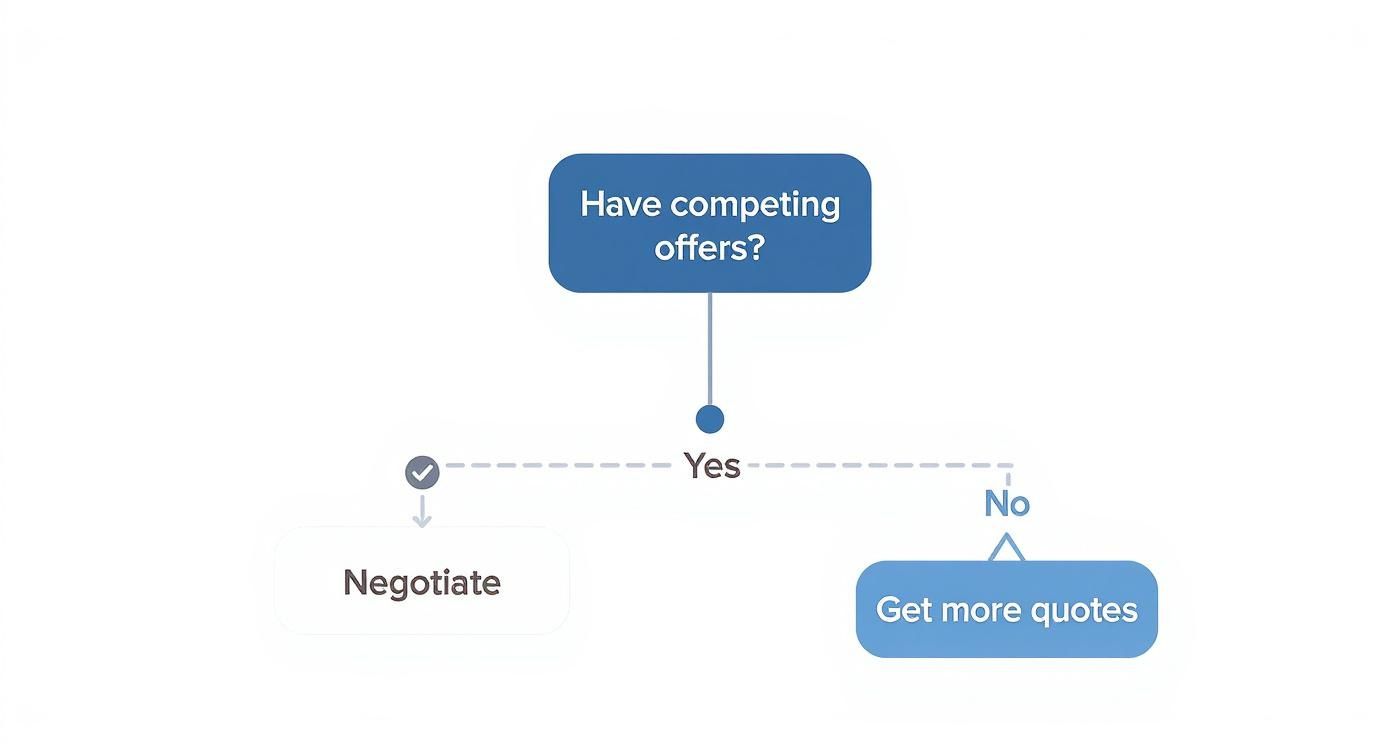
The single biggest takeaway here is that nothing gives you more power than having competing offers. Without another lender's offer in hand, your ability to negotiate is seriously limited. By taking a holistic view, you ensure you don't just win the battle on the interest rate only to lose the war on the total cost of your loan. When you analyze every line item of an offer, you can craft a mortgage that truly serves your financial goals, both now and for years to come.
Frequently Asked Questions About Negotiating Mortgage Rates
How much can you realistically negotiate off a mortgage rate?
A well-prepared borrower with a solid financial standing can realistically negotiate 0.25% to 0.50% off their offered rate. On a $400,000 loan, trimming 0.50% off your rate could save you over $70,000 in interest payments over 30 years. Research from Freddie Mac shows that getting quotes from at least five lenders saves borrowers an average of 0.25% right away.
Is it better to negotiate the interest rate or the closing costs?
This depends on your immediate cash needs versus your long-term goals. If you have the cash for closing and plan to stay in the home for many years, negotiating for the lowest possible interest rate will save you the most money over the life of the loan. If you are short on cash for closing, negotiating for lender credits to reduce your upfront costs is the smarter move, even if it means a slightly higher rate.
Will getting multiple mortgage quotes hurt my credit score?
No, this is a common myth. Credit scoring models like FICO and VantageScore are designed to allow for rate shopping. All hard inquiries for a mortgage that occur within a 14 to 45-day window are bundled together and counted as a single inquiry. This ensures you can shop for the best deal without harming your credit score.
Can I negotiate my mortgage rate after it has been locked?
It's difficult, but not impossible. If rates drop significantly after you've locked, your best option is to ask your lender for a "float-down." This feature, which sometimes requires an upfront fee, allows you to take advantage of the new, lower market rate. It is crucial to ask about a lender’s float-down policy before you lock your rate.
Are advertised mortgage rates negotiable?
Yes, absolutely. Advertised rates are marketing tools designed to attract highly qualified borrowers—often those with 800+ credit scores, low DTI ratios, and large down payments. The rate you are personally offered is based on your specific financial profile and should always be viewed as a starting point for negotiation, not the final offer.
Do mortgage brokers get better rates?
Mortgage brokers don't inherently get better rates, but they increase competition, which can lead to better deals. Brokers have access to a wide network of wholesale lenders, some of whom do not work directly with the public. This can uncover more competitive offers. However, you should still compare a broker's offer against quotes you get directly from banks and credit unions.
How do I leverage a competing offer without sounding confrontational?
The key is to be polite, professional, and data-driven. A great approach is to say, "I've really enjoyed working with you and would prefer to secure my loan through your company. However, I have another official Loan Estimate with a lower rate/fewer fees. Is there anything you can do to match this offer so we can move forward together?" This frames the negotiation as a collaborative effort.
What fees on a Loan Estimate are negotiable?
Focus on the fees in Section A (Origination Charges) of your Loan Estimate, as these are set directly by the lender. These typically include the origination fee, application fee, processing fee, and underwriting fee. Third-party costs like appraisal and title insurance are less negotiable with the lender, but you can often save money by shopping for these services yourself.
How do I ask for a lower interest rate on my mortgage?
To effectively ask for a lower rate, you must have leverage. After receiving an official Loan Estimate from your preferred lender, present them with a competing Loan Estimate from another lender that offers a better rate or lower fees. State clearly and politely that you would like to work with them but need them to match or beat the competing offer to earn your business.
When should I lock in my mortgage rate?
You should lock in your rate when you are comfortable with the rate offered and the corresponding monthly payment. If economic indicators suggest rates are rising, it's wise to lock sooner rather than later. If rates appear to be trending downward, you might "float" the rate for a short time, but this is a gamble. Generally, once you have an accepted offer on a house and have chosen a lender, it's time to seriously consider locking.
Ready to put these strategies into action and find a mortgage that truly fits your financial goals? At ShopRates, we make it easy to create a competitive environment for your business. Our platform connects you with multiple trusted lenders, giving you the leverage you need to negotiate with confidence and secure the best possible deal. Start comparing offers today.


