

A Financial Expert’s Guide to Mastering the House Buying Process
Embarking on the journey to buy a home is a monumental financial and personal milestone. While the typical timeline from an accepted offer to holding the keys can be a swift 30 to 60 days, the real, substantive work begins long before you start dreaming about paint colors or browsing online listings. The foundation of a successful home purchase is built not on open houses, but on meticulous financial preparation.
It all starts with getting your financial house in impeccable order.
Building Your Financial Foundation for a Home

Before you allow yourself to become emotionally invested in a charming craftsman bungalow or a sleek modern condo, your first strategic move must be a rigorous and honest assessment of your finances. Consider this phase as laying the structural groundwork for your future home. Without a solid, well-planned base, the entire process can become unstable and fraught with stress.
This preparation goes far beyond simply setting aside some cash. It's a strategic effort to position yourself as an ideal borrower in the eyes of lenders. They will scrutinize every detail of your financial history, so having everything organized, optimized, and transparent beforehand provides a significant competitive advantage in the home buying process.
Get to Know Your Credit Score
Your credit score is the primary gatekeeper to your mortgage options. It is one of the very first data points a lender evaluates, and it profoundly influences the interest rate you'll be offered. Even a fractional difference in your interest rate can translate into tens of thousands of dollars saved over the life of your loan.
A higher score signals to lenders that you are a reliable and low-risk borrower, which in turn unlocks the most favorable terms. Generally, lenders consider a FICO score of 740 or above to be excellent, placing you in the top tier for the lowest available interest rates. If your score is below this threshold, investing time to improve it before submitting a mortgage application is one of the most financially prudent decisions you can make.
Calculate Your Debt-to-Income Ratio
The next critical metric is your debt-to-income ratio (DTI). This straightforward yet powerful calculation compares your total recurring monthly debt payments (such as car loans, student loans, and credit card minimum payments) to your gross monthly income. Lenders rely on DTI to gauge your capacity to comfortably manage an additional monthly mortgage payment.
Most conventional lenders prefer a DTI of 43% or lower, and this figure must include your prospective mortgage payment. A high DTI can be a significant roadblock, as it suggests you might be financially overextended. Calculating this ratio early in your planning helps you establish a realistic and sustainable budget for your home search.
Start Saving for Your Down Payment and Closing Costs
The down payment is often perceived as the most significant cash hurdle for aspiring homebuyers. The long-standing advice has been to save 20% of the purchase price to avoid Private Mortgage Insurance (PMI), but this is no longer the only viable path to homeownership.
A diverse range of excellent loan programs exists with much more accessible down payment requirements.
- FHA Loans: These government-insured loans often require as little as 3.5% down, making them a popular choice for first-time buyers.
- Conventional Loans: It is increasingly common to find conventional mortgage products with down payments as low as 3%.
- VA and USDA Loans: For qualifying veterans, active-duty service members, and buyers in designated rural areas, these programs can offer 0% down payment options.
Before you formally apply for a mortgage, it is essential to have a comprehensive overview of your financial standing. This checklist details the key areas that lenders will meticulously review.
Home Buying Financial Checklist
| Financial Milestone | Target Goal | Why It Matters |
|---|---|---|
| Credit Score | 740+ for best rates | A higher score directly lowers your interest rate, saving you money every month and substantially over the entire term of the loan. |
| Debt-to-Income (DTI) | 43% or less (including mortgage) | This demonstrates to lenders that you can comfortably manage your existing debts alongside a new mortgage payment without undue financial strain. |
| Down Payment Savings | 3.5% – 20% of purchase price | A down payment reduces your total loan amount and can help you avoid PMI, which lowers your overall monthly housing cost. |
| Closing Cost Savings | 2% – 5% of purchase price | This fund covers essential third-party fees like appraisals, title insurance, and lender charges. You must have this cash available at closing. |
| Emergency Fund | 3-6 months of living expenses | This provides a crucial financial safety net for unexpected home repairs, maintenance, or income disruptions after you purchase your home. |
Methodically addressing these financial benchmarks will make the entire house buying process smoother, more predictable, and significantly less stressful.
Don’t forget about closing costs! Your savings target must extend beyond the down payment. You will also need liquid funds for closing costs, which typically range from 2% to 5% of the home's final purchase price. These fees cover necessary services like the appraisal, title insurance, and lender origination fees.
Whether your goal is a move-in-ready property or a fixer-upper with potential, a robust financial position is non-negotiable. If you are considering a property that requires renovations, exploring options for house renovation financing can be an excellent strategy to roll the cost of improvements into your primary loan. Taking the time to build this financial foundation ensures you are not merely buying a house—you are making a sound, sustainable investment in your future.
Securing Your Mortgage Pre-Approval
Once your financial affairs are in order, it's time to take the pivotal step that transitions you from a casual observer to a serious contender in the real estate market. Obtaining a mortgage pre-approval is unequivocally one of the most critical steps in the entire house buying process. This is the formal verification from a lender that establishes your firm budget and instantly elevates the credibility of any offer you make.
Consider the transaction from a seller's viewpoint. They are seeking assurance that a potential buyer is not only interested but also financially capable of completing the purchase. A pre-approval letter serves as tangible proof—it demonstrates that a lender has already conducted a thorough review of your finances and is prepared to back your offer up to a specified amount. This provides a massive advantage, particularly in a competitive market where you may find yourself in a multiple-offer situation.
Pre-Qualification Versus Pre-Approval
It is crucial to understand the significant distinction between these two terms. A pre-qualification is a preliminary, informal estimate of what you might be able to borrow. It is typically based on a brief conversation where you self-report your income and debts without verification. While it can be a useful starting point for budgeting, it carries virtually no weight with sellers or their agents.
A pre-approval, conversely, is a rigorous and verifiable process. It signifies that the lender has meticulously examined your financial documents—including tax returns, pay stubs, and bank statements—and has conditionally committed to lending you a specific sum of money.
A pre-qualification is analogous to getting a rough, non-binding quote for a project. A pre-approval is like having a signed contract with the funds held in escrow. Sellers and their agents take the latter far more seriously.
Getting pre-approved requires providing a lender with a detailed and transparent view of your financial life. This infographic simplifies what can feel like a complex journey into a clear, manageable sequence of steps.
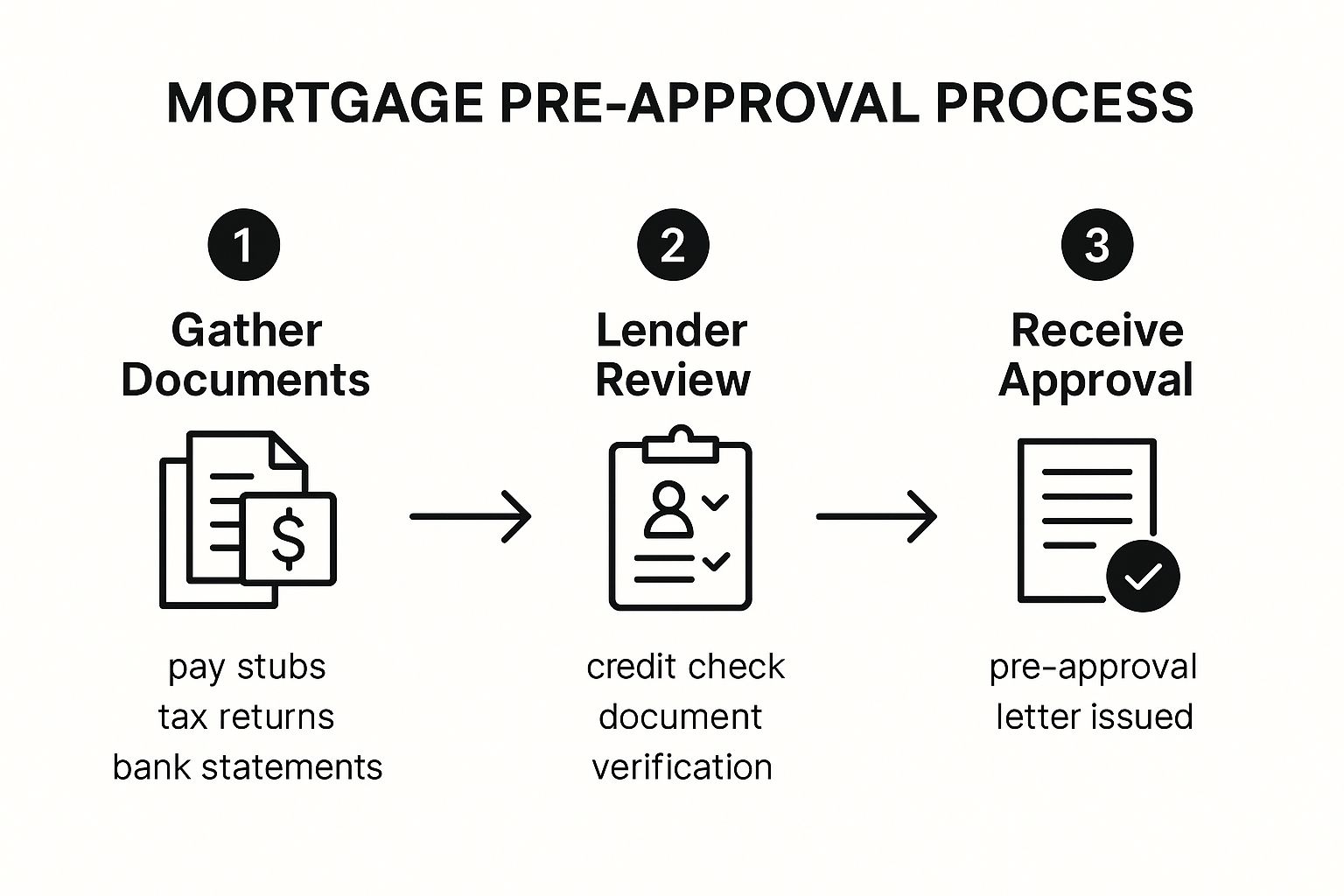
As illustrated, the process boils down to gathering your essential documents, allowing the lender to perform their due diligence, and then receiving the official letter that empowers your home search.
Documents You Will Need
Lenders require specific documentation to verify your ability to manage a loan. Having these documents organized and readily available will significantly expedite the pre-approval process. While some lenders may offer unique programs, such as those found in this guide to non-traditional lending options, the vast majority of conventional loans necessitate a standard set of core documents.
Be prepared to provide the following:
- Proof of Income: Typically your W-2s from the last two years and your most recent pay stubs covering a 30-day period.
- Tax Returns: Complete federal tax returns, including all schedules, for the past two years.
- Bank Statements: At least two months of statements for all checking and savings accounts.
- Asset Information: Statements for any investment or retirement accounts (e.g., 401(k), brokerage accounts).
- Identification: A clear, valid copy of your driver’s license or other government-issued photo ID.
For a more in-depth understanding of this phase, it is always beneficial to learn how to get pre-approved for a mortgage from seasoned professionals who navigate this process daily. Successfully completing this step means you will be prepared to submit a powerful, confident offer the moment you discover the perfect home.
The Strategic Search for Your New Home

This is the phase where the abstract becomes tangible. Armed with your mortgage pre-approval letter, you are officially transitioning from a passive dreamer to an active home hunter. This stage, however, is more than just leisurely scrolling through online listings. A successful home search is a strategic mission that demands a clear plan, the right professional partnership, and a nuanced understanding of the local market dynamics.
Your first move should not be towards an open house, but rather towards securing a top-tier real estate agent. This step should not be underestimated. An exceptional agent is far more than a gatekeeper with access to properties; they are your strategic advisor, your staunch advocate, and your skilled negotiator who will champion your interests from the initial showing all the way to the closing table.
Finding the Right Real Estate Agent
Avoid the temptation to simply sign on with the first agent you encounter. You are seeking a local expert—an individual with a deep, demonstrable track record of success in the specific neighborhoods you are targeting. Their granular knowledge of market trends, school districts, and even street-by-street value fluctuations is an invaluable asset that provides a significant competitive edge.
Commit to interviewing at least three potential agents. Inquire about their recent sales history, their preferred communication style, and their strategic approach to finding you a home in the current market. You will be in close contact with this person for a significant period, so personal chemistry and trust are essential. They will be your guide for the entire journey.
Defining Your Home Search Criteria
Before you step foot inside a single property, it is imperative to get crystal clear on your needs and wants. This single exercise will save you an immense amount of time and prevent the emotional burnout that can result from viewing dozens of unsuitable homes. The key is to differentiate your absolute non-negotiables from your desirable "nice-to-haves."
- Must-Haves: These are the deal-breakers. This list might include a minimum number of bedrooms, a location within a specific school district, or a manageable commute time. If a property does not meet these criteria, it is an immediate disqualification.
- Nice-to-Haves: These are the features you would love but could compromise on if necessary. Examples include a fenced-in yard, a dedicated home office, or a recently updated kitchen.
This list becomes your guiding compass. It enables you and your agent to filter out the noise and concentrate exclusively on properties that are a genuine fit for your lifestyle and budget.
Online platforms are indispensable during this preliminary stage, allowing you to gain a solid understanding of the market from your own home.
Tools like Realtor.com empower you to analyze the market by location, price, and specific features, giving you a realistic picture of what your budget can achieve.
Crafting a Compelling Offer
You've found it: the one. Now it's time to make an offer, and this is where your agent's expertise truly shines. A winning offer is not always about the highest price; it's about presenting the seller with a clean, confident, and appealing package.
Your agent will conduct a comparative market analysis (CMA), pulling data on what similar homes in the immediate area have recently sold for. This data-driven approach is your secret weapon for determining an offer price that is both fair and competitive.
From decades of experience, I've seen it time and again: a well-structured offer with intelligent contingencies can often beat a higher-priced offer that is riddled with potential complications. Sellers value certainty and a smooth closing process as much as they do the final sale price.
Beyond the purchase price, your offer will include contingencies. These are essentially safety clauses that allow you to withdraw from the contract without penalty if certain conditions are not met. The three most common are:
- Inspection Contingency: This provides a specific timeframe for you to have the home professionally inspected. If significant issues like a compromised foundation or a failing roof are discovered, you have the right to renegotiate, request repairs, or cancel the contract.
- Financing Contingency: This protects your earnest money deposit in the event your mortgage loan fails to secure final approval for any reason.
- Appraisal Contingency: This is a crucial protection for both you and your lender. It stipulates that the home must appraise for at least the agreed-upon purchase price.
Your agent will help you structure these terms to make your offer as attractive as possible to the seller while ensuring you remain fully protected. Executing this step correctly moves you one giant leap closer to ownership.
Navigating Inspections, Appraisals, and Underwriting
Having your offer accepted can feel like crossing the finish line, but it's more accurately the start of the final, most technical leg of the race. This period, often referred to as "due diligence" or the contingency period, is your dedicated window to verify that the house—and your loan—are precisely what you expect them to be.
This phase of the house buying process can be a true test of patience. According to 2023 data, the average time to close a home sale in the United States was approximately 45 days after the offer was accepted. This timeframe is dedicated to the careful coordination of the next several steps, and you can find more valuable market insights from the National Association of Realtors.
The Home Inspection Uncovers the Truth
Your first and most immediate action should be to hire a licensed, certified home inspector. This is not a task for a well-meaning relative or a friend with DIY experience. You need a qualified professional who will methodically examine every aspect of the property, from the foundation to the roof and everything in between.
The inspector's role is not to advise you on whether to buy the house, but to provide a completely objective, detailed report on its current physical condition.
An inspector's evaluation is exhaustive, but they place special emphasis on the major systems and structural components:
- Structure: Is the foundation sound? What is the condition and remaining lifespan of the roof? Are there signs of structural stress?
- Systems: They will test the electrical system, operate the HVAC, check the plumbing for leaks and pressure, and note the age of major appliances like the water heater.
- Exterior: The inspection includes the siding, windows, and, critically, the grading of the land around the foundation to assess drainage.
- Interior: They will search for evidence of moisture intrusion, test appliances, and evaluate the overall condition of the home's interior finishes.
The resulting report will likely be lengthy, detailed with photographs, and may seem intimidating at first glance. It is important not to panic. No home is perfect. The objective is to distinguish between major, costly defects and minor, manageable maintenance items.
A $500 inspection that uncovers a $15,000 foundation issue is the best investment you will ever make in the house buying process. It provides you with the leverage to renegotiate the price, request that the seller make repairs, or walk away from a potential financial catastrophe.
The Appraisal Confirms the Value
Simultaneously, while you are investigating the home's physical state, your lender is focused on its financial value. They will order an independent appraisal to ensure the property is worth at least the amount you have agreed to pay.
An appraiser functions like a real estate detective, analyzing the home’s size, features, and condition and comparing it against recent sales of similar properties in the same neighborhood. It is a vital reality check for the bank.
This step is a critical protection for your lender—they will not lend more money than the property is worth. If the appraisal comes in below the contract price, it can create a complication. You will have several options: attempt to renegotiate a lower price with the seller, bring additional cash to closing to cover the difference, or, if your contract includes an appraisal contingency, you can cancel the deal and have your deposit returned.
Surviving the Underwriting Process
Concurrently with the inspection and appraisal, your loan application enters its final, most rigorous stage: underwriting. This is where a human underwriter examines your entire financial profile—income, assets, debts, and credit history—under a microscope to grant the final loan approval.
This part of the house buying process can feel intense and invasive. The underwriter may come back with last-minute requests for additional documentation, such as an updated bank statement or a letter of explanation for a recent large deposit.
The absolute key to a smooth underwriting experience is to be exceptionally responsive. Reply to their requests immediately and thoroughly. Furthermore, it is critical to avoid any significant financial changes during this period. Do not apply for new credit, make a large purchase like a car, or change jobs. Any major shift in your financial profile can raise a red flag and jeopardize your loan approval at the final hour.
Once you receive the coveted "clear to close" from the underwriter, you can finally take a deep breath. You're on the home stretch.
Your Final Walkthrough and Closing Day Success

You have successfully navigated the complexities of offers, inspections, and the underwriting maze. You've reached the culmination of the house buying process, and all your diligent preparation is about to pay off.
Only two crucial steps remain between you and your new set of keys: the final walkthrough and the closing appointment. It is essential to remain focused and diligent, as these final actions are absolutely critical to a successful outcome.
The final walkthrough is your last opportunity to inspect the property before it legally becomes your responsibility. This typically takes place 24 to 48 hours before your scheduled closing. The objective is twofold: to confirm that the house is in the same condition as when you agreed to purchase it, and to verify that all contractually obligated repairs have been completed to a satisfactory standard.
Your Walkthrough Checklist
This is not a time for a casual glance. You must be methodical and thorough. While your agent will accompany you, this is your future home, and you should be hands-on in your inspection.
- Test Everything: Systematically flip every light switch. Run both the heating and air conditioning systems, regardless of the season. Test every appliance that is included in the sale.
- Look for Leaks: Turn on every faucet, flush every toilet, and inspect under all sinks for any new signs of moisture or water damage.
- Verify Repairs: Bring a copy of the repair addendum from your inspection negotiations. Check each item off the list one by one, ensuring the work was completed correctly.
- Check for Move-Out Damage: Carefully look for new scuffs on the walls, scratches on floors, or any other damage that may have occurred during the seller's move-out process.
If you discover an issue, now is the time to raise it. This is your final point of leverage. Any problems must be addressed and resolved with the seller before you sign the final closing documents.
Understanding Your Closing Disclosure
Approximately three business days before closing, you will receive a critical document called the Closing Disclosure (CD). Federal law mandates that you receive this document at least three full days before closing to allow for a thorough review. Do not let anyone rush you through this process.
Take out the Loan Estimate you received at the beginning of the process and compare it line by line with the new Closing Disclosure. The figures should be very similar. If the interest rate has changed or you see unexpected fees, contact your lender immediately. It is imperative to resolve any discrepancies before you arrive at the closing table.
This five-page document outlines the final, exact terms and costs of your loan. It confirms your interest rate, monthly payment, and the precise amount of money you need to bring to closing. It also provides a detailed itemization of every closing cost, showing exactly who is being paid and for what. Review every single line item.
The closing appointment itself is the formal signing ceremony. You will meet with a closing agent—typically an attorney or a representative from the title company—and sign a substantial stack of legal documents. You will provide a cashier's check or wire transfer for your down payment and closing costs and present your valid photo ID.
Once the last document is signed and the funds have been officially transferred, you will receive the keys. Congratulations, you are a homeowner.
Now that the paperwork is complete, the exciting task of moving in begins. A well-organized plan is essential, so consider getting started with an ultimate residential moving checklist. If you are also selling your current home, coordinating the financial timing can be complex. Understanding specialized financing tools can be a lifesaver. Learning about products like bridge loans in Los Angeles is an excellent way to see how you can manage the financial gap between buying and selling.
Frequently Asked Questions About the House Buying Process
Embarking on the house buying process is an exhilarating experience, but it is also a journey filled with unfamiliar terminology and significant decisions. It is perfectly normal for questions to arise at every stage.
Let's address some of the most common inquiries we hear from prospective homebuyers. Having clear answers to these questions will provide the confidence needed to move forward effectively.
How Long Does the Entire House Buying Process Usually Take?
From the point of an accepted offer to the day you receive the keys, the formal process—often called the "escrow" or "closing" period—typically takes between 30 and 60 days.
However, this timeline only represents a portion of the complete journey. The real timeline begins much earlier and includes the crucial preparation phase: saving for a down payment, improving your credit score, getting pre-approved, and the actual search for a home you love. This initial stage can take several months, or even a year or more, depending on your individual financial situation and the competitiveness of your local housing market.
What Is the Difference Between Being Pre-Qualified and Pre-Approved?
This is a critical distinction that can directly impact the strength of your offer in a competitive market.
Think of a pre-qualification as a brief, informal financial snapshot. You provide a lender with basic, unverified information about your income and debts, and they give you a rough estimate of what you might be able to borrow. It can be a helpful starting point, but it carries little weight with sellers because none of the information has been verified.
A pre-approval, in contrast, is a rigorous, in-depth financial review. A lender will pull your credit report, verify your income through pay stubs and tax returns, and examine your bank statements to confirm your assets. The result is a conditional commitment for a specific loan amount. Presenting a pre-approval letter with your offer signals to sellers that you are a serious, financially vetted buyer, making your offer substantially more compelling.
How Much Money Do I Actually Need for a Down Payment?
The traditional 20% down payment rule is widely known, primarily because it allows borrowers to avoid paying private mortgage insurance (PMI). However, it is by no means the only path to homeownership. Today, a wide variety of excellent loan programs are available to help people purchase homes with significantly less cash upfront.
- FHA Loans: These government-backed loans are a fantastic option for many first-time buyers, often requiring a down payment of just 3.5%.
- Conventional Loans: It is entirely possible to secure conventional financing with a down payment of only 3-5%, particularly for borrowers with strong credit scores.
- VA and USDA Loans: These programs are game-changers for eligible borrowers. For qualified veterans and active-duty military (VA) or buyers purchasing in designated rural areas (USDA), a 0% down payment loan may be an option.
Your best course of action is to have a candid conversation with an experienced loan officer. They are experts on the various programs available and can help you identify the ideal mortgage product for your specific financial circumstances.
What Are Closing Costs and How Much Should I Budget?
Closing costs are a frequent source of surprise for first-time homebuyers. These are the various fees required to finalize the real estate transaction, and they are entirely separate from your down payment.
As a general rule, you should plan on budgeting anywhere from 2% to 5% of the home's purchase price to cover these expenses.
So, what exactly are you paying for? Closing costs are a combination of fees for services like the lender's origination fee, the home appraisal, title insurance, attorney fees, and pre-paid items like property taxes and homeowners insurance. The good news is that federal law requires your lender to provide you with a detailed Loan Estimate upfront, which breaks down all of these anticipated costs so you can plan accordingly.
At ShopRates, our mission is to demystify the journey to homeownership. Our platform provides the tools to easily compare competitive loan offers from a network of lenders, ensuring you secure the best possible terms for your situation. Begin your path to homeownership with confidence and clarity with us today.


