

The Ultimate Guide to Private Money Lenders for Real Estate Investors
In the high-stakes world of real estate investing, speed and agility are your greatest assets. While traditional banks move at a glacial pace, bound by rigid regulations and mountains of paperwork, a powerful alternative has emerged as a go-to resource for savvy investors: the private money lender. Simply put, a private money lender is an individual or a private company that provides loans for real estate investments using their own capital.
They operate outside the strict confines of institutional banking, offering a streamlined, asset-focused approach that empowers investors to seize opportunities that would otherwise be lost. Understanding how to leverage this unique form of financing is no longer just an option; it's a fundamental strategy for anyone serious about building a real estate portfolio.
What Exactly Are Private Money Lenders?

It’s best to think of a private money lender as a strategic business partner, not a lender of last resort. Where a large bank sees a complex web of forms and a rigid credit score checklist, a private lender sees the intrinsic value and potential of your project. Their primary focus is the asset itself—the property you’re looking to acquire, renovate, or develop.
This "asset-first" philosophy is the cornerstone of private lending and fundamentally changes the financing dynamic. It enables them to bypass the slow, bureaucratic red tape that often plagues conventional lending. Instead of enduring a 30 to 60-day waiting period for a bank's approval, a private lender can frequently deliver funding in just 7 to 14 days. This incredible velocity provides a decisive advantage in competitive real estate markets where timing is paramount.
The Power of an Asset-First Approach
The fundamental difference lies in their underwriting process. Private money lenders are not nearly as concerned with your personal income history or a flawless credit report as a traditional bank would be. They are trained to evaluate the deal on its own merits, asking critical questions that get to the heart of the investment:
- What is the property's current "as-is" value?
- What will the after-repair value (ARV) be once improvements are complete?
- Is there a clear, profitable, and well-defined exit strategy?
Because they deploy their own private capital, they possess the autonomy to make common-sense, business-oriented decisions that institutional lenders, constrained by rigid guidelines, simply cannot. Their core objective is securing their investment in the property itself, making them an ideal financing partner for real estate investors, particularly those executing fix-and-flips or requiring a bridge loan to transition between deals. For a more detailed exploration of this process, you can review our comprehensive explanation of what private lending entails.
This flexibility and speed have supercharged the growth of the alternative lending space. The global private credit market is now valued at around $1.8 trillion, showing just how much demand there is for financing outside of traditional banks.
This incredible expansion is fueled by investors and developers who demand the certainty and speed that large institutions cannot consistently provide. The private credit sector has risen to the occasion, offering borrowers financing solutions designed to capture time-sensitive opportunities. In fact, industry analysts project this market could more than double in the coming years.
When to Use a Private Money Loan

Understanding the mechanics of private money is one piece of the puzzle. Knowing precisely when to deploy this powerful tool is what distinguishes seasoned professionals from novices. A private money loan isn't a universal solution for every financing need; it's a specialized instrument, perfectly suited for specific scenarios where traditional financing falls short.
Recognizing these key moments is the secret to leveraging this type of funding to its maximum potential.
The most classic application is in the fast-paced world of property flipping. Imagine you've identified a distressed property in a neighborhood with rapidly appreciating values. The seller needs a cash-equivalent offer and insists on closing in ten days. A conventional bank loan will take a month, perhaps longer. By that time, the opportunity will be long gone. This is prime territory for a private money lender. They will evaluate the property’s After-Repair Value (ARV) and provide the capital needed to close before another investor can swoop in.
Capitalizing on Time-Sensitive Opportunities
In real estate, speed is your greatest competitive advantage. Private money is the high-octane fuel that makes rapid execution possible. Investors frequently encounter situations where a quick close isn't just a desirable feature—it's the only path to securing the deal.
Consider these common scenarios where private money lenders for real estate are indispensable:
- Real Estate Auctions: The gavel falls, and you've won the bid. Now you must pay, often in full, within 24 to 72 hours. A pre-approved private money loan is often the only way to participate confidently in these events.
- Fix-and-Flip Projects: The entire fix-and-flip business model hinges on acquiring, renovating, and selling a property quickly to protect profit margins. Private lenders understand this dynamic. They can fund both the purchase and a significant portion of the renovation budget, enabling you to start work immediately.
- Wholesale Deals: A wholesaler secures a property under contract and then assigns that contract to an end buyer. To facilitate this, they need fast, reliable funding to close the initial transaction before flipping the contract.
Navigating Complex or Imperfect Situations
Private money also shines when the borrower or the property doesn't fit neatly into the rigid boxes used by traditional banks. Conventional lenders will often retreat from a property in significant disrepair, a unique commercial project, or a borrower with blemishes on their credit history—even if the underlying deal is a financial home run.
For example, an experienced developer might have a credit issue from a past venture but has found a commercial building with guaranteed rental income from a long-term tenant. A private money lender will focus on the asset's ability to generate cash flow, not just a historical FICO score.
Similarly, if you need to secure a new investment property before your current one sells, a private money bridge loan can provide the temporary capital to "bridge" that financial gap. It prevents you from missing out on a prime opportunity due to a simple timing misalignment.
A key takeaway is that private lenders finance the deal, not just the borrower. When the property's numbers make sense and there's a clear path to repayment, factors that would be absolute deal-breakers for a bank often become secondary.
This intense focus on the asset is what truly sets them apart. You’ll often hear the terms "private money" and "hard money" used interchangeably. While they are closely related, there are important nuances. It’s worth taking a moment to understand the differences between private mortgage lending and hard money loans to determine which is the best fit for your specific project. Ultimately, both are powerful tools for investors who need to be decisive, creative, and fast.
The Pros and Cons of Private Money: A Clear-Eyed View
Every financing instrument has its trade-offs, and private money is no exception. It can be an absolute game-changer for real estate investors, but it's certainly not a one-size-fits-all solution. A prudent investor must conduct a thorough analysis of both sides of the coin to determine if this path aligns with their project, timeline, and risk tolerance.
Making an informed decision means carefully weighing the incredible speed and flexibility against the tangible costs. For many astute investors, the trade-off is absolutely worthwhile—but only when they proceed with a full understanding of the landscape. Let’s break down the critical factors you need to consider.
The Clear Advantages of Private Capital
By far, the most significant benefit of working with private money lenders is speed. In a competitive market where the best properties disappear in days, the ability to close a transaction in just 7 to 14 days provides a massive strategic advantage. It allows you to make aggressive, cash-like offers that sellers find highly attractive, placing you ahead of buyers who are mired in the slow approval process of traditional banks.
Flexibility is the other major pillar of private lending. Banks operate with rigid, standardized loan products. Private lenders, by contrast, can structure terms that are tailored to the unique needs of your project. This often includes:
- Creative Loan Structures: They might fund not only the purchase price but also a substantial portion of your renovation budget, rolled into a single loan.
- Interest-Only Payments: This structure improves cash flow during the holding and renovation period, allowing you to allocate capital toward the project itself.
- Custom Repayment Schedules: The loan can be designed to match your project's specific timeline and exit plan.
Crucially, loan approvals are predominantly based on the asset. Private lenders are more concerned with the property's potential value and the strength of the deal than they are with your personal credit score. This asset-centric approach is a lifeline for experienced investors who may not meet every stringent requirement of a traditional bank.
The real power of a private money loan is its role as a strategic tool to seize an opportunity. It’s all about the deal itself, empowering smart investors to act decisively when a great property hits the market.
The Inherent Downsides and Risks
That speed and flexibility come at a cost, and it's a significant one. The primary drawback is the price. Interest rates on private money loans are substantially higher than those from a bank, typically falling within the 8% to 15% APR range. These rates directly reflect the lender's increased risk, the short-term nature of the loan, and the value of rapid execution.
In addition to interest, you must budget for origination fees, commonly referred to as "points." These are charged upfront at closing and usually range from 2 to 5 percent of the total loan amount. For a $300,000 loan, this translates to an immediate out-of-pocket cost of $6,000 to $15,000. To truly weigh your options, you have to understand the key differences between hard money loans vs. traditional loans to get an accurate picture of the total cost.
This is the central trade-off you're making: you receive your funding much faster, but you will pay a premium for that speed over a shorter period.
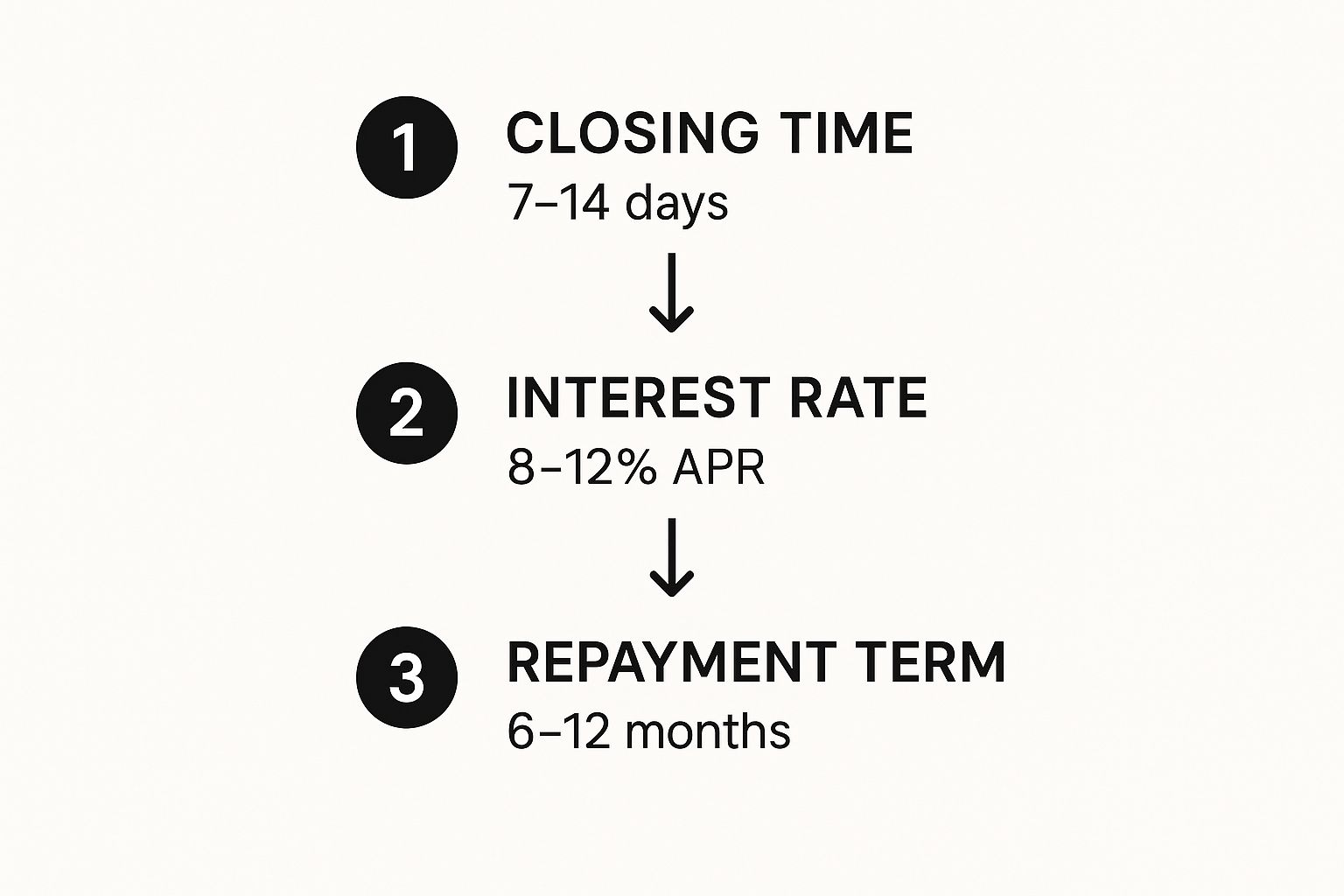
As the infographic illustrates, these three factors—speed, cost, and the loan term—are inextricably linked. You must determine which element is the highest priority for the specific deal you are undertaking.
Another crucial consideration is the short repayment window. Private money loans are not designed for long-term financing; they are typically due in full within 6 to 24 months. This compressed timeline means you absolutely must have a clear and realistic exit strategy. If your plan to flip or refinance the property is delayed, the pressure will mount as the loan's maturity date approaches.
Finally, remember that the private lending industry is not as heavily regulated as traditional banking. While most private lenders are legitimate professionals, the onus is on you to conduct thorough due diligence. You must meticulously vet any potential lender, check their references, and have an experienced real estate attorney review every loan document before signing. Neglecting this step can expose you to predatory terms and unnecessary risk.
Before committing, it's wise to get a clear picture of all potential costs. Here’s a quick breakdown of what you can typically expect.
Typical Costs Associated with Private Money Loans
| Cost Component | Typical Range | Description |
|---|---|---|
| Interest Rate (APR) | 8% – 15% | The annual cost of borrowing the money, which is significantly higher than conventional loans to compensate the lender for higher risk and a shorter term. |
| Origination Fees (Points) | 2 – 5 points | An upfront fee charged by the lender for processing the loan. One point equals one percent of the total loan amount. |
| Appraisal & Inspection Fees | $500 – $1,500+ | Costs for an independent appraisal to determine the property's value (especially its "after repair value") and a thorough inspection. |
| Legal & Closing Fees | $1,000 – $3,000+ | Fees paid to attorneys and title companies for preparing documents, ensuring a clear title, and facilitating the closing process. |
These figures provide a solid baseline for what to expect. Always request a detailed fee sheet from any potential lender so you can calculate your true borrowing costs and ensure your deal remains profitable.
How to Secure Your First Private Money Loan

Embarking on your first private money loan may seem daunting, but it’s a remarkably straightforward process once you understand the playbook. Unlike the slow, bureaucratic dance with traditional banks, private lending is engineered for speed and efficiency. The focus isn't on your personal financial history; it’s almost entirely on the quality and viability of your real estate deal.
Success hinges on three core principles: thorough preparation, professional presentation, and showcasing an investment opportunity that is too compelling to ignore. This guide will help you navigate the process with confidence, enabling you to assemble a loan package that commands attention and secures a swift "yes."
Prepare a Professional Loan Package
Before you even consider contacting a lender, you must have your documentation in order. A disorganized borrower is a significant red flag for any lender. A clean, comprehensive loan package demonstrates that you are a serious investor who respects their time and, more importantly, their capital.
This package is your deal’s professional resume, and it must be impeccable. Your objective is to anticipate and answer every question a lender might have before they need to ask it.
Here are the essential components of a winning package:
- A Detailed Project Plan: Outline the complete scope of work, a realistic timeline for completion, and the key milestones along the way. Be specific about the improvements you plan to make.
- A Comprehensive Budget: Itemize every anticipated cost. This includes the purchase price, all renovation expenses (materials and labor), closing costs, and holding fees (taxes, insurance, utilities). Always include a contingency fund of at least 10-15% to cover unexpected issues.
- A Rock-Solid Exit Strategy: Clearly explain how you intend to repay the loan. The two most common exit strategies are selling the property (for a fix-and-flip) or refinancing into a long-term mortgage (for a rental property). You must provide comparable sales data—the "comps"—to substantiate your projected after-repair value (ARV).
Find and Vet Reputable Lenders
With your loan package finalized, it’s time to identify the right lending partner. The private lending ecosystem operates heavily on relationships and reputation. While a quick online search is a reasonable starting point, the best private money lenders for real estate investors are typically discovered through your trusted professional network.
Begin by requesting referrals from experienced real estate agents, title companies, and attorneys in your local market. Another excellent method for meeting active lenders is attending local Real Estate Investor Association (REIA) meetings, where you can get direct feedback and recommendations from other borrowers.
Once you have compiled a shortlist, the vetting process begins. This step is absolutely critical to avoid predatory lenders and ensure you partner with a true professional who aligns with your goals.
A word of caution: Never work with a lender who demands a large, non-refundable upfront fee before you have a signed loan commitment. Legitimate lenders only get paid when your deal successfully closes.
When interviewing a potential lender, be prepared with direct questions to assess their experience, transparency, and process.
Critical Questions for Potential Private Money Lenders
- What is your lending criteria? Gain a clear understanding of their preferred loan-to-value (LTV) ratios, the types of properties they specialize in, and what kinds of projects they are most enthusiastic about funding.
- Can you provide a detailed term sheet? This document is non-negotiable. It should clearly outline the interest rate, origination points, loan term, and every single associated fee. There should be no ambiguity.
- What is your typical closing timeline? Speed is a key advantage. Confirm they can meet your deal's timeline, which should ideally be within 7-14 days from the submission of a complete package.
- Can you provide references from recent borrowers? Speaking with past clients is one of the most effective ways to verify a lender’s reputation and understand what their process is really like from start to finish.
By diligently preparing your project details and carefully vetting potential partners, you transition from being just another loan applicant to a valuable investment opportunity. This proactive approach not only enhances your chances of approval but also sets the stage for a smooth, successful, and profitable transaction.
The Future of Alternative Real-Estate Lending
The landscape of real estate finance is in a state of constant evolution, but private money lending has transcended its origins as a niche product. It is rapidly solidifying its position as a central pillar of modern investment strategy. To maintain a competitive edge, it is essential to understand the powerful trends shaping this market and anticipate where it is headed next.
For savvy investors and developers, this is more than just an industry headline; it represents a fundamental shift creating entirely new opportunities. The forces driving this change—from technological advancements to shifts in investor behavior—all point toward a future where flexible, non-bank solutions are an indispensable component of any strategic financing plan.
Technology Is Finally Streamlining the Process
One of the most significant forces disrupting the status quo is technology. Historically, underwriting a private loan was a manual, relationship-driven process. Today, that is changing rapidly. Sophisticated data analytics and AI-powered platforms are supercharging the underwriting process, allowing lenders to assess property values, market trends, and a project's viability with unprecedented speed and accuracy.
This infusion of technology creates a win-win scenario for all parties:
- For Borrowers: It translates to faster decisions and quicker access to capital. The crucial gap between identifying a great deal and securing the funding to close it is becoming significantly shorter.
- For Lenders: It provides superior risk management tools, enabling them to make smarter, data-informed decisions and price their loans more competitively.
- For the Market: It introduces a much-needed layer of transparency and efficiency into a corner of the financial world that has traditionally been opaque.
The Lines Between Markets Are Blurring
The private credit world is also benefiting from a broader wave of change in the financial markets. The once-sharp distinctions between public and private capital are becoming increasingly blurred, opening up new avenues for growth. For example, many successful venture-backed companies are choosing to stay private for much longer—often well beyond five years—to avoid the relentless pressure of quarterly earnings reports. This trend creates immense demand for flexible financing that the private credit market is perfectly positioned to provide.
Private debt is no longer viewed as just a temporary bridge loan. It's being recognized as a long-term, strategic source of capital. Institutional investors are now integrating it into mainstream portfolios to chase higher yields and diversify away from traditional stocks and bonds.
This growing acceptance is transforming private money from a tactical tool for a single real estate transaction into a respected asset class in its own right. As more institutional capital flows into the space, the market will continue to mature, offering more sophisticated products and greater stability for borrowers. As this evolution continues, investors are always looking for smart strategies to maximize ROI for multifamily properties to put this new capital to work. This shift signals a future where private money lenders play an even more vital role in funding real estate development and investment across the country.
Common Questions About Private Money Lenders
Let's cut through the noise. When you're exploring new financing options, you're bound to have questions. This section tackles the most common and critical questions we hear from real estate investors every day. We've designed these answers to be straightforward, practical, and immediately useful, clearing up everything from fee structures to the real-world differences between 'private' and 'hard' money.
Think of this as your quick-reference guide to shore up your understanding and resolve any lingering doubts before you make your next move.
What Is the Difference Between a Private Money Lender and a Hard Money Lender?
You will often hear these terms used interchangeably, and from a practical standpoint, that is generally acceptable. For the borrower, the experience and the loan product are nearly identical.
Technically, a 'hard money lender' is typically a professional lending company that funds loans based strictly on the "hard" asset—the property itself. It's a business-to-business transaction focused purely on the deal's numbers.
The term 'private money lender' is a broader category. It encompasses those professional firms but also includes high-net-worth individuals who lend their own personal capital. Ultimately, both are focused on asset-based lending that offers speed and flexibility far beyond the rigid confines of the traditional banking system.
What Interest Rates and Fees Should I Expect?
Private money loans come at a premium, which is the price for speed, convenience, and bypassing the extensive documentation required by a conventional bank.
Expect interest rates to be higher than a standard bank loan, typically landing somewhere between 8% to 15% annually. This rate reflects the higher risk the lender assumes and the rapid funding they provide.
In addition to the interest rate, lenders charge origination fees, often called 'points.' One point equals one percent of the loan amount, and you can expect to pay anywhere from 2 to 5 points at closing. You should also budget for standard third-party costs like appraisals, processing, and legal documentation.
Is There a Minimum Credit Score Requirement?
This is one of the most significant advantages for many investors. For private lenders, your credit score is a secondary consideration. While a traditional bank obsesses over your FICO score, a private lender remains laser-focused on the quality of the deal.
A project with a strong Loan-to-Value (LTV) ratio and a well-defined exit strategy can often secure funding even with a less-than-perfect credit history. That said, your credit is not entirely irrelevant—a lender may still review it, and a stronger score could potentially help you secure a slightly lower interest rate or more favorable terms.
How Quickly Can a Private Money Loan Close?
Speed is the defining characteristic of this financing. It is the primary reason investors turn to private money.
While a traditional bank loan can drag on for 30 to 60 days (or more), a private money loan can often close in as little as 7 to 14 days. This is not an exaggeration. Because the underwriting process is streamlined and asset-focused, experienced lenders can move with incredible velocity. In a competitive market where opportunities disappear quickly, this speed provides a massive competitive advantage.
What Is the Loan-to-Value (LTV) Ratio?
If there is one metric you must understand, it is the Loan-to-Value (LTV) ratio. It is the single most important number for any private lender.
LTV is calculated by dividing the loan amount by the property's appraised value. For example, if you receive a $150,000 loan on a property appraised at $200,000, your LTV is 75%.
A lower LTV signifies that you have more of your own capital—more "skin in the game"—invested in the property. This reduces the lender's risk and makes your loan application significantly more appealing. Most lenders will cap their LTV between 65% and 80% of the property's value.
What Do Private Lenders Look for in a Deal?
Private lenders prioritize two things above all else: the quality of the asset and your exit strategy. They need to be confident in the property's value and see a clear, credible plan for how you will repay the loan.
The most common exit strategies are:
- Selling the property for a profit (the classic fix-and-flip model).
- Refinancing into a long-term conventional loan (for a buy-and-hold rental property).
Your ability to articulate this plan with confidence, supported by solid numbers and comparable market data, is paramount to securing a loan.
Can I Use a Private Loan for My Primary Residence?
The short answer is almost always no.
Private money loans are classified as business-purpose loans. Lenders typically avoid financing owner-occupied primary residences because doing so triggers a host of strict consumer protection regulations, such as the Dodd-Frank Act. These loans are specifically designed for investment properties, fix-and-flips, new construction, and commercial real estate projects—not the home you plan to live in.
How Do I Find a Reputable Private Money Lender?
Finding a trustworthy lender is a matter of networking and due diligence. You won't find the best ones on a billboard.
Start by asking for referrals from your professional network: real estate agents, attorneys, contractors, and especially other local investors who are actively completing deals. Attending local Real Estate Investor Association (REIA) meetings is another excellent way to connect directly with active, reputable lenders in your area.
When vetting a potential lender, always check their references, ask to see a portfolio of their recently funded projects, and ensure that every single term is documented clearly and transparently in a formal term sheet.
Private credit has been particularly resilient in the middle market, where sponsored loan activity remained robust despite economic challenges. This resilience was partly due to demand for incremental or add-on financings, which helped maintain deal flow even as bank lending tightened. The market saw private credit expand to around $1.5 trillion at the start of the year, up from $1 trillion a few years prior, with expectations to reach $2.6 trillion within the next five years. To delve deeper into this trend, you can discover more insights about private credit's growth from Morgan Stanley.
What Happens If I Default on a Private Money Loan?
Defaulting on a private money loan is a serious matter. Because the property itself is the collateral securing the loan, the lender has the legal right to initiate foreclosure proceedings to reclaim their capital.
It is critical to understand that the foreclosure process with a private lender can be significantly faster than with a traditional bank. If you anticipate any trouble making a payment, communicate with your lender immediately and proactively. Some may be willing to work out a modification or extension, but their ultimate recourse is taking ownership of the property.
Are Private Money Loans Only for Real Estate Investors?
While the vast majority of private money is deployed to fuel real estate transactions, it can occasionally be used for other business purposes. For instance, it might serve as bridge financing for a company acquisition where a piece of commercial real estate is included as part of the collateral.
However, the loan's structure is almost always secured by a tangible, real asset. This makes private money a specialized financial tool designed primarily for property-related ventures and the investors who pursue them.
At ShopRates, our mission is to arm you with the knowledge and tools to make the smartest financing decisions for your real estate goals. Whether you're a seasoned pro needing quick capital or just starting out, we offer a transparent and secure marketplace to connect you with trusted lenders. Explore your options and find the right loan for your needs at ShopRates.com.


