

Your Comprehensive Guide to Auto Loan Interest Rates Today
Navigating the world of auto financing can feel complex, but understanding the forces that shape auto loan interest rates today is the first step toward securing a great deal. Rates are in constant flux, influenced by your personal credit profile, the vehicle you choose, and the broader economic landscape. However, a foundational principle remains constant: lenders almost always offer more favorable interest rates for new car loans compared to used car loans, viewing them as a lower-risk investment.
This guide is designed to be your definitive resource, providing the clarity and expert insights you need. As seasoned financial professionals at Shop Rates, we've helped thousands of consumers and businesses make informed decisions. Our goal is to empower you with the knowledge to not just understand the market, but to master it.
A Snapshot of Current Auto Loan Rates
To get the best possible terms on your next vehicle, you must first grasp the current state of the market. An auto loan interest rate isn't an arbitrary number; it's a precise calculation of risk from the lender's perspective. It reflects your financial reliability, the specifics of the vehicle, and the economic climate at large.
So, what are the primary factors that determine the rate you're offered? It comes down to a few critical components:
- Your Credit Score: This is the most significant factor. A high credit score is a testament to your history of responsible borrowing, unlocking the most competitive rates.
- New vs. Used Vehicle: Lenders favor new cars with lower rates because they have a predictable value and are covered by warranties, reducing the risk of costly mechanical failures.
- The Economic Climate: Macroeconomic forces, particularly actions by the Federal Reserve and the current inflation rate, establish the baseline interest rates that all lenders use as a starting point.
This infographic provides a powerful visual breakdown of how dramatically your credit score can impact the interest rate you receive.
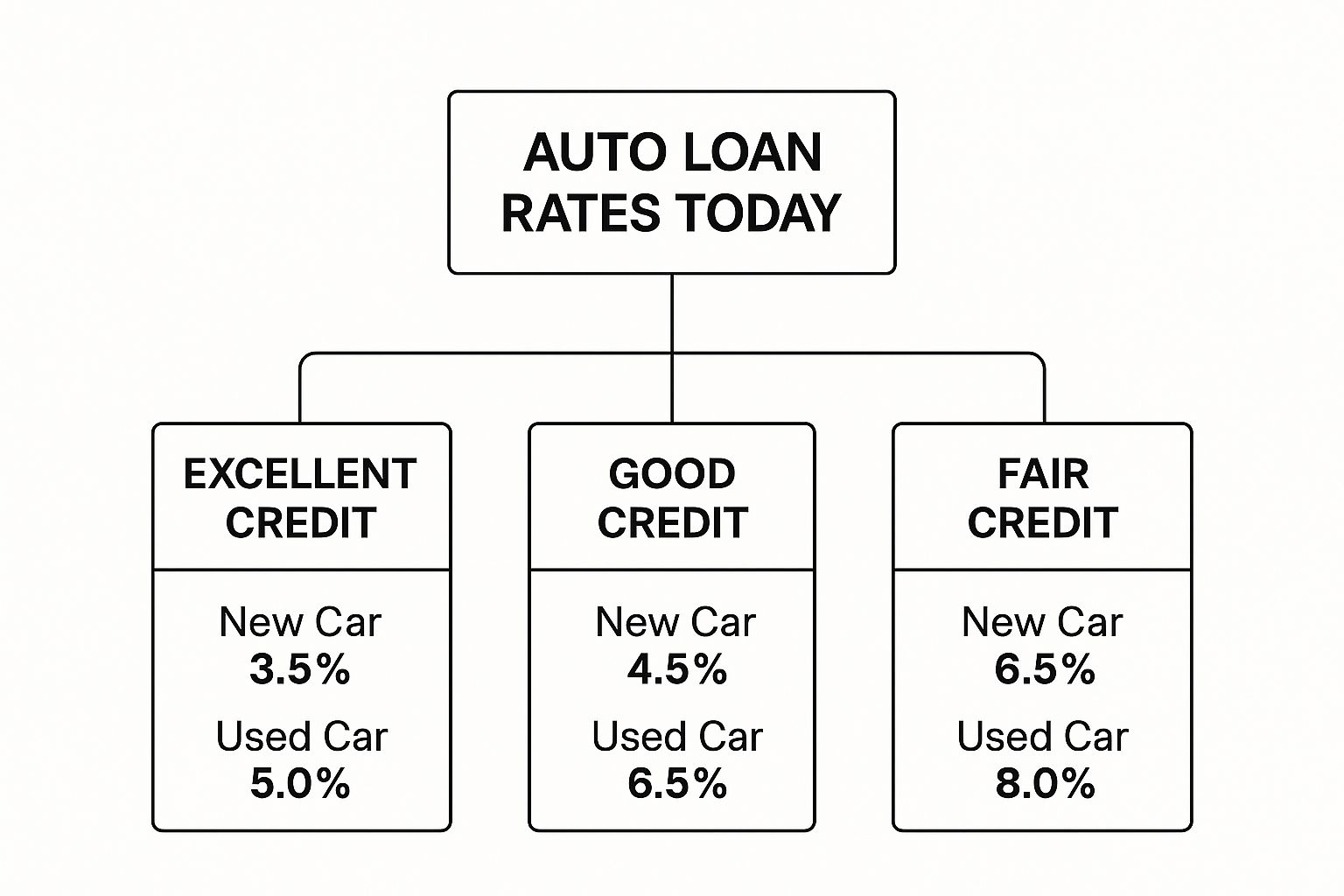
As illustrated, improving your credit profile from "Fair" to "Excellent" can cut your potential interest rate by nearly half. This translates into thousands of dollars in savings over the life of the loan.
Average Auto Loan Interest Rates by Credit Score
For a more granular view, the following table details the average Annual Percentage Rates (APRs) for new and used auto loans, segmented by FICO credit score tiers. This data provides a realistic benchmark for what you can expect in today's lending environment.
| Credit Score Range (FICO) | Average APR for New Car | Average APR for Used Car |
|---|---|---|
| Superprime: 781-850 | 5.38% | 6.80% |
| Prime: 661-780 | 6.89% | 9.04% |
| Nonprime: 601-660 | 9.62% | 13.72% |
| Subprime: 501-600 | 12.85% | 18.97% |
| Deep Subprime: 300-500 | 15.62% | 21.57% |
These figures, based on recent market analysis, highlight the substantial rate differences not only between credit tiers but also between new and used vehicles for the same borrower profile.
Interpreting the Numbers in the Current Market
Wider economic conditions have a direct and measurable impact on your loan offers. For instance, recent data from Experian.com shows that the average interest rate for a new car loan was 6.80%, while used car loans averaged a significantly higher 11.54%. This gap underscores the premium lenders place on the lower perceived risk of a brand-new vehicle.
The essential takeaway is this: while you cannot control macroeconomic trends, you have significant influence over the personal financial factors that lenders prioritize. Improving your credit score, increasing your down payment, and choosing your vehicle wisely are the most powerful strategies at your disposal.
This understanding of the current landscape of auto loan interest rates today is your foundation. The remainder of this guide will provide a detailed roadmap for optimizing your financial position and securing the best possible loan terms.
The Core Factors That Determine Your Auto Loan Rate

Have you ever wondered about the methodology behind the interest rate a lender offers? It’s not arbitrary. It's a calculated assessment of your creditworthiness. By understanding the key variables in this equation, you can take strategic steps to influence the outcome in your favor.
Every factor a lender considers is designed to answer one critical question: what is the likelihood this loan will be repaid on time and in full?
Your Credit Score: The Primary Indicator
Your credit score serves as a financial resume, offering lenders a quick summary of your borrowing history. A higher score, particularly one in the prime or super-prime range (above 661), signals that you are a reliable borrower and makes you eligible for the most competitive interest rates.
Conversely, a subprime score (below 660) indicates a higher risk to the lender, resulting in significantly higher rates. Your score is a direct reflection of your financial habits; therefore, consistent on-time payments and low credit card utilization are the cornerstones of building an excellent credit profile.
Loan Term and Vehicle Details
Beyond your personal credit history, the specific attributes of the loan and the vehicle itself are critical. These details help the lender quantify the risk associated with this specific transaction.
-
Loan Term: This is the duration of your loan. Shorter terms, such as 48 or 60 months, typically come with lower interest rates. While the lower monthly payments of a longer 72- or 84-month term may seem appealing, they invariably come with higher interest rates and a much greater total cost of borrowing.
-
Vehicle Age and Condition: Lenders consistently offer better rates for new vehicles. A new car has a known, predictable value and is less prone to mechanical failures that could impact your ability to make payments. An older used vehicle presents more uncertainty, and lenders price that increased risk into the interest rate.
-
Down Payment and LTV: Your down payment is directly correlated with your Loan-to-Value (LTV) ratio. A substantial down payment (ideally 20% or more) lowers the LTV, which reduces the lender's exposure and often qualifies you for a better interest rate.
Your Overall Financial Picture
Lenders look beyond your credit score to assess your overall financial stability. They need to be confident that you can comfortably manage a new car payment alongside your existing financial obligations.
Your Debt-to-Income (DTI) ratio is a key metric in this assessment. It represents the percentage of your gross monthly income that is allocated to monthly debt payments. Most lenders prefer a DTI below 43%. A low DTI demonstrates that you have sufficient disposable income to handle a new loan without financial strain.
For business owners, understanding how lenders evaluate your company's financial health is equally vital. Our in-depth guide explains how to secure business auto loans without a personal guarantee.
By viewing your financial profile through a lender's lens—critically evaluating your credit score, DTI, and desired loan terms—you can identify areas for improvement before submitting an application. This proactive preparation is the most effective strategy for securing a favorable rate.
How Economic Trends Shape Today's Car Loan Rates

The interest rate you are offered is not solely a reflection of your personal financial situation. It is also intrinsically linked to the broader economic environment. Macroeconomic forces establish the baseline for all borrowing costs, setting the stage long before a loan officer reviews your application.
The Federal Reserve is the primary architect of this environment. Its policy decisions create ripple effects throughout the entire financial system. Understanding these large-scale trends provides you with a strategic advantage, allowing you to anticipate market movements and time your purchase effectively.
The Federal Reserve and Inflation
The Federal Reserve is the single most influential entity affecting auto loan interest rates today. When the economy experiences high inflation—a rapid increase in the price of goods and services—the Fed intervenes. Its primary tool is to raise the federal funds rate, the benchmark interest rate for overnight lending between banks.
This action initiates a chain reaction. As it becomes more expensive for banks to borrow money, they pass these increased costs on to consumers in the form of higher interest rates on credit products, including mortgages, credit cards, and auto loans.
Simply put, a high-inflation environment leads to more expensive auto financing for everyone. Conversely, when the Fed lowers rates to stimulate economic growth, auto loan rates tend to decrease, making it a more opportune time to borrow.
Supply Chain and Vehicle Inventory
Beyond monetary policy, the fundamental principles of supply and demand within the automotive industry exert significant influence. Recent disruptions in the global supply chain have starkly illustrated how manufacturing constraints can impact vehicle availability and financing options.
When a shortage of essential components—such as microchips—stalls vehicle production, the number of new cars available at dealerships dwindles. This scarcity creates a challenging environment for consumers:
- Higher Vehicle Prices: With demand outstripping supply, the Manufacturer's Suggested Retail Price (MSRP) on both new and used vehicles escalates.
- Fewer Manufacturer Incentives: Automakers have little need to offer attractive financing incentives like 0% APR when they can sell every vehicle they produce at or above sticker price.
This confluence of higher prices and limited financing deals creates a difficult borrowing landscape, independent of an individual's creditworthiness. As supply chains normalize and vehicle inventories stabilize, we can expect a return of more competitive financing offers from manufacturers.
Looking ahead, many analysts predict that the current high-rate environment may persist. Some forecasts suggest new car loan rates could average 7.0% by late 2025, with used car loans hovering near 7.75%. These are projections, of course, and are subject to change with economic conditions. You can explore more expert analysis in the auto loan rate forecast on Bankrate.com.
Actionable Strategies to Secure a Lower Interest Rate

Market knowledge is valuable, but taking decisive action to improve your financial standing is what truly matters. Securing a lower interest rate is a result of meticulous preparation and a well-executed strategy, not luck. By following a proven game plan, you can enter any negotiation with the leverage needed to secure the most advantageous terms.
The single most effective action you can take is to arrange your financing before you visit a dealership. This one move fundamentally shifts the power dynamic, placing you in control of the transaction.
Get Pre-Approved First
Entering a dealership with a pre-approved loan offer is the equivalent of bringing your own financing team to the negotiating table. It immediately communicates to the dealer that you are a serious, well-qualified buyer who has done their due diligence.
The key is to shop for your auto loan with the same rigor you apply to shopping for the vehicle itself.
- Banks and Credit Unions: Begin with financial institutions where you have an existing relationship. They often provide preferential rates to loyal customers.
- Online Lenders: Digital-native lenders typically have lower operational costs, which can translate into more competitive rates and greater flexibility for borrowers.
- Compare Every Offer: To get a true sense of the market, apply with at least three different lenders within a 14-day period. Modern credit scoring models group multiple auto loan inquiries within this timeframe into a single event, minimizing any negative impact on your credit score.
Obtaining a pre-approval provides you with a tangible, firm interest rate to use as a benchmark. Our comprehensive guide on auto loan pre-approval provides a step-by-step walkthrough of this process, empowering you to compare offers and identify what constitutes a truly competitive deal.
Strengthen Your Financial Profile
Before you begin the application process, take a proactive approach to enhancing your financial profile. Even marginal improvements can yield substantial savings over the full term of your loan.
First, obtain your credit reports from all three major bureaus—Equifax, Experian, and TransUnion. Scrutinize them for any inaccuracies, such as accounts that are not yours or payments incorrectly marked as late. Disputing and correcting these errors can provide a swift and significant boost to your credit score.
Next, focus on your down payment. A larger down payment, ideally 20% or more of the vehicle's purchase price, reduces the principal amount you need to finance. This directly lowers the lender's risk and is almost always rewarded with a more favorable interest rate.
A substantial down payment does more than just lower your rate. It also helps prevent you from becoming "upside down" on your loan—a situation where you owe more than the vehicle is worth, which poses a significant financial risk.
Optimize Your Loan Structure
Finally, carefully consider the structure of the loan itself. While a longer term of 72 or 84 months results in a lower monthly payment, it also guarantees a higher interest rate and a significantly greater total interest cost.
Selecting the shortest loan term you can comfortably afford—typically 60 months or less—is a fiscally prudent strategy. This approach helps you secure a lower rate, accelerates equity build-up, and saves you a considerable amount of money over the long run.
After implementing these strategies, the logical next step is to see what rates you qualify for. You can often start your auto loan application online to get a clear and immediate picture of your options. This tactical approach puts you in command of your financial future.
Understanding the True Cost of Your Car Loan
An interest rate is merely a percentage until you translate it into the actual dollars it will cost you each month and over the entire loan term. It is crucial to connect the dots between auto loan interest rates today and their real-world financial impact. Even a fractional difference in your APR can quietly accumulate into thousands of dollars in additional interest payments.
This financial reality dictates your monthly payment and influences your overall financial well-being. For example, a seemingly minor 0.5% rate difference on a $40,000 car loan over a 60-month term can cost you over $500 in extra interest. This is precisely why rate shopping is not just a suggestion—it is one of the most critical financial decisions you will make when purchasing a vehicle.
The Hidden Risks of Longer Loan Terms
To make today's higher vehicle prices more manageable, a growing number of consumers are opting for extended loan terms of 72 or even 84 months. While this strategy successfully lowers the monthly payment, it introduces significant financial risks.
A longer term means you will pay substantially more in total interest. More critically, it dramatically increases the likelihood of becoming "upside down" on your loan. This occurs when you owe more on the vehicle than its market value—a precarious financial position if you need to sell, trade, or if the vehicle is totaled in an accident.
A shorter loan term forces you to build equity more quickly, providing a financial buffer against depreciation. A longer term has the opposite effect, leaving you financially exposed for an extended period.
The Real Cost of Today's Car Payments
The trend of larger loan amounts and longer terms has led to a predictable outcome: higher monthly payments. In 2025, the average new car payment has risen to $749 per month, a 1.9% increase from the previous year. This statistic underscores the importance of securing a competitive interest rate to maintain affordability.
While borrowers with excellent credit continue to access the best terms, every consumer benefits from understanding the total cost of borrowing. For the latest data, you can find comprehensive auto debt statistics at LendingTree.com.
Ultimately, the objective is to finance a vehicle, not a perpetual debt burden. While auto loans are specialized for vehicles, it's beneficial to understand how they compare to other credit instruments. Explore the key differences between personal loans and auto loans to gain a complete perspective on your financing options.
Frequently Asked Questions About Auto Loans
Entering the auto financing market can bring up many questions. As industry experts, we've compiled clear, authoritative answers to the most common queries we receive from car buyers.
What is a good APR for a car loan today?
A "good" APR is entirely dependent on your credit score. For borrowers in the super-prime tier (781+), an excellent rate for a new car might be around 5.4%, while a competitive used car rate could be near 6.8%.
For individuals with a strong prime score (661-780), a good new car rate is closer to 6.9%. The key takeaway is that "good" is relative to your credit profile. Your primary objective should be to secure the absolute lowest rate you qualify for by encouraging multiple lenders to compete for your business.
How can I get a 0 percent APR car loan?
Securing a 0% APR car loan is the pinnacle of auto financing, but these offers are rare and exclusive. They are almost always reserved for buyers with exceptional credit scores, typically 760 or higher.
These promotional rates are offered directly by vehicle manufacturers to incentivize sales of specific new models. You will not find a 0% offer on a used vehicle, and accepting one often means forfeiting other incentives, such as cash-back rebates.
Expert Insight: Be aware that 0% APR deals are usually tied to shorter loan terms, such as 36 or 48 months. This results in a higher monthly payment than a standard loan, so ensure it fits comfortably within your budget before committing.
Do interest rates change daily for auto loans?
While the economic indicators that influence them can fluctuate daily, auto loan interest rates offered to consumers do not typically change every day. Lenders adjust their rate sheets periodically in response to major economic shifts, market competition, and their own internal lending goals.
However, once a lender provides you with a rate quote, it is time-sensitive. The offer is typically valid for a limited period, often 30 to 60 days. This is why getting pre-approved when you are serious about buying is a strategically sound move, as it allows you to lock in a favorable rate while you search for the perfect vehicle.
What credit score is needed for the best car loan rates?
To access the premier interest rates that lenders offer, you will generally need a FICO credit score in the super-prime category, which is 781 or higher. Lenders view borrowers in this tier as having the lowest possible risk and, as a result, offer them their most attractive terms and lowest APRs.
Is it better to get a car loan from a bank or dealership?
The best source for an auto loan is whichever institution offers you the lowest rate and best terms. The most strategic approach is to secure a pre-approval from your bank, a credit union, or an online lender before you visit the dealership. This provides you with a powerful negotiating tool.
Present this pre-approval to the dealership's finance manager. They can then check their network of lenders or see if a special manufacturer financing offer can beat your existing offer. By creating this competition, you ensure you receive the best possible deal.
How much does one point on an interest rate matter?
A single percentage point can have a significant financial impact over the life of a loan. For example, on a $30,000 auto loan with a 60-month term, reducing your interest rate from 7% to 6% would save you approximately $800 in total interest. This clearly illustrates why diligent rate shopping is so crucial.
Can I refinance my auto loan for a better rate?
Absolutely. If auto loan interest rates today are lower than they were when you initially financed your vehicle, or if your credit score has significantly improved, refinancing is an excellent financial strategy. It can potentially lower your monthly payment, reduce the total interest paid over the life of the loan, or achieve both.
What are the average auto loan rates for bad credit?
For consumers with subprime credit (FICO scores from 501-600), average auto loan rates can be considerably higher. You might face rates around 13% for new vehicles and over 18% for used ones. If you are in this credit bracket, it is imperative to shop extensively to find the most affordable and manageable loan available.
Are used car loan rates always higher than new car rates?
Yes, this is a consistent and reliable principle in auto lending. Across all credit tiers, from deep subprime to super-prime, used car loan rates are consistently higher than their new car counterparts. Lenders perceive used cars as a greater risk due to factors like higher mileage, expired warranties, and faster depreciation. This increased risk is factored directly into the interest rate.
Ready to discover the best auto loan rate you qualify for? At ShopRates, we specialize in connecting consumers with a network of competitive lenders, ensuring you find the optimal financing for your next vehicle. Begin comparing your personalized offers today by visiting https://shoprates.com.


