The Ultimate Guide to Mortgage Closing Costs for New Homebuyers
As you stand on the brink of homeownership, having navigated the complex maze of house hunting and loan applications, one final hurdle remains: closing costs. For most new homebuyers, these costs represent the largest single expense you'll face besides your down payment. So, what exactly are they? Think of them as the collection of fees required to finalize your home loan and legally transfer the property into your name.
Typically, these costs range from 2% to 6% of the home's purchase price. Understanding these expenses isn't just a good idea—it's absolutely essential for a smooth, surprise-free journey to receiving the keys to your new home. This guide, drawing on decades of financial expertise from our team at Shop Rates in Nashville, TN, is designed to demystify every aspect of closing costs and empower you to navigate this final step with confidence.
What Exactly Are Mortgage Closing Costs
Welcome to the final stretch of your homebuying adventure! You’ve found the perfect place, secured loan pre-approval, and your offer was accepted. The finish line is just ahead, and that last step is handling the closing costs.
Imagine closing costs as the final service charge for all the professional expertise that has gone into making your home purchase a reality. It’s a bundle of individual fees paid to the various parties who facilitated the transaction—from your lender and the appraiser to the title company and local government offices.
Why Budgeting for Closing Costs Is Critical
Many first-time homebuyers concentrate so intensely on saving for a down payment that they are caught off guard by the sheer size of closing costs. Based on my extensive experience, failing to budget for these fees can create immense last-minute financial stress or, in the worst-case scenario, jeopardize the entire purchase.
To put this into perspective, the average mortgage closing costs for new homebuyers in the U.S. fall between 2% and 6% of the home's purchase price. For a typical single-family home, this often means a bill ranging from $6,800 to $18,000. These costs are influenced by the property's location, the type of loan you secure, and your lender's specific fee structure. You can discover more insights about real estate closing costs to see how they vary across the country.
This is precisely why gaining a firm grip on what to expect is so vital.
As seasoned lending experts here in Nashville, we at Shop Rates have witnessed firsthand how proper preparation can transform the closing process from a source of anxiety into a moment of genuine celebration. Knowing what to expect empowers you to ask the right questions and approach the closing table with the confidence you deserve.
To help you get organized, we've broken down the main cost categories you'll encounter.
At-a-Glance Closing Cost Categories
This table provides a high-level overview of where your closing costs will be allocated, what they cover, and a general idea of what to anticipate.
| Cost Category | What It Covers | Typical Price Range |
|---|---|---|
| Lender Fees | Costs associated with creating and processing your loan, such as origination and underwriting. | 0.5% – 1.5% of Loan Amount |
| Third-Party Fees | Payments to other professionals for services like the appraisal, title search, and credit report. | $1,500 – $5,000+ (Varies widely) |
| Prepaids & Escrow | Upfront payments for future expenses like property taxes, homeowners insurance, and mortgage interest. | 1% – 2.5% of Purchase Price |
While the list of individual fees on your Loan Estimate can seem long and intimidating, they genuinely fall into three primary buckets.
- Lender Fees: These are the charges from your mortgage provider for the work of creating and processing your loan. This includes fees for underwriting (the deep dive into your financial health to assess risk) and origination (all the administrative work to prepare your loan documents).
- Third-Party Fees: This category covers all the other professionals who played a role. These fees pay for essential services such as the home appraisal, title search, credit report pull, and in some states, attorney fees.
- Prepaids and Escrow Items: These aren't technically fees for services rendered but rather upfront payments for your future homeownership expenses. You’re essentially pre-paying for items like homeowners insurance, property taxes, and the mortgage interest that will accumulate between your closing date and your first official payment.
Decoding Your Loan Estimate Line by Line
Within three business days of submitting your mortgage application, a critical document will arrive in your inbox: the Loan Estimate. At first glance, it can appear as an intimidating wall of financial jargon and numbers. My advice is simple: don't let it overwhelm you.
It’s best to view this document as the official price tag for your home loan. Instead of being a source of confusion, this standardized form is your single most powerful tool for comparison shopping. It compels every lender to present their fees in the exact same format, allowing you to compare offers apples-to-apples. Becoming comfortable with this form is the key to identifying a great deal.
Breaking Down Lender Fees
The first major section you'll encounter is typically labeled "Loan Costs." This is where the lender—like us here at Shop Rates—details the charges for creating and processing your mortgage. These fees vary the most between different financial institutions, making this section the primary battleground for your comparison.
Two of the most common lender fees you'll see are:
- Origination Fee: This is an upfront charge for all the administrative work—processing your application, gathering documents, and preparing the loan for closing.
- Underwriting Fee: This fee covers the cost of the detailed financial investigation into your ability to repay the loan. The underwriter acts as a financial detective, verifying your income, assets, and credit history before giving the final green light.
You might also see a line item for discount points. These are optional fees you can pay to lower your interest rate. One point typically costs 1% of your loan amount and can reduce your rate by a set amount, such as 0.25%.
The Loan Estimate is designed for clarity. Fees are grouped based on whether you can shop around for them. Lender fees are set by the institution you choose, but many other third-party costs are open for you to find a better price.
Third-Party Service Fees You Can Shop For
This next bucket of charges covers services from independent professionals required to close the deal. The key difference here? Your lender permits you to shop around for these providers to find a lower price. This is a fantastic opportunity for savvy homebuyers to save real money.
Common services in this category include:
- Title Services and Lender's Title Insurance: This one is crucial. A title company researches public records to ensure the seller has the legal right to sell the property and that there are no hidden liens or claims. The insurance protects the lender from any future title disputes that might arise.
- Pest Inspection: In many areas, and especially for government-backed loans like FHA or VA, an inspection is required to check for termites or other wood-destroying insects that could compromise the home's structure.
- Survey Fee: This pays for a surveyor to officially map out the property's legal boundaries, ensuring you know precisely what land you are purchasing.
By taking an hour to get quotes from a few different title companies or inspectors, you can often trim several hundred dollars from your final bill. Your lender will provide a list of approved vendors, but you are never obligated to use them.
Services You Cannot Shop For
Finally, there’s a small group of third-party services that your lender will select for you. Because these services are core to the lender’s own risk assessment, you cannot choose your own provider.
The most common fees here are:
- Appraisal Fee: This pays a licensed appraiser to determine the home's fair market value. It’s an independent "price check" that ensures the property is worth the amount you're borrowing, protecting both you and the lender.
- Credit Report Fee: A simple charge for the lender to pull your credit history and scores from the major credit bureaus.
- Flood Determination Fee: This fee goes to a third party that determines if the property is located in a designated flood zone, which would require you to purchase separate flood insurance.
When you look at these components together, you can see how the different fees build your final closing cost total. Lender fees like origination and underwriting are just the beginning, followed by essential services like title insurance, the appraisal, and recording fees to make the deed official. You can discover more about how closing cost components add up to see a complete breakdown. By decoding your Loan Estimate line by line, you transform it from a complex form into a clear roadmap of your homebuying expenses.
Understanding Prepaids and Escrow Accounts

Just when you think you’ve got a handle on all the lender and third-party fees, a new section appears on your Loan Estimate: prepaids and escrow deposits. This is a very common point of confusion for homebuyers, but understanding this part is crucial for knowing exactly how much cash you'll really need to bring to the closing table.
Here’s the key difference: unlike fees for services that have already been performed, these charges are forward-looking. They represent your first contributions toward the recurring expenses of being a homeowner. Think of it as stocking the pantry of your new house before you even move in—you're loading up on essentials you’ll need down the road.
What Are Prepaids?
Prepaids are precisely what they sound like: you're paying certain homeownership costs upfront around the time you close. This is done to ensure there are no gaps in coverage or missed payments as the property officially changes hands.
The two most common prepaids you'll encounter are:
- Homeowners Insurance Premium: Lenders almost always require you to pay for your first full year of homeowners insurance at or before closing. This proves the property is protected from the very moment it becomes yours.
- Prepaid Mortgage Interest: Your first official mortgage payment isn't due on the first of the month immediately following your closing. Instead, it’s typically due on the first day of the following month. Prepaid interest is what you pay at closing to cover the interest that accrues daily from your closing date through the end of that month.
For example, let's say you close on June 15th. Your first mortgage payment won't be due until August 1st. At closing, you’ll need to prepay the interest for the remainder of June (from the 15th to the 30th).
How an Escrow Account Works
An escrow account—sometimes called an impound account—is essentially a dedicated savings account managed by your mortgage lender. Its sole purpose is to hold funds for your property tax bills and homeowners insurance premiums. The system ensures these significant bills get paid on time, every time, protecting both you and the lender from the risks of an insurance lapse or a tax lien.
Instead of being hit with two massive bills each year, your lender integrates these costs into your monthly mortgage payment. A small portion of every payment you make is funneled into this escrow account. When the tax and insurance bills are due, your lender pays them on your behalf using the money you've set aside.
Think of your escrow account as an automated bill-pay service for your biggest homeownership expenses. It smooths out your budget by breaking down large, annual costs into predictable, manageable monthly installments.
Calculating Your Initial Escrow Deposit
To kickstart this account, your lender collects an initial deposit from you at closing. Federal law permits lenders to collect enough to cover the upcoming payments, plus a cushion of up to two months’ worth of escrow payments. This buffer ensures there's enough cash in the account even if your taxes or insurance premiums increase unexpectedly.
Let’s walk through a quick example to see why this is necessary:
Imagine you close on your new home in April. Your property taxes are due twice a year, in June and December. Your first mortgage payment isn't until June 1st.
- Tax Due Date: The first large tax bill is coming up fast—in June, just two months after you close.
- Payments Collected: By the time that bill is due, your lender will have only collected one month's worth of tax money from your June mortgage payment.
- The Shortfall: That leaves a significant gap. To cover it, the lender requires an upfront deposit at closing to ensure the escrow account is properly funded from day one.
This initial deposit guarantees your escrow account isn't running on empty when the first tax and insurance bills arrive. It's a major reason why the cash you need to close is often higher than just the lender and third-party fees. Beyond mortgage costs, your escrow will handle items like homeowners insurance. To gain a better understanding of property coverage, it's worth spending time understanding your homeowners insurance policy.
How Loan Types and Market Trends Affect Your Costs
Your closing costs are not a static, one-size-fits-all number. Think of them as dynamic, shifting with the specific mortgage you choose and the broader economic climate. The mortgage industry is a marketplace, after all. When demand for loans or refinancing is high, the entire industry gets busier, and the cost of services like appraisals and underwriting can tick upward.
This is why it’s so important to understand the "why" behind the numbers on your closing disclosure. Many of these forces are outside your control, but knowing they exist helps you anticipate what you'll ultimately pay.
This breakdown shows where your money typically goes when you close on a home.
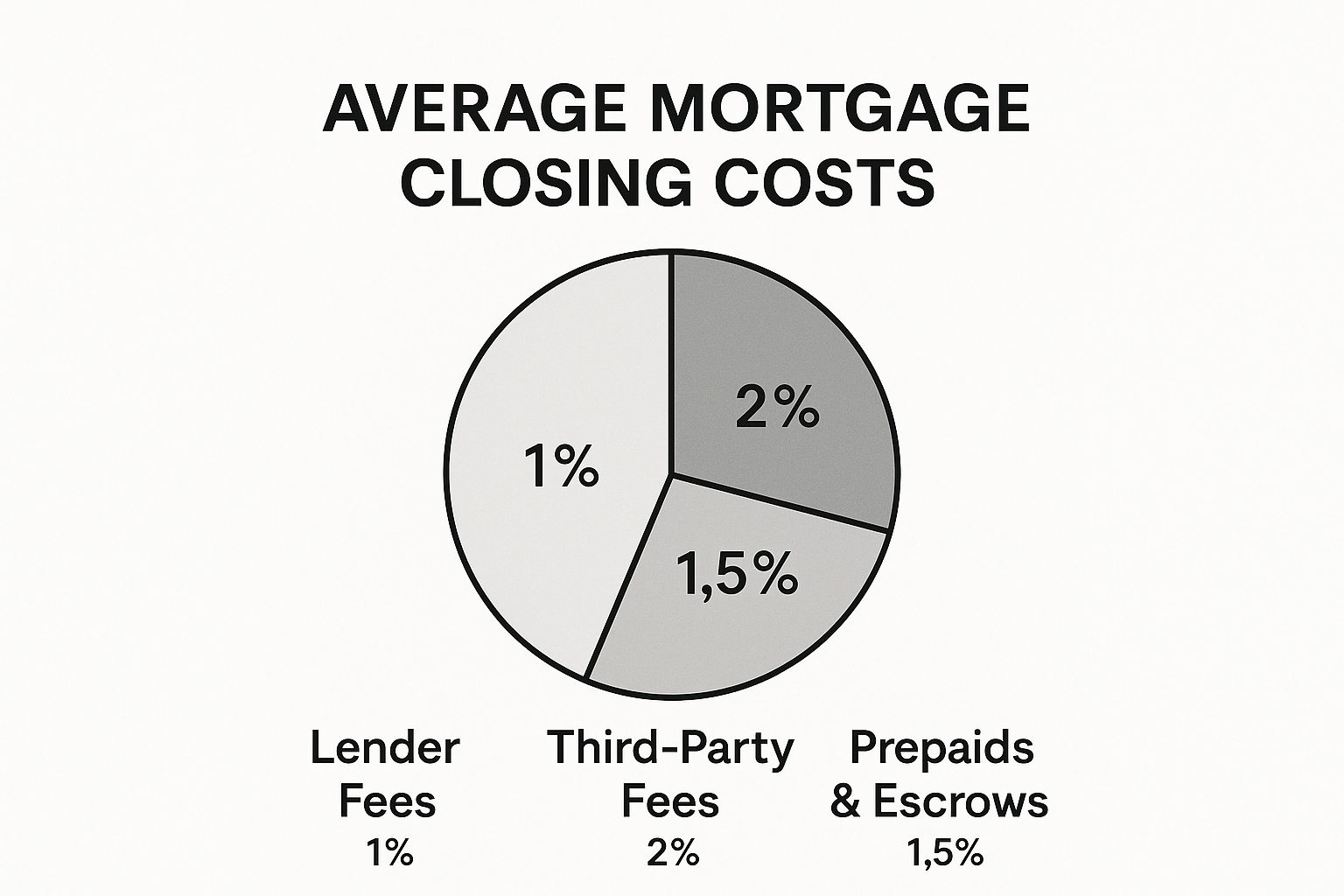
As you can see, a substantial portion of your final bill comes from third-party services and setting up your prepaid and escrow accounts—it's not just lender fees.
Comparing Costs Across Different Loan Types
The most significant factor you can control that directly impacts your closing costs is the type of loan you choose. Your mortgage choice adds or removes major line items from the final bill. Conventional, FHA, and VA loans, for example, each come with their own unique set of rules and required fees.
Here's a look at how different loan types stack up when it comes to closing costs.
Closing Cost Differences by Loan Type
| Feature | Conventional Loan | FHA Loan | VA Loan |
|---|---|---|---|
| Upfront Insurance Fee | None | Requires a 1.75% Upfront Mortgage Insurance Premium (UFMIP) that can be paid at closing or rolled into the loan. | Requires a one-time VA Funding Fee, which varies from 1.25% to 3.3% based on service, down payment, and prior use. |
| Monthly Insurance | Requires Private Mortgage Insurance (PMI) if the down payment is less than 20%. | Requires a Monthly Mortgage Insurance Premium (MIP) for the life of the loan in most cases. | No monthly mortgage insurance. |
| Best For | Borrowers with strong credit and a down payment of at least 3-5%. | Buyers with lower credit scores or smaller down payments. | Eligible veterans, active-duty service members, and surviving spouses. |
Because of these government-required insurance or funding fees, an FHA or VA loan will almost always have higher upfront closing costs than a comparable conventional loan. It's a trade-off that often enables buyers to get into a home with less money down, but it's a critical difference to be aware of at the closing table.
Market Fluctuations and Your Bottom Line
Wider economic trends absolutely play a role in what lenders charge. When mortgage activity surges—like during a major refinancing boom—the entire industry feels the pressure. Appraisers, underwriters, and title companies become swamped with work, and that high demand can sometimes lead to slightly higher fees for their services.
Just look at the massive swings in loan volume over the years. Government-backed loan originations have bounced from $304.9 billion in 2010 to a peak of roughly $775.4 billion in 2020. That kind of volatility puts real pressure on lender capacity and can influence the service fees you see.
Of course, the loan you choose will define your costs long after closing day, too. To get a better handle on these long-term factors, check out our guide on navigating the difference between fixed-rate and adjustable-rate mortgages. When you understand how all these pieces fit together, you’re in a much better position to anticipate your final bill and make the smartest choice for your future.
Actionable Strategies to Reduce Your Closing Costs
Now that you understand what closing costs are, it's time for the empowering part: actively working to shrink them. Too many homebuyers reach this stage and assume the fees are non-negotiable, but that couldn’t be further from the truth. With some savvy strategy, you can significantly reduce the amount of cash you need to bring to the closing table.
This is where you can take back control. Lowering your out-of-pocket expense is absolutely possible, and these are the time-tested strategies the pros use to make homeownership more affordable.
Shop Lenders to Compare Fees
The single most powerful move you can make to lower your closing costs is to shop around for your mortgage lender. While the interest rate is a huge deal, the lender's own fees—like origination, underwriting, and processing—can vary wildly from one institution to the next.
Don't make the mistake of accepting the first offer you receive. A few phone calls could save you hundreds, if not thousands, of dollars. Your goal is to get at least three official Loan Estimates from different lenders. This standardized document allows you to compare their fees line-by-line, making it incredibly easy to see who is charging more for the exact same service.
Negotiate Seller Concessions
In most real estate transactions, there's an opportunity to ask the seller to contribute to your closing costs. This is called a seller concession, and it's a fantastic tool. Essentially, the seller agrees to pay a specific amount of your closing fees directly from the proceeds they receive from the sale.
How you approach this really depends on the current market.
- In a buyer's market, where sellers are eager to make a deal, asking for concessions is common and often expected.
- In a seller's market, you might need to get more creative. A smart tactic is to offer a slightly higher purchase price in exchange for the seller covering your closing costs, which helps you preserve your cash.
This can be a game-changer because it directly reduces the money you need on closing day. For example, a $6,000 concession on a $300,000 home means $6,000 less you have to pay out-of-pocket.
Decode the No-Closing-Cost Mortgage
You’ve probably seen advertisements for a "no-closing-cost" mortgage, and it sounds like a dream come true. However, it’s critical to understand the trade-off. These loans don’t magically erase the fees; they simply change how you pay for them.
A "no-closing-cost" mortgage is a financing tool, not a free lunch. The lender covers your upfront fees in exchange for charging you a higher interest rate over the life of the loan.
This option can be a lifesaver for buyers who are short on cash for closing but can comfortably handle a slightly higher monthly payment. Just be aware of the long-term math: over 15 or 30 years, that higher interest rate will almost always cost you significantly more than if you had paid the closing costs upfront.
Explore First-Time Homebuyer Programs
Never overlook the assistance programs designed specifically for new buyers. Federal, state, and even local governments offer grants and forgivable loans to help people get into homes, and for many, they are a complete game-changer.
For example, many states have excellent programs that provide:
- Down payment assistance grants that you never have to repay.
- Closing cost assistance, often structured as a low-interest or forgivable loan.
- Mortgage Credit Certificates (MCCs), which provide a direct federal tax credit on the mortgage interest you pay each year.
These programs typically have income and purchase price limits, and you’ll likely need to complete a homebuyer education course. They also have minimum credit score requirements. You can get a better sense of how lenders view your financial standing by reading our guide on what credit score is needed for a mortgage to see where you stand.
By combining these strategies—shopping lenders, negotiating with the seller, understanding your loan options, and researching assistance programs—you can take charge of your final expenses and make your path to owning a home that much smoother.
Navigating the Final Steps: From Disclosure to Keys in Hand
You're in the home stretch. After weeks of house hunting, making offers, and wrangling paperwork, the finish line of your homebuying marathon is finally in sight. This is where it all comes together, and a little know-how will replace any last-minute jitters with the pure excitement of getting your new keys.
Your most important guide in this final stage is the Closing Disclosure, or CD. Federal law mandates that your lender provide this five-page document to you at least three business days before you’re scheduled to close. Think of it as the final, itemized bill for your new home, detailing every single cost, fee, and credit involved.
The Final Review
Those three days are not just for waiting; they are your golden opportunity for a final review. Your mission is to compare this Closing Disclosure line-by-line with the Loan Estimate you received at the beginning of the process.
Don't panic if some numbers have shifted slightly—prepaid items like property taxes are often adjusted based on the exact closing date. However, the core lender fees should be a near-perfect match. If you spot a significant, unexplained increase in a fee or have a question about any charge, no matter how small, speak up immediately. It is much easier to correct an error at this point than to unwind it after the fact.
This mandatory three-day review period is a powerful consumer protection. It’s designed to eliminate any possibility of last-minute surprises at the closing table, giving you the power to verify every number and ensure the deal you agreed to is the deal you’re getting.
Your Closing Appointment
The closing appointment is the main event—the formal meeting where the property legally becomes yours. It typically takes place at a title company or an attorney's office and usually concludes in about an hour.
You can expect a few key players to be present:
- You, the star of the show.
- A closing agent or attorney who facilitates the meeting.
- Your real estate agent, often there for moral support.
- The seller (or their representative).
You’ll be signing a small mountain of legal documents. The most important ones are the promissory note (your official promise to repay the loan) and the deed of trust (the document that secures the property as collateral). Don't let the stack intimidate you; take your time and ask questions. Our comprehensive mortgage document checklist is a fantastic resource for getting familiar with everything you'll see.
Finally, you’ll provide a cashier's check or proof of a wire transfer for your down payment and closing costs. Once every page is signed and the money is accounted for, you'll be handed the keys. Congratulations—you're a homeowner!
Frequently Asked Questions About Mortgage Closing Costs
Closing on a home brings up a multitude of questions, particularly around closing costs. As financial experts at Shop Rates who have guided countless homebuyers through this process, we've heard them all. This section provides quick, straightforward answers to the questions we hear most often from people just like you.
Can I Roll Closing Costs Into My Mortgage?
Yes, in many cases, you can roll closing costs into your mortgage, often through what's known as a "no-closing-cost" mortgage. However, it's crucial to understand that this isn't free—it's a trade-off. The lender covers your upfront closing fees in exchange for a slightly higher interest rate for the life of the loan. This can be a valuable option if you're short on cash, but it will almost always cost more in the long run due to the extra interest paid. Always calculate the long-term cost before committing.
When Exactly Do I Pay Closing Costs?
You will pay your closing costs on your closing day. This is the official date when you legally take ownership of your new home. Payment is typically made with a cashier's check or a wire transfer for the final amount specified on your Closing Disclosure. Your lender or the title company will provide you with the exact final amount and detailed payment instructions a few days before your closing appointment, so there will be no surprises.
How Are Seller Concessions Different From a Lower Price?
This is an excellent question that gets to the heart of negotiation strategy. A seller concession is when the seller agrees to pay a specific portion of your closing costs, which reduces the amount of cash you need to bring to the closing table. A lower sale price, on the other hand, simply reduces the total amount you're borrowing. For example, a $5,000 concession on a $300,000 home means you still borrow $300,000, but you need $5,000 less in cash on closing day. A $5,000 price drop to $295,000 lowers your loan amount and monthly payment, but you are still responsible for 100% of your closing costs.
Are There Any Closing Costs I Can Shop For?
Absolutely! This is one of the best ways to take control of your expenses. Your Loan Estimate form is specifically designed to highlight which services you can shop for. While you are locked into certain fees like the lender's appraisal and the credit report fee, you can and should get quotes for other key services. These often include title insurance services, pest inspection services, and property survey fees. Taking a little time to compare quotes for these items can lead to significant savings.
Ready to take the next step on your homeownership journey? At ShopRates, we're committed to making the mortgage process clear and affordable. Explore your options and get a transparent, competitive rate today.


