Mastering Real Estate Commercial Loans: A Complete Guide for Investors
Hearing the term "real estate commercial loan," it’s easy to assume it's merely a larger, more intricate version of a residential mortgage. That's a common misconception. In reality, these are highly specialized financial instruments, meticulously designed to empower investors and business owners to acquire, develop, or refinance properties that are intended to generate income.
Unlike a home loan, which places significant weight on your personal income and credit history, a commercial loan is underwritten with a fundamentally different question at its core: Can this property sustain itself financially? Lenders, including our team here at Shop Rates, are laser-focused on the asset's proven or potential capacity to produce revenue. This makes understanding these loans a strategic imperative for anyone serious about building a substantial real estate portfolio.
Understanding Commercial Real Estate Loans
It’s more accurate to view a commercial real estate loan not as simple debt, but as a strategic partnership. From our vantage point as nationwide lenders headquartered in the dynamic city of Nashville, TN, we see these loans as the essential fuel that propels entrepreneurs and investors toward their most ambitious goals. They are the financial engines powering everything from a gleaming new downtown office tower to a sprawling logistics and warehouse facility.
This guide moves beyond dry, textbook definitions. Our mission at Shop Rates is to provide a practical, investor-centric examination of commercial property financing. We aim to demystify the entire process, revealing how you can leverage these loans to achieve critical objectives such as:
- Property Acquisition: Securing financing to purchase existing commercial assets, whether it’s a bustling retail strip mall, a multi-family apartment complex, or an essential industrial warehouse.
- Business Expansion: Funding the ground-up construction of a new facility or a significant addition to your current operational footprint.
- Asset Refinancing: Optimizing your financial position by locking in more favorable loan terms or accessing equity from a property you already own to reinvest elsewhere.
Adopting an Investor's Mindset
To truly succeed in the commercial real estate arena, you must grasp how these financial products function on a deeper level. The very structure of a commercial loan—its terms, interest rates, and covenants—directly influences your property's cash flow and, by extension, its ultimate profitability. Lenders approach these transactions less like personal loans and more like distinct business ventures.
A commercial property's ability to generate sufficient income to cover its mortgage payment and all operating expenses is the single most critical factor for a lender. We quantify this with a key metric known as the Debt Service Coverage Ratio (DSCR).
This fundamental shift in perspective is crucial. Your loan application transforms from a summary of your personal finances into a compelling business case for the property itself. Your primary task is to prove, with verifiable data, that the building is a sound and profitable investment.
Setting the Stage for Success
Throughout this comprehensive guide, we will arm you with the actionable insights necessary to navigate the multifaceted world of commercial financing. We will dissect the various types of loans available, illuminate what lenders truly seek when they review an application, and provide you with the tools to assemble a financing proposal that commands attention and inspires confidence.
Your journey begins here, with the foundational understanding that securing the right loan is the first major milestone on the path to a profitable real estate investment. By mastering these core concepts, you will be in a vastly superior position to make shrewder financial decisions for your next major project.
Choosing The Right Commercial Loan For Your Goal
Think of the various types of real estate commercial loans as a master builder's toolbox. You wouldn't use a sledgehammer for delicate finish work, and similarly, you shouldn't apply a short-term financing solution to a long-term investment strategy. The essence of success lies in selecting the right tool—or in this case, the right loan—that is precisely engineered for your specific project.
Not all commercial loans are created equal. The optimal choice for you is contingent entirely on your objective, your investment timeline, and your overall financial position. Let's delve into the primary options so you can discern how they align with different investment strategies.
Traditional Commercial Mortgages
The traditional commercial mortgage stands as the reliable workhorse of the real estate investment world. It shares structural similarities with a residential mortgage but is specifically tailored for stable, income-generating properties like apartment buildings, established office complexes, or fully-leased shopping centers.
These loans are ideal for investors pursuing a "buy and hold" strategy. Lenders, including our team at Shop Rates, typically structure these with terms ranging from 5 to 20 years. The repayment schedule, or amortization period, is often extended over 25 or 30 years to maintain manageable monthly payments and enhance cash flow. Because these loans are for stabilized assets, lenders will require a verifiable history of income from the property and robust financial statements from you, the borrower.
SBA 7(a) And 504 Loans
If you are a small business owner planning to purchase or construct the property from which your business will operate, loans guaranteed by the Small Business Administration (SBA) can be a game-changer. It's a common misunderstanding that the SBA lends money directly. In reality, the SBA guarantees a significant portion of the loan for the lender, which substantially reduces the lender's risk.
This government backing translates directly into more advantageous terms for the borrower.
- SBA 7(a) Loans: This is the SBA's flagship program, prized for its remarkable flexibility. You can utilize the funds for real estate acquisition, but also for essential working capital or new equipment purchases. It's a fantastic, all-in-one financing tool for comprehensive business growth.
- SBA 504 Loans: This program is laser-focused on financing major fixed assets—namely, real estate and heavy machinery. The most significant advantage here is the remarkably low down payment, which can be as little as 10%. This feature makes it incredibly popular with business owners who wish to preserve capital for operational needs.
This image effectively illustrates the key distinctions between government-backed loans and their conventional counterparts.
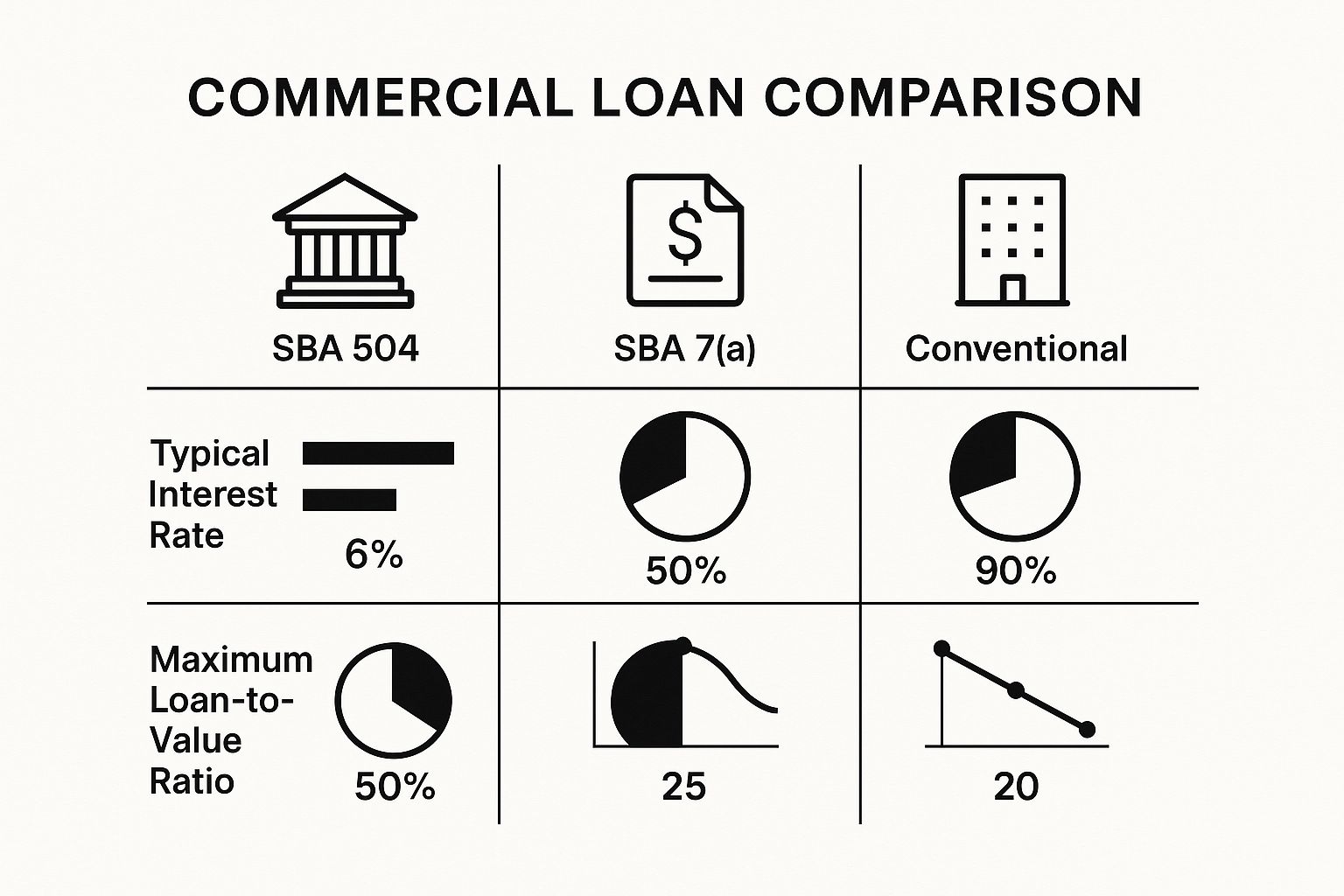
As you can see, SBA loans often permit a higher loan-to-value ratio, making property ownership far more attainable for qualifying small businesses.
Short-Term Financing: Bridge And Hard Money Loans
Sometimes, a compelling opportunity materializes that demands swift action. In these scenarios, speed and flexibility often outweigh the importance of securing the absolute lowest interest rate. This is where short-term financing enters the picture, acting as a "bridge" to get you from point A to point B efficiently.
Bridge loans are a strategic financial tool for investors who need to execute quickly. They are frequently used to acquire a property requiring renovation or stabilization before it can qualify for a traditional, long-term mortgage.
Bridge loans are precisely what their name implies: short-term loans, typically for 1-3 years, that empower you to close a deal rapidly or fund necessary improvements. Once the property is stabilized and generating consistent cash flow, you simply refinance the bridge loan into a permanent, traditional mortgage.
Hard money loans belong to the same family but are funded by private investors rather than traditional banks. The lending decision is predicated almost entirely on the intrinsic value of the property itself—the "hard" asset. While the interest rates and fees are undeniably higher, these loans can be funded in a matter of days, granting opportunistic investors the velocity needed to capitalize on time-sensitive deals.
Comparing Commercial Real Estate Loan Types
To help you visualize the available options side-by-side, here’s a concise breakdown of the most common loan types. Each is designed with a specific borrower and project profile in mind.
| Loan Type | Best For | Typical Loan Term | Key Feature |
|---|---|---|---|
| Traditional Commercial Mortgage | Buying stabilized, income-producing properties | 5-20 years | Long-term financing with competitive rates |
| SBA 7(a) Loan | Small business owners needing flexible capital | Up to 25 years for real estate | Can be used for real estate, working capital, and equipment |
| SBA 504 Loan | Business owners purchasing property for their operations | 10, 20, or 25 years | Very low down payment (often 10%) |
| Bridge Loan | Quickly acquiring or renovating a property before refinancing | 1-3 years | Speed and flexibility to secure a deal |
| Hard Money Loan | Investors needing ultra-fast funding based on asset value | 6 months – 2 years | Extremely fast closing time |
This table clarifies that there is no single "best" loan—only the most suitable loan for your unique circumstances.
Making an informed decision requires familiarity with the full spectrum of commercial real estate financing options available. When you comprehend these nuances, you can unlock opportunities that you might have otherwise overlooked.
Ultimately, the right loan is the one that aligns with your timeline, your risk tolerance, and the specific demands of your project. Whether you're a business owner acquiring your first building or a seasoned professional executing a value-add strategy, the perfect financing tool exists to help you achieve your objective.
How Lenders Evaluate Your Loan Application

Securing a commercial loan is not akin to passing a simple, binary test. It is far more about presenting a persuasive and well-documented business case for your property. When a loan application arrives on my desk, I'm not just reviewing a stack of documents; I'm deciphering a business plan. My goal is to thoroughly understand the viability of your project and, equally important, your demonstrated ability to execute it successfully.
This intensive evaluation process is called underwriting. It's where we move from concepts to concrete details, meticulously examining your financial health, your relevant experience, and the property's realistic potential to generate sufficient income to service its own debt. Think of it as your pitch for a strategic partnership—you are demonstrating to us why this venture is a sound, profitable endeavor for all parties involved.
The Five Cs of Credit Your Lender Scrutinizes
For decades, a time-tested framework has formed the bedrock of sound lending decisions: the Five Cs of Credit. This is not merely archaic banking terminology; it's the very lens through which we evaluate risk and potential. By understanding these five pillars, you can construct a loan package that speaks our language and fosters a high degree of confidence.
- Character: This fundamentally boils down to your track record and reputation. We analyze your credit history, your business standing in the community, and your experience in the specific real estate sector. Have you managed your financial obligations responsibly? Do you have a history of successful projects? Your character informs us if you are a reliable and trustworthy partner.
- Capacity: This is about the cold, hard numbers. Can the property's projected income realistically cover the new mortgage payment in addition to all operating expenses? We will soon discuss the specific metrics we employ to measure this.
- Capital: Lenders must see that you have "skin in the game." How much of your own capital are you injecting into the deal as a down payment? A significant equity contribution demonstrates your commitment and provides the lender with a protective cushion against unforeseen risks.
- Collateral: The property itself is the primary collateral for the loan. We must be confident that its market value provides more than adequate security for the loan amount. A professional, independent appraisal is a non-negotiable requirement in this step.
- Conditions: This C encompasses the broader economic and market context. What is the state of the local real estate market? What are the prevailing economic trends? We also consider the purpose of the loan and its proposed terms. These external factors help shape our assessment of the deal's overall risk profile.
Key Metrics That Make or Break Your Application
While the Five Cs provide the overarching framework, our final decision often hinges on two critical financial ratios. Mastering these numbers is absolutely essential for any prospective borrower.
The first is the Loan-to-Value (LTV) ratio. This is a straightforward comparison of the loan amount to the property’s appraised value. For example, if you require a $1.5 million loan for a property appraised at $2 million, your LTV is 75%. Most conventional lenders will set their maximum LTV between 65% and 80%, depending on the property type and market conditions.
However, the metric that truly commands the most attention is the Debt Service Coverage Ratio (DSCR). This ratio measures the property’s annual Net Operating Income (NOI) against its total annual mortgage payments. A DSCR of 1.0x signifies that the property generates just enough cash to cover its debt service—a scenario far too risky for any prudent lender.
We almost universally require a DSCR of at least 1.25x. This indicates that the property’s net income is 25% greater than its debt obligations, creating a healthy financial buffer to absorb unexpected vacancies or rising operating costs. A strong DSCR is the clearest indicator that your investment can stand on its own two feet. You can get a better feel for these numbers by using a commercial loans calculator to model different scenarios.
The Property's Story
Beyond your personal financials, the property itself undergoes a thorough examination. Our evaluation is a comprehensive audit of the asset's physical and financial health. This process involves rigorous acquisition due diligence designed to uncover any potential red flags before the loan is funded.
Here’s what we are diligently investigating:
- Location and Market Analysis: Is the property situated in a submarket with strong demand drivers and a positive growth trajectory, or is it in a location facing economic headwinds?
- Physical Condition: We meticulously review the appraisal and property condition reports, searching for deferred maintenance or structural issues that could escalate into significant capital expenditures.
- Tenant Quality and Lease Strength: For income-producing properties, the rent roll is paramount. Are the tenants established businesses with long-term leases, or is the building occupied by short-term tenants paying below-market rates?
- Income and Expense Verification: We scrutinize historical income statements and operating expenses to verify past performance and construct a realistic projection of future cash flow.
Ultimately, achieving loan approval means presenting a complete, transparent package that tells a convincing story of stability, profitability, and expert management. Your objective is to build a case so compelling that it leaves no doubt in the lender's mind.
Current Trends in Commercial Real Estate Lending
The world of real estate commercial loans is not a static environment; it ebbs and flows with the rhythm of the broader economy. For an investor or business owner, understanding the forces currently shaping commercial financing is analogous to a sailor knowing the prevailing winds before setting sail—it enables you to chart a more intelligent and direct course to your destination.
Staying abreast of these shifts allows you to anticipate lender sentiment, identify opportunities before they become widely recognized, and make timely decisions that protect and enhance your portfolio. The landscape is constantly influenced by interest rate movements, capital market liquidity, and the performance of different property sectors.
A Shift in Market Sentiment
For a period, the commercial real estate (CRE) market was grappling with the pressures of economic uncertainty. Capital became scarcer and more expensive to access. However, the tide has begun to turn, and in a significant way. Recent industry data reveals a major resurgence in optimism across the sector.
A prominent survey now indicates that over 68% of respondents anticipate a decrease in the cost of capital, and approximately 69% believe financing will become more readily available. This represents a profound reversal from the previous year when a mere 27% of respondents foresaw improving conditions. This renewed confidence is a clear signal that lenders are becoming more willing to deploy capital.
This shift isn't just a feeling; it’s a tangible change that impacts loan terms, underwriting standards, and the overall availability of real estate commercial loans. Lenders are responding to stabilizing economic indicators by reopening their lending channels, creating a much more favorable environment for well-prepared borrowers.
What this means in practical terms is that projects which might have been a difficult sell just a year ago may now find a very receptive audience among lenders.
Sector-Specific Performance and Opportunities
While the overall market sentiment is improving, opportunities are not distributed evenly across all property types. An astute investor understands where the momentum lies, and at present, the market is exhibiting a clear divergence in performance between different sectors.
- Industrial Sector: This segment remains the undisputed powerhouse of commercial real estate. Propelled by the relentless expansion of e-commerce and the critical need for resilient supply chains, the demand for warehouses, distribution centers, and logistics facilities is exceptionally robust. Lenders view industrial properties as low-risk, high-demand assets, making them one of the more straightforward property types to finance today.
- Office Sector: The office market, by contrast, is still navigating significant headwinds. The persistence of remote and hybrid work models has led to elevated vacancy rates, making lenders cautious. Securing a loan for an office building, particularly an older Class B or C property in a non-prime location, will necessitate a much stronger business case and likely a larger equity contribution from the borrower.
Understanding these sector-specific dynamics is critical. For instance, investors evaluating properties in thriving markets like the Nashville commercial real estate market should pay close attention to which local sectors are outperforming. Focusing on in-demand asset classes like industrial or multifamily can significantly improve your chances of securing favorable financing. The key is to align your investment strategy with the prevailing market currents.
A Step-by-Step Guide to the Application Process

Applying for a commercial real estate loan can feel like navigating a dense forest without a map. However, once you understand the path, it transforms into a clear, manageable journey from inception to completion. Think of it less as an intimidating ordeal and more as a series of well-defined checkpoints, each designed to confirm the strength of your project and your capacity to see it through to a successful outcome.
Breaking the process into distinct stages demystifies the experience. This roadmap will guide you through every step, from the initial exploratory conversation with a lender all the way to signing the final documents on closing day.
Stage 1: The Initial Conversation and Pre-Qualification
Your journey nearly always begins with a simple conversation. Long before you are asked to produce a single document, a candid discussion with a commercial loan officer is essential for establishing realistic expectations on both sides of the table.
This is not a formal application; it is a vital preliminary assessment. It's an opportunity for the lender to gain a high-level understanding of your vision and for you to learn what they will require from you. You’ll discuss the type of property you are targeting, your relevant experience, and your overall financial strength. While formal pre-approvals are uncommon in the commercial lending world, this dialogue serves as a critical pre-qualification step.
Unlike a residential loan where pre-approvals are standard practice, commercial real estate loans involve too many property-specific variables. The property's income potential is a massive piece of the puzzle that cannot be fully assessed until a specific asset is identified and put under contract.
This initial discussion helps you determine if you are ready to proceed or if you need to strengthen certain aspects of your financial profile first.
Stage 2: Assembling Your Financial Package
Once you have a specific property under contract, the process intensifies. This is when you construct the formal loan application package, and where your level of organization—or lack thereof—becomes immediately apparent. A clean, complete, and well-organized submission not only accelerates the process but also sends a powerful message to the lender that you are a serious, capable, and professional borrower.
Your lender will provide a specific checklist, but you should have these core documents compiled and ready for submission:
- Financial History: Be prepared with the last three years of both personal and business tax returns.
- Proof of Income: If you are a W-2 employee, you'll need recent pay stubs. For business owners, a year-to-date profit and loss (P&L) statement and a current balance sheet are required.
- Personal Financial Statement: This is a detailed snapshot of your personal balance sheet, itemizing all of your assets and liabilities.
- Deal-Specific Documents: The signed purchase and sale agreement, a current rent roll for the property, and at least two years of its historical operating statements are absolutely non-negotiable.
Having these documents prepared in advance makes an outstanding first impression. For a more detailed look at the required paperwork, our guide on how to apply for a business loan covers many of the same essential principles.
Stage 3: Underwriting and Due Diligence
After you have submitted your complete package, the lender’s underwriting team takes control. This is the most intensive and scrutinized phase of the entire process. Every single detail of your application and the property itself is placed under a microscope. The underwriter's role is to act as a skeptic on behalf of the bank, verifying every claim you have made and assessing every potential risk.
This stage can take several weeks to complete. During this period, the lender will order several key third-party reports to obtain a comprehensive, unbiased view of the transaction.
- The Commercial Appraisal: A state-licensed appraiser determines the property's fair market value. This is a critical number, as it directly influences the loan-to-value (LTV) ratio the bank is willing to offer.
- The Environmental Assessment: This report, commonly known as a Phase I Environmental Site Assessment (ESA), is conducted to identify any potential environmental hazards on the property, such as soil contamination from prior use.
- Title Search and Insurance: A title company performs a deep dive into the property’s public records to ensure there are no hidden liens or ownership claims that could jeopardize the transaction.
Your primary role during this phase is to be highly responsive. The underwriter will almost certainly have follow-up questions or requests for additional documentation. Prompt, clear responses are the only way to maintain forward momentum.
Stage 4: Commitment and Closing
Once the underwriter is satisfied and has granted their approval, the bank will issue a commitment letter.
This is the pivotal document. It is a formal, legally binding offer that outlines the final terms of the loan—the interest rate, the repayment term, any fees, and any final conditions that must be met before closing. You must review this letter meticulously with your attorney.
After you sign and return the commitment letter, the finish line is in sight. The closing process is a coordinated effort between your attorney and the bank's counsel as they prepare the extensive set of legal documents. Once everything is finalized, you will sign the loan agreement, and the lender will wire the funds to complete the purchase. All in, a typical timeline for real estate commercial loans ranges from 45 to 90 days, although more complex transactions can certainly take longer.
Finding Your Partner for Commercial Financing
Securing the right commercial real estate loan is not just a procedural step; it is a foundational cornerstone of your investment’s success. The entire journey demands meticulous planning, a deep understanding of the market, and, most importantly, a financial partner you can unequivocally trust. We hope this guide has provided you with the foundational knowledge to approach the complex world of lending with significantly more confidence.
From our headquarters here in Nashville, TN, our team at Shop Rates brings national expertise and a local touch to the table, guiding investors and business owners just like you through every stage of the process. We don't view ourselves as just a lender. Our purpose is to translate your unique vision into a tangible, workable financial reality. A significant part of this involves exploring smart financing strategies for investment properties, which can dramatically alter the trajectory of your wealth-building journey.
Taking the Next Step With Shop Rates
Choosing a lender ultimately comes down to finding a team that understands your objectives and possesses the experience to structure a loan that fits your needs perfectly. That is our primary focus—building lasting relationships by providing the clarity, support, and expertise you need to get deals done right. We live and breathe the nuances of real estate commercial loans and know precisely how to navigate the common pitfalls that can delay or derail a promising project.
The right financing partner doesn’t just provide capital; they provide confidence. They act as a strategic advisor, helping you analyze the deal from every angle to ensure it aligns with your long-term objectives.
If you’re prepared to take the next step—whether that's acquiring, refinancing, or building your next commercial property—our team is ready to listen. Let's collaborate to hammer out a financing strategy that’s custom-built for your project and your goals. At the end of the day, your success is the metric by which we measure our own, and we are committed to helping you achieve it.
Common Questions About Commercial Real Estate Loans
When you are delving into the world of commercial financing, numerous questions inevitably arise. That is perfectly natural. Having been in this business for decades, we have encountered nearly all of them from investors and business owners at every level of experience.
Consider this section a direct conversation where we address the most common inquiries we receive, providing the straightforward, reliable answers you need to proceed with confidence.
What Is a Typical Down Payment for a Commercial Real Estate Loan?
There isn't a single, fixed number; it operates more on a sliding scale. Most lenders will require a down payment somewhere in the range of 20% to 30% of the property's purchase price.
However, that figure can shift based on the specifics of the deal. If the property is considered higher risk—such as a hotel or a specialized, single-purpose building—a lender might require a larger down payment, sometimes approaching 40%. Conversely, a stable, fully-leased apartment building in a prime location might qualify for a lower down payment.
Of course, there are excellent exceptions. Government-backed programs, like the highly popular SBA 504 loan, are specifically designed to support business owners and can reduce the required down payment to as low as 10%.
How Long Does It Take to Get a Commercial Property Loan?
Patience is a fundamental virtue in commercial real estate. The approval process is considerably more protracted than what one would experience with a residential mortgage, typically taking anywhere from 30 to 90 days.
Why the extended timeline? It all comes down to the depth and rigor of the due diligence process. Lenders are conducting comprehensive investigations into everything: detailed property appraisals, environmental site assessments, and a meticulous, fine-tooth-comb review of your personal finances and the property's income-generating history. The final timeline is ultimately dependent on the complexity of the transaction, the completeness of your application package, and the lender's own internal workflow.
Can I Finance a New Construction Project with These Loans?
Absolutely, but you will require a specific tool for that job: a commercial construction loan. This is a distinct financial product from a standard mortgage for an existing building.
Think of it as a short-term line of credit designated solely for construction costs. Instead of receiving a lump sum upfront, the funds are disbursed in stages, known as "draws," as you achieve key construction milestones. Once the project is complete and "stabilized" (meaning it is leased up and generating rental income), you will refinance that short-term construction loan into a permanent, long-term commercial mortgage.
What Is the Difference Between Recourse and Non-Recourse Loans?
This distinction is critically important. The difference boils down to a single question: If you default on the loan, what assets can the lender pursue? It is a fundamental concept within the sphere of real estate commercial loans.
-
Recourse Loan: This is the most common structure. If you default, the lender can foreclose on the property and pursue your other personal assets—your primary residence, savings accounts, investments—to satisfy the outstanding debt.
-
Non-Recourse Loan: With this type of loan, the lender’s only remedy is the property itself. They can seize the collateral (the building), but they cannot access your personal assets.
As you can imagine, non-recourse loans are significantly less risky for you, the borrower. Consequently, they are generally more difficult to obtain and often come with higher interest rates, lower LTV ratios, or stricter underwriting criteria. The lender is assuming more risk and must be compensated for it.
Achieving a firm grasp of this distinction is absolutely crucial when you arrive at the negotiating table with a lender.
Ready to turn your commercial property goals into reality? The team at ShopRates is here to provide the expert guidance and tailored financing you need. Explore your commercial loan options with us today!


