

Your Expert Guide to Finding and Using a Private Money Lender
In the high-stakes world of real estate investing, speed and flexibility aren't just advantages; they are necessities. This is where a private money lender becomes an investor's most powerful ally. A private money lender is typically a person or a specialized lending company that provides short-term, asset-based loans using its own capital. Unlike traditional banks that get bogged down by credit scores and lengthy underwriting, a private lender's primary focus is the intrinsic value of the real estate itself. This fundamental difference enables them to close deals with a speed and agility that banks simply cannot match, giving savvy investors the edge they need to seize time-sensitive opportunities.
As a seasoned financial expert with decades of experience in the lending space, I've seen firsthand how the right funding partner can transform an investor's career. Here at ShopRates, a nationwide lender headquartered in Nashville, TN, we believe in empowering investors with knowledge. This guide is designed to give you that E-E-A-T (Experience, Expertise, Authoritativeness, and Trustworthiness) a seasoned investor needs to confidently navigate the private lending landscape.
Understanding the Private Money Lender

Imagine this scenario: you've uncovered a prime investment property, a diamond in the rough, but the seller needs to close fast. If you approach a conventional bank, you're staring down a 45 to 60-day approval process. By the time the bank's committee finally reviews your file, that golden opportunity will be a distant memory, snapped up by a more agile competitor. This is precisely the gap a private money lender is built to fill.
They operate entirely outside the slow, rigid framework of institutional banking. Think of them less as a monolithic financial institution and more as a nimble, specialized financial partner. A bank might offer a one-size-fits-all loan product, but a private lender provides a bespoke solution, a financial multi-tool tailored specifically to the nuances of your project.
The Core Principle: Asset-Based Lending
At its heart, the world of private money revolves around a simple yet powerful concept: asset-based lending. This means the lender's primary underwriting concern is the quality of the collateral you're putting up—the property. While your experience and financial standing are certainly part of their due diligence, the property's potential for profit is the true star of the show.
This asset-centric philosophy is what grants them their three key advantages:
- Unmatched Speed: Unburdened by the labyrinthine federal regulations and internal bureaucracy that plague traditional banks, private lenders can often approve and fund a loan in a matter of days, not weeks or months.
- Creative Flexibility: Loan terms are not etched in stone. A skilled private lender can structure a deal to accommodate the unique requirements of your project, a level of customization you’ll rarely find at a major financial institution.
- Broader Approval Criteria: A non-traditional income stream or a blemish on your credit report might trigger an automatic rejection from a bank. A private lender, however, is far more interested in the viability of your business plan and the strength of the deal itself.
This pragmatic, results-oriented approach has fueled meteoric growth in the private lending sector. The private credit market, of which these lenders are a vital component, swelled to an estimated $1.7 trillion globally as of mid-2023. As institutional banks continue to tighten their lending standards, a growing number of sophisticated investors are turning to private capital. To gain a more granular understanding of this dynamic, explore our complete guide on private lending.
Who Uses a Private Money Lender?
It is a common and costly misconception that private money is a financing source of last resort, solely for investors with poor credit. In truth, it is a strategic tool wielded by some of the most successful real estate professionals in the industry. It is the preferred funding method for any transaction where speed and certainty of closing are paramount.
Key Takeaway: If a private money lender is selling one thing, it's speed. For an investor, closing a deal in 10 days instead of 50 can be the difference between a profitable flip and a fantastic opportunity that slipped away.
From seasoned house flippers executing dozens of deals a year to commercial developers needing a bridge loan to get a project off the ground, private lenders provide the essential capital to act decisively. They are an indispensable resource for any investor who has learned the hard-won lesson that in real estate, timing isn't just a factor—it's everything.
Navigating the Private Money Loan Process
At first glance, securing a private money loan might seem intimidating. In reality, once you understand the components, it's a refreshingly logical and efficient process. For a real estate investor, this is where theory becomes practice—it’s the tangible process of turning a promising opportunity into a closed deal with keys in hand.
Forget the endless bureaucratic hoops of a conventional loan application. This process is about building a compelling business case for a financial partner. Your objective is to present a clear, well-documented path to mutual profit. When you present a meticulously prepared deal, saying "yes" becomes the only logical conclusion for the lender. The entire journey, from identifying a property to receiving funds, is engineered for one thing: velocity.
This infographic breaks down the key differences—funding speed, credit score flexibility, and typical loan amounts—that set private money apart from the old way of doing things.
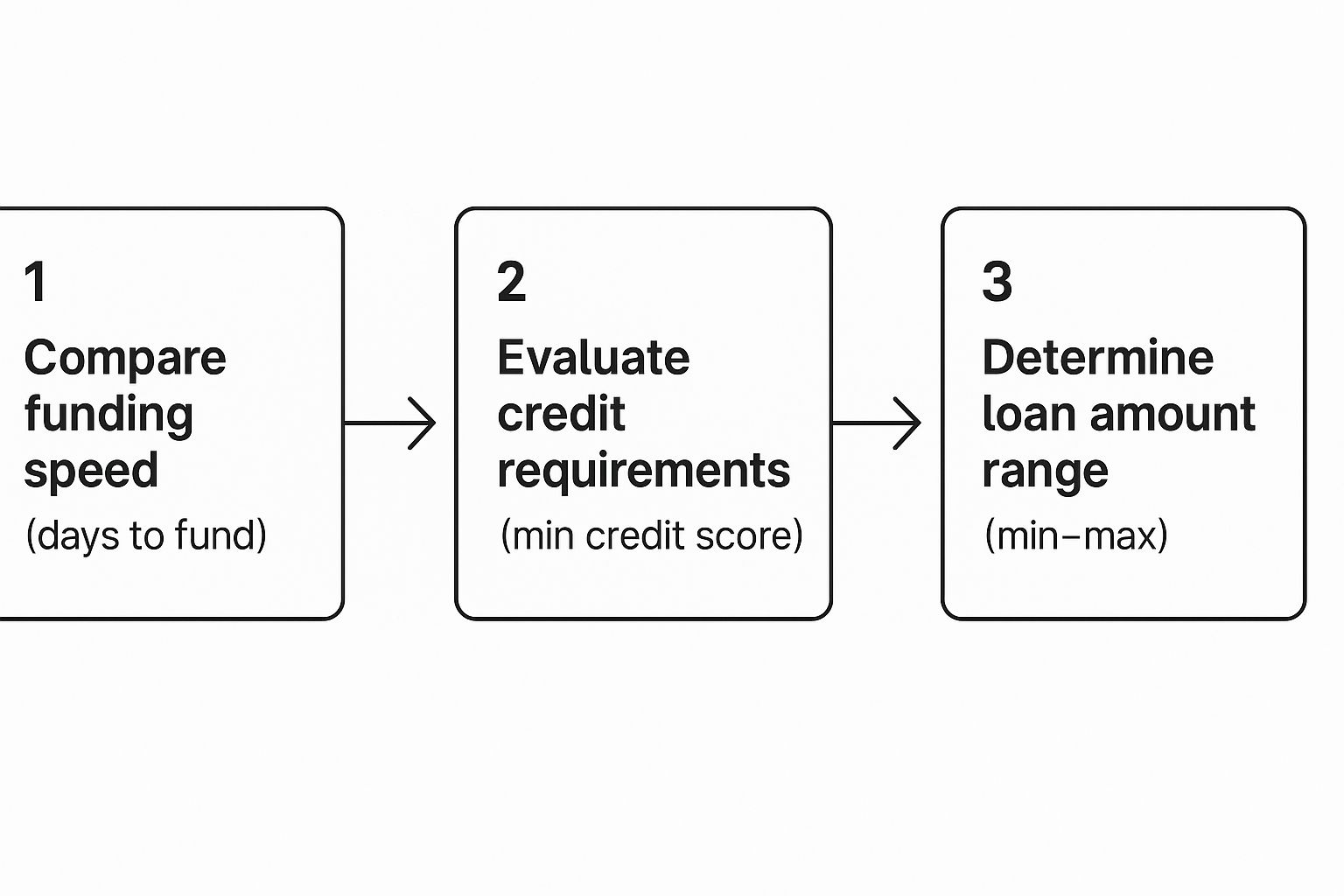
As you can see, the emphasis is squarely on flexibility and fast execution, two things absolutely critical in a competitive real estate market.
Assembling Your Winning Deal Package
Before you even consider contacting a lender, you must assemble your deal package. Nothing communicates "unprofessional" or "risky" to a lender faster than a disorganized, incomplete application. A professional, thoroughly researched package demonstrates that you are a serious operator who respects both their time and their capital.
Think of this package as your project's comprehensive business plan. It must include:
- Executive Summary: A concise, one-page overview of the entire transaction. Clearly state the property address, purchase price, a detailed renovation budget, your proposed exit strategy (flip or refinance), and the projected profit.
- Signed Purchase Contract: This is a non-negotiable prerequisite. A fully executed purchase agreement proves you have the property under contract and are ready to move forward.
- Detailed Rehab Budget: Do not use ballpark figures. Provide a line-item breakdown of all anticipated renovation costs, substantiated by contractor bids and material estimates.
- After Repair Value (ARV) Analysis: This is where you justify the project's profitability. Provide at least three to five strong comparable sales ("comps") of similar, recently sold properties in the immediate vicinity to support your projected ARV.
Presenting this complete package at the outset establishes immediate credibility and signals that you have done your due diligence.
Underwriting and the Term Sheet
Upon submission of your package, the lender commences their own due diligence, known as the underwriting phase. The significant advantage here is speed. Instead of languishing for weeks, you can expect their review to be completed within a few business days. They will meticulously analyze your numbers, assess the property's potential, and typically order their own independent appraisal to verify your ARV.
If the deal aligns with their lending criteria, they will issue a term sheet. This is a preliminary, non-binding offer that outlines the proposed loan terms: interest rate, loan amount, origination points, fees, and the repayment schedule. Scrutinize this document carefully. This is your opportunity to understand every associated cost before making a commitment. A quality lender will be fully transparent and prepared to explain every line item.
Once you accept the terms, legal counsel drafts the official loan documents. Upon signing, the funds are wired to the title or escrow company, and you can officially close on your property. This entire process, from the initial conversation to having cash-in-hand, can be completed in as little as 7 to 14 days—a stark contrast to the months-long ordeal of conventional financing.
When Is a Private Money Lender Your Best Bet?

Understanding the definition of a private money loan is one thing; knowing precisely when to deploy one is what separates amateur investors from seasoned professionals who build substantial wealth. A private money lender is not merely a fallback option for when a bank says no; in many common scenarios, they are the only viable path to get a profitable deal across the finish line.
The key is to identify the moments where their unique strengths—namely speed and flexibility—provide an undeniable competitive advantage. These aren't abstract concepts. They are real-world situations where an asset-focused lender's mindset decisively trumps a bank's slow, process-driven approach. For a real estate pro, this boils down to strategic decision-making: knowing when to call the bank and when to connect with a private funding partner.
The Classic Fix-and-Flip Project
This is the quintessential use case for private money, and for good reason. The entire fix-and-flip business model is predicated on velocity. You must acquire a distressed property, execute a rapid renovation, and sell it before carrying costs erode your profit margins.
Consider this: a motivated seller accepts your offer on a property that is perfect for a modern renovation, but they stipulate a 15-day closing period. A traditional mortgage? Simply not an option. The standard 45-day underwriting timeline would render the deal dead on arrival.
This is precisely where a private lender becomes your most valuable player. They can provide the capital to purchase the property and, in many instances, fund 100% of the renovation costs. Most importantly, they can do it all within a timeframe that keeps your deal alive. Their focus isn't on the home's current, neglected condition, but on its After Repair Value (ARV)—its future potential.
Real-World Example: An investor in Nashville identifies a property for $300,000 requiring a $50,000 renovation. Solid comparable sales support an ARV of $450,000. A private lender approves a loan covering both purchase and rehab, enabling the investor to close in just 12 days, effectively boxing out other bidders stuck waiting on conventional bank financing.
Needing a Bridge Loan to Fill a Gap
Have you ever found yourself in the precarious position of needing to purchase a new property before you've sold your existing one? This timing mismatch can create a significant and stressful capital crunch. A private money lender can step in with a bridge loan, a short-term financing instrument specifically designed to "bridge" this exact financial gap.
A bridge loan allows you to leverage the equity in your current property to fund the down payment on the new one. As soon as your old property sells, you pay off the bridge loan, seamlessly resolving the timing issue. It’s an elegant solution that prevents you from missing a compelling opportunity simply because your capital is temporarily tied up.
Snapping Up Rental Properties with DSCR Loans
For investors focused on building a long-term rental portfolio, the Debt Service Coverage Ratio (DSCR) loan is a revolutionary product offered primarily by private and non-QM lenders. Unlike conventional loans that require exhaustive documentation of personal income (W-2s, tax returns, etc.), a DSCR loan qualifies the borrower based almost entirely on the property’s ability to generate income.
The lender's underwriting is straightforward: will the projected rental income be sufficient to cover the monthly mortgage payment, taxes, and insurance (PITI)? As long as the property's cash flow can service its own debt—typically requiring a DSCR of 1.25 or higher—your personal income becomes a secondary consideration. This is how sophisticated investors scale their rental portfolios at a pace that traditional financing would never permit. For a deeper analysis, you can explore the differences between private mortgage lending and hard money loans in our detailed guide.
When Your Financials Don't Fit the Bank's Neat Little Box
Sometimes the deal is a home run, but the borrower’s financial profile is unconventional. Perhaps you are self-employed with fluctuating income, have a recent credit ding, or lack the two consecutive years of W-2 income that banks dogmatically require.
A private money lender has the flexibility to see past these rigid metrics. Their focus typically narrows to two critical questions:
- Is the real estate deal itself fundamentally sound and profitable?
- Does the borrower have sufficient "skin in the game" via a down payment?
If the answer to both questions is a firm "yes," they are often prepared to fund the loan. They provide access to capital for perfectly capable investors who are unfairly excluded by the one-size-fits-all criteria of the traditional banking system, effectively turning a bank's "no" into a confident "yes."
Understanding the Costs and Risks Involved
The primary allure of private money is undeniable: speed and flexibility. However, it is imperative to enter into any transaction with a clear and comprehensive understanding of the associated costs and risks. This convenience is not without a price; it comes with a distinct cost structure and a unique set of risks that differ significantly from those of a conventional bank loan.
Embarking on a private money loan without fully grasping the financial landscape is akin to setting sail without checking the weather forecast. You might reach your destination, but you are taking an unnecessary and potentially catastrophic gamble. A prudent investor understands that mitigating downside risk is just as crucial as pursuing upside potential.
Breaking Down the Primary Costs
The costs associated with a private money loan are generally transparent, but they differ from a standard mortgage statement. The two primary components are origination points and the interest rate.
-
Origination Points: This is the lender's upfront fee for originating, underwriting, and funding the loan. One "point" is equivalent to 1% of the total loan amount. Therefore, on a $300,000 loan, one point equals $3,000. Most private lenders charge between 1 to 4 points, which are typically paid at closing from the loan proceeds. This fee compensates them for their speed and specialized service.
-
Interest Rates: It is crucial to be realistic: these rates are higher than a 30-year owner-occupied mortgage. Because private money loans are short-term and carry a higher perceived risk for the lender, you can anticipate annual interest rates ranging from 10% to 18%. The precise rate is determined by the lender, the strength of the deal, and your experience as an investor. These are almost always structured as interest-only loans, meaning your monthly payment covers only the accrued interest, not the principal balance.
You must meticulously factor these costs into your project's pro forma from day one, as they will directly impact your net profit.
The Inherent Risks You Must Manage
Beyond the figures on a spreadsheet, there are strategic risks inherent to private money that demand a well-conceived mitigation plan. This is not intended to be daunting—it's a professional reality check to ensure you are adequately prepared.
The single greatest risk is the short repayment term. These are not 30-year amortizing loans. Most private money loans have a term of 6 to 18 months. This creates a ticking clock, necessitating a clearly defined and viable exit strategy from the moment you acquire the property.
Your exit strategy is your definitive plan to repay the loan in full. Before signing any loan documents, you must know exactly how you will achieve this. Are you going to sell the property (a fix-and-flip) or refinance into a long-term rental loan?
An inaccurate After Repair Value (ARV) calculation is another significant risk. Your entire profit projection hinges on the property's market value upon completion of the renovation. An overly optimistic ARV can cause your profit to evaporate, potentially leaving you underwater when it's time to sell or refinance. Always be conservative and use recent, highly relevant comparable sales to determine this critical figure.
Finally, you must remain attuned to broader market dynamics. The private lending ecosystem is not insulated from economic shifts. We've witnessed periods where liquidity tightens, causing some non-qualified mortgage (non-QM) lenders to face buyback demands on underperforming loans, such as DSCR and fix-and-flip products. This can strain their capital reserves. In overheated markets that have experienced rapid price appreciation, a market cool-down can make refinancing difficult if the new appraisal does not support the original loan amount, leading to potential defaults. It's wise to read more about how market shifts impact private lending to stay informed.
How to Choose the Right Lending Partner

A successful real estate investment hinges on more than just the property; the caliber of your lending partner can make or break your project. When you're seeking a private money lender, you aren't merely shopping for the lowest rate. You are searching for a strategic partner who understands your vision and possesses the experience to help you execute it. A great lender is a vital member of your professional team, not just a commodity source of capital.
This requires you to look beyond the term sheet and perform due diligence on the qualitative factors that define a true partner. The right lender provides experience, reliability, and a genuine vested interest in your success.
Vet Their Track Record and Reputation
Before you proceed, rigorous due diligence is essential. A lender with a long, verifiable history of successfully funded projects is a strong indicator of reliability. Do not hesitate to ask for references from past borrowers—in fact, you should insist upon it. Any reputable lender will be proud to connect you with investors they have served.
When you speak with these references, ask targeted, insightful questions:
- Was the funding process transparent and professionally managed?
- Were the funds delivered on time, as initially promised?
- How did the lender respond when unforeseen challenges or delays arose during the project?
The answers will provide a clear portrait of their professionalism and dependability, especially under pressure. A lender's reputation within the local real estate investment community is one of your most powerful vetting tools.
Prioritize Communication and Transparency
Let me be unequivocal: consistent, transparent communication is non-negotiable. From the initial inquiry, a quality lender should be forthright about their process, all associated fees, and realistic closing timelines. If obtaining a straight answer feels like an interrogation, or if you sense they are withholding information, consider it a significant red flag.
Key Insight: A lender who is transparent with costs and quick to answer questions before you sign is far more likely to be a supportive partner when you’re in the thick of a project. That early communication style really sets the tone for the entire relationship.
This transparency is increasingly critical as the lines between private and institutional capital continue to blur. A major industry trend is the formation of partnerships between direct lenders and large banks. For instance, Citi and Apollo recently launched a $25 billion private credit program, and Webster Bank is collaborating with Marathon Asset Management. These alliances can bring more resources to the market, but they also underscore the importance of knowing precisely who your counterparty is and how they operate.
Seek Flexibility and Local Market Knowledge
Every real estate transaction has unique characteristics. The best private money lenders understand this and demonstrate a willingness to be flexible. They can often structure a loan to accommodate the specific needs of your project, whether that involves a customized draw schedule for a renovation or an unconventional exit strategy.
A lender with deep local market expertise, like our team here at ShopRates in Nashville, TN, provides a distinct competitive advantage. They possess a nuanced understanding of neighborhood-specific property values, typical renovation costs, and current market trends. This ground-level insight enables them to assess your deal's potential with greater speed and accuracy, making them a far more effective partner. While the fundamentals are similar, the approach is different from a bank, so it's smart to learn how to compare mortgage lenders of all types to get a feel for the landscape.
Frequently Asked Questions About Private Money Lenders (FAQ)
Even after gaining a solid understanding of a private money lender's role, specific questions often arise as you prepare to execute a deal. This is perfectly normal. The most astute financial decisions are made from a position of confidence, which requires having all your questions answered before committing capital.
We have compiled the most frequent and critical questions we hear from real estate investors, from novices to seasoned veterans. Our aim is to provide direct, authoritative answers to ensure you can proceed with absolute clarity. Consider this your final pre-flight checklist before launching into the dynamic world of private real estate finance.
What Is the Difference Between a Hard Money and Private Money Lender?
This is arguably the most common point of confusion, and the terms are often used interchangeably, even by industry professionals. While the lines have blurred, a subtle distinction exists. "Private money lender" is the broader umbrella term, encompassing any non-institutional individual or entity lending their own capital, including organized firms, wealthy individuals, or even a family office. "Hard money lender" typically refers more specifically to an established, professional lending company whose primary business is providing short-term, asset-based loans secured by the "hard" asset—the property itself. In essence, all hard money lenders are private money lenders, but not all private money lenders are institutionalized hard money firms. For the borrower, the practical difference is minimal; both prioritize the asset over personal credit and provide superior speed.
What Credit Score Do I Need for a Private Money Loan?
This is a key differentiator from traditional banking. While conventional lenders often have rigid FICO score minimums, private money lenders take a more holistic view. The quality of the deal is paramount. They will review your credit report, but they are primarily looking for major derogatory events like a recent bankruptcy, foreclosure, or a pattern of non-payment, rather than fixating on the score itself. A lower credit score can often be mitigated by a strong deal, which includes a low purchase price, a solid renovation plan, a healthy down payment (skin in the game), and a well-supported After Repair Value (ARV). Your experience as an investor also carries significant weight. In short, the property's potential secures the loan, not your personal credit history.
How Quickly Can a Private Money Lender Close a Loan?
Speed is the definitive superpower of private money lending. While a standard bank mortgage can take 45 to 60 days to close, a proficient private money lender can drastically shorten this timeline. A typical closing timeframe is between 7 to 14 business days from the initial application to funding. This velocity is possible because they use their own capital, which allows them to bypass the bureaucratic red tape of traditional banks. Their streamlined, asset-focused underwriting process eliminates the weeks spent analyzing personal income documents, enabling investors to compete with all-cash buyers and capitalize on time-sensitive opportunities.
What Is a Typical Down Payment for a Private Money Loan?
Private lenders require borrowers to have "skin in the game" to ensure interests are aligned. The down payment is your tangible commitment to the project's success. Lenders evaluate deals based on two key metrics: Loan-to-Cost (LTC), which is the loan amount relative to the total project cost (purchase plus rehab), and Loan-to-Value (LTV), the loan amount relative to the property's value. Most private lenders will finance 70% to 90% of the purchase price and often 100% of the renovation costs. This means as the borrower, you should anticipate making a down payment of 10% to 30% of the purchase price. The exact amount will depend on the lender's specific program, the strength of the deal, and your track record as an investor.
Navigating the world of real estate financing can be complex, but you don't have to do it alone. Whether you're a seasoned investor needing a fast private money loan or a first-time homebuyer looking for the best mortgage rate, having a trusted partner makes all the difference. At ShopRates, we simplify the entire process, giving you access to a competitive marketplace of lenders for all your financing needs. Explore your options and take the next step toward your financial goals by visiting us at https://shoprates.com today.


