
The Entrepreneur’s Blueprint to Securing a Home Loan
Navigating the path to a home loan when you're self-employed is a distinctly different journey compared to that of a W-2 employee. But let's be crystal clear from the start: it is absolutely achievable. My experience in this field for over two decades has shown me that the key isn't if you can secure financing, but how effectively you can articulate your financial story to a lender. It all boils down to meticulous preparation and a deep understanding of how an underwriter views your business.
Why Getting a Mortgage When Self-Employed Is Different
For the entrepreneurs, freelancers, and small business owners here in Nashville and across the country, the road to a mortgage often has a few more twists and turns. A salaried individual can simply present a pay stub and a W-2, which tells a simple, predictable story of their income. Your financial narrative, however, is a much richer, more complex tale told through tax returns, profit and loss statements, and years of bank deposits. And that’s where the challenge—and the opportunity to shine—begins.
The Underwriter's Perspective on Your Income
At their core, mortgage lenders are in the business of managing risk. Their models and training are built to favor consistency and predictability. That steady, bi-weekly paycheck from a W-2 employee? It's the gold standard for them—a straightforward, low-risk income stream that fits neatly into their underwriting boxes.
Your income, however, likely ebbs and flows. Perhaps it’s tied to seasonal trends, the lifecycle of a major project, or just the natural rhythm of the market you serve. This inherent variability can raise a red flag for the automated systems and traditional underwriters who aren't accustomed to the dynamic reality of running a business.
The real point of friction, though, is how your taxable income is calculated. As a savvy business owner, you follow your accountant's advice to the letter: you claim every legitimate deduction possible. Marketing expenses, software subscriptions, a home office, mileage—it all contributes to lowering your tax burden. While that’s a brilliant strategy for your taxes, it significantly shrinks your adjusted gross income (AGI) on paper. And that AGI is the primary figure lenders use to determine how much you can afford to borrow.
It's the classic entrepreneur's dilemma: a lower AGI saves you thousands in taxes but can make it appear as if you don't earn enough to qualify for the home you want, even when your business is cash-flow positive and thriving.
To help you see the contrast more clearly, here’s a quick breakdown of how lenders view the two types of applications.
Key Differences in Loan Applications W-2 vs Self Employed
This table truly highlights the fundamental gap in documentation and income verification. It’s not that one is superior to the other; they simply speak different financial languages.
| Requirement | W-2 Employee | Self-Employed Applicant |
|---|---|---|
| Primary Income Proof | Pay stubs, W-2 forms | 2 years of personal & business tax returns |
| Income Calculation | Based on gross salary/wages | Based on Adjusted Gross Income (AGI) after deductions |
| Stability Verification | Employment verification call to HR | Profit & Loss statements, bank statements, business licenses |
| Key Lender Concern | Stability of the employer | Consistency and trend of business income over 24 months |
| Documentation Complexity | Low | High – requires detailed financial storytelling |
As you can see, the burden of proof is simply higher for a self-employed applicant. You have to paint a much more detailed and compelling picture to get the underwriter comfortable with your financial profile.
The Documentation Disconnect
The heart of the issue is that self-employed borrowers often don't fit into the neat, tidy boxes of conventional underwriting. Traditional mortgage guidelines, which frequently demand two years of tax returns, see a long list of business deductions and become hesitant.
Entrepreneurs understand that reinvesting profits back into the company is the engine of growth, but automated lending systems can easily misinterpret this as low profitability or higher risk. This misalignment is precisely why so many self-employed individuals receive an initial "no" from large, conventional banks. If you want to dive deeper into why these legacy models often miss the mark for entrepreneurs, check out the insights on nqmf.com.
The solution is to proactively bridge this documentation gap. You need to translate your entrepreneurial hustle and success into a clear, compelling financial narrative that a lender can understand and, most importantly, trust. This guide is your roadmap to doing exactly that, ensuring your dream of homeownership becomes a reality.
Assembling Your Lender-Ready Financial Dossier

Successfully landing a home loan when you're self-employed all comes down to meticulous preparation. Your mission is to build a financial dossier that tells a clear, consistent, and compelling story to any underwriter who examines it. This isn't just about gathering papers; it's about presenting your financial life with the kind of clarity that gets loans approved without endless questions.
Think of yourself as the CEO of your household, making a pitch to your most important investor—the lender. Every document must be clean, organized, and ready for scrutiny.
The Core Four Documents Lenders Need
While every borrower's situation is unique, underwriters almost always begin their review with a core set of documents. Having these buttoned up from the very beginning demonstrates that you are a serious, professional applicant and can shave significant time off the approval process.
Here's what you'll need at a minimum:
- Two Full Years of Tax Returns: This means everything—your personal (1040s) and business returns (Schedule C, 1120-S, K-1s, etc.). Lenders use these to establish a stable two-year income history.
- Year-to-Date Profit and Loss (P&L) Statement: This is crucial. It shows your current business performance and proves your income is on a similar—or better—track than the previous year.
- Recent Bank Statements: Be prepared for requests that can range from the last two months all the way up to 24 months of both personal and business bank statements.
- Business Licenses or Professional Certifications: These documents help prove your business is legitimate and that you’ve been operating for as long as you claim.
When you're putting this all together, it's vital to have a clear picture of what documents are typically needed for a mortgage, as self-employed applicants often face more extensive requirements.
Telling a Story with Your P&L Statement
Your Profit and Loss statement is more than just a spreadsheet of numbers; it's the current biography of your business. A simple, one-page summary often won't suffice. A detailed, month-by-month P&L for the current year is far more powerful, as it can showcase steady growth and explain any seasonal dips in your revenue.
For instance, a Nashville-based event planner I worked with might show lower income in January but a massive spike in the spring and fall. A monthly breakdown clearly explains this fluctuation. A simple year-to-date total, on the other hand, might just look like inconsistent income to an underwriter.
Pro Tip: Have your CPA or accountant prepare and sign your P&L. This adds a powerful layer of third-party verification and authority to the document, making it much more credible in an underwriter’s eyes.
Proactive Steps for Approval
The mortgage landscape for the self-employed is always shifting. While some lenders are becoming more flexible, standard practice still calls for at least two years of tax returns. However, I have seen strong applicants with consistent income trends get approved with just one year's return.
Before you even think about submitting your application, review your own documents with a critical eye. Do the deposits on your bank statements align with the revenue shown on your P&L? Are there any large, unusual deposits that require a clear explanation?
Finding and addressing these potential red flags yourself will prevent frustrating delays and tough questions from the lender down the line. Being fully prepared is the first step to a successful application.
Finding The Right Mortgage Beyond Conventional Loans
If you've hit a wall trying to secure a conventional loan, don't be discouraged. This is a common part of the journey for many entrepreneurs. The traditional mortgage world was designed for W-2 employees, and its rigid structure often fails to recognize the true financial strength of a healthy, cash-flowing business.
The good news is there's a whole world of mortgage products designed specifically for people like you. These aren't "last resort" options; they're intelligent financial tools built to assess your income in a way that actually makes sense for a business owner. They focus on your real cash flow, not just the bottom-line number on your tax return.
Unlocking Your Cash Flow With Bank Statement Loans
For many self-employed borrowers, the most powerful tool in the arsenal is the Bank Statement Loan. This product is an absolute game-changer. It allows lenders to calculate your qualifying income based on what truly matters: your business's cash flow.
Instead of scrutinizing your tax returns, underwriters will analyze 12 to 24 months of your business bank statements. They meticulously add up all eligible deposits to get a crystal-clear picture of your true revenue. From there, they'll apply a standard expense ratio for your industry to arrive at a qualifying income figure. For self-employed individuals, exploring alternative financing options like bank statement loans can be crucial when traditional income verification is a hurdle.
This approach provides a far more accurate assessment of your ability to afford a home, especially if you have significant business write-offs that dramatically reduce your taxable income.
Embracing Flexibility With Non-QM Loans
Bank statement loans fall under a broader category called Non-Qualified Mortgages (Non-QM). Think of Non-QM loans as the flexible, common-sense alternative to the strict guidelines of conventional financing. They are built from the ground up for borrowers with unique financial situations—a perfect description for most business owners.
These loans are valuable because they can accommodate:
- Alternative income documentation like bank statements or even qualification based on your assets.
- Borrowers with less-than-perfect credit who have other compensating factors, like a large down payment.
- Unique property types or situations that simply don't fit into the conventional box.
At Shop Rates, we specialize in helping entrepreneurs find the right fit. You can learn more about these flexible financing solutions by exploring our guide to non-traditional home loans.
Government-Backed Options: FHA Loans
Don't overlook government-backed programs, either. While they still require thorough income documentation, FHA loans can be an excellent path to homeownership for self-employed buyers, especially those who don't have a large amount of cash for a down payment.
With an FHA loan, you might qualify with a down payment as low as 3.5%, provided your credit score meets the minimum requirements. The underwriting is still detailed, but the flexible down payment and credit criteria can make it a much more accessible option for many business owners.
When you're weighing your options, it's helpful to see how they stack up against each other. Each loan product comes with its own set of requirements and benefits.
Comparing Loan Products For The Self Employed
| Loan Type | Primary Income Verification | Typical Credit Score Range | Pros & Cons |
|---|---|---|---|
| Conventional Loan | Tax Returns (Schedule C, K-1s) | 620+ (Higher is better) | Pros: Best rates, lower fees. Cons: Very strict income documentation, difficult with high write-offs. |
| Bank Statement Loan | 12-24 months of bank statements | 600+ | Pros: Uses real cash flow, not tax returns. Cons: Higher interest rates, larger down payment often required. |
| FHA Loan | Tax Returns | 580+ (for low down payment) | Pros: Low 3.5% down payment, flexible credit. Cons: Still requires tax returns, mortgage insurance is mandatory. |
| Asset-Based Loan | Verified liquid assets | 660+ | Pros: No income verification needed. Cons: Requires substantial liquid assets, not widely available. |
This table provides a quick snapshot, but remember that the right choice depends entirely on your specific financial picture—from your credit and cash reserves to the way your business income flows.
The infographic below highlights the key trade-offs between a standard mortgage and an alternative like a bank statement loan.
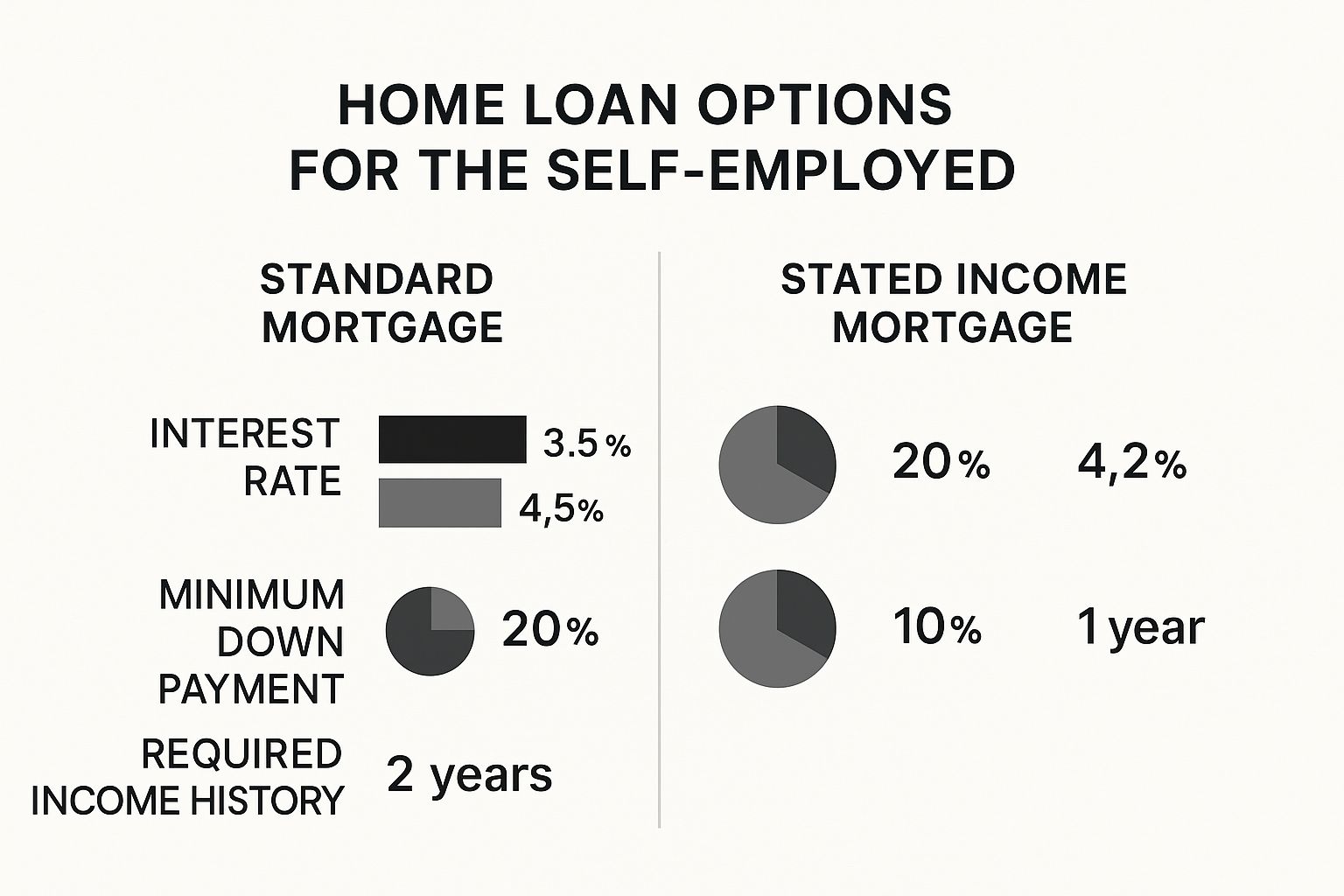
As you can see, alternative loans might have slightly higher rates, but they provide a vital pathway to homeownership by offering much more accessible income history requirements. For an entrepreneur, that flexibility can make all the difference.
Navigating the Underwriting Process Like a Pro

This is it—the final leg of the journey. Underwriting is where a real person, an underwriter, meticulously combs through every single document you’ve submitted. Their job is to verify that you are a reliable borrower who can comfortably handle the loan obligation.
For us self-employed folks, this stage is less about just submitting paperwork and more about anticipating the underwriter's mindset. You want to answer their questions before they even have to ask them. A clean, well-explained file moves to the approval stack much, much faster than one filled with ambiguities. It’s all about presenting a clear and confident financial story.
Demystifying Your Qualifying Income
Before you even fill out an application, you need to know exactly where you stand. The single most powerful thing you can do is calculate your qualifying income just as an underwriter would. This isn't your gross revenue or even the net profit on your P&L statement; it's a specific formula based on your tax returns.
Here’s a simplified version of the formula lenders use:
- Start with Net Income: Find the net profit from your business on your tax return (for sole proprietors, this is typically your Schedule C, Line 31).
- Add Back Deductions: Lenders allow you to add certain non-cash expenses back into your income. These almost always include depreciation and amortization, and often the business use of your home.
- Average Over Two Years: They take the total calculated income from your last two years, add them together, and divide by 24 to get your final monthly qualifying income.
Running these numbers yourself removes all the guesswork. It tells you exactly what the lender sees as your income, which is the key to applying for a home loan you can actually get approved for.
The Power of a Letter of Explanation
Life happens. Business income is rarely a perfect, straight line trending upward. A Letter of Explanation (LOX) is your opportunity to get ahead of the story and address any potential red flags before the underwriter starts asking questions. Don't wait for them to wonder about a dip in income or a large, unusual deposit.
A solid LOX should be:
- Brief and Factual: Get straight to the point. No emotional language or unnecessary fluff.
- Provide Context: Explain the "why" behind what they're seeing. For example, "In Q2 of 2023, my income temporarily decreased as I invested in new equipment, which has since led to a 20% increase in revenue, as shown in my recent P&L."
- Offer Documentation: If you can back up your explanation, do it. For instance, include receipts for a large purchase that explains a significant withdrawal from your account.
This isn't a place for excuses; it's a place for clear, professional explanations. A well-written LOX demonstrates that you are on top of your finances and can turn a potential "no" into a confident "yes."
From the moment you decide to apply until the day you close, maintain your financial life in a state of stability. Try to avoid taking on new debt, making large, unexplainable purchases, or changing your business structure. Consistency is your best friend during the home loan process.
Common Mistakes Self Employed Borrowers Make

After guiding hundreds of self-employed clients to the closing table, I've seen the same handful of preventable mistakes derail otherwise strong applications. These aren't rookie errors; they're common missteps made by successful entrepreneurs who are experts in their field but newcomers to the intricate world of mortgage lending.
Avoiding these pitfalls is often the difference between a smooth approval and a frustrating denial. Let's walk through the most critical ones.
One of the most frequent issues I see is the commingling of personal and business funds. Running your business revenue and personal expenses through a single bank account is an underwriter's worst nightmare. It makes distinguishing your actual business income from non-business deposits, like a birthday check from your aunt, nearly impossible.
This forces the lender to manually sort through every single transaction, often leading them to disallow legitimate business deposits simply because the source isn't crystal clear. The result? A lower qualifying income and a potential rejection.
The Problem With Undocumented Deposits
Large, undocumented cash deposits create immediate red flags for any lender. They are required by federal law to source all significant funds in your accounts.
If you deposit $5,000 in cash from a side job or from selling a piece of equipment, and you can't provide a clear paper trail, the underwriter simply cannot use that money. It won't count toward your down payment or your assets. For underwriting purposes, it might as well not exist.
Real-World Scenario: I once worked with a freelance photographer who sold some old camera gear for cash. He deposited it into his account right before applying. The underwriter flagged it, and because there was no invoice or bill of sale, the funds were excluded from his assets, which almost caused his loan to fall through.
It's absolutely crucial to document everything. For any large deposit, you need to be ready with:
- A signed bill of sale for any items sold.
- Invoices for client payments.
- A formal gift letter if the funds were a gift from a family member.
Last-Minute Business Structure Changes
Another critical error is altering your business structure right before or during the loan process. Deciding to switch from a sole proprietorship to an S-corp a few months before you apply for a home loan can be a major setback.
Lenders need to see a stable, two-year history for your specific business entity. When you change structures, you essentially reset the clock in their eyes.
This change can make it appear as though you've started a brand-new, unproven business, even if you’ve been successfully operating for years. It’s a simple change on paper that has massive implications for your home loan application.
The global home loan market is booming, with projections showing it could reach nearly $8.86 trillion by 2030. This growth, largely driven by purchase mortgages, highlights an increasingly competitive environment where a clean, straightforward application is paramount. You can discover more insights about the home loan market from industry analysis. As the market evolves, avoiding these simple mistakes becomes even more vital for self-employed individuals seeking financing.
Frequently Asked Questions About Self-Employed Mortgages
Navigating the world of home loans when you're self-employed can feel like a maze. As a lender based right here in Nashville, TN, we at Shop Rates have heard just about every question in the book. This section cuts through the noise to give you direct, no-nonsense answers to the queries we hear most often from entrepreneurs, freelancers, and small business owners just like you.
Can I Get A Home Loan With Only One Year Of Self-Employment History?
While the industry standard is definitely two years of self-employment history, getting a home loan with just one year of tax returns isn't impossible, though it does present a higher bar to clear. When a lender considers this, they will be looking for significant "compensating factors" to feel comfortable with the shorter track record. In practice, this means demonstrating exceptional financial strength, such as a high credit score (typically 700 or above), substantial cash reserves, and a larger-than-average down payment. It also helps your case immensely if you were employed in the exact same industry for at least two years right before you went out on your own. This shows the lender you have stability and deep expertise in your field, making your new venture look a lot less risky.
How Do Lenders Calculate My Income From Bank Statements?
When you apply for a bank statement loan, the lender essentially sets your tax returns aside and focuses entirely on the real cash flow of your business. This is a game-changer for entrepreneurs with a lot of write-offs. The underwriter will analyze 12 or 24 months of your business bank statements to determine what you can actually afford. The calculation involves adding up all the eligible, business-related deposits you've made over that time frame. Then, they apply an industry-standard "expense factor"—often around 50%, though this can vary by profession—to account for your business costs. For example, if your business accounts show $240,000 in deposits over 12 months, a 50% expense factor would result in a qualifying annual income of $120,000, which often paints a much more accurate picture of your financial strength.
Will My Business Debt Affect My Personal Mortgage Application?
Yes, your business debt can absolutely play a role in your personal mortgage application, but how it impacts you depends entirely on how that debt is structured and paid. If the debt is officially in your business's name and all payments are made directly from a dedicated business account, you can often exclude it from your personal debt-to-income (DTI) ratio. To do this, you'll need to provide at least 12 consecutive months of business bank statements proving the payments came from the business account, not your personal one. If you are personally liable for the debt or have been paying it from a personal account, it will almost certainly be counted against you.
What Is The Minimum Down Payment For A Self-Employed Home Loan?
The minimum down payment for a self-employed home loan can vary wildly depending on the type of loan you're pursuing. For government-backed options like an FHA loan, a self-employed borrower can potentially get in the door with as little as 3.5% down, assuming their credit score is 580 or higher. For conventional loans, the minimum can be as low as 3-5%, but the major hurdle is qualifying with your tax-return income after write-offs. This is where specialized products like Bank Statement or other Non-QM loans become essential. For these, lenders will typically require a larger down payment, often in the 10% to 25% range, to help offset the perceived risk of using non-traditional income verification. For many business owners, this trade-off is well worth it to finally secure a loan.
You can find more answers to your mortgage questions in our comprehensive home loan guide.


