A Savvy Investor’s Guide to Commercial Loans for Real Estate
Navigating the world of commercial loans for real estate can feel like stepping into an entirely different league compared to securing a home mortgage. While a residential loan centers on financing a personal residence, a commercial loan is a strategic financial instrument, secured by a property meticulously chosen to generate income.
To draw a clear distinction: a residential mortgage is like financing your family’s minivan. A commercial real estate (CRE) loan, however, is akin to securing the capital for an entire fleet of revenue-generating delivery trucks for your logistics business. The fundamental principle that separates them is the property’s core purpose: to produce a reliable stream of revenue.
Your Comprehensive Guide to Commercial Real Estate Loans

Welcome to your definitive guide for mastering the landscape of commercial real estate financing. As a team of seasoned financial experts at Shop Rates a top rated mortgage lender in Nashville, TN, but with a nationwide lending footprint, we’re dedicated to demystifying this entire process. Consider this your personal roadmap, designed to guide you from initial inquiry to a successful closing with unwavering confidence.
What Is a Commercial Real Estate Loan?
At its most fundamental level, a commercial real estate loan is the capital used to acquire, develop, or refinance a property intended for business activities. This encompasses a much wider array of properties than just the gleaming downtown skyscrapers that might first come to mind.
These loans are the financial lifeblood for a vast range of properties, including:
- Multifamily Apartment Complexes: Properties designed to house five or more residential units.
- Retail Storefronts: From the corner coffee shop to a large-scale regional shopping center.
- Office Buildings: Ranging from single-tenant professional offices to multi-story corporate headquarters.
- Industrial Warehouses: Facilities crucial for manufacturing, distribution, and logistics operations.
- Hospitality Properties: Hotels, motels, and other lodging businesses.
The market for these assets is in constant motion. The total outstanding commercial and multifamily mortgage debt in the U.S. recently swelled from $4.62 trillion to $4.79 trillion over the last year. This staggering figure signals a robust, ongoing commitment from investors, even amid economic shifts. You can delve into the data and observe market stabilization trends by reviewing research from credible sources like the Mortgage Bankers Association.
Navigating Today’s Market
A firm grasp of the current market is the essential first step in identifying both potential challenges and genuine opportunities. As a Nashville-based lender with a nationwide perspective, we have a unique front-row seat to see how local market dynamics influence the larger national picture.
For investors focusing on opportunities in our home state, a deep understanding of specific local trends offers a significant competitive advantage. You can gain valuable on-the-ground insights with our guide to Nashville commercial real estate.
Our primary objective is to equip you with the practical knowledge to make superior investment decisions. We will meticulously break down the various types of loans, pull back the curtain on what lenders truly prioritize, and walk you through every stage of the application process. Let’s begin.
Finding the Right Type of Commercial Property Loan
Selecting the right commercial property loan is analogous to a master craftsman choosing the precise tool for a specific job. You wouldn’t employ a sledgehammer to hang a priceless painting, and the financing you choose must be perfectly tailored to your real estate investment strategy. Not all commercial loans are created equal, and understanding the distinctions can mean the difference between a highly successful investment and a project that stalls before it even begins.
Consider this analogy: a traditional commercial mortgage is a long-term, stable partnership crafted for predictability. A bridge loan, conversely, is like a temporary, high-speed bypass on a map—it gets you to your destination much faster while you arrange your permanent financing. Each loan is engineered for a specific purpose, catering to different timelines, property types, and investor objectives.
Traditional Commercial Mortgages
Often referred to as term loans, these are the dependable, foundational workhorses of the commercial real estate finance world. They are the ideal fit for acquiring or refinancing a stabilized, income-generating property—think of a fully leased office building, a bustling retail strip mall, or a multifamily apartment complex with a history of high occupancy.
These loans function similarly to a residential mortgage, but the lender’s underwriting decision hinges on the property’s financial performance, not solely on your personal finances. Lenders will conduct a deep dive into key metrics like the Net Operating Income (NOI) to ensure the property generates sufficient cash flow to comfortably cover the loan payments.
- Best For: Investors purchasing or refinancing turnkey properties that already possess a proven, reliable income stream.
- Typical Loan-to-Value (LTV): Generally capped around 75%.
- Typical Term: Often structured as 5, 7, or 10-year terms, but with amortization schedules that can extend for 25 or even 30 years.
This loan structure provides predictable payments and long-term stability, making it the preferred choice for buy-and-hold investors.
Bridge and Construction Loans
So, what if your property isn’t stabilized yet? This is precisely where specialized, short-term financing becomes indispensable.
A bridge loan is engineered to “bridge” a temporary financial gap. For example, you might use one to rapidly acquire a property that requires renovations before it can qualify for a long-term traditional mortgage. It’s a fast but temporary solution, and the speed and flexibility are typically accompanied by higher interest rates.
A construction loan is designed for building a new property from the ground up or undertaking a major redevelopment. Instead of a single lump-sum disbursement, the lender releases funds in stages (known as draws) as key construction milestones are achieved. It’s the financial blueprint that brings a new real estate asset to life.
Government-Backed SBA Loans
The U.S. Small Business Administration (SBA) offers some fantastic loan programs that make financing more accessible, particularly for owner-occupied commercial real estate. This means the business owner must occupy at least 51% of the property’s total square footage.
- SBA 7(a) Loans: This is the SBA’s most popular and versatile program, offering funding that can be used for a wide range of business needs, including the purchase of real estate.
- SBA 504 Loans: This program is specifically designed for acquiring major fixed assets, such as real estate or heavy machinery. These loans feature long-term, fixed-rate financing and often require a significantly lower down payment.
Because the government guarantees a portion of the loan, lenders are far more willing to offer favorable terms, including higher LTV ratios.
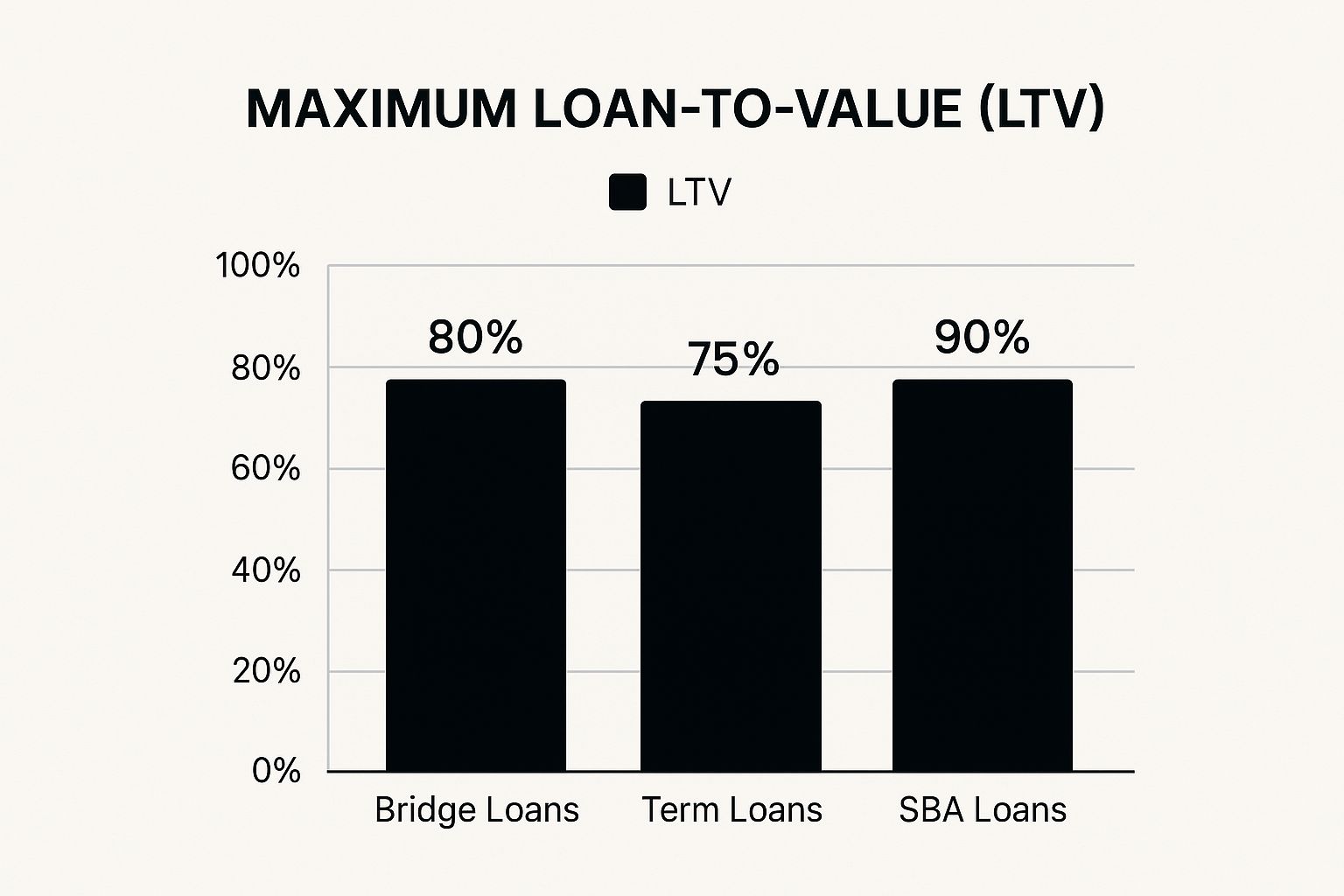
As this illustrates, government-backed SBA loans can provide substantially more leverage, which translates to less cash you need to bring to the closing table.
Conduit CMBS Loans
Conduit loans, also known as Commercial Mortgage-Backed Securities (CMBS) loans, represent a completely different financing structure. In this model, individual commercial mortgages are pooled together into a trust. Securities backed by this pool of mortgages are then sold as bonds to investors on the secondary market.
A key advantage of these loans is that they are typically non-recourse. This is a massive benefit for many investors, as it means the lender’s only collateral is the property itself—they cannot pursue your personal assets in the event of a default. They are an excellent match for investors seeking financing for large, stabilized properties who do not wish to sign a personal guarantee. The trade-off often involves less flexibility and more rigid prepayment penalties.
Hard Money and DSCR Loans
When you need to execute a deal with lightning speed, or when a property doesn’t fit the strict criteria of a traditional bank, alternative financing becomes your most valuable ally.
Hard money loans are short-term loans provided by private investors or specialized lending funds. The lending decision is based almost exclusively on the property’s value (specifically its after-repair value), not your personal credit score. They are incredibly fast to close but also more expensive, making them well-suited for fix-and-flip projects where the goal is to acquire, renovate, and sell the property quickly.
Another powerful tool for investors is the DSCR loan. The underwriting for these loans is based solely on the property’s cash flow—specifically, its ability to cover its debt service. This is a game-changer for real estate investors who may not have traditional W-2 income but own a portfolio of cash-flowing rental properties. If this describes your situation, you can learn more about what DSCR loans are and discover how they can accelerate your portfolio growth.
To help you visualize how these options compare, here’s a quick-reference table of the most common commercial loan types.
Comparing Commercial Real Estate Loan Types
| Loan Type | Best For | Typical LTV | Typical Term Length | Key Feature |
|---|---|---|---|---|
| Traditional Commercial | Buying or refinancing stable, income-generating properties. | Up to 75% | 5-10 years (25-30 yr amortization) | Predictable payments and long-term stability. |
| SBA 504 Loan | Owner-occupied businesses buying major fixed assets. | Up to 90% | 10-25 years | Low down payment and favorable fixed rates. |
| Bridge Loan | Short-term financing to “bridge” a gap, like for renovations. | Varies (asset-based) | 6 months – 3 years | Speed and flexibility for unstabilized properties. |
| Construction Loan | Funding new construction or major redevelopment projects. | Varies (based on cost) | 1-3 years | Funds are released in stages as work is completed. |
| Conduit (CMBS) Loan | Large, stabilized properties without personal guarantees. | Up to 75% | 5-10 years | Non-recourse; lender can only seize the property. |
| Hard Money Loan | Fix-and-flip projects needing rapid funding. | Up to 70% of ARV | 6 months – 2 years | Very fast closing; based on asset value, not credit. |
| DSCR Loan | Real estate investors with strong property cash flow. | Up to 80% | 30 years (often interest-only options) | No personal income verification required. |
Choosing the right loan is a critical first step on your investment journey. By thoroughly understanding the core purpose of each financial product, you can strategically align your financing with your investment objectives and position your project for success from day one.
What Lenders Look For in Your Loan Application

Securing a commercial real estate loan is a fundamentally different discipline than obtaining a mortgage for your home. Lenders are not just evaluating your personal creditworthiness; they are meticulously analyzing the entire investment as a distinct business venture. The most effective mindset is to approach it as if you’re presenting a comprehensive business plan. The property is the business, and you are its CEO.
When you bring a potential deal to us at Shop Rates, we systematically evaluate its overall viability through five critical pillars. Gaining a firm understanding of these pillars will empower you to present a rock-solid case and dramatically increase your probability of receiving an approval.
Pillar 1: The Borrower’s Experience and Financial Track Record
Before we even scrutinize the property’s details, our focus is on you, the investor. We need to see a consistent history of financial responsibility and, ideally, tangible real-world experience with similar projects. A strong personal credit history is a baseline requirement, but your business acumen and professional track record are equally vital.
Have you successfully managed rental properties in the past? Do you have a history of overseeing renovations or ground-up developments? A proven track record instills confidence that you possess the expertise to manage this new asset and skillfully navigate any unforeseen challenges.
Pillar 2: The Property’s Financial Health
The subject property must demonstrate the ability to stand on its own financially. This is where objective data and hard numbers do all the talking. We zero in on two key performance indicators that reveal everything we need to know about an asset’s performance and its capacity to service debt.
- Net Operating Income (NOI): This is the property’s total income after all operating expenses have been paid, but before debt service (mortgage payments). A strong, consistent NOI is irrefutable proof of the property’s profitability.
- Debt Service Coverage Ratio (DSCR): This ratio compares the property’s annual NOI to its total annual mortgage payments. We typically look for a DSCR of 1.25x or higher, which demonstrates that the property generates 25% more income than is needed to cover the loan.
Think of a healthy NOI and a strong DSCR as the foundational cornerstones of any successful commercial real estate loan application.
Pillar 3: Loan to Value and Your Equity
Lenders need to see that you have a meaningful financial stake in the deal—what we call “skin in the game.” This is where the Loan-to-Value (LTV) ratio comes into play. It’s a simple calculation that measures the loan amount against the property’s appraised value. For instance, if you are requesting a $750,000 loan on a property appraised at $1,000,000, your LTV is 75%.
Your down payment represents your equity stake. The more of your own capital you invest in the deal, the lower our perceived risk. A lower LTV demonstrates your commitment and provides a crucial financial cushion should market conditions change.
Pillar 4: The Property’s Condition and Market Position
The physical condition of a property and its strategic position within the local market are just as critical as its financials. We will always commission a professional appraisal to determine its precise value, but our analysis extends much deeper.
We examine its location, accessibility, the quality and stability of its tenants, and the overall market demand for that asset type. Is it a Class A office building in a thriving business district, or an older industrial warehouse requiring significant capital improvements? The stronger the property’s market position, the more attractive it is as collateral.
When we’re evaluating a project, especially one that involves new construction or a major gut renovation, we need absolute assurance of its financial viability. This makes effective construction budget management a massive factor in our approval process, as it directly impacts the project’s entire risk profile.
Pillar 5: The Borrower’s Global Cash Flow
Finally, we zoom out to assess the broader picture of your overall financial situation. We refer to this as global cash flow, and it evaluates your ability to support the debt payments from other income sources if the property’s income stream were to temporarily falter.
This could include income from other businesses, different investment properties, or your personal salary. Having robust global cash flow acts as a secondary safety net, assuring us that you can cover the mortgage during a vacancy period or when an unexpected capital expenditure arises. In the current economic climate, where commercial real estate loan growth by banks has slowed to a historic low of just 0.14% in the last quarter, this holistic view of your financial stability is often the final, decisive piece of the puzzle.
Your Guide to the Commercial Loan Application Process
Embarking on the commercial real estate loan process can feel like a formidable, complex undertaking. But in truth, it’s far less intimidating when you break it down into a clear, methodical, step-by-step process. It’s less about filling out one giant application and more about building a compelling, evidence-based case for your investment.
Think of it as telling a story. The main characters are you (the borrower), the property (the asset), and the numbers (the financials). The plot must logically lead to a successful, profitable venture that makes sound financial sense for all parties involved.
At ShopRates, our underwriting team has reviewed thousands of these narratives. The deals that secure approval the fastest—and with the most favorable terms—are invariably those that are well-prepared and professionally presented from the very beginning.
Let’s walk through the key stages of this journey together.
Step 1: The First Conversation (Pre-Qualification)
Every successful deal begins with a simple, direct conversation. Before you even contemplate filling out a formal application, your first move should be an initial consultation with a loan expert. This is where you articulate your vision for the property, and we begin to identify which financing tools are the right fit for the specific job.
During this pre-qualification phase, we’ll discuss your investment goals, your financial background, and the basic details of the property you are considering. It’s a collaborative discovery process. You don’t need every document ready at this stage, but approaching the conversation with a clear understanding of your financial picture is absolutely crucial.
Step 2: Building Your Loan Package
Once we have established a clear direction, it’s time to gather your documents and assemble a comprehensive loan package. This package serves as your formal pitch to the lender. It provides all the necessary evidence to demonstrate the strength and viability of your deal.
A well-organized and thorough package does more than just satisfy a checklist; it can dramatically accelerate the approval timeline. It signals to the lender that you are a serious, detail-oriented borrower who respects the process, which immediately builds confidence and sets a professional tone for the entire relationship.
Here’s what a robust loan package typically includes:
- Executive Summary: A concise, one-page overview of the deal. Think of it as the “elevator pitch” that highlights the property, your strategic plan, and your financing request.
- Personal Financial Statement: A detailed snapshot of your personal assets, liabilities, and net worth.
- Tax Returns: Lenders will typically request your last two to three years of personal and business tax returns.
- Property Financials: For an existing property, you’ll need its current rent roll and at least two years of operating history (income and expense statements).
- Purchase Agreement: The fully executed contract to purchase the property.
Step 3: Underwriting and Due Diligence
After you submit your application, it moves into the underwriting phase. This is the formal review process where the lender’s team meticulously verifies every detail of your loan package. You can think of underwriters as financial investigators; their job is to ensure the story your application tells is accurate and that the investment is fundamentally sound.
Simultaneously, the due diligence period begins. This is where we engage third-party experts to independently validate key aspects of the property itself.
The due diligence phase is non-negotiable for lenders. It’s where we independently verify the property’s value and condition. Key reports like the appraisal and environmental assessment provide an objective, third-party validation that protects both the borrower and the lender from unforeseen risks.
Common due diligence reports include:
- The Appraisal: A licensed, independent appraiser determines the property’s current market value. This is critical for confirming the Loan-to-Value (LTV) ratio.
- Environmental Site Assessment (ESA): A Phase I ESA is conducted to ensure the property is free from environmental contaminants, which could create significant future liabilities.
- Property Condition Report: This report assesses the physical state of the building, identifying any immediate repairs or future capital expenditures that need to be budgeted for.
Step 4: Commitment and Closing
If the underwriting and due diligence processes conclude successfully, the lender will issue a loan commitment letter. This is the formal, binding document that outlines the final terms and conditions of the loan. Receiving this letter is a major milestone in the process.
Once you have reviewed and accepted these terms, you advance to the final stage: closing.
During the closing, all final loan documents are signed, funds are transferred, and the property title is officially recorded in your name or the name of your entity. This is the finish line. It’s the point where all your strategic planning and preparation culminate, and you officially become the owner of a new commercial real estate asset.
Understanding Your Commercial Loan Interest Rate
Have you ever wondered why the interest rate on one commercial real estate deal can vary so significantly from another? It’s a frequent and important question. The rate a lender offers is not an arbitrary number; it’s the calculated result of a thorough risk assessment, blending macroeconomic trends with the specific details of your project.
Think of it like an insurance company setting a premium. The insurer analyzes the probability of a specific event occurring and prices the policy to reflect that risk. Lenders operate on a similar principle. They are calculating the perceived risk of default—the lower the risk they assess, the more favorable the rate you will secure. Understanding these influencing factors is the key to positioning your deal for the best possible financing terms.
Macro-Economic Influences
First, there are the broad economic forces that establish the baseline for all lending rates. These are factors entirely outside of your control, but they play a significant role in determining the starting point for your rate.
The most influential player in this arena is the U.S. Federal Reserve. When the Fed raises its benchmark interest rates to combat inflation, it becomes more expensive for banks to borrow money. They, in turn, pass those higher costs on to borrowers. Conversely, when the Fed cuts rates to stimulate the economy, borrowing costs decrease for everyone.
Deal-Specific Risk Factors
While you can’t directly influence Federal Reserve policy, you have a tremendous amount of control over the factors that lenders evaluate on a deal-by-deal basis. This is where you can truly impact your final interest rate. Ultimately, a lender’s primary objective is to gain confidence that the property will generate more than enough income to comfortably cover the mortgage payments.
Here are the key elements they will place under the microscope:
- Property Type and Stability: There is a significant difference in perceived risk between a fully leased apartment building in a prime location and a speculative hotel development. Lenders see stability in proven asset classes, which is why a stable, cash-flowing multifamily property will almost always command a lower interest rate.
- Loan Term and Structure: The duration of your loan is a critical factor. With a long-term, fixed-rate loan, a lender is locking up their capital for an extended period. They often charge a slightly higher rate for that long-term security compared to a shorter-term or variable-rate loan.
- Your Financial Strength: Lenders are investing in you as much as they are in the property. Your personal credit, your track record in real estate, and your overall financial health all play a crucial role. A history of successful projects provides a lender with the confidence that you know how to manage an asset effectively.
- Property Performance (DSCR): This is where the rubber meets the road. The Debt Service Coverage Ratio (DSCR) is a critical metric showing how much cash flow the property generates relative to its debt payments. A healthy DSCR, such as 1.35x or higher, is tangible proof that a comfortable cushion exists to cover the mortgage, which dramatically lowers the lender’s risk.
The good news for borrowers is that market sentiment appears to be shifting. Recent survey data indicates that approximately 68% of commercial real estate professionals now anticipate a decrease in financing costs. This renewed optimism could lead to more competitive rates for well-qualified projects. You can explore more insights on the CRE outlook from Deloitte to get a comprehensive view.
By focusing on these controllable, deal-specific factors, you can build a much stronger, lower-risk profile for lenders. To see how these variables might impact your own deal, plug some numbers into our free commercial loans calculator and explore a few different scenarios.
Partnering With Shop Rates for Your Next Investment

Selecting the right lending partner is every bit as critical as identifying the perfect property. You need more than just a source of capital; you need a strategic ally who is genuinely invested in your long-term success. This core principle is the bedrock of everything we do here at Shop Rates.
We have structured our company to offer the best of both worlds: the financial strength and broad reach of a nationwide lender combined with the dedicated, people-first service you’d expect from our Nashville-based team. For us, a commercial real estate loan is not merely a transaction. It’s the beginning of a long-term professional relationship, aimed squarely at helping you achieve and exceed your investment goals.
Why Choose Shop Rates
Our team’s deep expertise and an extensive network of capital partners provide us with a unique competitive edge. We can source competitive and often creative financing solutions for a vast spectrum of projects. Whether you are acquiring your first duplex or financing a large-scale industrial facility, we possess the tools and relationships to structure the optimal loan for your specific needs.
We are unwavering in our commitment to:
- Total Transparency: No hidden fees, no last-minute surprises. We will walk you through every line item and detail so you can make decisions with complete clarity and confidence.
- Reliability You Can Count On: We honor our commitments. You can expect clear, proactive communication and consistent support from the moment you apply until your deal is successfully closed.
- Building Genuine Relationships: Your success is the ultimate measure of our success. We invest the time to truly understand your vision and work tirelessly to help you bring it to fruition.
As you plan your next investment, accurately projecting your potential returns is a non-negotiable first step. A powerful tool like a Real Estate Flip Profit Estimator can be invaluable for running detailed financial scenarios before you commit capital.
At Shop Rates, we believe that the right financing is the foundation of a great investment. Our mission is to provide the expert guidance and tailored solutions you need to build your real estate portfolio, one successful deal at a time.
Ready to discuss your next project? Connect with one of our loan experts today for a no-obligation consultation. Let’s build something great together.
Frequently Asked Questions About Commercial Real Estate Loans (FAQ)
Entering the world of commercial real estate finance can feel like learning an entirely new language. Whether you’re a seasoned professional or just beginning your investment journey, questions are inevitable. Making confident, well-informed decisions depends on getting clear, straightforward answers.
That’s precisely why we’re here. We’ve compiled some of the most common questions we hear from investors just like you, cutting through the industry jargon to provide actionable, easy-to-understand insights.
What is the minimum down payment for a commercial loan?
Unlike residential mortgages, there is no single, fixed number for a down payment on a commercial property. As a general rule, you should plan for a down payment in the range of 20% to 35% of the purchase price.
The specific amount required is highly dependent on the details of the deal. For example, a stable, cash-flowing property with high-quality tenants represents lower risk to a lender, which may allow for a lower down payment. Conversely, a higher-risk project, such as ground-up construction or a property requiring significant renovations, will almost certainly necessitate a larger equity contribution from you.
There are notable exceptions. Government-backed programs like SBA 504 loans can be a game-changer for business owners purchasing their own building, sometimes requiring as little as 10% down.
Can I get a commercial loan with bad credit?
While a strong credit history is always advantageous, a less-than-perfect credit score does not automatically disqualify you from obtaining a commercial real estate loan. Prudent lenders evaluate the entire financial picture, not just a single score.
A deal can often be strengthened by positive factors in other areas. Think of it as a balancing act where strengths can offset weaknesses:
- A strong property: If the building itself generates exceptional cash flow (indicated by a high DSCR), lenders will often be more flexible regarding personal credit. The property’s performance speaks for itself.
- Significant equity: A larger down payment reduces the lender’s risk exposure, which can make them much more comfortable with a lower credit score.
- Proven experience: If you have a documented track record of successful real estate investments, that history demonstrates your ability to manage an asset and generate profits.
Furthermore, alternative financing options like hard money loans are specifically designed to focus almost entirely on the property’s intrinsic value, rather than the borrower’s credit history.
How long does it take to close a commercial loan?
Patience is a virtue in commercial real estate finance. The closing process for a commercial loan is a marathon, not a sprint, and typically takes longer than a standard home mortgage. A realistic timeframe to anticipate is anywhere from 45 to 90 days from the submission of your initial application to the final closing.
What contributes to this timeline? Several interdependent processes must occur, including third-party reports like appraisals and environmental site assessments, as well as the lender’s own internal underwriting. The single most effective action you can take to expedite the process is to have all your documentation in order from the start. A complete, well-organized loan package is your ticket to a smoother, faster closing.
What is a non-recourse loan?
This is a critical concept for every investor to understand. A non-recourse loan is a type of financing where the property itself serves as the sole collateral for the loan. If you default, the lender has the right to seize the asset, but they cannot pursue your personal finances or other assets to cover any remaining debt. It provides a significant layer of protection for you, the borrower.
In stark contrast, a recourse loan gives the lender the legal right to pursue your personal assets—such as your primary residence, savings accounts, or other investments—if the sale of the commercial property does not fully repay the outstanding loan balance. Understanding this distinction is absolutely vital when comparing loan offers.
For deeper dives into commercial real estate topics and answers to common questions, explore Fundpilot’s blog for additional resources.
Ready to take the next step in your investment journey? The experts at Shop Rates are here to provide the guidance and financing you need to succeed. Get in touch with us today to discuss your project.


