

A Homeowner’s Guide to Understanding and Securing the Best Home Equity Loan Rates
Tapping into your home's equity can be a powerful financial move, but the single most important number in this entire process is the interest rate. It's the direct cost of borrowing—what the lender charges for turning your home's paper value into tangible cash. This percentage doesn't just influence your monthly payment; it dictates the total amount you'll repay over the entire life of the loan. Understanding what drives this number is the first step toward making a truly informed financial decision.
What Exactly Is a Home Equity Loan Rate?

Think of the equity in your home—the difference between its market value and what you owe on your mortgage—as a powerful financial asset you've diligently built over time. Every mortgage payment and every bit of property appreciation contributes to this reservoir of value. A home equity loan is simply a financial tool that lets you access a portion of that value for significant life events, like a major renovation, consolidating high-interest debt, or funding a child's education. The interest rate is the lender's fee for providing you with this access.
It’s crucial to remember that a home equity loan is a second mortgage. It's a lien that sits behind your original mortgage, which means that in a worst-case scenario like a foreclosure, the primary mortgage lender gets paid back first. This subordinate position adds a layer of risk for the second mortgage lender, which is precisely why they scrutinize your complete financial profile so carefully before setting your interest rate. A higher perceived risk for them almost always translates to a higher interest rate for you.
Choosing Your Path: Fixed vs. Flexible Financing Options
When you decide to tap into your home's equity, you’re met with two primary pathways. The right choice for you hinges on your specific financial needs, your tolerance for risk, and how much you value predictable, stable payments.
-
Home Equity Loan: This is the most straightforward option. You receive a single, lump-sum payment upfront and repay it over a predetermined period, typically 5 to 20 years. These loans almost universally come with a fixed interest rate. This means your monthly payment for principal and interest will remain the exact same for the entire loan term, making it incredibly easy to budget for. It’s the ideal solution for large, one-time expenses where you know the exact cost ahead of time.
-
Home Equity Line of Credit (HELOC): This option functions more like a revolving line of credit, similar to a credit card. You're approved for a maximum credit limit based on your equity, and you can draw funds as you need them during a specified "draw period," which often lasts 10 years. HELOCs typically have a variable interest rate that fluctuates with a benchmark index like the prime rate. As the index changes, so can your payments, introducing an element of unpredictability. This flexibility is best suited for ongoing projects or unexpected costs where you don't need all the cash at once.
To truly grasp which product aligns with your goals, it's essential to compare a home equity loan vs. a HELOC and weigh the pros and cons for your unique circumstances.
For a quick reference, here’s how the two options compare side-by-side:
Home Equity Loan vs. HELOC: A Quick Comparison
| Feature | Home Equity Loan | Home Equity Line of Credit (HELOC) |
|---|---|---|
| How You Get Funds | One lump-sum payment upfront | Draw funds as needed, like a credit card |
| Interest Rate Type | Typically fixed and predictable | Typically variable and can change |
| Payment Structure | Consistent monthly payments of principal & interest | Interest-only payments during draw period, then principal & interest |
| Best For | Large, planned expenses (e.g., major remodel, debt consolidation) | Ongoing or uncertain costs (e.g., tuition, medical bills) |
Understanding this fundamental difference is your first critical step. A home equity loan offers stability and predictability, while a HELOC provides flexibility and access on demand. The rate you ultimately receive will directly impact the loan's affordability, which is why understanding what influences that rate is so vital.
What Factors Drive Your Home Equity Loan Rate?
Lenders don't pick your interest rate from a hat. It's the result of a sophisticated risk assessment, where they meticulously evaluate your personal financial health, the specifics of the loan you're requesting, and the broader economic environment. Gaining insight into these components allows you to see your application from the lender's perspective and take steps to present yourself in the best possible light.
This infographic highlights the key elements lenders analyze when determining your rate.
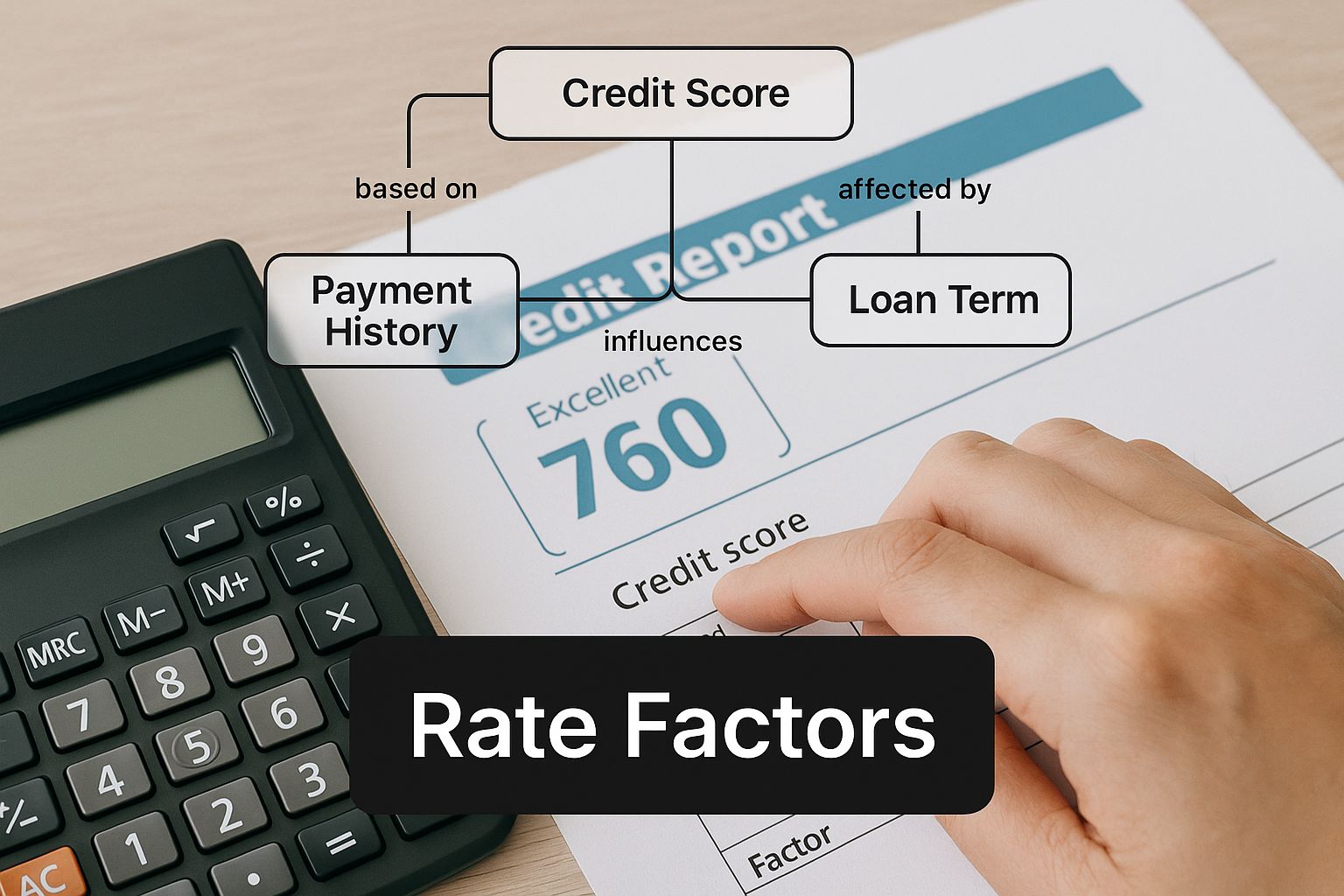
As illustrated, your credit score, existing debt obligations, and the amount of equity in your home are the central pillars of the entire underwriting process.
Your Personal Financial Profile: The Controllable Factors
Your financial history and habits are the most significant factors that are firmly within your control. Lenders are searching for concrete evidence that you can reliably manage debt and make timely repayments. They rely on a few key metrics to gauge this.
-
Credit Score: This three-digit number is your financial report card. A high score, particularly one 740 or above, signals to lenders that you are a low-risk borrower. This distinction almost always qualifies you for the most competitive interest rates. Conversely, a lower score indicates a higher risk of default, which lenders offset by charging a higher rate.
-
Debt-to-Income (DTI) Ratio: This is a powerful yet simple calculation: your total monthly debt payments divided by your gross monthly income. Most lenders set a threshold, often around 43%, because a lower DTI demonstrates that you have sufficient cash flow to comfortably absorb a new loan payment without financial strain.
Beyond these two core numbers, lenders also assess your overall financial stability. A key part of this involves understanding your debt-to-asset ratio, which provides a broader view of your financial solvency and management practices.
Loan-Specific Details: The Structure of the Deal
Next are the specific characteristics of the loan you are seeking. How much you wish to borrow in relation to your home’s value is a critical piece of the lender's risk calculation.
The loan-to-value (LTV) ratio is paramount here. It’s calculated by dividing the loan amount by your home's appraised value. For home equity loans, lenders use the combined loan-to-value (CLTV), which includes both your existing mortgage balance and the new home equity loan. The ideal CLTV for most lenders is 80% to 85%. The lower your CLTV, the more "skin in the game" you have, which reduces the lender's risk and typically results in a better interest rate for you.
Consider this practical example: boosting your credit score by just 50 points, from 690 to 740, could easily result in an interest rate reduction of half a percentage point or more. On a $75,000 home equity loan with a 15-year term, that seemingly small effort could save you thousands of dollars in interest over the life of the loan.
The Broader Economic Environment: The Uncontrollable Forces
Finally, there are macroeconomic forces that are entirely beyond your control but have a profound impact on all interest rates. The overall health of the national economy, inflation, and, most importantly, the monetary policy decisions of the Federal Reserve establish the baseline for lending rates across the board. The prime rate—the interest rate banks charge their most creditworthy corporate customers—is a critical benchmark that directly influences home equity loan and HELOC rates.
We’ve witnessed significant volatility in mortgage rates, which home equity loan rates tend to mirror. For instance, after the pandemic, the average 30-year fixed mortgage rate hit a historic low of 2.96% in 2021. By October 2023, however, that average had surged to 7.79%. This trend directly affects the cost of borrowing against your home, underscoring how much wider market forces can shape the loan offer you ultimately receive.
Decoding Current Market Trends and What They Mean for Rates
While mastering the factors you can control, like your credit score, is a vital part of securing a good rate, it's only half of the story. The other half is dictated by the broader economic landscape, which sets the fundamental cost of money for every lender.
I often use the analogy of a tide and a ship. The economy is the tide, and each borrower's application is a ship. Your personal financial health—your credit score, DTI, and equity—determines how seaworthy your ship is. But the tide itself, representing the general level of interest rates, is controlled by vast, impersonal forces. When the economic tide is low (a period of stability and low inflation), all ships float higher with better rates. When the tide rises (economic uncertainty or inflation), borrowing becomes more expensive for everyone.
The Federal Reserve's Prime Rate: The Ultimate Benchmark
If one market indicator deserves your attention, it's the prime rate. This is the interest rate commercial banks offer to their most creditworthy corporate clients. For consumers, it serves as a foundational benchmark that heavily influences the rates on variable-rate products and sets the baseline for fixed-rate loans.
The prime rate is directly tied to the federal funds rate, which is the primary tool the Federal Reserve uses to manage the economy. When you hear that "the Fed is raising rates," it means they've increased the federal funds rate, a move that almost instantly pushes the prime rate higher. This has a direct and tangible impact on home equity products.
- Direct Impact on HELOCs: Most Home Equity Lines of Credit (HELOCs) have variable rates that are explicitly priced as the prime rate plus a margin. For example, if your HELOC is structured as "Prime + 1%" and the prime rate increases by 0.25%, your HELOC's interest rate will increase by that exact amount almost immediately.
- Indirect Impact on Fixed-Rate Loans: While a fixed-rate home equity loan isn't directly tied to daily prime rate movements, lenders absolutely use the prime rate as their starting point when setting rates for new loans. When the prime rate is high, the fixed rates offered on new home equity loans will also be higher to reflect the increased cost of funds for the lender.
Tappable Equity and Lender Competition
The economic shifts over the past few years have created a unique situation for homeowners. Rapid property value appreciation has caused the amount of home equity to soar to historic levels. This has ignited intense competition among lenders, who are all eager to help homeowners unlock that accumulated wealth.
Market dynamics like these are governed by supply and demand. As we moved into 2025, U.S. homeowners were sitting on a staggering $17.6 trillion in total home equity, with an incredible $11.5 trillion of that considered "tappable" (meaning it can be borrowed against while maintaining a safe equity cushion). This massive pool of available equity, combined with lenders offering more aggressive introductory HELOC rates, led to a 22% surge in equity withdrawals in the first quarter compared to the prior year—the highest volume in 17 years. This perfectly illustrates the interconnectedness of market trends, lender behavior, and homeowner actions. You can explore more data on how record equity levels are influencing the market.
A competitive lending market is a borrower's greatest advantage. When lenders are actively competing for your business, they are far more motivated to offer better rates, reduce fees, and provide more flexible terms to win you over. This is precisely why it is so critical to shop around using a platform like ShopRates, which leverages that lender competition to your benefit.
How to Secure the Lowest Possible Home Equity Loan Rate
Securing an excellent rate on a home equity loan is not a matter of luck; it’s a direct result of diligent preparation. By taking proactive steps to strengthen your financial profile, you can significantly improve your odds of being viewed as an ideal, low-risk borrower—the exact type every lender is looking for.
This is your strategic playbook for transforming a good loan application into an exceptional one. The objective is clear: demonstrate that you are a responsible and financially stable borrower. When you succeed, lenders reward you with lower interest rates, which can translate into thousands of dollars in savings over the term of your loan. Let’s dive into the actionable steps you can begin today.
Fortify Your Credit Score
Your credit score is the most influential number a lender will examine. They view it as a direct measure of your creditworthiness and reliability. A higher score signifies lower risk, which is the key to unlocking the best possible loan terms and the lowest interest rates.
First, obtain your credit reports from all three major credit bureaus: Equifax, Experian, and TransUnion. Review them meticulously for any errors, inaccuracies, or fraudulent accounts. Even minor mistakes can unnecessarily suppress your score. Disputing and correcting these errors is often the fastest way to achieve a meaningful score improvement.
Beyond that, focus on these fundamental habits:
- Pay Every Bill on Time, Every Time: Your payment history is the single largest component of your credit score. A single late payment can have a significant and lasting negative impact.
- Keep Credit Card Balances Low: High credit utilization can suggest to lenders that you are overextended. A widely accepted rule of thumb is to keep your balance below 30% of the credit limit on each card.
- Avoid New Credit Applications: Each time you apply for a new loan or credit card, it can result in a "hard inquiry" on your credit report, which may temporarily lower your score. Refrain from applying for new credit in the months leading up to your home equity loan application.
Optimize Your Debt-to-Income Ratio
Immediately after your credit score, lenders scrutinize your debt-to-income (DTI) ratio. This is the straightforward comparison of your total monthly debt obligations to your gross (pre-tax) monthly income. Lenders use this metric to assess whether you can comfortably manage an additional loan payment without overstretching your budget.
Most lenders prefer a DTI of 43% or lower. If your DTI exceeds this threshold, securing approval can be more difficult, and if you are approved, it will almost certainly be at a higher interest rate.
To lower your DTI, you have two primary levers: reduce your debt or increase your income. Prioritize paying down high-interest debt, such as credit cards or personal loans, to reduce your monthly obligations. Simultaneously, explore opportunities to increase your income, whether through a side business, freelance work, or negotiating a raise.
Shop Around and Compare Multiple Offers
This is the most common and costly mistake a borrower can make: accepting the first loan offer they receive. Home equity loan rates can vary significantly from one lender to another. Banks, credit unions, and online lenders are all competing for your business, and their offers will reflect their different risk appetites and cost structures.
This is where a service like ShopRates becomes an invaluable asset. By enabling you to get quotes from multiple lenders simultaneously, you create a competitive dynamic where each lender is incentivized to present their best offer. This simple act of comparison shopping is the most effective way to ensure you are not leaving money on the table.
The same principles of diligence apply when seeking a primary mortgage. You can find more strategies for lowering your overall mortgage rate in our comprehensive guide. Never underestimate the power of evaluating all your options—it is the final, crucial step toward securing the most affordable financing available.
Action Plan for a Better Interest Rate
Achieving a better rate is a strategic process, not an overnight fix. Here is a simple checklist to guide you through the key steps and provide a realistic timeline.
| Action Step | Impact on Your Rate | Timeline |
|---|---|---|
| Pull & Review Credit Reports | High | 1-2 Hours (Fixing errors can take 30-60 days) |
| Pay Down Credit Card Balances | High | 1-3 Months |
| Set Up Automatic Bill Payments | High | 3-6 Months (to show consistent history) |
| Calculate & Lower Your DTI | Medium-High | 1-6 Months |
| Gather Financial Documents | Low (but essential for speed) | 1 Week |
| Compare Offers from 3-5 Lenders | High | 1-2 Weeks |
By systematically working through these steps, you place yourself in the strongest possible negotiating position to not only gain approval but to secure a rate that makes a meaningful difference in your monthly budget and long-term financial health.
Comparing Loan Offers Like an Expert
Receiving several home equity loan offers is an exciting step, but it's where the real analysis begins. To identify the truly best deal, you must look beyond the advertised interest rate and focus on the one figure that tells the complete story: the Annual Percentage Rate (APR).
Think of the interest rate as just one component of the loan's cost. The APR, however, provides the full picture. It combines the interest rate with most of the lender’s associated fees—such as origination fees, appraisal costs, and other closing costs—into a single, standardized percentage. This makes the APR the single most effective tool for making an accurate, apples-to-apples comparison between different loan offers.
Digging Deeper Than the APR
While the APR should be your primary guide, it's still essential to examine the fine print of each loan estimate. Lenders are legally required to provide a detailed breakdown of all fees, and it is your responsibility to understand exactly what you are agreeing to.
As you compare home equity loan offers, it's wise to understand how they fit within the broader context of various mortgage solutions available to homeowners today.
Pay special attention to these potential hidden costs or restrictive terms:
- Prepayment Penalties: Some lenders impose a fee if you pay off your loan ahead of schedule. This can be a significant disadvantage if you anticipate selling your home, refinancing, or paying off the loan early within the first few years.
- Annual Fees: These are particularly common with HELOCs. A seemingly minor annual fee can accumulate into a substantial cost over the 10- or 20-year lifespan of the credit line.
- Variable Rate Caps: If you are considering a HELOC, you must identify the lifetime interest rate cap. This specifies the absolute maximum your rate can ever reach, providing a crucial safeguard against extreme market volatility.
Making an intelligent decision means comparing the total loan structure, not just the headline rates. One offer might have a marginally lower APR but includes a harsh prepayment penalty, making another offer a more prudent long-term choice for your specific financial goals. It's also worth asking if a home equity loan or a cash-out refinance better suits your needs. You can run some numbers using a cash-out refinance calculator to compare different scenarios.
So, What's Next for Home Equity Rates?
While predicting the future of interest rates is never an exact science, we can analyze current trends to make educated forecasts. The lending landscape is continuously evolving, shaped by macroeconomic policy, lender innovation, and the changing needs of homeowners like you. If you're considering tapping into your home's equity, staying informed about these trends will empower you to make a more strategic and timely decision.
Ultimately, the future of home equity rates hinges on three key factors: the Federal Reserve's actions on interest rates, the stability of home values, and the level of competition among lenders for your business.
As the economy fluctuates, any adjustments to the prime rate will have a near-immediate ripple effect on borrowing costs, especially for those with variable-rate HELOCs. And as long as home prices remain stable or continue to appreciate, it fosters confidence for both homeowners and lenders—you feel secure in your asset, and they feel secure extending credit against it.
The Demand for Home Equity Isn't Going Anywhere
Let’s be clear: the desire for homeowners to access their equity is strong and growing. Projections indicate that the global home equity lending market is poised for significant expansion, expected to grow from USD 29.3 billion in 2023 to an estimated USD 42.7 billion by 2033. This substantial growth signals that using home equity to finance major projects like renovations or to consolidate debt is becoming an increasingly mainstream financial strategy. You can explore more data on this expanding market on market.us.
This isn't just an abstract statistic—it's a sign of a healthy and competitive future for borrowers. As more people seek to access their equity, lenders will be forced to compete more aggressively for business. This competition will likely lead to better products, more efficient processes, and more attractive rates. It’s excellent news for anyone on the borrowing side of the equation.
This trend also highlights the growing role of technology in lending. Expect to see faster, more transparent, and more user-friendly digital platforms for applying and getting approved for loans. This technological push will not only simplify the process for you but will also intensify competition among lenders, which could lead to even better home equity loan rates for borrowers with strong financial profiles.
For homeowners, the takeaway is clear: maintaining strong credit and staying informed about market shifts will be your ticket to capitalizing on the best borrowing opportunities as they arise.
Frequently Asked Questions About Home Equity Loan Rates
Navigating the world of home equity can bring up a lot of questions. To help you move forward with confidence, we've compiled clear, expert answers to the most common inquiries we receive from homeowners just like you.
Are Home Equity Loan Rates Fixed or Variable?
The type of interest rate depends entirely on the product you choose, as they are structured in fundamentally different ways.
-
A traditional home equity loan almost always comes with a fixed interest rate. Your rate is locked in on day one and will not change for the life of the loan. This results in a consistent, predictable monthly payment, making it ideal for budgeting large, one-time expenses.
-
A Home Equity Line of Credit (HELOC), conversely, typically has a variable rate. This rate is tied to a financial index, most commonly the prime rate. As the index moves up or down with market conditions, your HELOC rate will adjust accordingly, which means your monthly payments can change over time.
How much can I lower my home equity loan rate by improving my credit score?
While there's no precise formula, improving your credit score is one of the most powerful actions you can take to secure a lower interest rate. A higher score directly signals to lenders that you are a reliable, low-risk borrower. As a general rule, moving from a "fair" credit score (around 650) to a "very good" score (760 or higher) could easily reduce your interest rate by one to two full percentage points. On a $50,000 loan, this difference could save you thousands of dollars in interest over the loan's term.
Is now a good time to get a home equity loan?
While it’s tempting to try to time the market perfectly, the "best time" to get a home equity loan is less about macroeconomic conditions and more about your personal financial situation. The most important questions are internal: do you have a specific, valuable use for the funds? Do you have significant equity built up in your home? And are your personal finances (income, credit, and DTI) in excellent shape? If the answer to these questions is yes, then now could be the right time for you. The crucial next step is to compare current home equity loan rates to ensure the monthly payment fits comfortably within your budget.
What is the difference between an interest rate and an APR on a home equity loan?
Understanding this distinction is critical for making an accurate comparison between loan offers. The interest rate is simply the percentage charged for borrowing the principal loan amount. The Annual Percentage Rate (APR) provides a more comprehensive view of the loan's cost. The APR includes the interest rate plus most of the lender's fees and closing costs (like origination fees and points), expressed as a single annualized percentage. To make a true apples-to-apples comparison between lenders, you should always compare the APR, as it more accurately reflects the total cost of borrowing.
Can I get a home equity loan with bad credit?
It is more challenging, but not necessarily impossible. Lenders view a lower credit score as an indicator of higher risk. To compensate for that risk, they will almost certainly offer you a significantly higher interest rate and may require you to have a lower loan-to-value ratio. Some lenders specialize in working with borrowers with sub-optimal credit, making it even more essential to shop around diligently to find the best possible terms for your situation.
Do I have to pay closing costs on a home equity loan?
Yes, in most cases, home equity loans come with closing costs, similar to your original mortgage. These costs can cover services such as the property appraisal, loan origination, title search, and recording fees. These costs are typically rolled into the loan's APR to give you a clearer picture of the total expense. Be wary of lenders advertising "no-closing-cost" loans; often, they offset these waived fees by charging a higher interest rate over the life of the loan.
Ready to see what rates you qualify for? At ShopRates, we make it easy to compare offers from multiple lenders, ensuring you find the best possible home equity loan rates for your financial goals. Start comparing your personalized loan options today!


