
Saving for a House: A Financial Expert’s Guide to Reaching Your Down Payment Goal
Saving for a house isn't just about stashing cash away; it's about executing a clear, disciplined plan. After decades of guiding clients through this very process, I can tell you that the people who succeed are the ones who define their specific down payment number, build a budget around that goal, and then make saving as automatic as breathing.
The Reality of Saving for a House Today

So, you're thinking about buying a home. Let's be honest—the journey can feel like a mountain climb, especially when you look at the numbers. But after decades of guiding people through this exact process, I've learned how to cut through the noise and focus on what actually gets you to the finish line. It's more achievable than you might think, especially with a solid roadmap in hand.
There's no sugarcoating it: the financial landscape has changed. Between late 2019 and late 2024, the median home sale price in the U.S. shot up by a staggering 43.8%. That climb pushed the typical down payment to over $30,000, which is a 125.5% jump from just five years ago. You can dig into more of the data behind these down payment trends on Realtor.com.
Don't let those numbers scare you off. The path to success hasn't changed. It all starts with breaking that intimidating down payment goal into smaller, more manageable pieces.
Your Home Savings Journey at a Glance
To make this feel less like a guessing game, I've broken down the entire process into four clear stages. Think of this as your roadmap from day one to closing day. It’s a proven framework that gives you a bird's-eye view of what's ahead, so you can tackle one phase at a time with confidence.
| Stage | Primary Goal | Key Actions |
|---|---|---|
| Stage 1: Foundation | Establish a clear savings target and timeline. | Calculate your down payment, analyze your budget, and set a monthly savings goal. |
| Stage 2: Accumulation | Build your down payment fund consistently. | Automate savings, reduce non-essential spending, and explore ways to boost income. |
| Stage 3: Protection | Safeguard your funds as you near your goal. | Keep savings in a secure, liquid account and start saving for closing costs separately. |
| Stage 4: Finalization | Prepare for the home buying process. | Get pre-approved for a mortgage and assemble your home buying team. |
Seeing it laid out like this demystifies the whole thing, doesn't it? This framework takes you from the initial "what-if" stage all the way to finally getting those keys in your hand.
As a nationwide lender based right here in Nashville, TN, we at ShopRates see firsthand how a well-structured plan turns aspiring buyers into happy homeowners. The most successful savers are those who build a strong foundation before getting caught up in house hunting.
For a more detailed walkthrough of the entire homeownership journey, our complete guide on the https://shoprates.com/steps-to-buying-a-house/ is the perfect next step.
Calculate Your Down Payment Target
Let’s be honest, “saving for a house” isn’t a real plan—it’s a wish. After decades of helping people navigate this process, I can tell you the very first step is to get specific. You need a concrete, personal down payment target. This isn't about scaring you with a big number; it's about making your goal real and tangible, something you can actually work toward.
So, how do you find that magic number? It boils down to two things: the typical home prices where you want to live and the kind of mortgage you’re likely to get.
The loan you choose dramatically changes the game. For example, a conventional loan often requires a 20% down payment to sidestep Private Mortgage Insurance (PMI). On a $400,000 home, that's a hefty $80,000. But an FHA loan might let you in the door with just 3.5% down, which is only $14,000 for the same house. The trade-off? A smaller down payment usually means a higher monthly mortgage payment and more interest over the long haul.
Setting a Pace That Fits Your Life
Where you are in life and your career will naturally influence how much you can realistically save. Nobody expects a 25-year-old to have the same savings power as a 55-year-old.
Recent data shows the median down payment for all homebuyers is around 13%. But when you look closer, the numbers tell a story:
- Buyers aged 22-31 put down about 8%.
- Those between 32-41 manage closer to 10%.
- As people establish their careers, that figure climbs, with buyers over 67 putting down 28% or more.
The trick is to work backward. Once you have a target—whether it’s $14,000 or $80,000—and a rough timeline, you can break it down into a clear monthly savings goal. This turns an overwhelming figure into a series of manageable, bite-sized steps.
Take a look at this chart. It gives a great visual for how you might approach saving based on your income.
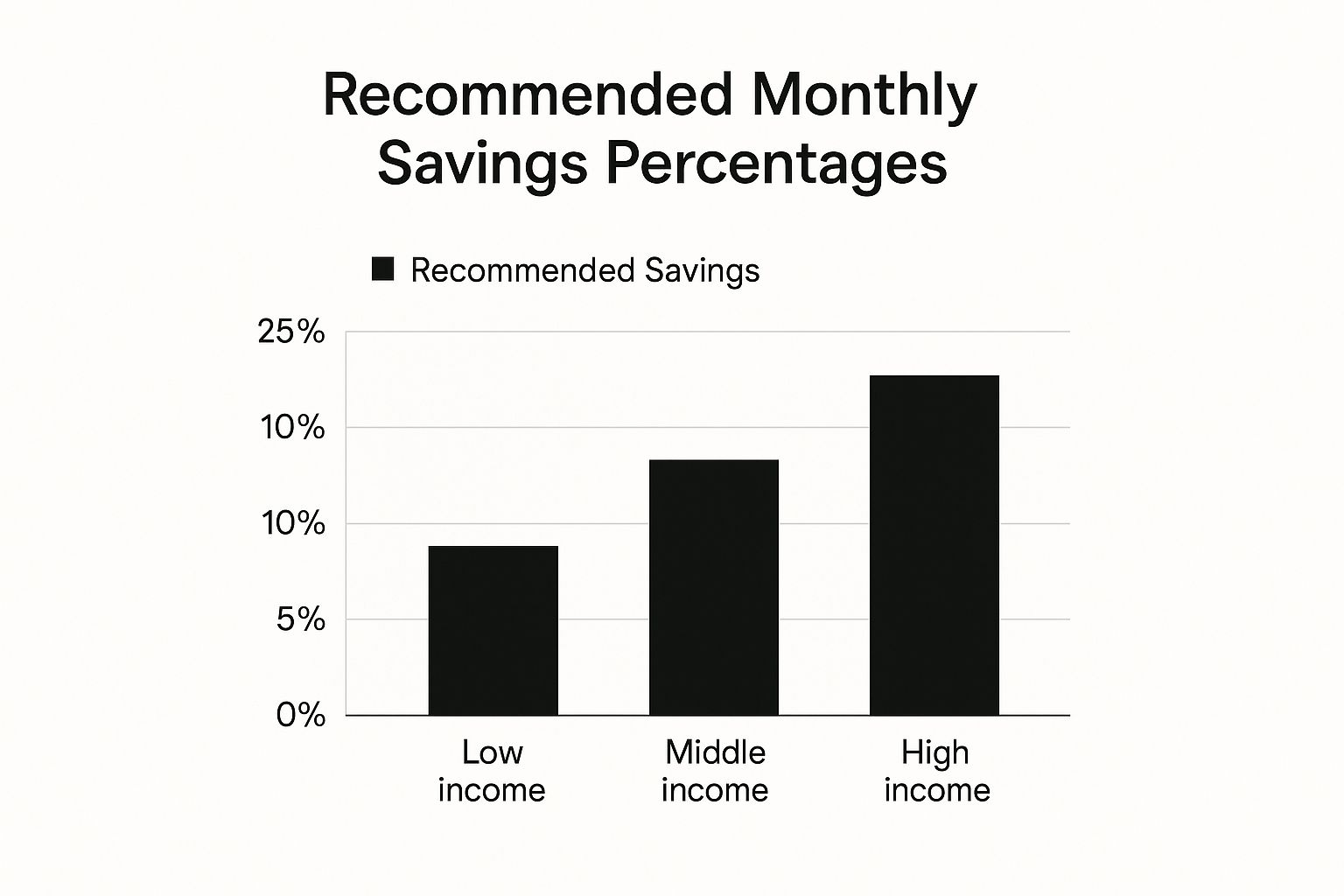
As you can see, it doesn’t matter if you’re saving 10% or 20% of your income. The real key is consistency. That's what builds the momentum you need to finally get the keys to your own place.
If those smaller down payment options sound appealing, it’s worth exploring all the avenues available. For some, there are even possibilities of an FHA loan with zero down payment. It just goes to show there’s more than one path to that front door.
Automate and Optimize Your Savings
With a clear target in sight, it's time to build the engine that actually gets you there. This is where we shift from planning to save to actively saving. The single most effective strategy I've seen over my decades of experience is making the process automatic. It’s about removing willpower from the equation.
The guiding principle here is simple: pay yourself first. This isn't just a clever saying; it’s a powerful mindset shift. Before a single dollar goes to bills, groceries, or your morning coffee, a portion of your paycheck is whisked away to your house fund.
The easiest way to make this happen? Set up an automatic transfer from your checking account to your savings account. Schedule it for the day after you get paid. The money is gone before you even see it, let alone have the chance to spend it.
Make Your Money Work For You
Where you stash your down payment savings is a bigger deal than you might think. A regular savings account is a start, but a high-yield savings account (HYSA) is a much smarter move. These are typically offered by online banks and come with interest rates that can blow traditional bank rates out of the water.
An HYSA essentially gives you a small, consistent bonus just for saving. It won’t make you wealthy overnight, but that extra interest compounds. Over time, it can easily add hundreds, or even thousands, of dollars to your fund without you doing a thing. For anyone serious about buying a home, it’s a non-negotiable step.
In my experience, keeping your house fund in a dedicated HYSA creates a powerful psychological barrier. You're far less likely to raid it for random expenses when you know it's specifically for that life-changing goal.
Trim the Fat Without Giving Up Your Life
Finding more money to save doesn't mean you have to live on ramen and cancel your social life. The key is to make smart, strategic cuts that have a big impact without making you miserable.
A quick audit of your recurring expenses can be incredibly revealing. You might be surprised by what you uncover.
- Tackle Subscription Creep: Comb through your bank statements. Are you still paying for streaming services, apps, or gym memberships you never use? Canceling just a few of these can easily free up $50 or more each month.
- Negotiate Your Bills: Once a year, make a call to your cell phone, internet, and insurance providers. A simple question like, "Are there any new promotions I qualify for?" or mentioning a competitor's price can often get your bill lowered.
- Try the 30-Day Rule: For any non-essential purchase over a set limit, maybe $100, force yourself to wait 30 days. More often than not, the initial impulse fades, and you can redirect that cash straight into your savings.
It’s these small, intentional moves that build incredible momentum. When you combine the power of automation with mindful spending, you turn the dream of homeownership into a concrete, achievable plan.
Find More Money to Accelerate Your Goal

A steady, automated savings plan is your foundation, but let's be honest—sometimes the pace feels too slow. To really get ahead of schedule, you have to actively find new sources of cash to funnel into your savings. This is where you switch from playing defense (cutting costs) to playing offense (boosting your income).
I've watched countless clients slash years off their savings timeline by picking up a side hustle. This doesn't have to mean a soul-crushing second job. The modern gig economy offers a ton of flexible options.
- Cash In on Your Skills: Are you a talented writer, a whiz with graphic design, or a master of organization? Platforms like Upwork or Fiverr let you sell those skills on your own time.
- Turn Hobbies Into Income: If you love baking, woodworking, or crafting, you could sell your creations on a marketplace like Etsy or even at local Nashville markets.
- Use What You Have: Driving for a rideshare service or delivering food are classic examples of flexible work you can fit around your life.
The trick is finding something that doesn't burn you out. Seriously, even an extra $200 a month can make a massive difference and shave a surprising amount of time off your goal.
Handling Financial Windfalls
We all get them eventually—a tax refund, a bonus at work, maybe even a small inheritance. It feels like free money, and the urge to just absorb it into your everyday budget or splurge on a vacation is powerful. This is a make-or-break moment for your savings plan.
Here’s my best advice: treat that money like it never existed for your daily spending. The second you find out it’s coming, decide that 100% of it is going straight into your high-yield savings account for the down payment. This one disciplined move can be worth months of your regular, painstaking saving.
A financial windfall is a test of your commitment. Earmarking it for your house fund before you even have a chance to spend it is a powerful move that separates serious savers from casual dreamers.
The Delicate Topic of Gift Funds
In many cultures, saving for a home isn't a solo mission—it's a family affair. Historically, the way people saved was deeply social. Research from the 1970s in Tonga, for instance, showed how families would often pool resources to help members with huge purchases like a house. While modern saving is often more individual, the tradition of family help is still very much alive. You can discover more insights about these unique reader profiles on FreeMoneyFinance.com.
Accepting a financial gift from family toward your down payment is an incredible advantage, but you have to handle it correctly. Lenders will demand a "gift letter"—a formal document signed by the giver stating the money is a true gift, not a loan that you have to repay.
This is a critical step because it proves the funds won't impact your debt-to-income ratio. It’s a simple process, but you need to be transparent with both your family and your lender. This is especially true if you are trying to qualify for one of the home loans for bad credit in Nashville, Tennessee, where lenders will examine every dollar of your financial situation.
Protect Your Savings for a Smooth Closing
https://www.youtube.com/embed/HBDK7kIQePU
You’ve done the hard work, watched the numbers climb, and finally hit your down payment goal. It’s a massive accomplishment, but from my experience helping countless buyers, the journey has one more critical phase. This is where a small misstep can cause big problems right at the finish line.
The final months before you buy are all about protection. You have to guard your hard-earned savings against any last-minute surprises or market swings. This isn't the time to chase investment returns; it's the time to lock down your funds.
Think of it this way: your down payment fund is no longer an investment. It's now cash you need to have ready and accessible. Moving those savings into a secure, liquid account like a high-yield savings account is non-negotiable. This simple move shields your money from stock market volatility, ensuring every dollar you saved is there when you need it for closing.
Don't Forget About Closing Costs
One of the biggest mistakes I see first-time homebuyers make is completely forgetting to budget for closing costs. These are the fees required to finalize your mortgage and officially transfer the property into your name. They are entirely separate from your down payment and can be a real shock if you aren't prepared.
Typically, closing costs run between 3% and 4% of the home's purchase price. So, for a $400,000 house, you could be looking at an additional $12,000 to $16,000 on top of your down payment.
These fees cover a variety of essential services, including:
- Loan Origination Fees: What the lender charges for processing your loan application.
- Appraisal Fee: Pays for a professional appraisal to confirm the home's market value.
- Title Insurance: Protects you and the lender from any claims against the property's title from the past.
- Credit Report Fees: The cost for the lender to pull your credit history.
- Underwriting Fees: Covers the lender's cost of verifying all your financial information.
The smartest way to handle this is to treat your closing costs as a separate savings goal. Once you have a good estimate of what they’ll be, start a dedicated fund for them so you don’t have to dip into your down payment.
This level of preparation is what separates a stressful, chaotic closing from a smooth, confident one. By anticipating these final expenses and protecting your primary fund, you walk into your closing day ready for anything. You've worked too hard to let a preventable surprise derail your dream at the last moment.
FAQ: Your Questions on Saving for a House Answered
Buying a home is a huge milestone, and it's completely normal to have a ton of questions along the way. I've spent decades in finance, and I've seen firsthand what trips people up. Let's tackle some of the most common questions I hear from aspiring homeowners to clear the path forward.
How much should I realistically save for a house each month?
There’s no magic number here. The right amount for you is deeply personal and depends on your income, lifestyle, and how soon you want to be a homeowner. A good starting point is the 50/30/20 budget. The idea is simple: 50% of your take-home pay covers your needs (rent, utilities), 30% goes to wants (dining out, hobbies), and 20% is dedicated to savings. Your mission is to funnel as much of that 20% chunk as you can straight into your house fund. The most practical approach is to work backward. Figure out your total down payment goal, set a realistic timeline, and then divide the total by the number of months. This gives you a monthly savings target that's challenging but actually achievable.
Is it better to use a high-yield savings account or invest my down payment?
For a goal that’s less than five years away—and a down payment almost always is—a high-yield savings account (HYSA) is my top recommendation. It all comes down to one thing: protecting your principal. Investing has the allure of higher returns, but it also comes with the very real risk of market volatility. The last thing you want is for your hard-earned down payment to drop in value right when you’re ready to make an offer. An HYSA keeps your money safe and accessible. Your funds will still grow, just at a modest and predictable rate, without any exposure to the stock market's ups and downs. This peace of mind ensures every dollar you save will be there when you need it.
Can I use my 401(k) or IRA to help buy my first home?
Technically, yes, you can. But I always tell clients to tread very carefully with this strategy. It’s a decision that can have major ripple effects on your long-term financial security. The IRS allows first-time homebuyers to withdraw up to $10,000 from a traditional IRA for a down payment, penalty-free, and many 401(k) plans offer loan options. The trade-offs are significant, though. A 401(k) loan can stall your retirement fund's growth and usually has strict repayment terms if you leave your job. Pulling from an IRA means you forfeit all the future tax-deferred growth that money would have generated. My strong advice? Talk to a trusted financial advisor to weigh the long-term consequences for your retirement before you even consider it.
How long does it take to save for a down payment on a house?
This varies dramatically based on your income, savings rate, and home prices in your target area. For a person earning the national median income and saving 10% of it, it could take anywhere from 5 to 10 years to save for a 10% down payment on a median-priced home. However, you can significantly shorten this timeline by increasing your savings rate, boosting your income with a side hustle, or exploring low-down-payment loan programs like FHA or VA loans.
What are the biggest mistakes to avoid when saving for a house?
The most common mistake is not having a specific savings goal. "Saving for a house" is too vague; you need a number. The second biggest error is keeping your savings in a checking account where it's easy to spend, or investing it in volatile assets where it could lose value. Finally, many people forget to budget for closing costs, which can be a significant expense that catches them by surprise right before they get the keys.
At ShopRates, a nationwide lender based in Nashville, TN, we believe that an informed borrower is an empowered one. Our mission is to give you the tools and expert guidance you need to tackle your home financing journey with confidence. Ready to see what mortgage options are out there for you? Explore your personalized loan options and get competitive rates with ShopRates today.


