

Essential Steps to Buying a House: Your Comprehensive Guide
Embarking on the journey to buy a home is one of life’s most significant financial milestones. Before you lose yourself scrolling through online listings, the real first step begins long before the house hunt. It’s not about finding the perfect kitchen or the biggest backyard; it’s about meticulously getting your financial house in order. As a seasoned financial expert and nationwide lender based in Nashville, TN, I’ve witnessed firsthand that the path to a smooth, successful home purchase is paved with diligent preparation.
This comprehensive guide will walk you through the essential steps: building a rock-solid financial foundation, securing a powerful mortgage pre-approval, finding an exceptional real estate agent, navigating the house hunt, making a strategic offer, and finally, crossing the finish line on closing day. Over my decades in this industry, one truth remains constant: the most successful and least stressful home purchases always start with a robust financial game plan.
Building Your Financial Foundation for Homeownership

Before you fall in love with a charming colonial or a sleek modern condo, the most critical work unfolds within your personal finances. I’ve guided countless aspiring buyers at Shop Rates, and I can tell you unequivocally: individuals who meticulously prepare their financial profile first experience the smoothest, most rewarding journey to ownership.
This preparation goes far beyond simply stashing cash away. It’s about strategically positioning yourself to be an ideal candidate in the eyes of any lender. A strong financial footing provides incredible leverage, translating directly into better loan options, lower interest rates, and significantly more negotiating power when you finally find “the one.”
Strengthen Your Credit Score
Your credit score is the first metric any lender scrutinizes. It’s a numerical representation of your financial reliability. A higher score, especially one 740 or above, is your golden ticket to the most competitive mortgage rates available. The difference in interest rate between a good score and an excellent score can save you tens of thousands of dollars over the life of your loan.
Begin by obtaining your credit reports from all three major bureaus: Equifax, Experian, and TransUnion. You are entitled to a free report from each annually. Scrutinize these reports for any errors, such as incorrectly reported late payments or accounts you don’t recognize. Disputing inaccuracies is your right, and successfully removing them can provide a tangible boost to your score.
Expert Tip: The single most effective way to improve your score is unwavering consistency: pay every bill on time, every single time. Your payment history is the most heavily weighted factor in your credit score, and even a single late payment can leave a lasting mark.
Master Your Debt-to-Income Ratio
Immediately after your credit score, lenders analyze your Debt-to-Income (DTI) ratio. This simple yet critical calculation reveals the percentage of your gross monthly income that is allocated to your existing monthly debt payments. For lenders, it’s a primary indicator of your capacity to comfortably manage a new mortgage payment without financial strain.
As a general rule, lenders prefer to see a DTI of 43% or less, including your potential new housing payment. To calculate yours, sum up all your monthly debt obligations (car loans, student loans, minimum credit card payments) and divide that total by your gross monthly income.
If your DTI is elevated, the most effective strategy is to aggressively pay down debt—prioritizing high-interest credit cards—before you begin the mortgage application process. While specialized funding options exist for unique circumstances, such as hard money loans in Alhambra, California for investors needing rapid closes, any individual seeking a conventional mortgage should make achieving a low DTI their foremost priority.
Understand Global Market Realities
The path to homeownership doesn’t exist in a vacuum; it is profoundly influenced by broader economic forces. The global housing market has shown surprising resilience, with home prices rising while mortgage delinquency rates remain low—a signal that homeowners are, by and large, managing their payments effectively.
In 2024, many central banks have begun to lower interest rates, a move that could enhance borrowing affordability and attract more buyers to the market. However, the flip side is that global house prices have been appreciating at an annual rate of approximately 3.3% to 3.6%. This trend highlights a crucial point: while lower rates may improve affordability on a monthly basis, appreciating home prices mean your financial preparedness and down payment savings are more critical than ever.
Getting a Powerful Mortgage Pre-Approval
Once your financial house is in impeccable order, the next pivotal move is to secure a mortgage pre-approval. This isn’t merely a friendly suggestion; in today’s competitive market, it is an absolute necessity. A pre-approval letter from a reputable lender like us at Shop Rates instantly elevates your status from a casual browser to a serious, credible buyer in the eyes of both real estate agents and sellers.
Consider this: a pre-approval is a conditional commitment from a lender, stating they will loan you a specific amount, contingent upon the property meeting their appraisal and title requirements. It proves to all parties involved that you possess the financial capacity to stand behind your offer, giving you a decisive advantage when multiple bids are on the table.
Pre-Approval vs. Pre-Qualification
It is critically important to understand the profound difference between pre-qualification and pre-approval. While they sound similar, they represent vastly different levels of financial scrutiny and credibility.
- Pre-qualification: This is a superficial, informal estimate of your potential borrowing power. It is based solely on the financial figures you provide, with absolutely no verification. It is a ballpark estimate, not a firm commitment.
- Pre-approval: This is the authentic, rigorous process. It involves a comprehensive underwriting review of your financial history, where we analyze your income, assets, and debts. We verify every detail with official documentation, culminating in a conditional commitment to lend.
Walking into a property viewing with a pre-approval letter empowers you to make a confident, decisive offer on the spot. It signals to the seller that you are a serious contender, not just an exploratory window shopper.
A Lender’s Insight: I have seen this scenario play out countless times: a buyer with a rock-solid pre-approval letter wins the property over a slightly higher offer from a buyer who lacks one. Sellers value certainty above all else, and a pre-approval is the strongest form of financial certainty a buyer can provide.
Gathering Your Financial Documents
To secure that powerful pre-approval, you must provide a transparent view of your financial life to your lender. This isn’t an exercise in intrusion; it’s a necessary due diligence process to ensure the loan is a sustainable and comfortable fit for your financial future. Having these documents organized and ready will significantly accelerate the process.
Be prepared to provide:
- Proof of Income: Typically, this includes your most recent pay stubs covering a 30-day period, along with your W-2s from the past two years.
- Tax Returns: We will need to review your complete federal tax returns for the last two years.
- Bank Statements: Have statements from the last two to three months ready for all checking, savings, and investment accounts.
- Debt Information: Compile a comprehensive list of all your monthly debt payments, including car loans, student loans, and credit card statements.
While this is the standard protocol for most conventional loans, some buyers may explore alternative financing. For those in unique investment scenarios, it can be beneficial to review a guide to collateral-based financing. Nevertheless, for the overwhelming majority of aspiring homeowners, a traditional pre-approval is the clearest and most effective path to success.
With a strong mortgage pre-approval secured, you’re ready for the exhilarating phase of the journey: finding your future home. But before you start bookmarking listings and scheduling tours, it is critical to recognize that buying a home is a team sport. You are the captain, but you need skilled, experienced players on your side to expertly navigate the market and secure a winning deal.

Your most valuable player, without question, will be a top-tier real estate agent. This is not the moment to engage a friend-of-a-friend or a part-time relative. You need a dedicated, full-time professional who lives, breathes, and has a deep-seated understanding of the specific neighborhoods you are targeting.
The right agent does far more than unlock doors. They are your strategic advisor, your chief negotiator, and your repository of local market intelligence. Having walked through hundreds of homes, they can spot potential red flags—a subtle slope in the floor, faint signs of old water damage—that an untrained eye would completely miss. A great agent listens intently to your goals and provides candid, honest feedback, even if it means advising you against purchasing a house that isn’t the right long-term fit.
Finding Your Ideal Real Estate Agent
Selecting the right agent is one of the most consequential decisions you will make in this process. An ineffective agent can cost you time, money, and potentially your dream home.
Make it a priority to interview at least three different agents. Ask them targeted questions about their specific experience within your price range and the precise areas you’re considering. A proficient agent should be able to instantly pull up data on recent comparable sales and market trends, demonstrating their expertise without hesitation.
Here’s what you should be screening for:
- Hyper-Local Expertise: They should possess an intimate knowledge of the streets, schools, and the unique character of each neighborhood on your list.
- Clear Communication: A great agent is consistently responsive and keeps you informed at every stage. You should never feel left in the dark.
- Proven Negotiation Skills: Ask for concrete examples of how they have successfully negotiated favorable terms for past clients. This skill is invaluable when it’s time to make an offer.
- A Solid Network: The best agents have a curated list of trusted professionals—from home inspectors to contractors—which can become a massive asset during and after the transaction.
Transforming Your Wish List into a Search Strategy
Now, let’s translate that dream-home wish list into a pragmatic, real-world search strategy. It is incredibly easy to become distracted by cosmetic features like shiny new kitchens or perfectly staged living rooms. Your task is to look beyond the surface and evaluate a property’s core, unchangeable attributes.
My Personal Framework: I always advise clients to focus on the “Three L’s” of a property: Location, Layout, and Lot. These are the fundamental elements you cannot easily change. Paint colors, light fixtures, and flooring are relatively simple and inexpensive to update. You cannot, however, pick up the house and move it to a better school district or rectify a dysfunctional floor plan without a major, costly renovation.
As you commence your search, leverage online tools like Zillow or Redfin to get a sense of the market, but rely on your agent’s expert guidance to interpret what you’re seeing. When you visit properties, don’t just wander through aimlessly. Approach each visit with a clear mission.
- Look for tell-tale signs of deferred maintenance, such as water stains on the ceiling or cracks in the foundation.
- Pay close attention to the home’s orientation on the lot. Does it receive ample natural light throughout the day?
- Drive through the neighborhood at various times. Is it quiet at night? What is the commute truly like during peak rush hour?
This disciplined, strategic approach will empower you to cut through the noise and identify a home that genuinely fits your lifestyle, not just one that looks appealing in photographs.
You’ve analyzed dozens of listings, walked through numerous homes, and finally, you’ve found it—the one that feels right. This is where the tactical work begins. Crafting a compelling offer is an art form, a delicate balance of demonstrating your seriousness as a buyer without overpaying.
At Shop Rates, we guide buyers through this critical stage daily. A winning offer is about so much more than the price; it encompasses a suite of contingencies designed to protect you and what is likely the largest investment of your life. A well-structured offer doesn’t just present a number—it tells a story to the seller that you are an enthusiastic, prepared, and highly qualified buyer.
Crafting a Winning Offer
Think of your offer as a formal, strategic proposal. Your real estate agent is your most valuable asset here, combining the power of your pre-approval with their deep local market insights to formulate a strong, competitive price.
A winning offer is constructed from several core components:
- Offer Price: This is the headline number, but it must be backed by a solid strategy. Your agent will conduct a comparative market analysis (CMA) using “comps” (recently sold comparable properties) to justify your price and demonstrate to the seller that your offer is data-driven.
- Financing Contingency: This is your essential safety net. This clause permits you to withdraw from the contract without penalty if, for some unforeseen reason, your mortgage financing does not receive final approval. With a strong pre-approval, this contingency signals to sellers that your financing is a near certainty.
- Inspection Contingency: This provides you with a defined period—typically 7-14 days—to hire a professional home inspector and conduct any other necessary specialized inspections (e.g., for radon, pests, or structural issues). It’s your opportunity to perform thorough due diligence.
- Appraisal Contingency: This protects you if the bank’s official appraisal values the home for less than your agreed-upon offer price. It grants you the ability to renegotiate with the seller or walk away, rather than being forced to cover the gap out of pocket.
- Earnest Money Deposit: This is your “skin in the game.” It is a good-faith deposit, usually 1-3% of the sale price, submitted when the purchase agreement is signed. It proves your commitment to completing the transaction.
A Note From My Experience: I have seen strong offers with a slightly lower price beat out higher offers simply because they had fewer contingencies and were accompanied by a compelling personal letter to the seller. Sometimes, connecting on a human level can be the secret weapon that seals the deal.
The Critical Due Diligence Period
Once the seller accepts your offer, the clock starts on your due diligence period. This is your non-negotiable window to learn everything you possibly can about the property’s physical condition before you are legally obligated to purchase it. Whatever you do, do not rush this phase. This is one of the most crucial steps in buying a house.
Your top priority is the professional home inspection. A thorough inspector will scrutinize everything from the foundation to the roof, providing you with a detailed report. Do not be alarmed if the report is lengthy; no home is perfect, not even new construction. The objective is to identify any major “deal-breaker” issues—such as a failing HVAC system, evidence of structural problems, or an old roof at the end of its lifespan.
This period is also when you’ll negotiate any necessary repairs with the seller. You might request they fix specific items or, more commonly, provide a credit at closing so you can hire your own contractors to perform the work. This is another moment where a skilled agent proves their immense value, helping you negotiate from a position of strength and knowledge.
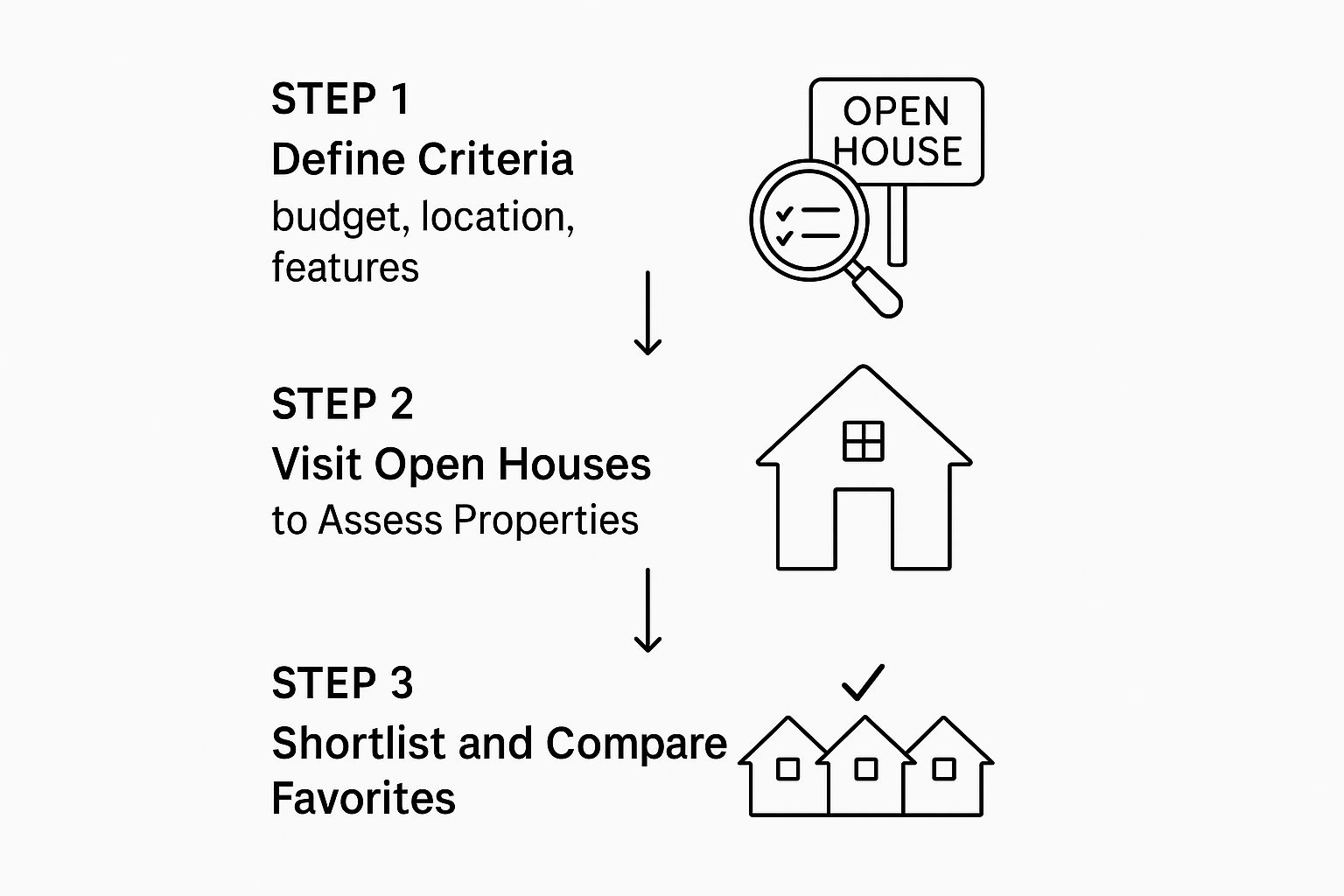
The image above perfectly illustrates how all the initial preparatory work—defining your needs and actively searching—culminates at this crucial juncture, positioning you to make an informed and confident offer.
To help you stay organized during this fast-paced period, here’s a checklist of what to focus on.
Home Buying Due Diligence Checklist
This table summarizes the key checkpoints during the offer and inspection phase. Think of it as your roadmap to ensure no stone is left unturned.
| Phase | Key Action | Expert Tip |
|---|---|---|
| Offer | Determine offer price based on comps. | Don’t just focus on the list price. Your agent’s analysis of recent sales provides the most accurate guide to a property’s true market value. |
| Offer | Define contingencies (financing, inspection, appraisal). | A “cleaner” offer with fewer contingencies is more appealing to sellers, but never waive protections you aren’t 100% comfortable forgoing. |
| Inspection | Schedule a professional home inspection immediately. | Attend the inspection if possible. Walking through the property with the inspector provides invaluable context that a written report alone cannot convey. |
| Inspection | Review the inspection report for major issues. | Concentrate on structural, safety, and major system issues (roof, HVAC, plumbing, electrical). Minor cosmetic flaws are not typically negotiation points. |
| Negotiation | Request repairs or credits from the seller. | Asking for a closing cost credit is often simpler and gives you complete control over the quality of the repair work after you take possession. |
| Final Walk-Through | Verify agreed-upon repairs are complete. | A day or two before closing, walk the property one last time to ensure everything is in the agreed-upon condition and no new issues have arisen. |
Diligently managing these items ensures you’re making a sound investment, not just buying a property, but acquiring it with full awareness of its condition.
Understanding Current Market Dynamics
Successfully navigating this process requires keeping a keen eye on the macroeconomic landscape. The U.S. housing market remains a complex and dynamic environment. While home price growth is projected to be modest at 3% or less for the year due to more cautious buyers and tight inventory, the complete story is more nuanced.
Interestingly, the supply of new homes for sale recently reached its highest level since 2007. However, the overall inventory of existing homes—which constitutes the vast majority of the market—is still 20% to 30% below historical norms. This inventory squeeze means that even in a generally cooling market, buyers in desirable locations must often act with speed and decisiveness to secure a home. You can learn more about how these supply metrics affect the housing market to stay ahead of the curve.
From Final Underwriting to Closing Day

You have successfully navigated the intricate dance of offers and inspections, and the finish line is finally in sight. This last leg of the journey—from final underwriting to closing day—can feel like a whirlwind of documentation and deadlines. At Shop Rates, we guide clients through this final phase every day, ensuring every detail is meticulously managed so you can arrive at the closing table with confidence, not confusion.
The first major hurdle is the final mortgage underwriting. This is where the lender’s underwriter conducts one last, deep dive into your entire loan file. They will meticulously review your income, assets, debt, the property appraisal, and title report, verifying every single piece of information before issuing the final “clear to close.”
Do not be alarmed if the underwriter surfaces with a last-minute request for an additional document, such as your most recent pay stub or an updated bank statement. This is a normal part of the process. The key is to respond with urgency to keep the transaction on schedule. A one-day delay in providing a document can easily push your closing date back by several days.
Securing Insurance and Reviewing the Title
While the underwriter is completing their review, you have a couple of critical tasks to manage.
First, you must secure a homeowner’s insurance policy. Lenders require proof of an active insurance policy before they will fund your loan. Take the time to shop around and compare quotes to find a policy that provides the coverage you need at a competitive price.
Second, you will receive the results of the title search. A title company performs this comprehensive search to confirm that the seller has the legal right to transfer ownership and to ensure there are no outstanding liens or claims against the property. Review this report carefully with your real estate agent or attorney to address any potential issues.
Expert Insight: Think of the title search as a comprehensive background check on the property itself. It uncovers the home’s legal history, protecting you from future claims against your ownership. Overlooking its importance is a risk you simply cannot afford to take.
Understanding Your Closing Disclosure
Approximately three business days before your scheduled closing, you will receive a legally mandated document: the Closing Disclosure (CD). Federal law requires that you have this document in your possession for a minimum of three days to review before you are permitted to sign your final loan documents.
The CD provides a detailed, itemized breakdown of all the final costs associated with your loan. Compare it, line by line, against the Loan Estimate you received at the beginning of the process. If you notice any significant discrepancies or have a question about a specific fee, you must contact your lender for clarification immediately.
This is your final opportunity to ensure every number is accurate. It’s a vital step, and even for those exploring unconventional financing, the details are paramount. While understanding alternative options like hard money loans in Covina, California can offer a broader perspective on lending, the Closing Disclosure is a standard and non-negotiable part of virtually every home purchase.
Common Questions About the Home Buying Process
Over my decades in the lending industry, I’ve heard just about every question imaginable from aspiring homeowners. The path to buying a house can feel like a maze, but getting clear, direct answers makes the whole journey a lot less stressful.
Here at Shop Rates, I’m tackling some of the most frequent questions we get. My goal is to cut through the jargon and give you straightforward advice based on years of hands-on experience, so you can move forward with confidence.
How Long Does It Usually Take To Buy A House?
This is usually the first thing people ask, and the honest-to-goodness answer is: it varies.
Once you have an accepted offer on a home, the closing process itself—the part involving the lender, appraisal, and legal paperwork—typically takes anywhere from 30 to 60 days. That’s the standard window for underwriting, the appraisal, title search, and getting all the final documents signed.
But the part you control, the actual house hunt, is a real wildcard. It could be a few weeks or it could stretch into several months. It all depends on what’s available in your local market, how specific your wish list is, and how ready you are to jump on the right property when you see it.
What Is The Difference Between Pre-Qualified and Pre-Approved?
Getting this right is one of the most vital steps in the home buying process. A pre-qualification is really just a rough, informal guess of what you might be able to borrow. It’s based entirely on the financial numbers you provide yourself, without any verification. Think of it as a quick first look.
A pre-approval, on the other hand, is a game-changer. It means a lender like us has dug in and thoroughly reviewed your financial documents—your income, your assets, your credit, and your debts. It’s a conditional commitment from us to lend you a specific amount of money.
Sellers and their agents take pre-approvals far more seriously because it’s proof that you’re a legitimate, vetted buyer ready to make a serious move.
Expert Takeaway: In a hot market, an offer from a pre-approved buyer will almost always beat an offer from a buyer who is only pre-qualified, even if the pre-qualified offer is slightly higher. Sellers crave certainty, and a pre-approval provides it.
How Much Do I Really Need For A Down Payment?
The old myth that you absolutely must have a 20% down payment is what keeps way too many would-be buyers renting. While putting down 20% is fantastic because it lets you avoid private mortgage insurance (PMI), it’s definitely not a hard-and-fast rule.
There are many fantastic loan programs that require much, much less.
- Conventional Loans: You can often get into a home with as little as 3% to 5% down if you qualify.
- FHA Loans: These government-backed loans are a popular choice, requiring just a 3.5% down payment.
- VA and USDA Loans: For eligible veterans and those buying in qualified rural areas, these amazing programs may require 0% down.
Why Is The Current Housing Supply So Important?
Keeping an eye on market dynamics is crucial because it directly hits your wallet. A huge factor driving the market today is the major global housing shortage. Across key developed economies, there’s a staggering deficit of about 6.5 million housing units needed to meet today’s demand.
This imbalance has ignited a serious affordability crisis, making homeownership a tough goal in many major cities. It’s pushed more than 80% of households in these areas to rent instead of buy. For you, the homebuyer, this translates to more competition for fewer homes and steady upward pressure on prices. It makes your financial preparation more critical than ever. You can discover more insights about the global housing shortage and its far-reaching effects.
At Shop Rates, we’re here to help you navigate every single step of the home buying process with clarity and confidence. From finding the perfect mortgage to understanding the market, our team is ready to provide the expert guidance you need. Explore your personalized loan options with us today!


