
What Is a Non-QM Loan and Who Can Benefit From It?
A non-QM loan is a mortgage meticulously designed for creditworthy borrowers whose financial lives don't neatly fit the standard W-2 mold. It offers a more flexible, common-sense path to homeownership for individuals like entrepreneurs, real estate investors, and gig economy professionals by leveraging alternative methods to verify their clear ability to repay.
Your Path to Homeownership Beyond W-2s

If a traditional mortgage application feels like trying to fit a square peg into a round hole, you're not alone. Here at Shop Rates, based right here in Nashville, TN, we work with countless successful Americans who earn their income in ways that simply don't align with the rigid paperwork demanded by conventional lenders. This is precisely where a non-qualified mortgage (non-QM loan) creates a real opportunity.
Think of it as a custom-tailored financial solution. Instead of relying exclusively on tax returns and pay stubs, which can be misleading for business owners, lenders like us can examine other powerful evidence of your financial strength to gain a true, comprehensive picture of your finances.
Who Truly Benefits from This Flexibility?
This practical approach to underwriting opens doors for a broad spectrum of strong borrowers who might otherwise be unjustly overlooked. We see firsthand how these loans empower individuals who are perfectly capable of managing a mortgage but are disqualified by outdated, one-size-fits-all requirements.
- Self-Employed Professionals: Freelancers, consultants, and business owners frequently have substantial income that isn't accurately reflected on tax returns due to legitimate business write-offs. Our team can help you navigate the best home loan options for your unique self-employed status.
- Real Estate Investors: Individuals who derive their living from rental income can use a property's cash flow to qualify, a far more relevant metric than their personal W-2 income.
- Gig Economy Workers: Drivers, designers, and other contract workers with fluctuating yet significant earnings can showcase their true financial capacity, not just what a single, unrepresentative pay stub indicates.
This isn't about loosening standards; it's about applying smarter, more relevant standards. The goal is to provide a viable pathway to homeownership for creditworthy individuals who build their wealth outside the confines of a traditional 9-to-5 job.
To put it simply, non-QM loans are designed for borrowers who don’t fit into the strict regulatory box of Qualified Mortgages but can still unequivocally demonstrate their ability to repay a loan. Unlike some of the high-risk products seen before the 2008 financial crisis, today's non-QM loans must adhere to the Consumer Financial Protection Bureau's Ability-To-Repay (ATR) rule, which mandates thorough verification of your financial standing.
For a more granular look into what lenders scrutinize, this comprehensive guide to non-QM loan requirements can further illuminate the process.
Qualified Mortgage (QM) vs. Non-Qualified Mortgage (Non-QM) at a Glance
To truly grasp where non-QM loans fit into the lending landscape, it's helpful to see them side-by-side with their traditional counterparts. This table distills the core differences in a straightforward manner.
| Feature | Qualified Mortgage (QM) | Non-Qualified Mortgage (Non-QM) |
|---|---|---|
| Income Verification | Strict reliance on W-2s, tax returns, and pay stubs. | Flexible; uses bank statements, asset depletion, or property cash flow. |
| Borrower Profile | Primarily traditional employees with steady, documented income. | Self-employed individuals, investors, gig workers, and foreign nationals. |
| DTI Ratio | Typically capped at 43%. | More flexible; often accommodates higher DTI ratios based on compensating factors. |
| Loan Features | Prohibits risky features like interest-only periods or negative amortization. | Can include features like interest-only periods to meet specific financial strategies. |
| Regulation | Meets strict CFPB Ability-to-Repay (ATR) requirements. | Still must meet the ATR rule, but with greater underwriting freedom. |
Essentially, while QM loans follow a very rigid, standardized script, non-QM loans empower lenders to consider the whole story, providing a much-needed solution for financially sound borrowers with unconventional income streams.
Why Non-QM Loans Are Not Subprime Loans

Let’s clear the air on a pervasive and damaging misconception: a non-QM loan is not a subprime loan. The shadow of the 2008 financial crisis lingers, and for good reason. However, it's absolutely critical to understand how today's mortgage landscape is fundamentally different—and immeasurably safer for everyone involved.
The term "subprime" became infamous for loans issued with little to no income verification, often to borrowers with poor credit histories. It was a formula for financial collapse. In response, regulators created a new, safer standard called the Qualified Mortgage (QM) rule. This rule built a strict, standardized box for verifying a borrower’s income and ability to pay, primarily using W-2s and tax returns.
The Modern Safety Net: The Ability-to-Repay Rule
Think of a QM loan as an off-the-rack suit. It fits a lot of people perfectly, but it was never designed to fit everyone. Today’s dynamic economy is filled with successful, creditworthy individuals who simply cannot prove their income with a neat and tidy pay stub. This is where non-QM loans enter the picture—not as a riskier alternative, but as a more flexible and intelligent one.
The single most important distinction is that every non-QM loan, without exception, must comply with the federal Ability-to-Repay (ATR) rule. This is not a suggestion; it is the law.
The ATR rule legally mandates that lenders like us at Shop Rates make a good-faith determination that you have the financial capacity to repay your mortgage. It's about utilizing different documentation, not inferior standards.
This means a non-QM lender still performs a rigorous, meticulous analysis of your finances. We just employ different, more appropriate tools to accomplish the task.
Different Paperwork, Not Different Standards
Instead of requesting tax returns from a business owner that have been minimized by legitimate write-offs, we can use 12 or 24 months of bank statements to see their actual cash flow. For a seasoned real estate investor, we can evaluate a property's potential rental income instead of just their personal W-2.
Here’s how the focus has completely shifted from the past:
- Subprime (Pre-2008): Often focused on the property's value with minimal regard for whether the borrower could actually make the payments. Verification was lax, if it occurred at all.
- Non-QM (Today): Entirely focused on the borrower's proven ability to repay the loan. This is supported by thorough documentation, just in a non-traditional format that reflects modern earning realities.
A non-QM loan isn't a shortcut around the rules. It is a distinct, fully regulated pathway designed for the financial realities of today's entrepreneurs, investors, and freelance professionals. It provides a vital, safe, and sound solution for those who build their success outside the lines of a traditional 9-to-5 job.
Who Is the Ideal Candidate for a Non-QM Loan?

This is where the true value of non-QM lending becomes clear. We've discussed the mechanics, but let's move beyond definitions and meet the actual people who benefit most from this type of flexible financing.
Think of them as creditworthy individuals whose success stories are written in their bank statements and business ledgers, not just on a W-2 form.
For example, imagine a freelance web developer who recently landed several major contracts. Her monthly income is fantastic but fluctuates, making last year's tax returns an outdated and inaccurate snapshot of her current financial reality. For her, a bank statement loan tells a much truer—and more compelling—story about her capacity to handle a mortgage.
Or, consider a savvy real estate investor. On paper, his personal taxable income appears modest because of smart, legal write-offs like depreciation on his rental portfolio. Yet those same properties are generating a significant, reliable stream of cash flow every single month. A traditional loan might completely miss that vital detail, but a non-QM loan is specifically built to see it.
Beyond Entrepreneurs and Investors
The flexibility of non-QM lending doesn't stop there. It extends to several other groups who find conventional mortgage requirements far too rigid. Each of these scenarios highlights a specific challenge that a non-QM loan can solve with a practical, common-sense approach.
- Individuals Recovering from a Credit Event: Life is unpredictable. A past bankruptcy, foreclosure, or short sale—often termed a "credit event"—can automatically disqualify someone from a QM loan for years, even if their financial life is completely back on track. A non-QM loan can offer a second chance to responsible borrowers who have done the hard work of rebuilding their financial standing.
- Foreign Nationals: Buyers from other countries looking to invest in U.S. property often lack a U.S. credit history or a Social Security number. Specialized non-QM products like ITIN loans are designed specifically to help them secure financing.
- Gig Economy Professionals: From rideshare drivers to freelance writers, millions of Americans now assemble their income from multiple sources. A non-QM loan can aggregate all those varied income streams to paint a clear, understandable financial picture for a lender.
At its core, a non-QM loan serves the borrower whose financial life doesn't fit neatly into a standardized box. It's for the financially sound individual who needs a lender to look at their complete story, not just a few specific documents.
The rise of non-QM loans is directly linked to the explosion in non-traditional work and a modern borrower landscape that conventional underwriting often struggles to comprehend. These loans give lenders the tools to assess real cash flow from diverse sources—like self-employment income or rental properties—without having to rely solely on tax returns. This is a game-changer for countless deserving borrowers. You can find out more about how borrowers are choosing non-QM loans and why this trend continues to gain momentum.
Exploring Different Types of Non-QM Loan Products
The term "non-QM loan" isn't a single, monolithic product. It’s more accurate to think of it as a specialized toolbox, with each tool meticulously crafted for a specific financial situation. Understanding what’s inside this toolbox is the key to identifying the right solution for your unique homeownership goals.
At Shop Rates, we help borrowers open this toolbox every day. We find that once people see the different options available, they realize a path to financing they thought was closed is actually wide open. Let's examine some of the most common and effective non-QM loan products on the market.
Bank Statement Loans for Entrepreneurs
For self-employed individuals, freelancers, and small business owners, the Bank Statement Loan is often the perfect instrument. Traditional lenders live and die by tax returns, but entrepreneurs are experts at minimizing their taxable income through legitimate business expenses and write-offs. While that’s a brilliant strategy for tax season, it can make it challenging to show the true, consistent cash flow their business actually generates.
A Bank Statement Loan resolves this problem by analyzing 12 to 24 months of your personal or business bank statements. Lenders carefully analyze your deposits to calculate a qualifying monthly income, giving them a real-world picture of your financial health. This method acknowledges your actual earnings, not just what remains after deductions.
DSCR Loans for Real Estate Investors
Real estate investors often encounter a similar roadblock with personal income documentation. A Debt Service Coverage Ratio (DSCR) Loan is specifically engineered to bypass this issue entirely. This loan is an absolute game-changer for investors seeking to expand their portfolios.
Instead of scrutinizing your personal tax returns or pay stubs, a DSCR loan qualifies you based on the investment property's cash flow. The lender simply verifies that the property's projected rental income is sufficient to cover the new mortgage payment and other expenses. If the property can pay for itself, your personal income doesn't even enter the equation.
You can learn more about the specifics in our detailed guide on what a DSCR loan is and how it works for rental property investors.
The infographic below illustrates the core pillars of non-QM loan eligibility, highlighting the flexible approaches lenders take toward income, credit, and debt.
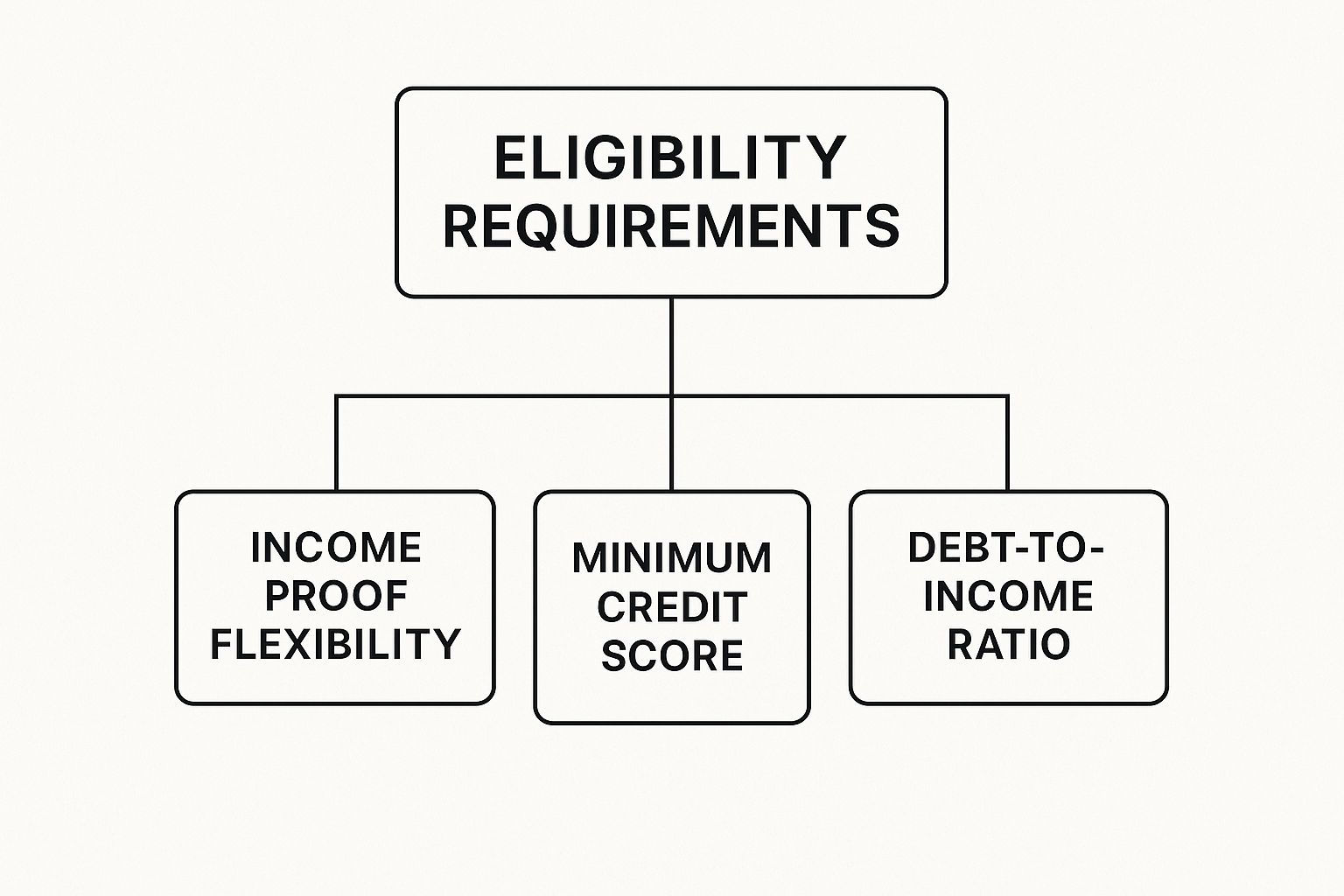
As you can see, flexibility in income verification is the central advantage, supported by more forgiving standards for credit and DTI.
The non-QM space is filled with creative solutions designed to match specific borrower profiles with the right kind of financing. The table below breaks down some of the most common loan types and shows who they're built to help.
Common Non-QM Loan Types and Their Best Use Cases
| Non-QM Loan Type | Primary Income Verification Method | Ideal Borrower Profile |
|---|---|---|
| Bank Statement Loan | Analysis of 12-24 months of bank deposits | Self-employed borrowers, freelancers, and small business owners with high cash flow but low taxable income. |
| DSCR Loan | Property's projected rental income | Real estate investors whose property cash flow covers the mortgage, regardless of personal income. |
| Asset Depletion Loan | Calculation of income from liquid assets | Borrowers with high net worth (stocks, bonds, retirement funds) but low documented monthly income. |
| Interest-Only Loan | Traditional or alternative documentation | Borrowers who want a lower initial payment for a set period, often investors or those expecting future income growth. |
This table clearly highlights how non-QM lenders have moved beyond the one-size-fits-all approach of traditional mortgages to serve a much broader range of qualified, creditworthy borrowers.
Other Specialized Non-QM Solutions
Beyond those popular options, the non-QM toolbox contains even more specialized solutions.
- Asset Depletion or Asset-Based Loans: These are ideal for borrowers with significant liquid assets (like stocks, bonds, or retirement accounts) but lower documented monthly income. Lenders calculate a qualifying income by "depleting" a portion of these assets over the loan term.
- Interest-Only Loans: This option provides serious payment flexibility by allowing you to pay only the interest on the loan for a set period, typically the first 5 to 10 years. This results in a much lower initial monthly payment, which can be a strategic choice for investors or those anticipating a significant income increase in the near future.
By understanding these different products, you can see how non-QM loans offer practical solutions for almost any creditworthy borrower who doesn't fit neatly into the traditional lending box.
Weighing the Pros and Cons of Non-QM Financing
Making an informed financial decision means looking at the whole picture, not just the highlights. Here at Shop Rates, we believe in being completely transparent about how different financing options work. The biggest advantage of a non-QM loan is simple and powerful: it opens the door to financing for solid, creditworthy borrowers who just don't fit into the narrow box of traditional income verification.
However, that kind of flexibility comes with its own set of trade-offs. It is crucial to examine both sides of the coin before making a decision. Our goal is to provide the clarity you need to make the right strategic move for your unique financial journey.
The Upside: Real Flexibility When You Need It Most
The game-changing advantage here is the ability to use different kinds of documents to prove you can handle the loan. This single feature brings homeownership within reach for countless people who are otherwise locked out of the conventional mortgage market.
- Access for Modern Earners: It creates a viable path forward for self-employed entrepreneurs, seasoned real estate investors, and anyone thriving in the gig economy.
- Underwriting That Makes Sense: Lenders get to evaluate your actual cash flow through bank statements or assess a property's income potential. This often paints a much more accurate picture of your financial health than a W-2 or a tax return ever could.
- Custom-Fit Solutions: It’s less of a one-size-fits-all product and more of a financial toolkit. This includes options like the non-traditional home loans we specialize in, designed for unique financial situations.
The Trade-Offs: What to Keep in Mind
This flexibility means lenders are stepping outside the standardized, government-backed safety net, which naturally results in different terms.
Think of a non-QM loan as a strategic financial tool. Understanding the costs lets you use it effectively, often as a way to secure a property now with a plan to refinance into a conventional loan down the road.
Here are the key factors to consider:
- Potentially Higher Interest Rates: To account for the more hands-on, customized underwriting process, non-QM loans often carry slightly higher interest rates than their conventional counterparts.
- Larger Down Payments: Lenders typically require a larger down payment to balance their risk, often in the 10% to 20% range, and sometimes more depending on the specific scenario.
- Possible Prepayment Penalties: Some non-QM products may include a prepayment penalty. This is a fee you would pay if you decide to pay off or refinance the loan within the first few years.
As the workforce continues to evolve, more people are recognizing the value in this kind of flexible income verification. In fact, the non-QM market recently hit a record 8% of all mortgage rate locks. This trend is being driven by lenders who are becoming more comfortable with alternative documentation as they adapt to the modern borrower. This balanced perspective should give you the confidence to decide if this path is the right one for you.
Frequently Asked Questions About Non-QM Loans
Stepping off the beaten path of conventional financing naturally brings up important questions. It's smart to be thorough. To provide you with the clarity you need, we've compiled answers to the most common questions we hear from clients at our Nashville office of Shop Rates about non-QM loans. Think of this as your straightforward, no-fluff guide to understanding precisely what a non-QM loan is and, more importantly, what it can do for you.
Are Non-QM Loans Just a New Name for Subprime Loans?
No, not at all. In fact, they are fundamentally different. The term "subprime" instantly recalls the reckless lending practices before the 2008 financial crisis, where income and asset verification were often minimal or ignored. Today, every single non-QM loan is legally bound by the Ability-to-Repay (ATR) rule. This is a critical federal regulation from the Consumer Financial Protection Bureau (CFPB) that requires lenders to make a solid, good-faith effort to confirm you can actually afford to repay the loan. While the documentation for a non-QM loan is more flexible—using bank statements instead of W-2s, for example—the underwriting process itself remains incredibly thorough. It’s not about cutting corners or lowering standards; it’s about using the right documentation for your unique financial story.
Will I Get Stuck With a Sky-High Interest Rate?
It’s true that non-QM loans often have slightly higher interest rates than their conventional QM counterparts. This small premium compensates the lender for the flexibility and the hands-on, manual underwriting that occurs outside the strict Fannie Mae and Freddie Mac framework. However, "slightly higher" does not mean unreasonable. The rate you're offered will depend on several key factors: your credit score, the size of your down payment, the specific type of non-QM loan you're using, and your overall financial profile, including cash reserves. For many borrowers, paying a little more in interest is an excellent trade-off for the opportunity to purchase a home they would otherwise be locked out of. It is essential to compare offers from lenders who specialize in the non-QM space to ensure you secure the best possible terms for your situation.
Can I Refinance a Non-QM Loan Into a Conventional One Later On?
Absolutely, and this is a prudent strategy we see successful borrowers use all the time. Many individuals use a non-QM loan as a "bridge" to get into their dream home now, with a clear plan to transition to a conventional loan down the road. Think of a non-QM loan as your entry ticket into the real estate market. It gets your foot in the door today, so you can refinance into a traditional loan once your financial paperwork aligns with conventional standards. For instance, a freelance graphic designer might use a bank statement loan to buy a house. After a couple of years of filing tax returns that demonstrate a strong, stable income, they can easily refinance into a conventional QM loan. This simple move could secure them a lower interest rate and potentially eliminate private mortgage insurance (PMI), saving them a significant amount of money over the life of the loan.
What Kind of Down Payment Will I Need for a Non-QM Loan?
You can generally expect the down payment for a non-QM loan to be higher than what you might see with some government-backed loans. While an FHA loan might allow entry with as little as 3.5% down, the typical range for non-QM loans is between 10% and 20%, and sometimes more. The exact percentage is not set in stone and will depend on several variables: the specific loan program you choose, your credit profile, whether the property is a primary home or an investment, and the overall strength of your application. Providing a larger down payment demonstrates your commitment to the lender and reduces their risk. In many cases, a larger down payment can also help you secure a better interest rate, making it a wise financial move if you have the available capital.
At Shop Rates, our entire focus is on helping people with unique financial stories find the right mortgage. Our marketplace connects you directly with expert lenders who understand the nuances of non-QM financing.
Ready to see what you could qualify for? Visit ShopRates.com to compare real loan offers and take that next step toward owning your own home.


