
Home Loans Nashville TN: A Seasoned Expert’s Guide
Securing a home loan in Nashville is a journey that starts long before you ever sign on the dotted line. It begins with truly understanding the city's unique real estate pulse. As a nationwide lender with our headquarters planted right here in Music City, we've had a front-row seat to the market's evolution for decades. This gives us an invaluable, boots-on-the-ground perspective that we're excited to share, helping you make the most informed decision for your future.
Navigating Home Loans in Nashville
Welcome to your definitive guide for financing a home in Nashville. Music City’s real estate scene is as dynamic and vibrant as its world-famous music industry, filled with incredible opportunities but also its fair share of complexities. Our mission is to cut through the noise and equip you with the foundational knowledge to walk into your home-buying journey with genuine, well-earned confidence.
Think of this first section as your command center. We'll provide a bird's-eye view of the current landscape, covering the essential market trends, what a typical mortgage looks like right now, and the key factors driving affordability. This will set a solid stage for the deeper dives into loan types, eligibility, and application strategies that follow.
The Current Market Landscape
If there's one word to describe the Nashville housing market right now, it's "transitioning." After several white-hot years of breakneck price growth, the market is finally catching its breath. In my experience, these periods of stabilization are crucial. We're witnessing a shift towards a more balanced environment between buyers and sellers, a change that directly influences your search for the right home loan.
There are a few key trends you need to have on your radar:
- Slowing Price Growth: The days of dramatic, double-digit price hikes are moderating. Prices are still appreciating, but at a much more sustainable and predictable pace. This is a sign of a healthier, more mature market.
- Rising Inventory: More homes are hitting the market. For buyers, this is fantastic news—it means more choices and, importantly, a bit more room to negotiate.
- Elevated Interest Rates: This remains a major headline. Higher borrowing costs are still a primary concern, placing affordability front and center for nearly every buyer in town.
These forces are converging to create a market that’s complex but certainly not impenetrable. While it's not a full-blown buyer's market just yet, the shifting dynamics mean that a smart, well-prepared buyer has a much better shot at success than they did just a year or two ago.
To give you a real sense of where things stand, let's look at the numbers.
Here’s a quick snapshot of the key figures you’ll be working with as you start your home loan journey in Nashville.
Nashville Home Loan Snapshot
| Metric | Current Figure |
|---|---|
| Median Home Price | $510,000 |
| Year-Over-Year Price Growth | 2.5% increase |
| Average 30-Year Fixed Rate | ~6.8% |
| Typical Monthly Mortgage | ~$2,624 |
These numbers, based on recent data from early 2025, paint a clear picture. The steady but modest price increase paired with interest rates hovering near 6.8% has pushed the typical monthly mortgage to around $2,624. This really underscores how vital it is to find a competitive loan that fits your budget.
For many aspiring homeowners, especially if this is your first time, those figures can feel a bit daunting. But please, don't be discouraged—help is available. There are some fantastic local programs designed to ease the financial burden. We've put together a comprehensive resource on first-time home buyer programs in Nashville, TN that can make a huge difference.
Understanding the Nashville Housing Market

Before you even start thinking about a loan application, you have to get a feel for the rhythm of the city’s real estate beat. As a lender rooted right here in Nashville, we’ve watched the market’s ebbs and flows for decades, learning to look past the splashy headlines to see what’s really happening on the ground. This kind of insight is absolutely critical for anyone looking to secure home loans in Nashville, TN.
Think of the housing market like a pendulum. For a few years, it swung hard in the sellers' direction, driven by blistering demand and rapidly climbing prices. Now, that pendulum is swinging back toward the middle. This has created a more balanced—and frankly, more complex—environment for everyone.
Getting a handle on this shift is the first step to setting yourself up for success. It changes everything from your power to negotiate to the kind of loan that will best serve you.
From Boom to Balance: The New Nashville Market
The story of Nashville's housing market over the last few years has been one of whiplash-inducing change, and that volatility has a direct impact on your home-buying strategy.
The intense seller's market we just came out of—the one defined by bidding wars and buyers waiving every contingency they could—has cooled off. Today's buyers have a bit more breathing room, but that doesn't mean it's an easy road. Affordability, heavily influenced by interest rates, is now the central theme of the conversation.
As local lenders, we see this play out every single day. Buyers are more selective, real negotiations are back on the table, and the entire power dynamic has shifted. A buyer who comes to the table prepared and understands these new conditions has a serious advantage.
Knowing whether you’re walking into a buyer's, seller's, or balanced market is fundamental. It dictates your entire approach, from how you craft an offer to how you secure your financing.
Key Market Drivers You Need to Watch
Several key factors are shaping the current Nashville market. Keeping a close watch on these trends will empower you to make much smarter decisions when you’re ready to get pre-approved for a home loan.
- Inventory Levels: The number of homes for sale is finally on the rise. More inventory means more choices for you and less pressure to make a snap decision. It’s a welcome change for buyers who felt completely shut out just a year or two ago.
- Price Adjustments: While overall prices in Nashville have held strong, we're seeing more and more price reductions on individual listings. This is a clear signal that sellers are adjusting their expectations to meet the reality of current demand.
- Economic Health: Nashville's job market is a powerhouse and continues to attract new residents daily. This steady stream of people moving to Music City provides a strong, stable foundation for long-term housing demand, even as the market finds its new balance in the short term.
As you dive deeper into understanding the Nashville housing market, remember that preparing a property for sale is a crucial step that can significantly influence its value and appeal. For some great insights on maximizing a home's presentation, check out these essential home staging tips.
Ultimately, securing the right home loan in Nashville, TN, takes more than just a good credit score. It demands a strategic understanding of the environment you're stepping into. By analyzing these trends, you can time your purchase, structure a compelling offer, and choose a financing option that aligns perfectly with both the market's reality and your personal financial goals.
Choosing The Right Mortgage For Your Nashville Home
Picking the right mortgage is a lot like choosing the foundation for a new house. When you get it right, you're setting yourself up for a stable financial future. But get it wrong, and you could be dealing with the fallout for years to come. For anyone looking at home loans in Nashville, TN, the sheer number of options can feel overwhelming, but each one is designed for a specific kind of buyer and situation.
Think of the different loan types as tools in a toolbox. You wouldn't grab a hammer when you need a screwdriver. In the same way, the perfect mortgage for a military veteran is probably not the best fit for a first-time homebuyer who has saved up a smaller down payment. Getting a handle on how each loan works is your first real step toward making a decision you can feel good about for decades to come.
The Four Main Loan Types for Nashville Buyers
Most folks buying a home in Nashville will end up with one of four main types of loans. Each one has its own rulebook, perks, and ideal customer. Let's break them down from an insider's perspective.
- Conventional Loans: These are the workhorses of the mortgage world and aren't guaranteed by the federal government. They're an excellent match for buyers with solid credit and a down payment of at least 3-5%. That said, putting down 20% is the magic number to avoid paying for Private Mortgage Insurance (PMI).
- FHA Loans: Backed by the Federal Housing Administration, FHA loans are a fantastic path to homeownership for first-time buyers or anyone whose credit score isn't perfect. You can get into a home with a down payment as low as 3.5%, and the credit requirements are much more forgiving than conventional loans.
- VA Loans: This is an incredible benefit for our active-duty military, veterans, and eligible surviving spouses. Guaranteed by the U.S. Department of Veterans Affairs, these loans often require no down payment at all and have no PMI, making it significantly easier for those who've served our country to buy a home.
- USDA Loans: Created to help build up rural and suburban communities, USDA loans are another powerful option that offers 0% down payment. You might be surprised to learn that some areas within the Nashville metro actually qualify, making this a great tool for buyers willing to look just outside the city proper.
The biggest difference between these loans usually comes down to who is insuring them. That, in turn, dictates the rules and requirements you, the borrower, will need to meet.
Fixed vs. Adjustable Rates: A Core Decision
After you've zeroed in on a loan type, your next big decision is about the rate structure. This choice will affect your monthly payment and how much you pay over the long haul more than almost anything else.
You'll have to decide between a fixed-rate mortgage, where your interest rate is locked in for the life of the loan, and an adjustable-rate mortgage (ARM), where the rate can fluctuate over time. To really dig into which is right for you, our guide on fixed vs. adjustable-rate mortgages in Nashville breaks down the pros and cons in detail.
A key figure that impacts all of these loan types is the conforming loan limit. This is a benchmark set by federal regulators that determines the maximum loan amount Fannie Mae and Freddie Mac can buy. For 2025, the baseline conforming loan limit for a single-family home in Nashville is a hefty $806,500. This high limit is a direct reflection of our local home values and gives many buyers access to conventional loans with good terms, even for pricier homes. Any loan above this amount is considered a "jumbo loan," which usually has stricter rules. You can see how Nashville's market conditions influence these numbers by checking out the latest real estate market forecast.
As a seasoned lender in Music City, my advice is simple: Match the loan to your life, not the other way around. Your financial profile, career stability, and how long you plan to stay in the home are the most important factors in this decision.
To lay it all out, here is a simple table that shows who each loan typically serves best.
Comparing Popular Home Loans for Nashville Buyers
This table gives you a quick snapshot of the most common loan options, helping you see at a glance which one might align with your financial situation.
| Loan Type | Best For | Down Payment | Credit Score |
|---|---|---|---|
| Conventional | Borrowers with strong credit and stable finances. | 3% – 20%+ | 620+ (740+ for best rates) |
| FHA | First-time buyers or those with lower credit scores. | As low as 3.5% | 580+ |
| VA | Eligible veterans and active-duty military members. | Often 0% | Flexible |
| USDA | Buyers in eligible rural or suburban areas. | Often 0% | Generally 640+ |
Ultimately, choosing the right mortgage isn't just about chasing the lowest interest rate. It's about finding the right financial product to support your dream of owning a home right here in Nashville. By understanding these fundamental options, you're already on the right track to a smart and successful purchase.
How to Qualify for a Home Loan in Tennessee
Getting a mortgage isn't about hitting one magic number; it's more like presenting a complete story of your financial health. As lenders, we look at your entire financial picture to assess your ability to comfortably take on a long-term loan. Think of it as building a case for yourself as a dependable borrower. The stronger your case, the better your loan options will be.
There are four main pillars we examine for every single loan application: your credit score, your debt-to-income ratio (DTI), your employment history, and the cash you've saved for a down payment and closing costs. Understanding how lenders view each of these components is the first step toward building a rock-solid application for your Tennessee home.
The Power of Your Credit Score
Your credit score is usually the first thing that comes to mind, and for good reason. It’s a quick snapshot of your history with debt. A higher score tells a lender you’re a lower-risk borrower, which almost always translates into a better interest rate.
While there’s no single number that guarantees approval, we generally see scores fall into these tiers:
- 740 and above: This is top-tier, excellent credit. If you're in this range, you can expect to qualify for the best interest rates and loan terms available.
- 670-739: This is considered good credit. You shouldn’t have much trouble getting approved for most types of loans and will still see very competitive rates.
- 620-669: This range is often the minimum threshold for many conventional loans. You can definitely still qualify, but you might be looking at slightly higher interest rates.
- Below 620: A conventional loan might be tough to secure, but don’t lose hope. This is precisely why programs like FHA loans exist—they're designed to help borrowers in this very situation.
Your score is a huge piece of the puzzle. To get a better sense of where you stand, we put together a detailed guide on what credit score is needed for a mortgage that really breaks down what lenders are looking for.
Understanding Your Debt-to-Income (DTI) Ratio
After your credit score, your Debt-to-Income (DTI) ratio is arguably the most critical number we analyze. It’s a simple calculation: how much you owe each month compared to how much you earn. This percentage gives us a clear picture of how much of your monthly income is already spoken for by other debts.
To figure it out, we add up all your monthly debt payments—things like car loans, student loans, and credit card minimums—and divide that total by your gross monthly income. For most home loans, we strongly prefer to see a DTI of 43% or lower, although certain loan programs can offer more flexibility.
From a lender's perspective, DTI is a powerful indicator of your capacity to take on new debt. A low DTI shows you have plenty of room in your budget to handle a mortgage payment without financial strain.
Proving Stable Employment and Income
Lenders need to be confident that you have a steady, reliable income to make your mortgage payments month after month, year after year. It's not just about how much you make, but also about the consistency and reliability of that income. We typically look for a two-year history of stable employment, ideally with the same employer or at least in the same line of work.
This can sometimes feel like a hurdle for Nashville buyers, especially with so many people being self-employed or part of the vibrant gig economy. If that's you, don't worry—it's incredibly common here in Music City. It just means we'll need a bit more documentation, like two years of tax returns and profit-and-loss statements, to get an accurate picture of your income.
Saving for Your Down Payment and Closing Costs
Finally, you’ll need to demonstrate that you have the cash on hand for your down payment and closing costs. The amount you'll need can vary wildly depending on the loan you choose. For instance, VA and USDA loans might require no down payment at all, while an FHA loan could need as little as 3.5% down.
And don't forget, the down payment isn't the only check you'll write. You'll also need to cover closing costs, which typically run between 2% to 5% of the home's purchase price. Building up your savings to handle these expenses is a crucial step that shows any lender you’re serious and financially prepared for homeownership.
The Step-By-Step Mortgage Application Process
Navigating the mortgage process for a home in Nashville can feel like you're trying to learn a new dance on the fly. There's a certain rhythm to it, specific steps you can't miss, and a few key partners you need to stay in sync with. But once you understand the choreography—from the opening move of pre-approval to the grand finale on closing day—the whole experience becomes much smoother and far less intimidating.
As a lender rooted right here in Music City, we’ve guided thousands of homebuyers through these exact steps. We’ll break down the entire timeline into a clear, easy-to-follow roadmap, giving you the insider’s perspective to keep everything moving forward.
This visual simplifies the mortgage journey into three core phases, starting well before you find a house and ending when you finally get the keys.
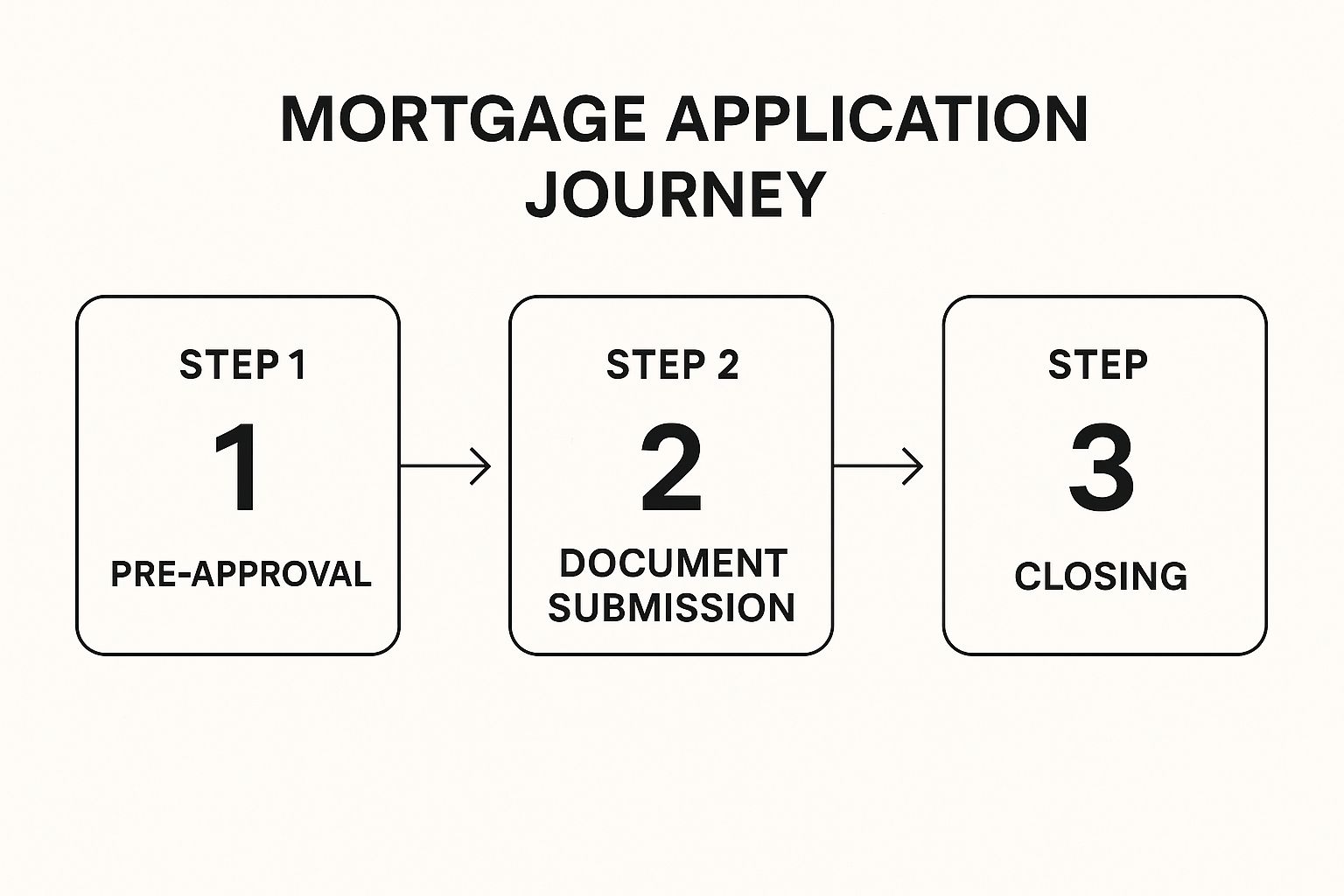
It shows that getting your buying power confirmed is the first phase, and the legal transfer of the property is the last. The critical bridge connecting them is submitting all your documents for review.
Step 1: The All-Important Pre-Approval
Before you even think about scrolling through listings, your very first move should be getting pre-approved. Think of a pre-approval letter as your golden ticket in Nashville's competitive housing market. It's a lender's conditional promise to loan you a specific amount of money, which proves to sellers that you're a serious, qualified buyer.
To get you pre-approved, we'll take a comprehensive look at your finances. Here's what that involves:
- Credit History: We’ll pull your credit report to see your score and get a feel for your payment history.
- Income Verification: You'll need to provide documents like recent pay stubs and W-2s so we can confirm your earnings.
- Asset Review: We'll review your bank statements to make sure you have the funds needed for a down payment and closing costs.
A solid pre-approval doesn't just tell you what you can afford; it gives you a massive advantage when it's time to make an offer.
Step 2: The Full Application And Underwriting
Once you’ve found that perfect Nashville home and have a signed purchase agreement, the process really kicks into high gear. Now it’s time to submit your formal mortgage application, which involves a much deeper dive into your financial world. This is where you'll provide all the paperwork to back up the info you gave us during pre-approval.
From there, your file heads to underwriting. An underwriter is like a financial detective whose one job is to meticulously verify every single detail of your application. They double-check everything to ensure the loan meets all guidelines and, most importantly, that you have the documented ability to repay it.
Insider Tip: The #1 reason for closing delays is slow or incomplete paperwork during underwriting. When your loan officer asks for something, get it back to them as quickly and completely as you can. It’s the best way to keep your closing on schedule.
Step 3: Appraisal, Final Approval, And Closing
While your loan is in underwriting, we’ll order a home appraisal. This is where an independent, licensed appraiser assesses the property’s value to make sure it’s worth at least what you've agreed to pay. It’s a critical step that protects both you and the lender from overpaying for a home.
After the appraisal comes in and the underwriter gives their final stamp of approval, you’ll get the three words you've been waiting for: "clear to close." The final step is the closing itself. You'll sign a mountain of paperwork, pay your down payment and closing costs, and then, finally, get the keys to your new Nashville home.
As you move through the process, it’s vital to budget for more than just your down payment. For a detailed guide on what to expect, it’s worth understanding first-time home buyer closing costs. This will help you get ready for the final numbers you’ll see on closing day, so there are no surprises.
Finding the Best Mortgage Rates in Nashville
The interest rate is the single most powerful number in your mortgage. I’ve seen it time and time again over my career: over a 30-year loan, even a fraction of a percentage point can mean the difference of tens of thousands of dollars. That’s money that either stays in your pocket or goes straight to the lender.
Securing the lowest possible rate for your Nashville home loan isn’t a matter of luck; it’s a matter of strategy. As lenders who live and breathe this market, we see how different forces—from big-picture Federal Reserve announcements down to your personal credit history—all come together to create the rate you're offered. Understanding these factors gives you the power to find the best deal out there.
The Power of Shopping Around
If there's one piece of advice I can't stress enough, it's this: shop around. It's the single most effective strategy for getting a lower interest rate. Don't just take the first offer you get. You absolutely must get quotes from at least three to five different lenders, because rates can vary significantly from one institution to the next.
This isn't just about chasing the lowest number. It's about comparing the full offer, which you'll see laid out in a standardized document called a Loan Estimate. This form makes it easy to compare apples to apples, looking at not just the interest rate but also all the associated fees and closing costs.
A study by a government-sponsored enterprise found that borrowers who get at least five quotes can save an average of $3,000 over the life of their loan. In a hot market like Nashville, those savings can be even more substantial.
Should You Lock Your Rate?
Once you have an offer you like, you’ll face a key decision: should you "lock" your rate? A rate lock is simply a lender's guarantee to hold a specific interest rate for you for a set period, typically 30 to 60 days, while your loan is being processed.
- When to Lock: If you see rates creeping up or you’ve found a rate that fits your budget perfectly, locking it in provides incredible peace of mind. You won't have to sweat the market fluctuations that could drive up your monthly payment before you close.
- When to Float: On the other hand, if you believe rates might dip in the near future, you could choose to "float" your rate. This means you’re hoping it will be lower when you're ready to close. Just remember, it's a gamble. Rates could just as easily go up.
As your local Nashville lender, we watch the market daily. We can give you real-time guidance on when it makes the most sense to lock in your rate based on what we're seeing in current trends.
Understanding and Using Mortgage Points
You might hear about an option to buy "mortgage points" or "discount points" to lower your interest rate. In simple terms, one point typically costs 1% of your total loan amount and can reduce your rate by a set amount, often around 0.25%.
Think of it as pre-paying some of your interest upfront to get a lower monthly payment for the life of the loan. The key is to figure out your "breakeven point"—the month where the savings from your lower payment finally outweigh the initial cost of the points. To calculate this, just divide the cost of the points by your monthly savings.
For example, let's say you pay $4,000 for points and that saves you $50 per month. Your breakeven point is 80 months ($4,000 / $50). If you plan on staying in your Nashville home longer than that, buying points could be a very smart financial move.
Frequently Asked Questions About Nashville Home Loans

As you prepare to find your own piece of Music City, you're going to have questions. It’s only natural. The home loan process, especially in a dynamic market like Nashville's, involves many moving parts and can feel overwhelming at times.
To help you find clarity, we've compiled the most common questions our team hears every single day from homebuyers just like you. Think of this as a straightforward conversation with a local expert who intimately understands the unique challenges and opportunities of the Nashville real estate scene. Let’s dive in and demystify some of these common concerns.
What Credit Score Is Needed To Buy a House in Nashville?
This is usually the first question on every buyer's mind, and for good reason. While the absolute minimum score can change depending on the loan program, a score of 620 is the general starting point for a conventional loan in Nashville. If you're aiming for the most competitive interest rates, lenders really like to see scores of 740 or higher.
But don't panic if your score isn't in that top range. That’s what different loan types are for. FHA loans, for instance, are designed to be more forgiving and can be an option for borrowers with scores as low as 580. The main takeaway is that there's almost always a path forward, and we work with clients all across the credit spectrum.
Are There First-Time Homebuyer Programs in Tennessee?
Yes, absolutely! And from my decades of experience, I can tell you they are often a total game-changer for many Nashville buyers. Tennessee has several fantastic programs specifically designed to make homeownership more accessible for first-timers.
The main hub for this kind of help is the Tennessee Housing Development Agency (THDA). They offer a couple of key programs:
- The Great Choice Home Loan: This program provides solid, competitive 30-year fixed-rate mortgages.
- Down Payment Assistance: THDA also offers help to cover the big upfront hurdles of a down payment and closing costs, often in the form of a second, forgivable loan.
These programs are designed to significantly lower the financial barrier to owning a home. Our loan officers know the ins and outs of every THDA requirement and are experts at walking first-time buyers through the entire process from start to finish.
Having been in this business for decades, I can tell you that using a first-time homebuyer program is one of the smartest things a new buyer can do. It helps you hold on to your savings and starts you off on much stronger financial footing.
How Much Is a Typical Down Payment in Nashville?
The old idea that you must have 20% down is one of the biggest and most persistent myths in real estate. It's simply not true for most people today. While putting 20% down on a conventional loan is great because it lets you avoid private mortgage insurance (PMI), very few buyers—especially first-timers—actually put that much down.
In Nashville, the real-world down payment depends entirely on your loan type. An FHA loan requires as little as 3.5% down. For our veterans and military members using a VA loan, or for buyers in certain rural areas using a USDA loan, the down payment can even be 0%.
When you look at the averages, most first-time buyers in the Nashville area are realistically putting down somewhere between 5% and 10% of the home's price.
At ShopRates, we bring together the muscle of a national lender with the indispensable, on-the-ground knowledge of a local Nashville team. We know this city, we know its neighborhoods, and we know what it takes to get the right home loan here. If you’re ready to move forward with a lender that gives you the best of both worlds, let's explore your options together. Find your perfect rate at https://shoprates.com.


