
Your Expert Guide to Finding a Hard Money Loan Lender for Fast Financing
When a traditional bank’s timeline just won't cut it, a hard money loan lender can feel like the secret weapon in a savvy real estate investor's arsenal. For years, I've watched investors use this financial express lane to bypass the competition. It’s a route that focuses on a property’s inherent potential rather than a borrower’s financial past, empowering you to lock down promising deals before others even get their paperwork started.
Why Top Investors Rely on a Hard Money Loan Lender
In my decades of experience in the financial world, I’ve seen one truth hold fast in real estate investing: speed isn't just a nicety—it's currency. Countless investors have lost out on incredible opportunities simply because a conventional mortgage approval was stuck in a weeks-long (or even months-long) pipeline. A hard money loan lender operates on a completely different clock, one built for the speed and adaptability that modern markets demand.
The real game-changer is where we, as lenders, focus our underwriting. Instead of getting bogged down in every minute detail of your credit score and personal income, a hard money lender is primarily interested in the “hard” asset: the property itself. This asset-first approach is what allows us to green-light a deal and get funds into your hands in a fraction of the time.
This rapid-fire funding is absolutely critical for time-sensitive plays like:
- Property Auctions: Where you need to show up with cash or guaranteed financing ready to go. You can't ask an auctioneer to wait a month for your bank.
- Fix-and-Flip Projects: Snapping up a property quickly so you can start renovations and get it back on the market fast is the core of this model.
- Bridge Financing: Covering the financial gap when you're buying a new property before the old one has sold.
The image below breaks down the core differences between a traditional mortgage and a hard money loan, showing exactly where each one shines.
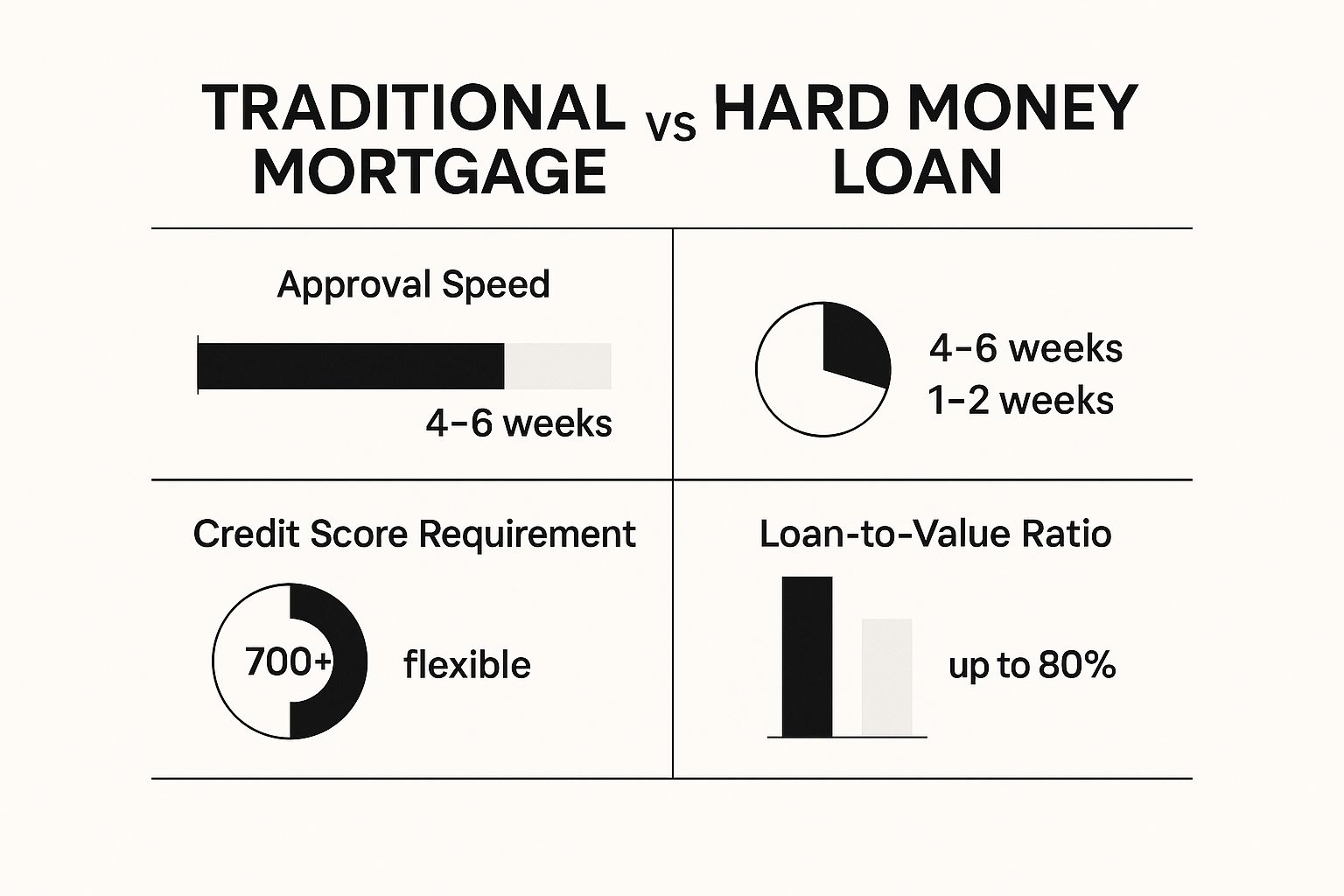
As you can see, what you trade in higher costs you gain back in incredible speed and a much more forgiving view of your personal credit history. This table provides a quick side-by-side look at the key distinctions.
Hard Money vs Traditional Loans At a Glance
| Feature | Hard Money Loan Lender | Traditional Bank |
|---|---|---|
| Primary Focus | The property's value (ARV) | Borrower's credit & income |
| Approval Speed | As fast as a few days | Weeks to months |
| Loan Term | Short-term (6-36 months) | Long-term (15-30 years) |
| Credit Score | Lenient requirements | Strict requirements |
| Interest Rates | Higher (8-15%) | Lower |
| Best For | Fix-and-flips, auctions, bridge loans | Primary residences, long-term holds |
Ultimately, these two financing tools are designed for completely different jobs. A bank loan is a marathon, designed for stability over decades. A hard money loan is a sprint, built for seizing immediate opportunities.
Seizing Opportunity in a Competitive Market
Today’s market realities have only cranked up the demand for this kind of alternative financing. With traditional banks denying roughly 43% of commercial loan applications and house flipping still making up about 2% of all home sales in late 2024, the need for fast, reliable capital is crystal clear. These conditions have cemented hard money lenders as essential partners in the real estate investment game.
For any investor using hard money, being able to accurately forecast a project's profitability is everything. Knowing how to calculate their potential rate of return is a non-negotiable skill; it’s how you determine if a deal's numbers can justify the financing costs.
Yes, the costs are higher, but the strategic advantages can easily make it worthwhile. To see just how this tool can level up your investment strategy, check out our guide on the benefits of a hard money loan for a deeper dive.
Understanding How Hard Money Loans Work

To really grasp how a hard money loan lender operates, it helps to picture a valuable property as a locked treasure chest. A traditional loan application is like trying to crack a long, complicated combination lock—it's a meticulous process that can take weeks. A hard money loan, on the other hand, is the master key. It unlocks the chest based on the value of the treasure inside, not on a lengthy personal evaluation.
At its heart, a hard money loan is a purely asset-based form of financing. This means the loan is secured almost entirely by the "hard" asset itself—the real estate. Where conventional banks will pour over every detail of your credit history and income statements, hard money lenders are laser-focused on one thing: the property's value.
This fundamental difference is what makes incredible speed possible. Once an appraisal is done and the title is clear, a deal can often be funded in a matter of days, not the 30 to 60 days that are standard for a typical bank mortgage.
The Loan-to-Value (LTV) Calculation
For any hard money deal, the most critical number is the Loan-to-Value (LTV) ratio. This is the simple metric lenders use to decide how much they're willing to lend you, based on what the property is actually worth.
The LTV ratio is the lender’s safety net. By lending only a percentage of the property's value—usually in the 60% to 75% range—they make sure their investment is protected if the borrower defaults and they have to take back the property.
For a fix-and-flip project, this calculation gets a bit more sophisticated, often using the After Repair Value (ARV). This is the estimated market value of the property after you’ve completed all the planned renovations. A good lender who knows your local market can confidently assess the ARV, giving you the capital needed for both the purchase and the improvements.
Short-Term Strategy and Exit Plans
It’s important to remember that hard money loans are strategic, short-term tools. They aren't meant to be held for decades like a traditional 30-year mortgage. The typical loan term is anywhere from six months to a few years, designed specifically to bridge a financial gap and get a project done.
Because they’re short-term, every single hard money loan needs a crystal-clear exit strategy. This is your road map for repaying the loan in full. A lender won’t even consider funding a deal until they see a viable and believable exit plan.
Common exit strategies include:
- Selling the Property: This is the classic "fix-and-flip" model. You renovate the property, sell it for a profit, and use the proceeds to pay back the loan, cover your costs, and pocket the difference.
- Refinancing: After you've renovated and stabilized a property, especially a rental, you can refinance into a long-term, lower-rate conventional mortgage. The new mortgage pays off the hard money loan, and you're left with a cash-flowing asset.
While hard money offers a unique path to funding, it's always smart to have a well-rounded understanding of real estate financing. Reviewing general tips on getting approved for a rental property loan can provide knowledge that complements your strategy and prepares you for every stage of your investment journey.
Who Is the Ideal Candidate for a Hard-Money Loan?

Hard money loans are a very specific tool, and while they aren't the right fit for every borrower, they are an absolute game-changer for the right investor with the right project. The perfect candidate isn't defined by a flawless credit score but by the sheer strength of their investment opportunity. These are the people who know that speed and flexibility are the most critical ingredients for success.
These borrowers get it. They understand that a hard money loan lender plays by a different rulebook than a traditional bank. The conversation shifts away from a borrower's financial past and focuses squarely on the future potential of a real, tangible asset.
Scenarios Where Hard Money Shines
Certain investment situations are practically built for this kind of financing. The investors who really thrive with hard money are often tangled up in projects where time is money, and conventional loans are just too slow or rigid to keep up.
Here are the most common profiles of a perfect hard money borrower:
- The Fix-and-Flip Investor: This is the classic example. They need to grab a distressed property fast, fund the renovations, and get it back on the market for a profit. The speed of a hard money loan lets them compete with cash buyers and get the demolition crew on-site almost immediately.
- The Bridge Loan Seeker: These are often experienced investors or even homeowners who’ve found their next property but are stuck waiting for their current one to sell. A hard money bridge loan closes that financial gap, making sure they don’t lose the new deal while waiting for the old one to close.
- The New Construction Developer: Small-scale builders and developers frequently use hard money to acquire land and cover those initial, crucial construction costs. Once the project is framed up and further along, they can more easily roll that into traditional construction financing or sell the project.
An ideal candidate for a hard money loan also has a rock-solid grasp of their project's financial health and liquidity. Success in this game often comes down to meticulously performing thorough cash flow analysis to prove the deal can handle the loan costs and still turn a profit.
What Lenders Look For Beyond a Credit Score
While your personal credit isn't the main event, a reputable lender won’t just ignore it. However, they put far more weight on the viability of the deal itself. In this world, your investment opportunity is your single greatest asset for securing funding.
A strong candidate will walk in and present a lender with:
- A Substantial Down Payment: Lenders need to see you have "skin in the game." Bringing a down payment, usually 20-30% of the property’s value, shows you're committed and seriously reduces the lender's risk.
- A Well-Researched Project Plan: This isn't just a back-of-the-napkin sketch. It includes realistic renovation budgets, detailed timelines, and a deep understanding of the local market's after-repair value (ARV). Lenders want to partner with people who have done their homework.
- A Clear and Profitable Exit Strategy: This is completely non-negotiable. You must have a defined plan to pay back the loan, whether that's flipping the property for a profit or refinancing into a traditional, long-term mortgage.
The Real Costs of Speed and Convenience

Let's be clear: the biggest advantage of a hard money loan—getting cash in your hands incredibly fast—doesn't come for free. It comes at a premium. But for a savvy real estate investor, this isn't a downside. It’s a calculated business expense.
Think of it this way: you're paying for access to rapid capital, incredible flexibility, and a lender who's willing to shoulder risk that a traditional bank wouldn't even consider. That premium gets paid in two primary ways: higher interest rates and origination fees, often called "points." This is how the lender is compensated for funding a deal in days, not months, and for focusing on the property's potential instead of your credit history. Getting a firm grip on these costs from the get-go is the only way to know if a deal is truly profitable.
Breaking Down the Numbers
Hard money loans will always have higher interest rates than a conventional mortgage. That's the trade-off. The private credit world, which hard money is a big part of, has grown into a multi-trillion dollar market precisely because it offers this fast, flexible financing when banks are bogged down by red tape.
In today's market, you can generally expect interest rates to fall somewhere between 8% and 12%. Investors willingly accept this because the loan is short-term, which means they aren't exposed to long-term rate risk. Plus, the speed they gain allows them to jump on opportunities others miss.
On top of the interest rate, you’ll also have origination fees. These are charged right at closing and are calculated as a percentage of the loan amount.
- Origination Fees (Points): One "point" is simply 1% of the total loan. Most hard money lenders will charge anywhere from 2 to 4 points. So, if you're taking out a $300,000 loan, be prepared to pay between $6,000 and $12,000 in origination fees when you close.
A Real-World Fix-and-Flip Example
Let's walk through how this plays out in a real deal. Say you've found a diamond in the rough: a distressed property you can buy for $200,000. Your contractor estimates it needs $50,000 in renovations, and you project the After Repair Value (ARV) will be a solid $350,000.
A hard money lender steps in and agrees to fund 80% of the purchase price and 100% of the repair budget. This gives you a total loan of $210,000. The terms offered are 10% interest and 3 points over a 12-month term.
Now you have the raw numbers to see if the deal actually works. You have to meticulously weigh your total financing costs against your project expenses and your potential profit. Being able to run these numbers is a non-negotiable skill for any serious investor. For a step-by-step walkthrough, check out our Nashville investor's toolkit to calculate hard money loan costs. It’s designed to give you the confidence to analyze any deal and know exactly when it’s time to pull the trigger.
How to Vet and Choose the Right Lending Partner
Finding a lender who will give you money is easy. Finding a genuine financial partner who gets your vision and actively wants your project to succeed? That's a different game entirely.
The right hard money loan lender isn’t just a bank account; they're a critical member of your team. But the wrong one can sink a promising deal before you even break ground. Choosing your lender requires the same level of care you put into finding the property itself. You’re not just shopping for the lowest rate—you’re vetting for expertise, honesty, and reliability. This is especially true in private lending, where you have to watch out for predatory "loan-to-own" schemes.
A Practical Checklist for Vetting Lenders
Before you even think about signing a term sheet, it’s time to ask some direct questions. A solid, reputable lender will welcome your due diligence. A sketchy one will get defensive. Your mission is to size up their character just as much as their loan terms.
Here’s what you need to zero in on:
- Reputation and Track Record: Don't be shy—ask for references from past borrowers. A legitimate lender will have a portfolio of successful projects and happy clients ready to vouch for them.
- Transparency in Fees: Demand a clear, itemized breakdown of all potential fees. This means origination points, underwriting costs, appraisal fees, and any possible extension penalties. Hidden costs are a massive red flag.
- Responsiveness and Communication: How fast do they return your calls or emails? A lender who ghosts you during the vetting process will almost certainly be a nightmare to reach when you need an urgent draw request mid-project.
- Local Market Knowledge: Do they actually understand the neighborhood you're investing in? A lender with deep local expertise is an invaluable asset. They can help you accurately pin down the After Repair Value (ARV) and confirm your project's real potential.
Your relationship with a hard money lender is fundamentally a business partnership. Trust and transparency are the bedrock of that partnership. If a lender pressures you, glosses over details, or makes promises that seem too good to be true, it’s a clear signal to walk away.
Streamlining Your Search with a Trusted Platform
Let's be honest—the vetting process can be exhausting and overwhelming. This is where a platform like ShopRates becomes an indispensable part of your toolkit.
Instead of making dozens of cold calls and starting from scratch with every lender, we offer a direct path to a network of pre-vetted, reputable financial partners. We’ve already done the heavy lifting of checking their credibility.
When you use ShopRates, you get instant access to multiple competitive offers from lenders who get the speed and specifics of real estate investing. This doesn't just save you a ton of time; it gives you the confidence that you're working with a reliable professional who is invested in your success. For investors in Tennessee, for instance, our platform can connect you with the best hard money lenders in Nashville who have a proven history of funding successful local projects. This targeted approach ensures you find a partner with the right experience for your deal.
FAQ: Your Hard Money Loan Lender Questions Answered
Stepping into the world of hard money lending can feel like learning a new language, especially if you’re used to the slow, predictable rhythm of traditional banks. It’s a space filled with opportunity, but it’s natural to have questions. As a seasoned expert from ShopRates, a nationwide lender based in Nashville, TN, I've heard them all. Let’s cut through the noise and get you straight answers to the questions real estate investors ask most.
How quickly can I actually get funding from a hard money loan lender?
This is the big one. Speed isn’t just a feature of hard money; it’s the main event. While a conventional bank loan will have you waiting around for 30 to 60 days (if you’re lucky), a solid hard money lender can get cash in your hands in just 7 to 14 days. How is that even possible? It’s because we look at the deal differently. We’re not spending weeks digging through every corner of your personal financial history. Our focus is squarely on the asset—the property itself. This quick turnaround is a massive strategic advantage, especially when you’re up against multiple offers at a property auction or need to meet a seller’s urgent timeline.
What is the typical term for a hard money loan?
Think of a hard money loan as a short-term tool, not a long-term commitment. It’s not your 30-year mortgage. These are bridge loans designed to get you from point A to point B. The typical loan term is anywhere from 6 months to 2 years. For bigger projects like ground-up construction, you might see terms extending to 3-5 years, but that’s less common. The whole point is to give you the capital to acquire and improve a property. Once that’s done, you execute your exit plan—either selling it for a profit or refinancing into a more traditional, long-term loan.
Can I get a hard money loan with poor credit?
Yes, and this is another area where hard money shines. Because hard money lenders are primarily asset-based, the property is the star of the show. We are far more interested in the deal’s potential—specifically its After Repair Value (ARV)—and the strength of your down payment than we are in your FICO score. Now, a lender will almost certainly pull your credit as part of their due diligence. But a low score isn’t an automatic rejection like it often is at a bank. If you’ve found a great property with a clear, profitable path forward, your credit history becomes a much smaller piece of the puzzle.
What is an exit strategy and why is it required by every hard money loan lender?
Your exit strategy is simply your plan for paying back the loan. It’s not just a formality; it’s the most critical part of your pitch. A lender needs to see a clear, believable plan because it’s how we mitigate our risk and ensure we get paid back. There are two classic exit strategies in the real estate world: 1) The Flip: You buy the property, renovate it, and sell it for a profit. The proceeds from that sale pay off the hard money loan. 2) The Refinance: Often called the "BRRRR" method (Buy, Rehab, Rent, Refinance, Repeat). After you’ve renovated and stabilized the property by placing a tenant, you refinance with a traditional lender. That new, long-term mortgage pays off the short-term hard money loan, and you’re left holding a cash-flowing rental property.
What makes a hard money loan "hard"?
The term "hard money" doesn't refer to the difficulty of getting the loan, but rather to the loan being secured by a "hard" asset—the physical real estate. Unlike a "soft money" loan from a bank that heavily relies on soft assets like your credit score and income history, a hard money loan is based on the tangible value of the property itself. This asset-focused approach is what allows for the speed and flexibility that define this type of financing.
Ready to see how fast you can get funded for your next real estate deal? At ShopRates, we connect you with a network of pre-vetted, reliable hard money lenders who are ready to compete for your business. Compare offers and find the perfect financial partner for your project today at https://shoprates.com.


