

Your Expert Guide to Hard Money Lender Financing
As a seasoned financial expert based in Nashville, TN, I've spent decades helping real estate investors navigate the complexities of funding. One of the most powerful, yet often misunderstood, tools in an investor's arsenal is the hard money loan. At its core, a hard money lender is your go-to source for fast, short-term financing on real estate deals. These loans are secured by the property itself—the "hard asset"—not by your personal credit score.
Think of a hard money loan as a strategic tool for investors who need to pounce on time-sensitive opportunities. They're absolutely essential for house flippers and developers who can't afford to wait on the sluggish pace of a traditional bank.
Demystifying The Hard Money Lender

Imagine you're at a competitive real estate auction. You just won the bid, but there's a catch: you have to fund the entire purchase in ten days. A conventional bank, with its mountains of paperwork and weeks-long underwriting process, just can't make that happen.
This is precisely the scenario where a hard money lender demonstrates its true value. We step in as a specialized financial partner for real estate investors facing these exact situations.
Unlike traditional banks that get bogged down scrutinizing your tax returns, credit history, and debt-to-income ratio, a hard money lender’s focus is squarely on the property. We are private companies or individuals—like us here at ShopRates in Nashville, TN—funding loans with our own capital. This independence from institutional red tape is what allows for incredible speed and flexibility.
At the end of the day, our evaluation boils down to one simple question: is this a good deal? If the property shows strong potential for a healthy profit, we feel secure knowing our investment is backed by a valuable, tangible asset.
The Asset-First Approach
This "asset-first" model is what truly defines the hard money lending industry. It’s a completely different way of looking at risk. Instead of getting hung up on your past financial performance, our focus is on the future value of the real estate you're trying to acquire.
This approach is a game-changer for investors, especially in situations like:
- Fix-and-Flips: Buying a distressed property to renovate and sell for a quick profit.
- Bridge Loans: Needing short-term cash to purchase a new property before you've sold your current one.
- Construction Projects: Securing the initial capital to get a new build off the ground.
- Properties Needing Repair: Funding the purchase of a home that is in too poor of a condition to qualify for traditional financing.
Because the property itself secures the loan, we're far less concerned about blemishes on a borrower's credit report. For a deeper dive into how this all stacks up, check out our detailed comparison of hard money loans vs. traditional loans. It breaks down why one might be a better fit for your specific project.
Hard Money Lender vs Traditional Bank At a Glance
To put it plainly, hard money lenders and banks operate in two different worlds. One is built for speed and opportunity, the other for stability and long-term security. Seeing them side-by-side makes the distinction crystal clear.
| Attribute | Hard Money Lender | Traditional Bank |
|---|---|---|
| Primary Focus | The property's value (the "hard asset") | The borrower's credit and financial history |
| Funding Speed | 3-10 days | 30-60+ days |
| Loan Term | Short-term (6-24 months) | Long-term (15-30 years) |
| Approval Basis | After Repair Value (ARV) and deal potential | Credit score, DTI, income, tax returns |
| Flexibility | High; terms are often negotiable | Low; strict institutional guidelines |
| Best For | Fix-and-flips, bridge loans, quick closings | Primary residences, long-term holds |
This table highlights the fundamental trade-off: hard money offers unparalleled speed and flexibility in exchange for shorter terms and higher rates, making it a tool for profit-generating projects, not long-term homeownership.
A hard money loan isn't a "loan of last resort." For savvy investors, it's a strategic first choice to secure competitive deals, leveraging speed as their primary advantage. In a hot market, the ability to close in days, not months, is often the single factor that wins the deal.
Ultimately, a hard money lender fills a critical gap that conventional banking simply can't. We provide the agility and capital needed for investors to act on opportunities that would otherwise be lost to time. While the terms are shorter and the rates are typically higher, the trade-off is access to rapid funding that can unlock significant profits. For investors who know their market and have a clear exit strategy, it’s a calculated business decision that pays off.
How the Hard Money Loan Process Works
Forget the mountain of paperwork and molasses-slow pace of traditional bank lending. The hard money loan process is built for one thing: speed. It’s a straightforward, predictable path designed to get capital in your hands so you can lock down your deal before someone else does.
The whole system is designed around the asset, not just the applicant. We’re laser-focused on the deal's potential, making sure the property's value is solid enough to back the loan. This asset-first mindset is what lets us cut through the red tape and move decisively—a massive advantage in today's cutthroat real estate markets.
The Four Core Steps to Funding
At its heart, the hard money loan process breaks down into four clear stages. While every deal has its own quirks, this is the reliable roadmap you can expect when you work with a lender like ShopRates. Let’s walk through it with a classic scenario: a real estate investor ready to pounce on a fix-and-flip opportunity.
-
Initial Application and Pre-Approval: This is where it all starts. You’ll fill out a simple application covering the essentials: your project details, purchase price, renovation budget, and the all-important After Repair Value (ARV). We aren't digging through years of your tax returns; we just need the core data to see if the deal makes sense. You can expect to see a pre-approval or a term sheet in your inbox within a day or two if the numbers line up.
-
Property Valuation and Due Diligence: Once you're pre-approved, we get down to the most critical step: verifying the property's value. We'll bring in a professional appraiser to confirm both its current "as-is" value and the projected ARV. The ARV is the estimated market value of the property after you’ve completed all the planned renovations. Honestly, this is the most important number in hard money lending because it dictates the maximum loan amount.
-
Underwriting and Loan Documents: With the appraisal locked in, our underwriting team does a final review. They’ll run a title search, check for any pesky liens, and put the final touches on the loan terms. This is also where we formalize the Loan-to-Value (LTV), which is simply the loan amount as a percentage of the property's value. As soon as everything gets the green light, we’ll send over the official loan documents for you to sign.
-
Closing and Funding: The finish line. A title company or attorney handles the closing. You sign the final paperwork, and we wire the funds directly to the closing agent. From start to finish, the entire timeline can be as short as a single week.
This infographic paints a clear picture of that accelerated workflow, showing how each step flows right into the next to get you to the closing table fast.
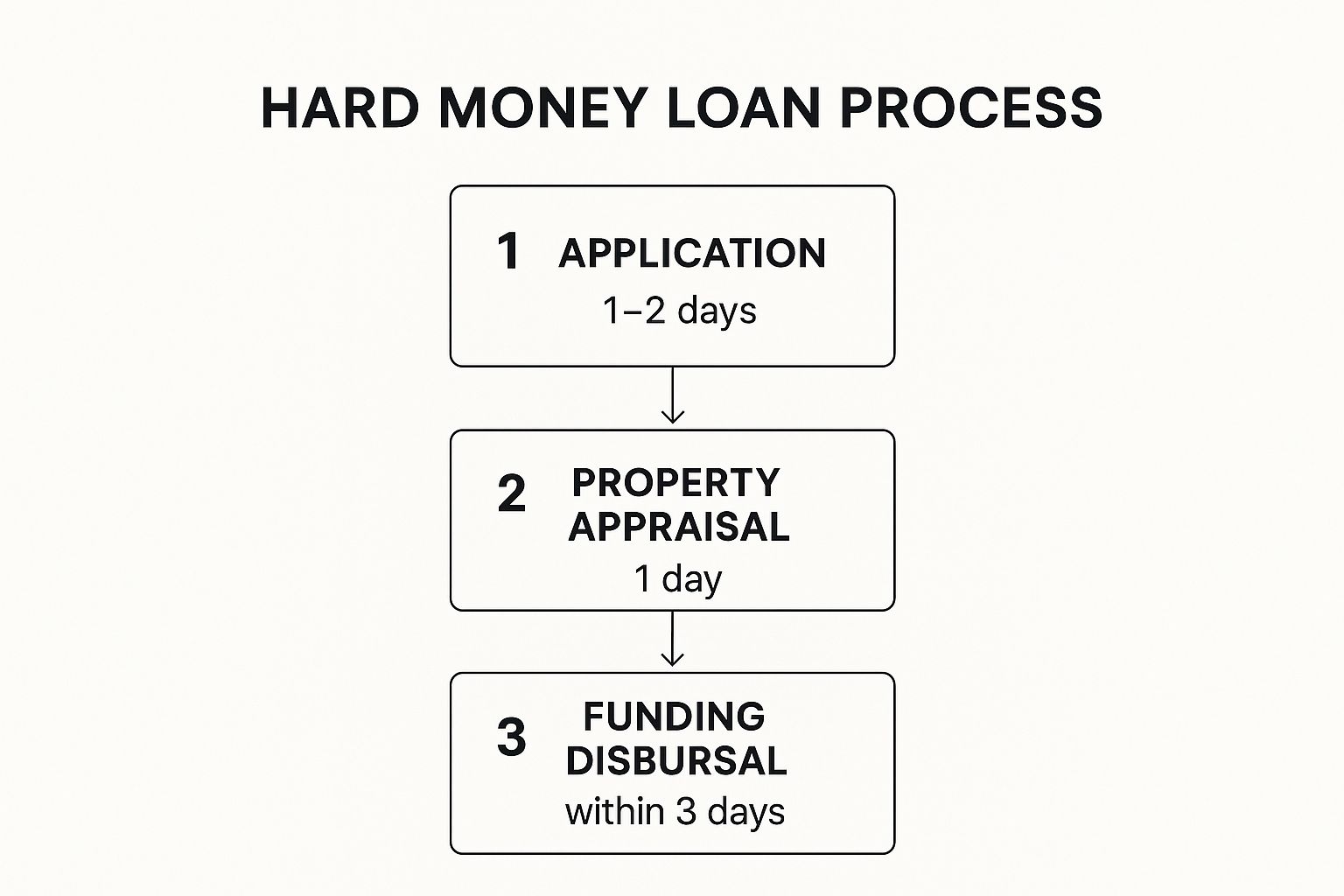
The takeaway here is that a hard money loan's timeline is measured in days, not the weeks or months you’d be waiting on a conventional lender.
Why This Process Exists Today
This need for speed isn't happening in a vacuum. As big banks have become more restrictive, the private credit market—which is where hard money lending lives—has exploded to an estimated $2 to $3 trillion globally. This growth is a direct answer to investors who need fast, no-nonsense capital.
Plus, technology like AI-powered valuations and digital closings has poured gasoline on the fire, slashing approval times from over 50 days at a bank to just 10–14 days for a hard money loan. Yes, the interest rates, typically 8% to 12%, are higher than a bank loan. But savvy investors gladly make that trade for the speed and certainty they need to capitalize on a fleeting opportunity. You can dive deeper into these trends by exploring the latest 2025 hard money lending forecasts.
Key Takeaway: The hard money process puts the deal itself front and center, not your personal financial history. A strong After Repair Value (ARV) and a clear, profitable exit plan are the real keys to getting funded quickly and successfully.
Ultimately, knowing how this all works gives you, the investor, the upper hand. It demystifies what’s happening behind the curtain and makes it clear why a hard money lender is often the best strategic partner for any time-sensitive real estate project.
The Strategic Advantages of Hard Money Loans
Choosing a hard money loan isn't just about getting from point A to point B; it’s about picking the right vehicle to win the race. For serious real estate investors, the benefits of working with a hard money lender like ShopRates aren't mere conveniences. They're powerful strategic tools that blast through the roadblocks traditional financing puts up.
At the heart of this advantage is a simple, yet profound, focus on the asset’s potential. A bank sees risk in a borrower's credit history, but a hard money lender sees opportunity in the property's future value. This fundamental shift in perspective opens doors to profitable projects that would never make it past a conventional loan committee. It’s a partnership built on a shared goal: unlocking a property's inherent value.
Unbeatable Speed to Seize Opportunity
In real estate, speed kills the competition. The ability to close a deal in days, not months, is arguably the most significant advantage a hard money loan offers. Picture this: a distressed property hits the market at a deep discount. It won't last. An investor with a traditional pre-approval is still weeks away from funding, but one backed by a hard money lender can make a cash-like offer and close in as little as a week.
This speed is a direct result of the streamlined, asset-focused underwriting process. By prioritizing the property's After Repair Value (ARV) over exhaustive personal financial checks, we can make decisions and get funds into your hands with remarkable quickness. This isn't just about convenience; it's about giving you the power to act decisively when a golden opportunity arises. You get the deal while others are still filling out paperwork.
This dynamic has become even more critical in today's market. With banks in 2025 denying around 43% of commercial loan applications and conventional mortgage rates on the rise, the bottleneck for investors is real. The private credit sector, which includes hard money lending, has swelled by 15% to reach about $3.5 trillion globally, stepping in to meet the demand. You can explore more data on why hard money is becoming essential for real estate financing in a tight credit market.
Flexibility Where Banks Are Rigid
Beyond sheer speed, hard money loans offer a level of flexibility that traditional banks simply can't touch. Because we're private lenders using our own capital, we aren't bound by the same strict, one-size-fits-all institutional rules. This opens the door for more creative and customized financing solutions.
Think about these common scenarios where flexibility is everything:
- Unique Properties: Banks often run from properties that need significant repairs or have unconventional layouts. A hard money lender can see past the current state and fund the deal based on its future potential.
- Complex Deal Structures: Need funding for the purchase and the renovation? A hard money loan can often roll both into one package, providing draws as you hit project milestones.
- Self-Employed Borrowers: Investors with fluctuating or non-traditional income streams often get stuck in a bank's rigid verification process. Our focus stays on the asset, not your W-2.
The real power of hard money financing lies in its ability to adapt. It’s not just a loan; it’s a tailored financial solution designed to fit the unique contours of your specific real estate project, giving you the support needed to tackle complex renovations or acquisitions with confidence.
Ultimately, these strategic advantages—speed and flexibility—transform a hard money loan from a simple financial product into a competitive edge. It's the tool that allows seasoned investors to act with the confidence of a cash buyer, secure deals that don't fit into a bank's rigid box, and build their portfolios with agility and precision.
Navigating the Risks of Hard Money Financing
Here at ShopRates, we see ourselves as your financial partner, and that means being completely transparent. Any powerful tool has its risks, and hard money loans are no different. Having an honest, eyes-wide-open conversation about these risks isn't about scaring you off—it's about empowering you to use this type of financing with the confidence and precision of a pro.
Let’s be direct: hard money loans carry higher interest rates and much shorter repayment timelines than a typical bank loan. This isn't a design flaw; it's a direct reflection of the speed and flexibility you get, and the asset-based risk the lender is shouldering. The trick is to view these terms not as a penalty, but as a calculated cost of doing business to seize a specific, profitable opportunity.
The Art of Mitigating Risk
The most successful real estate investors I've met aren't just great at sniffing out deals. They are absolute masters of mitigating risk. They understand that a hard money loan is a short-term bridge, not a long-term place to live. Getting this mindset right is crucial for turning potential downsides into manageable parts of your plan.
Most of the time, when a project goes sideways, it's not the loan's fault. It's the plan—or lack thereof—surrounding the loan. Every seasoned investor I know builds their strategy on three non-negotiable pillars:
- A Bulletproof Exit Strategy: This is everything. Before you even think about signing the loan documents, you need a crystal-clear, realistic plan for how you're going to pay it back. This almost always means either selling the property (a flip) or refinancing into a long-term, conventional mortgage (the BRRRR method).
- Meticulous Due Diligence: Overestimating the After Repair Value (ARV) is a classic rookie mistake that can completely sink a project. You have to do your homework—run the numbers, analyze comparable sales ("comps"), and get an objective, professional appraisal to make sure your profit margins are actually achievable.
- A Healthy Contingency Fund: In real estate, the unexpected is the only thing you can guarantee. It could be hidden mold, a sudden jump in lumber prices, or a permit that takes weeks longer than you thought. You need a financial cushion. A contingency fund of 10-20% of your total renovation budget isn't just a good idea; it's the professional standard.
As a lender, we’ve seen thousands of projects. The ones that succeed and the ones that fail almost always have one thing in common: the quality of their plan. The best investors treat the loan as just one piece of a larger business plan, with well-defined "what if" scenarios for when things don't go exactly as scripted.
Mastering Your Exit Plan
Your exit strategy is the single most critical piece of your risk management puzzle. A hard money loan's short term—often just 12 to 24 months—means the clock is always ticking. You don't have the luxury of waiting out a market slump like you might with a 30-year mortgage.
You really have two main paths out:
- The Sale (Fix-and-Flip): If you're planning to sell, your success lives and dies by your timeline and budget. Construction delays or a market that suddenly cools off can vaporize your profits and put you in a tough spot as your loan's maturity date looms.
- The Refinance (BRRRR): If you plan to keep the property as a rental, you have to be certain you can qualify for a traditional mortgage once the dust settles. This means getting your personal finances in order and making sure the property will meet a bank's much stricter appraisal standards post-renovation.
Failing to game out these realities is one of the most common hard money loan mistakes we see investors make. By truly understanding and actively managing these risks, you transform a hard money loan from a potential liability into one of the most effective tools in your real estate investing arsenal.
Who Is an Ideal Candidate for a Hard Money Loan?

Figuring out if you’re the right fit for a hard money loan is about more than just checking off boxes. While plenty of people can apply, the borrowers who really knock it out of the park with this type of financing share a certain mindset. They don’t see hard money as a last resort; they see it as a high-performance tool for grabbing specific, time-sensitive opportunities.
So, to help you see if you fit the profile, let’s go beyond generic descriptions and look at real-world scenarios. These are the investors we see every day, the ones who know how to turn speed and flexibility into pure profit.
The Experienced House Flipper
Meet Sarah. She’s a seasoned house flipper with a dozen successful projects under her belt, and she knows her local market like the back of her hand. A dilapidated but perfectly located property just popped up for sale, but there's a catch: the seller needs to close in ten days to stave off foreclosure.
Sarah is a perfect candidate. Her deep experience means she can nail the After Repair Value (ARV) and map out a realistic renovation budget in her sleep. The property’s potential is obvious, and her track record gives a lender like ShopRates all the confidence we need in her ability to execute the plan and sell for a profit inside of 12 months. For her, the higher interest rate isn’t a deterrent; it’s a calculated business expense to lock down a deal that’s going to net a 40% return on investment.
The Savvy Real Estate Developer
Next up is David, a small-scale developer who just wrapped up a successful four-unit townhouse project. An opportunity has just landed in his lap to buy an adjacent vacant lot for his next build. The problem? His capital is still tied up in the recently completed project, which is on the market but hasn't sold yet.
David needs a bridge loan—a classic use for hard money. He's an ideal candidate because his need is short-term and his plan is rock-solid. A hard money loan lets him secure that land now before another developer scoops it up. His crystal-clear exit strategy is to pay off the hard money loan the moment his first project sells, making this a low-risk, high-reward move for everyone involved.
The Auction Buyer
Finally, there’s Marcus. He specializes in snapping up properties at real estate auctions, an environment where you need cash or a cash-equivalent offer and closing periods as short as one week. A traditional bank loan? Not a chance. It’s just too slow.
Marcus thrives here because he partners with a reliable hard money lender. He gets pre-approved, which lets him bid with the same confidence as a cash buyer. As soon as the gavel falls, his lender can fund the deal well within the tight deadline. His true expertise is his ability to assess a property's value and potential on the spot, a skill that makes him a perfect match for this kind of rapid-fire financing.
The common thread weaving through all these candidates is clarity. They have a well-defined project, a deep understanding of their numbers, and a non-negotiable exit strategy. Their success hinges on seeing the loan as a lever to generate profit, not as long-term debt.
If you're a real estate investor thinking about hard money, getting a firm grip on your project's financial performance is non-negotiable. It's smart to brush up on the key metrics for real estate investors to make sure every deal is built on a solid foundation.
Ultimately, the ideal candidate for a hard money loan is a strategic thinker. They are typically:
- Real estate investors (not looking for a primary residence).
- Action-oriented and need to move faster than the competition.
- Experienced enough to confidently manage a project budget and timeline.
- Focused on the profit potential of a specific, well-vetted deal.
If this sounds like you, then partnering with a hard money lender could be the very thing that unlocks your next big opportunity.
How to Choose the Right Hard Money Lender
Picking a lending partner is easily one of the most important decisions you'll make on your real estate investment journey. This goes way beyond just hunting for the lowest interest rate. The right hard money lender becomes a real collaborator, someone who’s genuinely invested in your project's success. The wrong one? They can turn a slam-dunk deal into a financial nightmare.
Your mission is to find a lender who doesn't just hand over capital, but also gives you the confidence to move forward. A great partner—a role we take seriously here at ShopRates—is someone who builds the relationship on a foundation of solid trust and reliability from day one.
Look Beyond the Interest Rate
That headline interest rate is obviously a key number, but it's only one piece of a much larger puzzle. A temptingly low rate can easily get buried under a mountain of hidden fees and unfavorable terms. When you're vetting a potential hard money lender, you have to be willing to dig a little deeper.
Here’s a practical checklist of questions you absolutely must ask:
- Origination Points: What percentage of the loan are you charging me upfront? (1% to 4% is the typical range).
- Draw Schedules: For my renovation, how will you release the construction funds? Is it a fair, milestone-based system, or am I going to face crippling delays waiting for my money?
- Prepayment Penalties: What if I flip this property faster than planned? Will I get hit with a penalty for paying off the loan early?
- Closing Timelines: What is your realistic, guaranteed closing window? When you say you can close in 7-10 days, can you actually back that up?
Getting a handle on their approval process is also crucial. As you evaluate potential partners, understanding how to get approved for a secured business loan from a private lender can give you a ton of valuable insight into what you should expect.
Reputation and Local Expertise Matter
A lender's track record tells you everything you need to know. Never hesitate to ask for case studies or to speak with some of their past clients. A reputable lender will be proud to show off their history of successful deals and happy partners. Their standing within the local real estate community—among agents, title companies, and contractors—is a huge tell. It's a powerful signal of their professionalism and reliability.
Your lender's local market knowledge is a priceless asset. A partner who understands neighborhood-specific valuation trends, permit processes, and reliable contractor networks can help you avoid costly mistakes and identify hidden opportunities.
This local expertise is especially critical. For instance, if you're investing in Tennessee, finding the best hard money lenders in Nashville means you’re partnering with someone who truly gets the nuances of that specific market. This insider knowledge can be the difference between a good investment and a truly great one. Choose a partner who invests in your success as much as you do.
Frequently Asked Questions About Hard Money Lenders
Every real estate investor has questions when they're starting out with a new type of financing. We've had thousands of conversations with clients over the years, and a few key questions always come up. Here are the straight-up, no-fluff answers to what investors really want to know.
Can I get a hard money loan with bad credit?
Yes, in most cases you can. This is a common question and a primary advantage of working with a hard money lender. Because the loan is secured by the property (the "hard asset"), your personal credit score is a secondary consideration. The lender's main concern is the viability of the real estate deal itself, specifically the property's After Repair Value (ARV). While your credit will be reviewed, a low score is not an automatic disqualifier if the deal is strong.
What are typical hard money loan repayment terms?
Hard money loans are designed for short-term projects. Repayment terms typically range from 6 months to 36 months. The specific term is aligned with the project's timeline. For a fix-and-flip, a 12-month term is common. For larger projects like new construction or extensive renovations, terms might extend to 24 or 36 months. The key is to match the loan term to your exit strategy, whether it's selling the property or refinancing into a long-term mortgage.
What fees are associated with hard money loans?
Besides the interest rate, the most common fee is origination points. These are an upfront fee for processing the loan, calculated as a percentage of the total loan amount. One point equals 1% of the loan. The typical range is between 1 to 4 points. Other potential costs include appraisal fees, underwriting fees, and standard closing costs. A trustworthy lender will provide a clear, itemized list of all fees before you commit.
How fast can a hard money loan close?
Speed is the signature benefit of hard money. While a traditional bank loan can take 30 to 60 days or more, a hard money lender can often close and fund a loan in as little as 7 to 14 business days. This rapid timeline is possible because the underwriting process is focused on the asset's value rather than an exhaustive review of the borrower's personal financial history. This gives investors a significant competitive advantage in fast-moving markets.
Ready to move on your next real estate deal with speed and confidence? The team at ShopRates is here to help you navigate the financing process and secure the capital you need. Compare your hard money loan options today and get the expert support you deserve.


