
Mastering DSCR Loan Requirements: An Expert’s Guide for Investors
As a real estate investor, you know that the right financing can make or break a deal. Here at Shop Rates, a nationwide lender headquartered in Nashville, TN, we've spent decades helping investors like you navigate the world of specialized financing. One of the most powerful tools in your arsenal is the Debt-Service Coverage Ratio (DSCR) loan, and this guide is built to give you the expert clarity you need to master its requirements.
When you're looking to secure a DSCR loan, the primary focus shifts from your personal income to the property's cash flow. Lenders are principally concerned with a Debt-Service Coverage Ratio (DSCR) of at least 1.0, a solid credit score (typically 620 or higher), and a down payment in the 20-25% range.
Let's unpack what these core requirements truly mean for your investment strategy.
Your Guide to Investor-Focused Real Estate Loans

Unlike a conventional mortgage where lenders meticulously pore over your tax returns and pay stubs, DSCR loans flip the script. The underwriting spotlight pivots entirely to the investment property itself.
The core question is refreshingly simple: can the property's rental income cover its own mortgage and operating expenses? This unique, asset-based approach is a game-changer for a wide spectrum of investors, particularly:
- Self-employed investors with fluctuating or complex income streams that are difficult to document traditionally.
- Entrepreneurs and freelancers whose financial profiles don't fit neatly into the W-2 box required by conventional lenders.
- Seasoned investors aiming to scale their portfolio beyond the restrictive limits imposed by conventional loan programs.
Understanding the Evolving Loan Landscape
It's crucial to understand that DSCR loan requirements are not static; they are dynamic and adapt to market conditions. From our vantage point as active lenders, we've observed a trend toward more flexible lending criteria, which is excellent news for discerning investors.
For instance, some lenders have relaxed their minimum DSCR thresholds to 1.0, opening the door to financing for properties that essentially break even on cash flow from day one. We have also seen loan-to-value (LTV) limits increase, with some programs now offering up to 85% financing on qualified rental properties, providing investors with superior leverage.
Of course, savvy investors recognize that financing is just one component of a successful investment. Maximizing returns also demands sharp financial management. A significant part of that strategy involves staying current on all the tax deductions for rental property that can substantially improve your net profit.
Because these loans are engineered for business-minded investors, they stand out as a premier choice among the various non-traditional home loans available today. In this guide, we'll walk you through every key requirement, cementing our role as your trusted partner in growing your real estate portfolio.
DSCR Loan Requirements At a Glance
To make this information more digestible, here is a quick-reference table summarizing the typical requirements for securing a DSCR loan.
| Requirement Category | Typical Range or Minimum | Why It Matters for Your Loan |
|---|---|---|
| DSCR Ratio | 1.0 to 1.25+ | This is the main event. It proves the property's income can cover its debt. A higher ratio signifies lower risk for the lender, which translates to better terms for you. |
| Credit Score | 620+ (often 680-720 for best rates) | Even though personal income isn't the focus, your credit history demonstrates your reliability as a borrower. A stronger score unlocks better interest rates and terms. |
| Down Payment / LTV | 20-25% Down (75-80% LTV) | A larger down payment reduces the lender's risk. It shows you have "skin in the game" and provides an immediate equity cushion. |
| Cash Reserves | 6-12 months of PITI | Lenders need to see that you have sufficient liquid capital to cover mortgage payments during potential vacancies or for unexpected repairs. |
| Property Type | 1-4 unit residential, some commercial | Most DSCR loans are for standard residential rentals (single-family, duplexes, etc.), but programs exist for larger multi-family or commercial properties. |
| Experience | Not always required, but helps | While many programs are open to new investors, a proven track record can help you secure more favorable terms or qualify for larger, more complex loans. |
This table provides a solid framework of what to expect. As you can see, qualification hinges less on your personal W-2 and more on the financial strength of the investment deal itself. That is the fundamental power of DSCR lending.
Why DSCR Loans Are a Game-Changer for Investors

Think about the process of obtaining a traditional mortgage. It often feels like a high-stakes job interview for your personal finances. Lenders pore over every detail—pay stubs, tax returns, W-2s, and employment history. You are the one under the microscope.
A DSCR loan flips that entire script on its head.
Instead of interviewing you, the lender interviews your property. The primary question is no longer about your personal income; it's about whether the property itself can generate enough cash flow to cover its own mortgage and expenses. It’s that logical.
This fundamental shift makes DSCR loans such a potent tool for real estate investors. It moves the conversation away from your personal bank account and squarely onto the performance of the asset. If you're looking for a deeper dive on the mechanics, our detailed guide explains what is a DSCR loan and how this unique approach can unlock doors that conventional financing often keeps shut.
Unlocking Your Investment Potential
This property-centric model creates a direct path to financing for many investors who would otherwise face roadblocks. It is a purpose-built solution for the common hurdles that can grind a growing real estate portfolio to a halt.
- For the Self-Employed: If you're an entrepreneur, freelancer, or business owner, you understand the frustration. Your income might be substantial, but it doesn't fit into the neat two-year W-2 box that traditional lenders demand. A DSCR loan sidesteps this entirely, judging you on the quality of the deal you've found, not the structure of your paycheck.
- For the Portfolio Builder: Have you hit a wall with conventional loans? It's a common problem. Lenders like Fannie Mae often impose a cap on the number of mortgages one person can hold, typically around 10. DSCR loans have no such limits, giving savvy investors the freedom to scale their portfolios without hitting an artificial ceiling.
- For Faster Closings: When lenders don't have to comb through two years of your personal tax returns and employment history, the underwriting process is dramatically faster. In a competitive market where speed is a currency, closing a deal quickly can be the very factor that gets your offer accepted.
The Freedom of Property-Based Underwriting
At its core, the most significant benefit of a DSCR loan is this incredible freedom from personal income verification. It’s a financing tool built on the commonsense principle that a good investor’s worth is measured by their ability to find profitable deals, not by the name on their W-2.
By focusing on the property's net operating income versus its debt obligations, lenders can confidently finance an asset that pays for itself. This commonsense approach is why DSCR loans have become a preferred tool for building wealth through real estate.
Essentially, if you find a great investment property, it can qualify for its own loan. This empowers you to act on opportunities based purely on the merit of the deal itself, creating a more logical and efficient path to building a successful rental portfolio.
Decoding the Core DSCR Ratio Requirement
If there’s one metric that sits at the very heart of a DSCR loan application, it’s the ratio itself. You can think of it as the property's financial "health score." It’s a straightforward, unbiased look at whether an investment can truly stand on its own two feet, paying its own way without ever needing support from your personal finances.
Lenders like us at Shop Rates in Nashville lean on this metric so heavily because it cuts right to the chase. It answers the single most critical question every real estate investor should be asking: does this property actually generate more income than it costs to own? A solid "yes" here is the bedrock of any successful DSCR loan.
Breaking Down the Calculation
The formula itself is refreshingly simple. It’s the property's Gross Rental Income divided by its total annual debt obligations, which you’ll often hear called PITI (Principal, Interest, Taxes, and Insurance).
- Gross Rental Income: This is the total potential rent you could collect over a full year. For an occupied property, lenders will verify this with a signed lease agreement. If the property is vacant, they will rely on an appraiser's professional opinion of what the fair market rent should be (often from a Form 1007 appraisal).
- Total Debt Service: This bucket includes the full proposed mortgage payment (both principal and interest), along with annual property taxes, homeowners insurance, and any applicable HOA fees. These are the core, non-negotiable costs of owning that property.
The DSCR calculation is simple yet powerful: Gross Rental Income ÷ Total Debt Service (PITI) = DSCR. It’s the clearest indicator of an investment property’s financial viability, serving as the primary benchmark for lenders.
What Is a Good DSCR Ratio?
In the eyes of a lender, not all DSCR ratios are created equal. There are clear tiers that not only determine if you get the loan but also dictate the quality of the terms you'll be offered.
The market for Debt-Service Coverage Ratio (DSCR) loans has certainly evolved its standards. Lenders generally look for a minimum credit score of around 620. The DSCR number remains the star of the show, with most lenders accepting a bare minimum DSCR of 1.00, which means the property's income is just enough to cover its debts. However, the preferred target for savvy investors is a DSCR around 1.25 or higher. Hitting this level signals a healthy financial cushion and often unlocks better loan terms, like lower interest rates. You can learn more about evolving DSCR loan standards and see how they might affect your next application.
Let's break down what these numbers really mean for you:
- DSCR of 1.0: This is the break-even point. The property’s income perfectly covers its debt, with nothing left over. While some lenders might approve a loan at this level, they view it as a higher-risk proposition, often requiring compensating factors like a larger down payment or higher credit score.
- DSCR of 1.15 to 1.24: This range is generally seen as healthy and profitable. It demonstrates the property is generating a consistent profit, making it a much more reliable investment in a lender's eyes.
- DSCR of 1.25 or Higher: This is the gold standard. A ratio this high proves there's significant positive cash flow, creating a substantial buffer to handle vacancies or unexpected repairs. Landing in this tier almost always gets you access to the most competitive interest rates and favorable loan terms available.
Meeting Other Essential DSCR Loan Requirements
While a strong DSCR is the star of the show, it doesn't perform solo. Lenders look at your entire financial picture to ensure you are a reliable and well-prepared investor. Think of these other requirements as the essential supporting cast—they work in concert with your DSCR to create a compelling application that gets approved.
Beyond the property's cash flow, lenders zoom in on three key pillars: your credit score, your down payment (or Loan-to-Value), and your cash reserves. Each one tells a part of your story as a borrower, demonstrating financial responsibility and your readiness to handle the realities of property ownership.
This visual gives you a quick, simple breakdown of how the DSCR ratio itself is calculated.
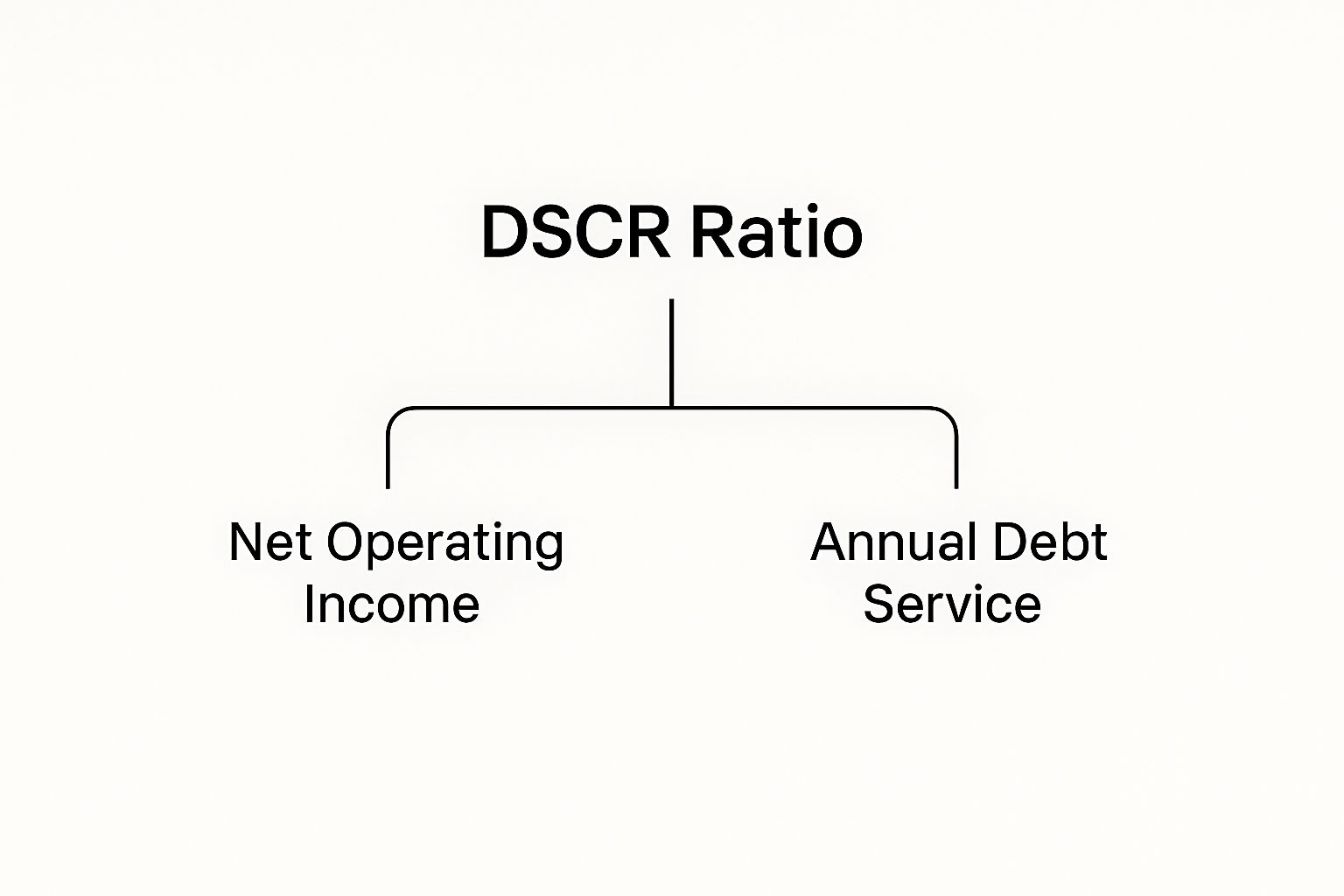
As you can see, the ratio is a direct comparison between the property's income and its debts. It’s the very foundation of the loan's approval. Now, let’s dig into the other factors that build upon this foundation.
The Role of Your Credit Score
Even though a DSCR loan is designed to bypass personal income verification, your credit score remains a critical piece of the puzzle. It’s the ultimate testament to your history of managing debt responsibly. A strong credit score can sometimes even help compensate for a property with a borderline DSCR, demonstrating to the lender that you’re a low-risk borrower they can count on.
While requirements vary from lender to lender, a minimum credit score of 680 is a common floor for most programs. However, to access the best rates and terms, investors with scores over 720 often find themselves in a much more advantageous position. Lenders also tend to favor DSCR thresholds of 1.2x to 1.25x and Loan-to-Value (LTV) ratios around 80%, which translates to a 20% down payment.
Down Payment and Loan-to-Value (LTV)
Your down payment is your "skin in the game." A substantial down payment—typically 20-25% of the purchase price—directly lowers the lender's risk. The logic is simple: the more of your own capital you invest upfront, the smaller the loan and the lower the LTV ratio.
A lower LTV provides the lender with an immediate equity cushion. This buffer protects their investment if property values dip or if you encounter a financial rough patch. For this reason, putting more money down can be a powerful strategy to strengthen your application, especially for first-time investors or those eyeing properties with a DSCR closer to the 1.0 minimum.
It's also worth noting that some specialized properties, like short-term rentals, can have unique requirements. If you're looking at vacation properties, our guide on getting a DSCR loan for an Airbnb in Nashville offers targeted advice from our local experts.
The Importance of Cash Reserves
Finally, lenders need to see that you can weather a storm. Cash reserves—liquid funds sitting in your bank account after closing—are non-negotiable proof that you can handle unexpected vacancies, sudden repairs, or other financial hiccups without defaulting on your mortgage.
Lenders will typically require you to have 3 to 12 months of PITI (Principal, Interest, Taxes, and Insurance) payments saved in a verifiable account. This safety net demonstrates you're prepared for the unpredictable nature of being a landlord.
This requirement isn't just a box to check; it’s a fundamental sign of a prepared and responsible investor. It shows you’ve planned beyond the purchase and are ready for the long-term responsibilities that come with owning investment property.
How to Strengthen Your Loan Application
So, you’ve pinpointed a fantastic investment property, run the numbers, and your heart sinks a little. The DSCR is hovering just below what your lender needs, putting the whole deal in jeopardy. It’s a scenario we see all the time, but let me be clear: this is rarely a dead end. As lenders who have seen countless deals come together, we at Shop Rates know that a "maybe" can often be massaged into a "yes" with a few smart, strategic moves.
This is where the sharp investor separates from the pack. Instead of walking away, they start looking for levers to pull. It’s all about creatively and strategically improving the property's financial picture to nudge that DSCR into the green light zone.
Boost Your Income Streams
The most straightforward path to a better DSCR is to increase the property’s gross rental income. This isn't just about finding properties with higher base rent; it's about ensuring every single dollar of potential revenue is on the table and properly accounted for.
- Tally Up All Ancillary Income: Does the property offer paid parking spots, coin-operated laundry, pet fees, or rentable storage units? Don't overlook these. Every dollar of consistent, verifiable income needs to be presented to your lender. These "small" income streams can add up quickly and make a material difference in the calculation.
- Justify Higher Rent with Smart Upgrades: A gut renovation is not always necessary. Sometimes, minor, cost-effective improvements can justify a higher fair market rent in an appraiser's eyes. Think fresh paint, modern light fixtures, or updated cabinet hardware. These are small investments that significantly boost a property's appeal and its income potential on paper.
Trim Your Expenses and Debt
The other side of the DSCR coin is your total annual debt service. Bringing down your expenses directly improves your ratio, giving you more breathing room.
Think of your DSCR as a balancing scale. You can either add weight (income) to one side or remove weight (expenses) from the other. The most effective strategy often involves doing a little bit of both.
One of the first places to look is property insurance. Premiums can vary dramatically between carriers, so shopping around for more competitive rates is a simple but effective way to lower the "I" in your PITI. Another powerful, though not always possible, tactic is to negotiate a lower purchase price. Even a small reduction in the principal loan amount can have a meaningful, positive impact on your DSCR.
Finally, a surefire way to improve your DSCR is by increasing your down payment. Putting more skin in the game reduces your total loan amount, which in turn lowers your monthly mortgage payment. It’s a direct and powerful way to make the property’s financials look much stronger to a lender.
A Comparative Look at Boosting Your DSCR
To help you visualize these options, let's break down the different tactics an investor can deploy. Each has its own level of effort and is best suited for specific situations.
Strategies to Boost Your Property's DSCR
| Strategy | Impact on DSCR | Effort Level | Best Scenario for This Tactic |
|---|---|---|---|
| Increase Down Payment | High | Low (Financial) | When you have liquid capital available and want a direct, guaranteed improvement to the ratio. |
| Negotiate Lower Price | High | Medium | In a buyer's market or when the inspection reveals issues that justify a price reduction. |
| Shop for Cheaper Insurance | Low to Medium | Low | Always a good idea; perfect for deals that are just shy of the required ratio. |
| Document Ancillary Income | Low to Medium | Low | On multi-unit or commercial properties with existing extra income sources (laundry, parking, etc.). |
| Perform Minor Upgrades | Medium | Medium | On value-add properties where cosmetic fixes can quickly and demonstrably increase market rent. |
Ultimately, strengthening your application is about being resourceful. By examining both the income and expense sides of the equation, you can often find the extra margin you need to get your loan across the finish line.
Frequently Asked Questions About DSCR Loan Requirements
Can I use a DSCR loan for an Airbnb?
Absolutely. In fact, it’s one of the most popular uses for DSCR loans. Lenders, including our team right here in Nashville, are very comfortable financing short-term rentals like properties listed on Airbnb and VRBO.
The underwriting process is slightly different from that of a traditional long-term rental. Instead of looking at a signed lease, lenders will turn to specialized data from sources like AirDNA to project your potential income. They may also use an appraiser’s professional report on the local vacation rental market (a “short-term rental analysis”). The core principle is exactly the same: the property’s projected income has to cover the mortgage and expenses to meet that all-important DSCR requirement.
Is it possible to get a DSCR loan with no experience?
Yes, it is. This is one of the biggest draws for people just starting their real estate investment journey. While a track record of successful rentals never hurts, the lender’s primary focus is on the property itself. They care most about the deal’s numbers—its cash flow potential, your credit score, and the liquid cash you have on hand.
As a first-time investor, you might be offered slightly higher interest rates or be asked for a larger down payment, perhaps in the 25-30% range. This is simply how lenders balance the perceived risk. But if you’ve found a great property with a solid DSCR, the deal can absolutely stand on its own, making these loans a fantastic on-ramp for new investors.
What happens if my DSCR falls below 1.0 after I close?
This is an astute question, and one we hear often. The answer should put your mind at ease. Once the loan is closed and funded, the lender’s job is effectively done, as long as you continue to make your payments on time.
The DSCR is an underwriting tool used to qualify you for the loan in the first place. Lenders do not continue to monitor it month after month throughout the life of the loan.
The bottom line is this: after closing, your primary responsibility is making the monthly payment. However, and this is important, if you ever want to refinance or pull cash out, you’ll have to qualify all over again based on the property’s current performance and the lender’s prevailing dscr loans requirements. This is precisely why starting with a DSCR well above 1.0 provides such a valuable safety net for the future.
Do I need an LLC for a DSCR loan?
While it’s not always mandatory for a single property, we almost always recommend it as a best practice. Holding your investment properties in a Limited Liability Company (LLC) or other corporate entity is a smart move for liability protection, as it creates a legal barrier between your personal assets and your business dealings.
From a lending perspective, it’s no problem at all. Most DSCR lenders are perfectly comfortable—and often prefer—lending to an LLC. The process is straightforward, and our loan officers can walk you through exactly what documentation your business entity will need to provide for a smooth closing.
Ready to see how your investment property stacks up? The experts at ShopRates are here to guide you through every step of the DSCR loan process. Compare your loan options today and take the next step toward growing your real estate portfolio with confidence.


