Can I Buy a House With a Down Payment Less Than 3%? Complete State-by-State Guide for 2025
Down Payment Less Than 3%
The dream of homeownership feels increasingly out of reach for many Americans facing rising home prices and the challenge of saving for a traditional 20% down payment. However, what many prospective buyers don’t realize is that numerous mortgage programs exist that require far less—in some cases, as little as 0% down. This comprehensive guide explores how you can buy a house with a down payment of less than 3%, detailing program requirements, state-specific opportunities, and actionable steps to make your homeownership dreams a reality.
Whether you’re a first-time home buyer in Tennessee, a veteran exploring VA loan benefits, or a family considering rural property through USDA financing, understanding your options is the first step toward unlocking affordable pathways to homeownership. At Shop Rates, we specialize in connecting borrowers with competitive mortgage programs that fit their unique financial situations.
Understanding Low Down Payment Mortgage Programs
The mortgage industry has evolved significantly over the past decade, with lenders and government-sponsored entities recognizing that the traditional 20% down payment creates an insurmountable barrier for many creditworthy borrowers. Today’s low down payment mortgage options balance accessibility with responsible lending, allowing qualified buyers to purchase homes while maintaining reasonable monthly payments and building equity from day one.
These programs aren’t simply promotional offers or temporary fixes—they’re established, regulated mortgage products backed by federal agencies, government-sponsored enterprises, and reputable lenders committed to sustainable homeownership. Understanding which program aligns with your financial profile, property location, and long-term goals is essential for making an informed decision.
What Is the Lowest Down Payment I Can Make on a House?
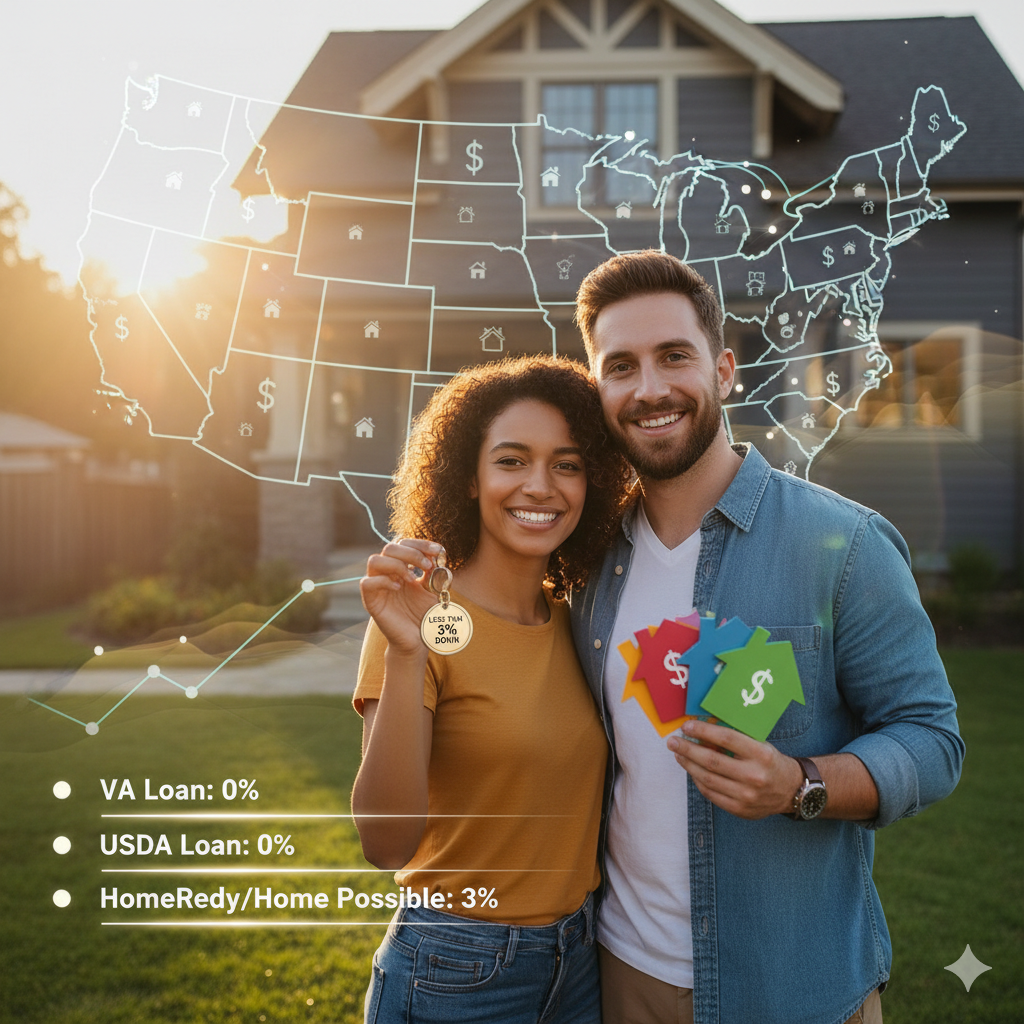
The absolute lowest down payment available is 0%—meaning you can finance 100% of your home’s purchase price. Two primary programs offer this extraordinary benefit: VA loans for eligible veterans and active-duty service members, and USDA loans for properties in designated rural and suburban areas. Beyond these zero-down options, conventional loan programs from Fannie Mae and Freddie Mac require just 3% down, while FHA loans require 3.5%.
For many buyers, combining a 3% down conventional loan with down payment assistance grants can effectively reduce out-of-pocket costs to under 3% or even zero. This strategic approach has helped thousands of families achieve homeownership without depleting their savings for emergencies, home improvements, or moving expenses.
Zero Down Payment Home Loans: VA and USDA Programs
VA Loans: The Ultimate $0 Down Benefit for Veterans
VA loans represent one of the most generous mortgage benefits available, honoring the service of veterans, active-duty military members, National Guard and Reserve members, and eligible surviving spouses. These loans require absolutely no down payment, no private mortgage insurance (PMI), and typically offer competitive interest rates below conventional mortgage benchmarks.
Key VA Loan Benefits:
- 0% down payment required on homes up to the local conforming loan limit
- No monthly PMI premiums, saving hundreds of dollars monthly
- Lenient credit score requirements, often accepting scores as low as 580
- Seller can pay all closing costs on behalf of the buyer
- Streamlined refinance options to lower rates without new appraisals
- Available in all 50 states for eligible property types
While VA loans do charge a one-time funding fee (typically 2.15% for first-time use, which can be rolled into the loan), this cost is significantly offset by the absence of PMI over the loan’s lifetime. Veterans with service-connected disabilities are exempt from the funding fee entirely. To explore current VA loan rates and requirements, visit the official VA Home Loans website or check competitive mortgage rates through Shop Rates.
USDA Loans: 100% Financing for Rural and Suburban Properties
The USDA Rural Development Guaranteed Loan program offers another legitimate zero down payment option, designed to promote homeownership in eligible rural and suburban communities. Contrary to common perception, USDA-eligible areas aren’t limited to farmland or remote locations—many suburban communities within commuting distance of major cities qualify, encompassing approximately 97% of the nation’s geographic area and roughly one-third of the population.
USDA Loan Highlights:
- 0% down payment with 100% financing available
- Income limits apply based on household size and county median income
- Property must be located in USDA-eligible area (check eligibility maps online)
- Competitive interest rates, often matching or beating conventional rates
- Low monthly mortgage insurance premiums (1% upfront, 0.35% annual)
- Credit score minimum typically 640, though some lenders accept lower scores
For Tennessee residents, significant portions of counties outside Nashville, Memphis, Knoxville, and Chattanooga qualify for USDA financing. Buyers should verify property eligibility using the USDA Property Eligibility Map and consult with experienced lenders who can navigate income documentation requirements.
3% Down Payment Conventional Loans: HomeReady and Home Possible
For buyers who don’t qualify for VA or USDA loans, conventional mortgage programs requiring just 3% down provide an excellent alternative to FHA financing. These programs—Fannie Mae’s HomeReady and Freddie Mac’s Home Possible—offer several advantages over FHA loans, including lower mortgage insurance costs and the ability to cancel PMI once you reach 20% equity.
Fannie Mae HomeReady®: 3% Down for Low-to-Moderate Income Borrowers
HomeReady is designed for creditworthy borrowers with limited down payment funds or those purchasing in low-to-moderate income census tracts. This program recognizes that responsible financial management shouldn’t be penalized simply because a borrower hasn’t accumulated a large down payment, particularly in high-cost housing markets where saving 20% can take decades.
HomeReady Program Features:
- Minimum 3% down payment required
- Income limits apply in most areas (typically 80% of area median income)
- No income limits for properties in designated low-income census tracts
- Minimum 620 credit score generally required
- Allows boarder or non-occupant co-borrower income to qualify
- Lower PMI rates compared to standard conventional loans
- Can be used for primary residences including single-family homes, condos, and multi-unit properties (up to 4 units)
First-time buyers particularly benefit from HomeReady’s flexibility with income sources and its recognition that household financial stability often involves multiple earners or rental income from multi-unit properties. Complete program details are available through Fannie Mae’s HomeReady page.
Freddie Mac Home Possible®: Affordable 3% Down Alternative
Home Possible parallels HomeReady’s mission of expanding homeownership access but operates through Freddie Mac’s network of approved lenders. The programs share similar structures and benefits, with subtle differences in underwriting guidelines that may favor certain borrower profiles.
Home Possible Advantages:
- 3% minimum down payment requirement
- Income restrictions based on area median income (80% threshold in most locations)
- Available for first-time and repeat home buyers
- Flexible credit standards with 660 minimum score preferred
- Can include income from non-borrower household members
- Reduced mortgage insurance compared to standard loans
- Requires completion of online homeownership education course
The mandatory homeownership education—typically a free 8-hour online course—provides valuable financial literacy training covering budgeting, credit management, and home maintenance. This investment in borrower education correlates with lower default rates and long-term homeownership success. Learn more at Freddie Mac’s Home Possible website.
FHA Loans Combined With Down Payment Assistance
Federal Housing Administration (FHA) loans require a 3.5% down payment, slightly above the 3% threshold but often accessible through down payment assistance (DPA) programs that can cover all or part of this amount. When structured properly with state or local DPA grants, buyers can achieve an out-of-pocket down payment of less than 3% or potentially zero.
FHA Loan Core Benefits:
- Minimum 3.5% down payment (580+ credit score), or 10% down (500-579 score)
- Lower credit score requirements than conventional programs
- Higher debt-to-income ratio tolerance (up to 50% in some cases)
- Gift funds from family members accepted for entire down payment
- Recent bankruptcy or foreclosure more forgiving than conventional loans
- Assumable mortgages can be transferred to qualified buyers
The primary drawback of FHA financing is permanent mortgage insurance premiums that remain for the loan’s lifetime (for loans with less than 10% down), adding to monthly costs. However, for borrowers with credit challenges or higher debt ratios, FHA often provides the only viable path to homeownership. Official FHA resources are available through HUD’s FHA website.
State-by-State Down Payment Assistance Programs
Every state operates at least one housing finance agency (HFA) that administers down payment assistance programs, grants, and favorable loan terms for qualified buyers. These programs transform a 3% or 3.5% down payment requirement into an achievable reality by providing thousands of dollars in direct assistance, forgivable loans, or deferred-payment second mortgages.
Down payment assistance comes in several forms: outright grants that never require repayment, forgivable loans that are forgiven after maintaining occupancy for a specified period (typically 5-10 years), deferred-payment loans with no monthly payment that are repaid when you sell or refinance, and low-interest second mortgages with affordable monthly payments. Eligibility typically hinges on income limits, first-time buyer status, completion of homebuyer education, and property location.
Tennessee Down Payment Assistance Programs
Tennessee residents benefit from comprehensive first-time home buyer programs through the Tennessee Housing Development Agency (THDA). The Great Choice Plus program combines competitive interest rates with down payment and closing cost assistance of up to 4% of the loan amount, covering nearly all upfront costs for qualified borrowers.
Tennessee-Specific Opportunities:
- THDA Great Choice Plus: Up to 4% down payment assistance for first-time buyers
- Tennessee Heroes Program: Additional benefits for teachers, law enforcement, firefighters, EMTs, and corrections officers
- Hardest Hit Fund: Assistance for buyers in economically distressed counties
- Local city programs in Nashville, Memphis, Knoxville, and Chattanooga with additional grants
For buyers wondering “how much money is needed to buy a house in Tennessee,” the answer with proper DPA utilization can be as little as $2,000-$5,000 for inspections, appraisal, and minor prepaid costs. Tennessee buyers can start exploring options through Shop Rates’ mortgage programs to connect with lenders experienced in THDA programs.
Finding Down Payment Assistance in Your State
Beyond Tennessee, every state maintains robust DPA programs with varying structures and funding levels. California offers CalHFA programs with substantial grants in high-cost areas. Texas provides multiple options through TSAHC (Texas State Affordable Housing Corporation). Florida’s Florida Housing Finance Corporation administers several first-time buyer initiatives. New York’s SONYMA program helps buyers statewide with generous assistance amounts.
How to Find Your State’s Programs:
- Visit your state Housing Finance Agency website (search “[State] HFA”)
- Contact HUD-approved housing counseling agencies for personalized guidance
- Consult with experienced local lenders who actively participate in state programs
- Check county and city websites for municipal-level assistance
- Explore employer-sponsored homebuyer assistance if available
The Consumer Financial Protection Bureau maintains a helpful home loan toolkit that guides buyers through the mortgage process, while HUD’s counseling agency search connects you with free expert advisors in your area.
Qualification Requirements for Low Down Payment Loans
What Credit Score Is Required for a 3% Down Mortgage?
Credit score requirements vary significantly across loan programs, with more flexible options available for borrowers still building or rebuilding credit. Conventional 3% down programs (HomeReady, Home Possible) typically require minimum scores of 620-660, though some lenders approve borrowers with scores as low as 600 when compensating factors exist. FHA loans remain accessible with scores as low as 580 for 3.5% down, or even 500 with 10% down payment. VA and USDA loans don’t mandate specific minimum scores, though individual lenders typically establish 580-620 floors.
Borrowers with scores below 620 should focus on FHA or government-backed loans, while those above 660 can access the most competitive conventional programs with lower insurance costs. Improving your score by even 20-40 points before applying can save thousands of dollars over the loan term through better interest rates and reduced mortgage insurance premiums.
Income Limits and Debt-to-Income Ratio Guidelines
Most low down payment programs impose income limits to ensure assistance reaches those who need it most. HomeReady and Home Possible typically restrict eligibility to households earning no more than 80% of area median income, though exceptions exist for properties in designated low-income census tracts. USDA loans enforce strict income caps varying by county and household size, generally limiting eligibility to 115% of area median income.
Debt-to-income (DTI) ratios measure your monthly debt obligations against gross income. Conventional loans prefer DTI ratios below 43%, though some lenders approve up to 50% with strong compensating factors like substantial reserves or excellent credit. FHA loans accommodate DTI ratios up to 50% or higher, making them ideal for buyers with student loans, car payments, or other debt obligations. VA loans offer exceptional flexibility with no strict DTI caps, instead employing residual income calculations that assess actual disposable income after all expenses.
Understanding Private Mortgage Insurance With Low Down Payments
Any conventional loan with less than 20% down payment requires private mortgage insurance (PMI) to protect the lender against default risk. However, PMI on 3% down conventional loans is significantly less expensive than FHA mortgage insurance premiums and can be canceled once you reach 20% equity through payments and appreciation. Monthly PMI costs typically range from 0.3% to 1.5% of the loan amount annually, depending on your credit score, down payment size, and loan-to-value ratio.
Importantly, VA and USDA loans don’t charge traditional PMI at all. VA loans have no mortgage insurance, only the one-time funding fee. USDA loans charge a 1% upfront guarantee fee and 0.35% annual fee—substantially less than FHA’s combined upfront and annual premiums. For borrowers concerned about PMI costs, prioritizing conventional 3% down programs over FHA when credit permits provides the clearest path to insurance removal and long-term savings.
How Much Cash Do I Actually Need to Close?
While down payment requirements receive primary attention, understanding total cash-to-close is critical for accurate budgeting and avoiding surprises at closing. Beyond your down payment, closing costs typically add 2-5% of the purchase price, covering lender fees, title insurance, attorney costs, prepaid property taxes and insurance, and recording fees.
Minimum Cash to Close Example (on a $250,000 purchase):
- 3% down payment: $7,500
- Typical closing costs (3%): $7,500
- Home inspection ($400-600): $500
- Appraisal ($400-700): $550
- Total cash needed: $16,050
However, several strategies substantially reduce this amount. Requesting seller-paid closing costs (often 3-6% of purchase price) eliminates most closing costs. Using down payment assistance grants covers the down payment entirely in many cases. Accepting lender credits in exchange for slightly higher interest rates can offset thousands in fees. Negotiating in buyer-favorable markets may secure both seller concessions and DPA, potentially reducing your required cash to just $2,000-$5,000 for inspections and prepaid items.
Step-by-Step Guide to Buying With Less Than 3% Down
Step 1: Assess Your Financial Readiness
Begin by obtaining your free credit reports from all three bureaus, reviewing your debt-to-income ratio, and calculating your available savings for down payment and closing costs. Understanding your starting position guides which programs to pursue and whether preliminary credit repair or debt paydown would improve your options.
Step 2: Research Programs and Requirements
Investigate VA eligibility if you’re a veteran or active military. Check USDA property eligibility if considering rural areas. Research your state HFA programs and local DPA opportunities. Compare conventional 3% down versus FHA 3.5% down based on your credit profile. Take required homebuyer education courses if mandatory for your chosen programs.
Step 3: Get Pre-Approved With Multiple Lenders
Contact at least 2-3 lenders experienced with low down payment programs. Compare not just interest rates but also lender fees, closing cost estimates, and customer reviews. Obtain formal pre-approval letters specifying your maximum loan amount and program type. Pre-approval demonstrates seriousness to sellers and strengthens your offer competitiveness.
Step 4: Find a Knowledgeable Real Estate Agent
Work with an agent experienced in low down payment transactions who understands program property requirements, can negotiate seller concessions effectively, and knows how to structure offers that sellers will accept even with minimal down payment and requested concessions.
Step 5: Search for Eligible Properties
Focus your search on properties that meet program requirements. VA and conventional loans accept most property types. USDA loans require rural eligibility verification. FHA properties must meet specific safety and habitability standards. Some programs restrict manufactured homes or investment properties.
Step 6: Make Strategic Offers
Craft offers that request seller-paid closing costs when market conditions permit. Ensure your offer price accounts for requested concessions. Consider offering slight price premiums in exchange for maximum seller contributions. Include strong earnest money deposits to demonstrate commitment despite low down payment.
Step 7: Complete Due Diligence
Order professional home inspections to identify any issues. Review all inspection reports carefully and negotiate repairs or credits for significant problems. Ensure the property appraises at or above contract price. Address any title issues or HOA concerns promptly.
Step 8: Finalize Your Loan
Submit all requested documentation promptly to avoid delays. Respond quickly to underwriter conditions or requests for additional information. Maintain stable employment and avoid major credit changes during the process. Review your Closing Disclosure carefully three days before closing.
Step 9: Close on Your Home
Bring required funds via wire transfer or cashier’s check as specified by your closing attorney. Review all closing documents carefully before signing. Ask questions about anything unclear. Receive your keys and officially become a homeowner with minimal cash out of pocket.
Frequently Asked Questions About Low Down Payment Home Loans
Can I buy a house with a down payment of less than 3%?
Yes, absolutely. VA and USDA loans require 0% down payment for eligible buyers. Additionally, you can effectively achieve less than 3% out-of-pocket by combining a 3% down conventional loan or 3.5% FHA loan with down payment assistance grants that cover part or all of your down payment requirement.
Are there truly no down payment home loans available?
Yes, two major programs offer legitimate zero down payment financing. VA loans require no down payment for eligible veterans, active-duty service members, and qualifying spouses. USDA loans require no down payment for properties in eligible rural and suburban areas, subject to income limits. These are established government programs, not promotional schemes or temporary offers.
Do I need to be a first-time home buyer to qualify for low down payment loans?
Not necessarily. While many down payment assistance programs target first-time buyers, the major loan programs themselves don’t always require first-time status. VA and FHA loans are available to both first-time and repeat buyers. USDA loans have no first-time requirement. Conventional 3% down programs like HomeReady and Home Possible allow repeat buyers, though first-time buyers may access additional benefits.
What credit score do I need for a mortgage with less than 3% down?
Minimum credit scores vary by program. FHA loans accept scores as low as 580 (or 500 with 10% down). VA loans have no official minimum, though most lenders prefer 580-620. USDA loans typically require 640 minimum. Conventional 3% down programs generally need 620-660 minimum scores. Higher scores qualify for better rates and lower insurance costs.
Will I have to pay Private Mortgage Insurance with a low down payment?
Conventional loans with less than 20% down require PMI, which can be canceled once you reach 20% equity. FHA loans require mortgage insurance premiums for the life of the loan (with less than 10% down). VA loans have no PMI, only a one-time funding fee. USDA loans charge a 1% upfront fee and 0.35% annual guarantee fee, significantly less than FHA premiums.
Can I combine down payment assistance with a low down payment loan?
Yes, this is one of the most powerful strategies for minimizing out-of-pocket costs. Many state and local down payment assistance programs are specifically designed to layer with FHA, conventional, VA, or USDA loans. You can use a DPA grant to cover your 3% or 3.5% down payment requirement, effectively reducing your cash investment to near zero.
How do I find state-specific down payment assistance programs?
Start by searching for your state’s Housing Finance Agency, which administers most state-level programs. Contact HUD-approved housing counseling agencies for personalized guidance. Speak with experienced local lenders who actively participate in DPA programs. Check county and city government websites for municipal assistance. Many resources are available through HUD’s website and the Consumer Financial Protection Bureau.
What are the income limits for 3% down programs like HomeReady or Home Possible?
Both programs typically limit eligibility to households earning 80% or less of area median income, though limits vary by location and household size. Properties in designated low-income census tracts may have no income restrictions. These limits are substantial—in many markets, households earning $60,000-$100,000 annually qualify. Check with your lender for specific limits in your area.
Can I use gift funds to cover my down payment?
Yes, most programs accept gift funds from family members for all or part of your down payment. FHA loans allow 100% of the down payment to come from gifts. Conventional loans typically require at least 5% of the down payment from your own funds if putting down less than 10%, with the remainder allowed from gifts. VA loans generally require no minimum borrower contribution. Proper gift documentation is essential.
How much cash do I realistically need to close if my down payment is less than 3%?
With strategic planning, you may need as little as $2,000-$5,000 for inspections, appraisal, and unavoidable prepaid items. Combining a 3% down loan with down payment assistance covers your down payment. Requesting seller-paid closing costs eliminates most closing expenses. Using lender credits reduces fees further. However, conservative budgeting suggests having $5,000-$10,000 available to handle unexpected expenses and provide financial cushion after closing.
Is it harder to get an offer accepted with a down payment less than 3%?
In competitive markets, low down payment offers face more scrutiny, but they’re far from impossible. Sellers primarily care about strong financing, reasonable terms, and closing certainty. Counter any perceived weakness by obtaining solid pre-approval, submitting larger earnest money deposits, writing flexible offer terms, and working with experienced agents who can advocate effectively. In balanced or buyer-favorable markets, down payment size rarely impacts offer competitiveness.
What are the typical interest rates for low down payment loans?
Interest rates on low down payment loans are competitive with standard mortgages. VA and USDA loans often feature the lowest rates available. Conventional 3% down rates typically run 0.125%-0.375% higher than 20% down loans due to increased risk. FHA rates are generally competitive with conventional rates. Your individual rate depends primarily on credit score, debt ratios, and overall financial profile rather than down payment amount alone.
Do I have to pay back down payment assistance grants?
It depends on the program structure. True grants never require repayment. Forgivable loans are forgiven after you occupy the property for a specified period, typically 5-10 years. Deferred-payment loans require no monthly payment but are repaid when you sell or refinance. Low-interest second mortgages have small monthly payments. Always review specific program terms carefully before accepting assistance.
Which lenders offer 3% down mortgages in my state?
Most major lenders and many local banks and credit unions offer conventional 3% down programs. The key is finding lenders experienced with these programs who actively participate in state DPA initiatives. Start by contacting your state Housing Finance Agency for lists of approved lenders. Shop Rates can connect you with competitive lenders offering low down payment programs with strong customer service and smooth closings.
What are the property requirements for low or zero down payment loans?
Property requirements vary by program. Conventional and VA loans accept most property types including single-family homes, condos, townhomes, and 2-4 unit properties. USDA loans require properties in designated rural and eligible suburban areas. FHA properties must meet minimum safety and habitability standards. Most programs require the property to be your primary residence, though some conventional loans allow multi-unit properties where you occupy one unit.
Can I buy a multi-unit property with a low down payment?
Yes, both FHA and conventional 3% down programs allow purchase of 2-4 unit properties as your primary residence, with rental income from other units helping you qualify for the loan. VA loans also permit multi-unit purchases with 0% down. This strategy allows you to become both a homeowner and rental property investor simultaneously, with tenant rent offsetting your mortgage payment.
What steps should I take before applying for a low down payment mortgage?
Review your credit reports and address any errors. Calculate your debt-to-income ratio and pay down high-interest debt if possible. Save for closing costs and emergencies, even if using DPA for down payment. Research programs you qualify for and complete any required homebuyer education. Gather financial documentation including pay stubs, tax returns, and bank statements. Get pre-approved with multiple lenders to compare options.
How long does it take to get pre-approved for a low down payment mortgage?
Pre-approval typically takes 1-3 business days with complete documentation. You’ll need recent pay stubs, W-2s or tax returns, bank statements, and information about debts and assets. Some lenders offer same-day pre-approvals. Strong applications with clear documentation process faster. Working with experienced lenders familiar with your chosen program streamlines the process and reduces back-and-forth requests.
Does my state offer special housing programs for teachers, police, or veterans beyond VA loans?
Many states provide enhanced benefits for public service professionals. Tennessee’s Heroes Program assists teachers, law enforcement, firefighters, and EMTs. Other states offer similar initiatives with additional grants, reduced interest rates, or relaxed eligibility requirements for essential workers. These programs layer on top of standard first-time buyer assistance, potentially covering your entire down payment and closing costs.
What are home buyer education requirements for low down payment loans?
Freddie Mac Home Possible requires completion of an approved homebuyer education course. Most down payment assistance programs mandate education. FHA, VA, and Fannie Mae HomeReady don’t require education but strongly encourage it. Courses typically involve 6-8 hours of online modules covering budgeting, mortgage types, home maintenance, and avoiding foreclosure. Many courses are free through HUD-approved counseling agencies.
How do state housing finance agencies help low down payment buyers?
State HFAs administer multiple programs including down payment assistance grants, below-market interest rate mortgages, mortgage credit certificates providing tax credits, and specialized programs for veterans, teachers, and other groups. They coordinate with approved lenders to deliver benefits seamlessly within your loan closing. Most HFAs also provide free homebuyer education and counseling services to help you succeed.
What’s the difference between a 3% down conventional loan and an FHA loan?
Conventional 3% down loans require stronger credit (620-660 minimum) but offer lower mortgage insurance that can be canceled at 20% equity. FHA loans accept lower credit scores (580 minimum) and higher debt ratios but charge higher insurance premiums that remain for the loan’s lifetime with less than 10% down. Conventional loans are generally better for borrowers with good credit, while FHA serves those with credit challenges or higher debt levels.
Can I refinance out of my low down payment loan later to remove PMI?
Yes, once you’ve built 20% equity through payments and appreciation, you can refinance into a conventional loan without PMI. This strategy works well for borrowers who started with FHA loans and permanent mortgage insurance. Alternatively, conventional loan PMI automatically terminates at 22% equity through scheduled payments, or you can request removal at 20% equity with a new appraisal showing sufficient value.
What are the maximum loan limits for low down payment programs?
Loan limits vary by program and location. Conventional loans follow conforming loan limits set by FHFA, currently $806,500 in most areas and higher in expensive markets. FHA limits vary by county, typically ranging from $498,257 to $1,149,825. VA loans have no maximum, though lenders may impose internal limits. USDA loans don’t have explicit limits but restrict eligibility based on property location and household income relative to area median.
What are the closing costs on a 3% down payment mortgage?
Closing costs typically range from 2-5% of the purchase price, regardless of down payment amount. On a $250,000 home, expect $5,000-$12,500 in closing costs covering lender fees, title insurance, attorney fees, recording charges, and prepaid property taxes and homeowners insurance. However, these costs can be substantially reduced through seller concessions, lender credits, and DPA programs that cover both down payment and closing costs.
Conclusion: Your Path to Homeownership With Minimal Down Payment
Buying a house with a down payment less than 3%—or even zero—is not only possible but increasingly common as programs evolve to meet the realities of modern housing markets and buyer financial profiles. Whether through VA loans offering zero down for veterans, USDA loans providing 100% financing in eligible rural areas, conventional 3% down programs for creditworthy borrowers, or strategic combinations of FHA loans with down payment assistance, multiple pathways exist to achieve homeownership without the traditional 20% down payment barrier.
Success requires understanding your options, improving your financial profile where possible, researching state and local assistance programs, and working with experienced professionals who can navigate the complexities of low down payment transactions. The key is taking action—checking your credit, exploring program eligibility, connecting with knowledgeable lenders, and beginning the pre-approval process.
At Shop Rates, we’re committed to helping Nashville residents and borrowers nationwide discover competitive mortgage programs that fit their unique circumstances. Whether you’re a first-time buyer wondering how to buy a house in Tennessee with minimal funds, a veteran exploring VA loan benefits, or a family considering rural property, we connect you with lenders offering the solutions you need.
Your homeownership journey doesn’t have to wait years while you save for a massive down payment. With the right program, proper planning, and expert guidance, you can move from renter to homeowner far sooner than you might think. Explore current mortgage rates and take the first step toward making your homeownership dreams a reality with a down payment of less than 3%.


