
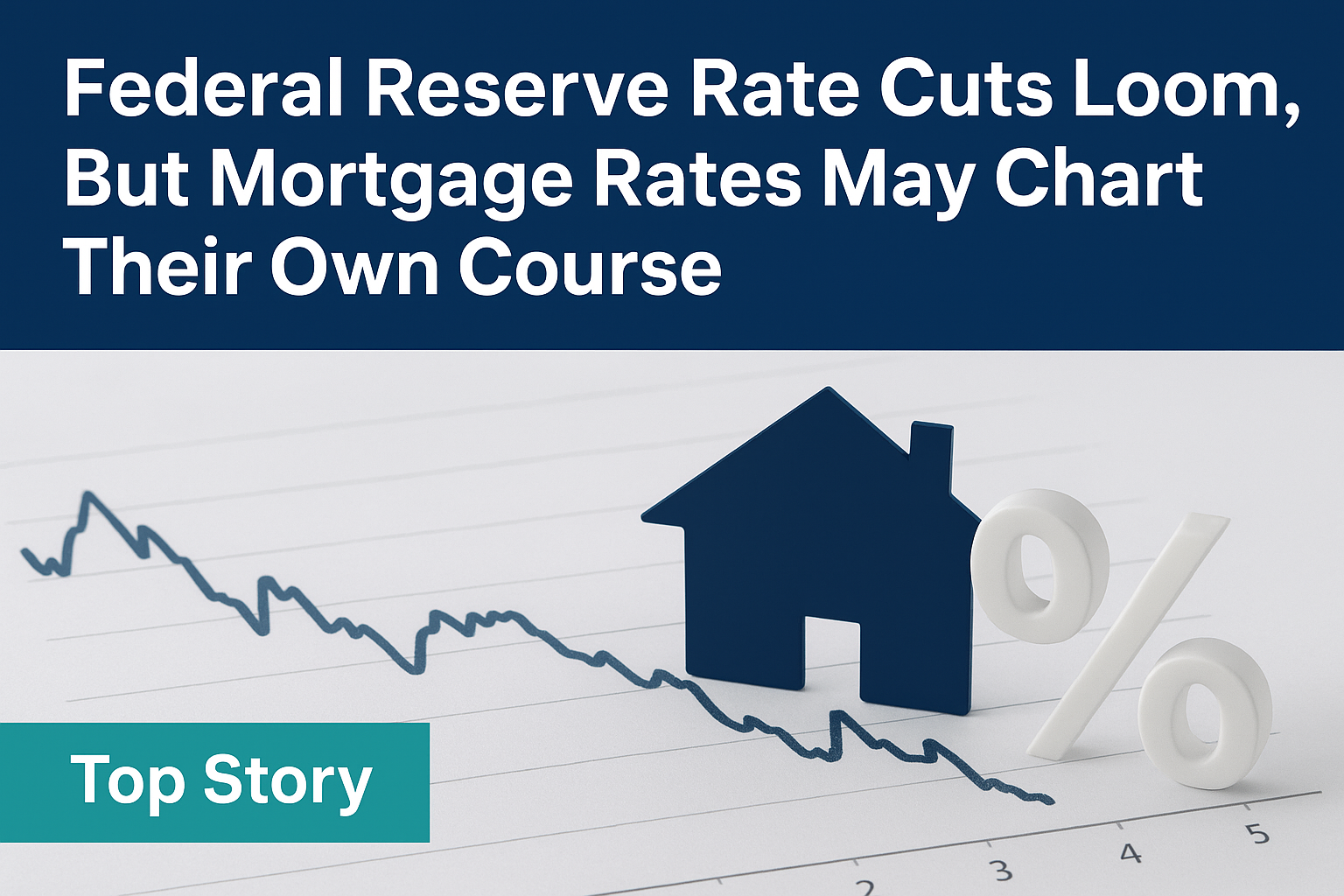
Fed Rate Cuts on the Horizon – But Mortgage Rates May Not Follow
Homebuyers and homeowners should prepare for volatility as economic data continues to shift bond markets.
Nashville, TN — August 18, 2025 — The Federal Reserve is widely expected to announce another interest rate cut at its upcoming September 16–17 meeting. While many Americans are hopeful this will translate into lower mortgage rates, industry experts caution that the connection between the Fed’s policy and 30-year fixed-rate mortgages is not as straightforward as most assume.
This week, average mortgage rates slipped to 6.58%, the lowest point since October 2024. The decline has sparked new interest from buyers sidelined by last year’s affordability crunch. Yet, seasoned mortgage professionals warn that today’s mortgage rates already bake in expectations of a Fed rate cut, meaning further declines may be limited—or could even reverse.
Why Fed Moves Don’t Guarantee Lower Mortgage Rates
The Federal Reserve controls the federal funds rate, which directly affects short-term lending instruments such as credit cards, auto loans, and home equity lines of credit. But mortgage rates, particularly the widely used 30-year fixed rate, are determined largely by longer-term Treasury yields and investor sentiment in the bond market.
“Fed rate cuts set the tone, but they don’t directly set mortgage rates,” said one mortgage advisor. “Mortgage pricing depends heavily on how investors interpret Fed policy, inflation trends, and future borrowing needs. That’s why we sometimes see mortgage rates climb even as the Fed is cutting.”
Indeed, this was the case last fall when the central bank began easing policy. Instead of declining, mortgage rates unexpectedly climbed higher, frustrating both lenders and would-be buyers.
The Role of Treasury Yields and Mortgage Spreads
At the heart of mortgage rate movements is the 10-year U.S. Treasury yield—a benchmark used by investors to assess the long-term economic outlook. Mortgage rates typically move in tandem with this yield, though not always in lockstep. The spread between Treasuries and mortgage-backed securities can widen or narrow depending on factors such as investor appetite, market volatility, and global economic conditions.
These dynamics explain why mortgage rates remain stubbornly high compared to historical norms, despite a cooling economy. Lenders must balance bond investor demand with borrower affordability, and when spreads widen, consumers pay the difference.
Data-Driven Volatility Ahead
According to CME FedWatch, there is currently an 85% probability of a Fed rate cut in September. But that doesn’t mean mortgage rates will move predictably. Over the next several weeks, markets will digest critical economic data, including reports on hiring, consumer inflation, and producer price trends.
Recent weak jobs numbers helped push mortgage rates to their current year-to-date lows. However, stronger-than-expected inflation data or robust consumer spending could easily reverse that trend, driving rates higher again.
“Mortgage markets move on expectations,” explained one Georgia-based loan officer. “When those expectations are confirmed, you don’t see much change. But when data surprises the market—positive or negative—that’s when rates swing.”
Buyers Weighing Their Options
For homebuyers, the past year has been a test of patience. Rates hovering near or above 7% significantly reduced affordability and purchasing power. The recent decline to 6.58% translates to roughly $20,000 more in purchasing power for a household with a $3,000 monthly housing budget, compared to the spring peak.
Still, many buyers remain hesitant, hoping that the Fed’s next move will unlock even better deals. Lenders, however, warn against waiting too long.
“That’s the toughest conversation to have with clients,” said a Tucson-based mortgage originator. “They want to hold off until after the Fed meeting, assuming rates will fall further. But markets usually price in Fed policy before it happens. Waiting could mean missing today’s opportunity.”
This hesitation isn’t new. In September 2024, when mortgage rates briefly fell to 6.2%, dozens of homeowners explored refinancing but ultimately held out for lower rates. When rates bounced back up, those deals evaporated—costing borrowers potential monthly savings of $300 to $400.
Risk of “Timing the Market”
While some investors and seasoned borrowers may benefit from waiting for precise rate movements, most consumers are advised to take a broader view. Mortgage professionals consistently emphasize affordability and stability over speculation.
“There’s no crystal ball,” noted one Midwestern loan officer. “Rates change daily, sometimes hourly, based on global and domestic data. For the average family, it’s better to secure a comfortable payment today than gamble on a quarter-point shift that may or may not come.”
This approach reflects a growing recognition among buyers that long-term homeownership goals—such as building equity, securing stability, and gaining tax advantages—are more important than trying to capture the lowest possible rate.
Refinancing Landscape Still Limited
The refinancing market has remained sluggish in 2025, with most homeowners locked into significantly lower rates secured during the pandemic. Even with the recent dip, today’s 6.5%–6.6% averages offer little incentive for most households.
That said, industry insiders note that borrowers with higher debt loads or adjustable-rate mortgages (ARMs) may still benefit from refinancing into a fixed rate, even if it’s not historically low. In volatile markets, predictability often outweighs marginal cost differences.
Housing Market Implications
Lower rates, even modestly lower, could inject momentum into a housing market that has struggled with affordability challenges and tight inventory. Buyers sidelined in recent months are re-entering the market, though supply constraints continue to push home prices higher in many metro areas.
Experts suggest that if rates stabilize in the mid-6% range, demand could build steadily, though competition for limited inventory may keep affordability stretched. Conversely, if economic data disappoints and rates climb back above 7%, demand could slow sharply again, reinforcing the stop-and-start nature of the housing recovery.
Looking Ahead
As the September Fed meeting approaches, both buyers and lenders will be watching economic data releases closely. Whether rates fall further, hold steady, or rebound, the overarching message remains clear:
Mortgage rates are not directly tied to Fed rate cuts
Market expectations often move ahead of the Fed
Affordability and monthly payment comfort should outweigh speculation
In short, while Fed actions matter, the bond market and investor sentiment will ultimately determine where mortgage rates head next.
About Shop Rates
Shop Rates is a trusted mortgage and financial resource, helping homebuyers and homeowners navigate shifting markets with confidence. Through personalized service and deep market insights, the team is committed to providing solutions that align with clients’ financial goals and homeownership dreams.
Media Contact:
Kevin Leonard
Director
Kevin@shoprates.com
(888) 396-7284


